Food Hygiene
 Health & Safety
 Safeguarding
 First Aid
 Business Skills
 Personal Development


Safer Food Better Business (SFBB) is a food safety pack from the Food Standards Agency (FSA) for small food businesses in England and Wales. You fill in its “safe methods” to show how you control food safety risks, then keep a daily diary. It helps you meet the legal duty to have food safety procedures based on HACCP principles.
Key takeaways
- SFBB is a free Food Standards Agency (FSA) pack that small food businesses in England and Wales can download from GOV.UK.
- Food businesses must have food safety procedures based on HACCP principles, and SFBB is one way to meet this legal requirement.
- Separate packs are available for caterers, retailers, Indian cuisine, Chinese cuisine and childminders, along with a care home supplement.
- Complete the safe methods once, maintain the daily diary and review it every four weeks.
- SFBB does not replace staff training. Food handlers must still receive appropriate supervision, instruction or training in food hygiene.
If you run a café, takeaway, small restaurant or shop, an environmental health officer (EHO) will probably ask to see your Safer Food Better Business pack. This guide explains what SFBB is, which pack fits your business, and how to fill it in so it reflects what really happens in your kitchen.
What Is Safer Food Better Business?
Safer Food Better Business is a ready-made food safety management system from the FSA. GOV.UK describes it as “food safety management procedures for small businesses in England and Wales”.
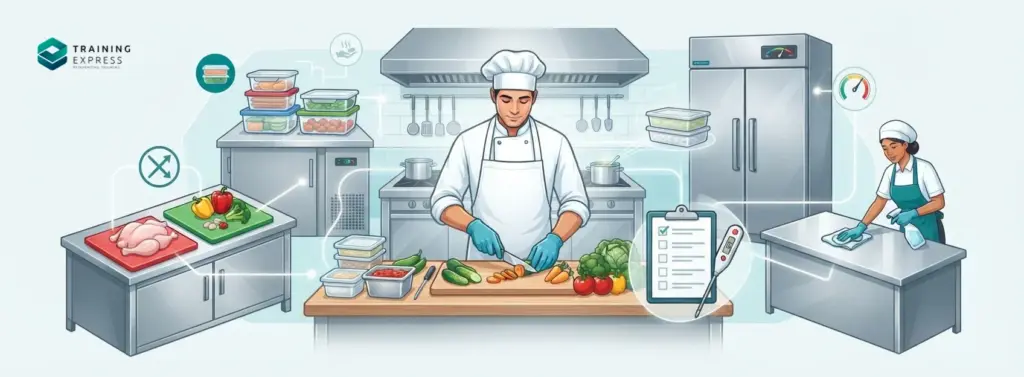
A food safety management system is your written record of how you keep food safe: how you stop contamination, cook food properly, keep it cold and clean up. Big businesses often write their own from scratch. SFBB gives smaller businesses a template written in plain English, so you can record what you do without being a food scientist.
SFBB is based on HACCP, which stands for Hazard Analysis and Critical Control Point. It’s a way of spotting what could go wrong with food and putting checks in place at the points that matter most.
Is SFBB a Legal Requirement?
No, SFBB itself isn’t a legal requirement, but having a food safety management system is. SFBB is one way to meet that legal duty.
The duty comes from Article 5(1) of Regulation (EC) No 852/2004, which says food business operators “shall put in place, implement and maintain a permanent procedure or procedures based on the HACCP principles”. You can read it on legislation.gov.uk. In Great Britain this regulation is now assimilated law (EU law kept in UK law after Brexit), while Northern Ireland follows the EU version.
The law also says your records should suit the size and nature of your business. That’s why a small café can use SFBB instead of a full HACCP plan. You could use a different system, but whatever you choose must be written down, followed and kept up to date. If you’re not sure what’s right for you, ask your local council’s food safety team.
Which SFBB Pack Do You Need?
Choose the SFBB pack that matches your main type of business. The FSA publishes these packs on GOV.UK:
| Your business | Pack to use |
|---|---|
| Restaurant, café, takeaway, pub kitchen or caterer | Caterers pack |
| Shop selling food, such as a convenience store or deli | Retailers pack |
| Indian restaurant or takeaway | Indian cuisine pack |
| Chinese restaurant or takeaway | Chinese cuisine pack |
| Registered childminder providing food | Childminders pack |
| Small residential care home | Residential care homes supplement [VERIFY: whether it's used alongside the caterers pack] |
| College teaching catering | Teaching resources |
What if you're in Scotland or Northern Ireland?
SFBB covers England and Wales only. In Scotland, catering businesses use CookSafe from Food Standards Scotland, which helps caterers set up HACCP-based systems. In Northern Ireland, caterers and retailers use Safe Catering.
When might you need a full HACCP plan instead?
If you use more complex processes, such as vacuum packing, curing or cooking sous vide, SFBB may not cover everything. In that case you may need a full HACCP plan. Your council’s food safety team can tell you what’s expected.
How Do You Get an SFBB Pack?
You can download SFBB from GOV.UK, either the full pack or one section at a time. The content is published under the Open Government Licence, so you can download and print it without paying.
Some councils also sell printed packs with a year’s diary. Somerset Council, for example, sells printed SFBB packs. You can also keep the diary electronically, according to GOV.UK, by downloading the diary pages, filling them in and saving them.
What's Inside the SFBB Pack?
The SFBB pack has four “safe methods” sections, a management section and a diary. GOV.UK lists the contents as cross-contamination, cleaning, chilling, cooking, management and using the diary.
| Section | What it covers |
|---|---|
| Cross-contamination | How you stop harmful bacteria, allergens and physical objects getting into food |
| Cleaning | How you clean surfaces and equipment, and your cleaning schedule |
| Chilling | How you keep food cold, cool hot food and defrost safely |
| Cooking | How you cook, reheat and hot-hold food safely, and check it's done |
| Management | How you run food safety day to day, from opening checks to training and suppliers |
| Diary | Your daily sign-off, problem log and 4-weekly review |
The management section includes opening and closing checks, extra checks, “prove it” checks, managing food allergen information, training and supervision, customers, suppliers and contractors, stock control, product withdrawal and recall, and a safe method completion record.
How to Fill In Your SFBB Pack: Step by Step
To fill in SFBB, work through each safe method and record what you actually do, complete the management section, then sign the diary every day and review it every four weeks. Here’s how we suggest you approach it.
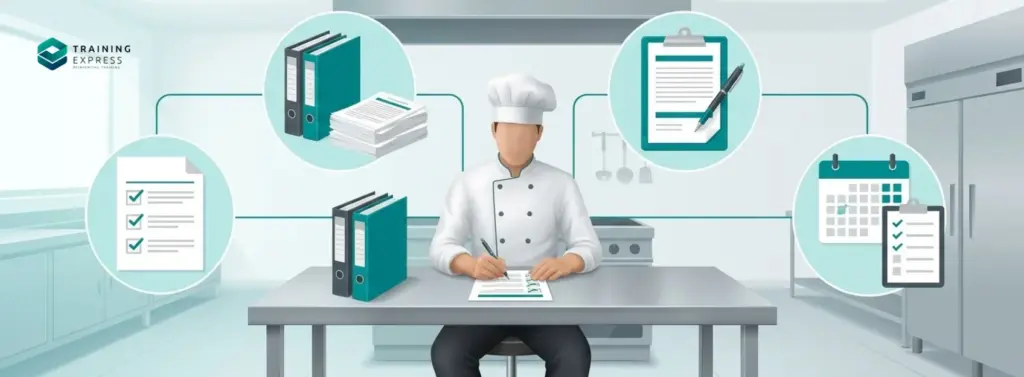
Step 1: Read Each Safe Method and Mark What Applies
Go through the safe methods one by one. Each explains why it matters and what good practice looks like. Mark the ones that apply to your business, and skip any that don’t (for example, hot holding if you never keep food hot).
Step 2: Write Your Own Methods in the Spaces
This is where most packs fall short. Write what your team actually does, in your own words. “We probe chicken in the thickest part and check it’s piping hot” is far more useful than ticking a box. If what’s written doesn’t match what happens, an inspector will notice.
Step 3: Complete the Management Section
Fill in your opening and closing checks, staff training records, supplier list and contacts, and your cleaning schedule. Include how you manage allergen information. If you need help with that part, our guide to the allergen matrix and our guide to the 14 allergens show you what to record.
Step 4: Start the Daily Diary
Each day, a manager signs to confirm the opening and closing checks were done. If something goes wrong, such as a fridge running warm, you write down what happened and what you did about it.
Step 5: Do the 4-Weekly Review
Every four weeks, look back at the diary. Did the same problem keep happening? Have you changed your menu, suppliers or staff? Update your safe methods to match, and record the review.
Example Diary Entries
These entries are an illustrative example written by us. They are not an official FSA example.
| Day | Opening and closing checks | Problems and action taken | Signed |
|---|---|---|---|
| Monday | Done | None | Manager's signature |
| Tuesday | Done | Walk-in fridge reading too warm at opening. Moved high-risk food to the second fridge, called the engineer, checked again after an hour. | Manager's signature |
| Wednesday | Done | New bread supplier. Checked allergens on the label and updated our allergen records. | Manager's signature |
| Thursday | Done | None | Manager's signature |
What Do Inspectors Look For in Your SFBB?
Inspectors want to see that your SFBB is complete, accurate and actually used. A neat pack that nobody follows won’t help you.
During a visit, an EHO will typically:
- check that each relevant safe method is filled in and matches what they see in the kitchen
- ask staff how they do things, such as checking food is cooked
- look through recent diary pages and problems you’ve recorded
- check your training records and supplier list
How you manage food safety is one of the areas inspectors score for your food hygiene rating. A well-kept SFBB is good evidence, but it doesn’t guarantee a particular rating. For more on what affects your score, see our guides to food hygiene ratings and how to get a 5-star rating.
GOV.UK says to keep completed diary pages safely until your next visit from a food safety officer, who may review both the diary and the pack.
Common SFBB Mistakes
- Filling it in once and forgetting it. SFBB only works if you use it every day.
- A copy-and-paste diary. The same entry every day, with no problems ever recorded, looks unrealistic.
- Methods that don’t match reality. If you write “we use separate boards for raw meat” but don’t, that’s worse than leaving it blank.
- Untrained staff. Your team needs to know the methods, not just the manager.
- Skipping allergens. The management section covers allergen information, and inspectors will ask about it.
- Not updating after changes. A new menu, supplier or piece of equipment means a review.
Does SFBB Replace a Food Hygiene Certificate?
No. SFBB is your business’s system, while training is about your people. You need both.
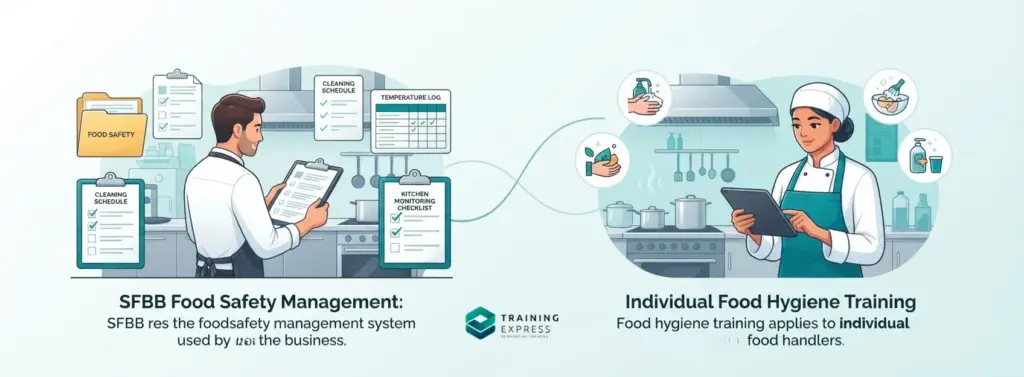
Annex II, Chapter XII of Regulation 852/2004 says food business operators must ensure “that food handlers are supervised and instructed and/or trained in food hygiene matters commensurate with their work activity”. You can read it on legislation.gov.uk. The law doesn’t name a specific certificate, but a recognised course is a clear way to show training has happened.
Most food handlers take a Level 2 course, while supervisors often take Level 3. Our Level 2 Food Hygiene and Safety for Catering and Food Hygiene and Safety Level 3 courses are a practical place to start. To compare levels, see our food hygiene certificate page.
SFBB vs HACCP: What's the Difference?
SFBB is a simplified, ready-made system based on HACCP principles, while a full HACCP plan is one you build yourself for your exact processes. Both meet the same legal duty.
| SFBB | Full HACCP plan | |
|---|---|---|
| Who it suits | Small caterers, retailers and childminders | Larger or more complex businesses |
| How it's built | Fill in a ready-made template | Written from scratch for your processes |
| Based on | HACCP principles, simplified | The seven HACCP principles in full |
| Records | Daily diary and 4-weekly review | Monitoring records for each critical control point |
The seven principles are set out in Article 5(2) of the regulation. Our guide to the 7 principles of HACCP explains each one. The law also says the people who develop and maintain your HACCP-based procedures must have adequate training in applying HACCP principles, which our HACCP Training for Food Safety course covers.
Back Up Your SFBB With Trained Staff
SFBB shows how your business keeps food safe. Training makes sure your team can actually do it. Explore our food hygiene certificate courses from Level 1 to Level 3, or compare options in our guide to the top 7 UK food hygiene courses. Each course includes a CPD certificate, and you can find out what’s genuinely free in our guide to a free food hygiene certificate.
Selling food packed on site? Make sure your labels meet Natasha’s Law too.
Frequently Asked Questions (FAQs)
What is a Safer Food Better Business pack?
It’s a food safety management pack from the Food Standards Agency for small food businesses in England and Wales. It contains safe methods for cross-contamination, cleaning, chilling and cooking, a management section and a diary. You record how you keep food safe, then sign the diary daily to show you’re following your methods
How do I get a Safer Food Better Business pack?
You can download it from GOV.UK, either as a full pack or section by section. The content is published under the Open Government Licence, so you don’t need to pay to download it. Some councils also sell printed packs with a year’s diary. Make sure you choose the pack that matches your business type.
How do I complete a Safer Food Better Business pack?
Work through each safe method, mark the ones that apply and write what you actually do in the spaces. Complete the management section, including training records, suppliers and cleaning schedule. Then sign the diary every day, record any problems and what you did, and review everything every four weeks.
What is the SFBB pack for retailers?
The retailers pack is the version of SFBB for shops that sell food, such as convenience stores and delis. It follows the same idea as the caterers pack, with safe methods, a management section and a diary, but focuses on the risks of selling and storing food rather than cooking it. Download it from GOV.UK.
Is SFBB a legal requirement?
SFBB itself isn’t, but having a written food safety management system based on HACCP principles is. Food businesses must have one under Article 5 of Regulation 852/2004. SFBB is a simple way for small businesses to meet that duty, but you can use another system if it’s suitable for your business.
How long should I keep SFBB diary pages?
GOV.UK says to keep completed diary pages safely until your next visit from your local authority’s food safety officer. The officer may want to see both the diary and your SFBB pack. We suggest keeping them in date order in one folder or digital file, so you can find them quickly during an inspection.
Can I use a digital SFBB instead of paper?
Yes. GOV.UK says you can keep an electronic diary by downloading the diary pages, filling them in and storing them electronically. You can also print the pages and fill them in by hand. Whichever you choose, keep records up to date and easy to show an inspector.

Robert Lawrence
Author | Specialises in E-Learning.
Robert Lawrence is an author at Training Express, with over 5 years of experience creating practical resources and strategies to support learners and enhance their professional & personal development.
Reviewed by: Amelia Frey, Food Hygiene & Safety Specialist at CupStory