Food Hygiene
 Health & Safety
 Safeguarding
 First Aid
 Business Skills
 Personal Development
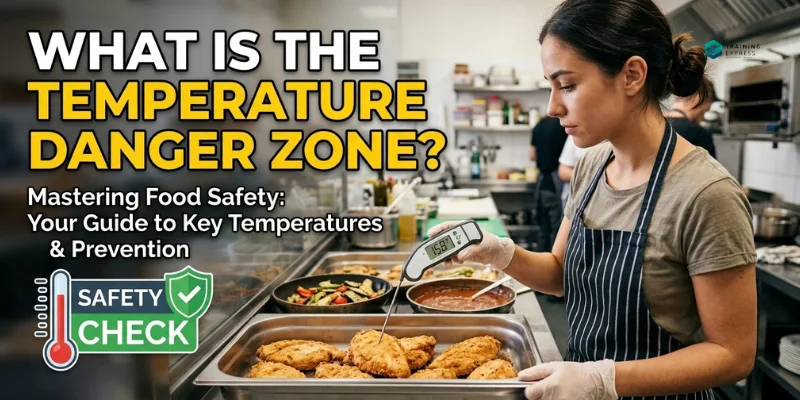

Leave a cooked chicken breast on the counter for four hours and it can look, smell, and taste completely fine — and still put someone in hospital. That’s the danger zone doing its work invisibly.
Here’s what it actually is, why it matters more than most kitchens treat it, and exactly what temperatures to hit at every stage.
Table of Contents
What Is the Temperature Danger Zone?
The temperature danger zone is the range in which bacteria grow fastest on food. Outside it, in either direction, growth slows to a crawl or stops.
Two versions of this number circulate, depending on where you’re reading from:
- UK (Food Standards Agency): 8°C to 63°C
- US (FDA Food Code): 40°F to 140°F, which converts to 4°C–60°C
Older UK guidance — and a fair number of training sites still online — quotes 8°C to 60°C. That figure is outdated. The FSA’s current position sets the top of the zone at 63°C, matching the temperature food must be hot-held at. If your training material still says 60°C, it’s worth double-checking against the current FSA page.
Below the zone, cold slows bacteria down. Above it, heat kills them off. The zone itself — that lukewarm middle ground — is where things go wrong.
Why Bacteria Multiply So Fast in This Range
Bacteria don’t just tolerate the danger zone. They thrive in it. The sweet spot for growth sits around 37°C — body temperature, not coincidentally, since that’s what a lot of pathogens evolved to exploit.
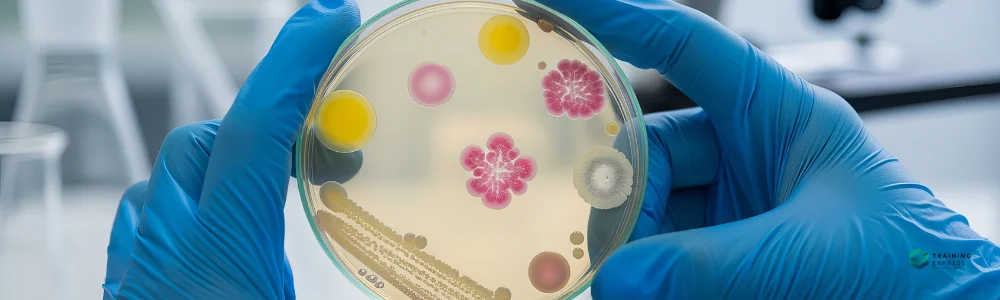
Under ideal conditions, bacteria like Salmonella, E. coli, Listeria, and Campylobacter can double in number every 20 minutes. Start with a few hundred cells on a piece of chicken left out after cooking, and by hour three you’re looking at hundreds of thousands. None of that shows up as a smell, a texture change, or a colour shift. The food looks fine right up until it isn’t.
Freezing is often misunderstood here too. It doesn’t kill bacteria — it just puts them to sleep. Thaw the food back into the danger zone and, given time, they wake up and carry on multiplying exactly where they left off.
The 2-Hour Rule (and When It's Actually 1 Hour)
This is the part most short explainers skip, and it’s the single most practical rule in the whole topic.
- Perishable food can sit in the danger zone for up to 2 hours total before it needs to be discarded or brought back into a safe range.
- If the ambient temperature is above roughly 32°C (90°F) — a hot kitchen, an outdoor buffet in summer — that window shrinks to 1 hour.
- The clock is cumulative. Thirty minutes on the counter while plating, then forty-five minutes on a buffet table, adds up. It doesn’t reset.
This is also where a lot of otherwise careful kitchens slip up: cooling food too slowly counts as danger-zone time too, not just serving it too slowly.
Safe Temperature Chart: Storage, Cooking, Holding
| Stage | Target |
|---|---|
| Fridge storage | Below 5°C (41°F) |
| Freezer storage | -18°C (0°F) or below |
| Cold holding / display | Below 8°C (46°F) |
| Hot holding | Above 63°C (145°F) |
| Cooking — most food | Core temp of 70°C for 2 minutes, or 75°C for 30 seconds |
| Cooking — poultry | Core temp of at least 74–75°C |
| Reheating | 75°C (some regions require 82°C — check local guidance) |
| Cooling after cooking | Below 8°C within 2 hours (some standards allow 4 hours to reach this) |
A few things worth flagging that generic charts often leave out:
- Whole cuts of meat and steaks can be served at lower internal temperatures than mince or poultry, because pathogens on whole muscle cuts are mostly on the surface, not distributed through the meat.
- Scotland requires a higher legal cooking temperature (82°C) than England, Wales, and Northern Ireland (70°C) — worth knowing if you operate across UK regions.
- Time matters as much as temperature. Food held at exactly 60°C needs 45 minutes to be safe. At 70°C, that drops to 2 minutes. At 80°C, just 6 seconds. Higher temperature buys you speed.
How to Cool Food Down Safely
Cooling is where the danger zone bites people who’d never dream of leaving food out on purpose. A large pot of soup or a tray of rice doesn’t cool evenly just sitting on a counter — the centre can stay in the danger zone for hours while the surface looks cold.
The safest method, used across most commercial kitchens:
- Get food from cooking temperature down to around 21°C within 2 hours.
- Continue cooling from 21°C to below 8°C within a further 4 hours (or faster).
- Speed this up with an ice bath, a blast chiller, or by splitting large batches into smaller, shallower containers so heat escapes faster.
- Never put a large hot pan straight into a packed fridge — it raises the ambient temperature and puts everything nearby at risk.
How to Check Temperature the Right Way
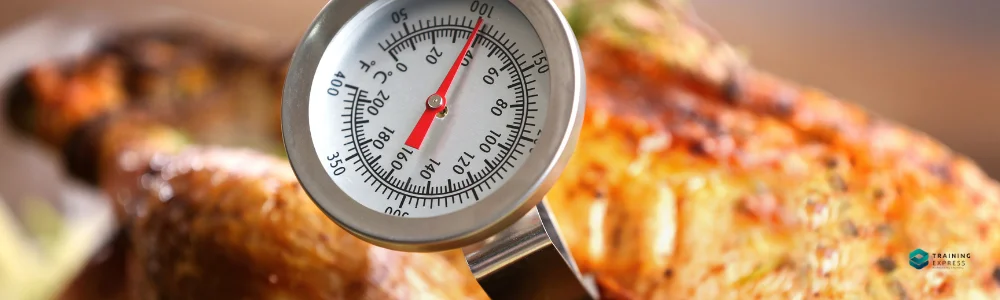
A thermometer is only as reliable as the person using it.
- Use a probe thermometer, inserted into the thickest part of the food, avoiding bone and the base of the pan.
- Calibrate it regularly — ice water should read 0°C, boiling water should read 100°C. If it’s off by more than a degree or two, recalibrate or replace it.
- Clean the probe with an alcohol wipe or disinfectant between uses, especially between raw and cooked food, to avoid cross-contamination through the equipment itself.
- Check fridge and freezer units daily, not just the food inside them — most commercial units display this, and it should be logged as part of your HACCP records.
- Colour and texture changes (pink to white in chicken, clear juices) are useful secondary checks, but they’re not a substitute for a temperature reading.
Common Mistakes That Push Food Into the Danger Zone
- Batch-defrosting on the counter instead of in the fridge overnight.
- Overfilling the fridge, which blocks airflow and leaves warm spots where food creeps into the zone.
- Buffet service running long without checking hot-holding units are actually holding at 63°C+.
- Stacking hot food in deep containers to cool, which traps heat in the centre.
- Trusting a “sell by” date over an actual temperature check on high-risk foods.
- Skipping probe calibration for months, so every reading afterward is quietly wrong.
What to Do Next
If you’re writing kitchen procedures or training staff, don’t stop at “keep food out of the danger zone” — that’s the part everyone already half-knows. The parts that actually prevent incidents are the ones most guides skip: the cumulative 2-hour clock, two-stage cooling, and probe calibration. Put a laminated version of the chart above by the pass, and check it’s actually being read, not just displayed.
Frequently Asked Questions (FAQ)
What is the temperature danger zone for food?
The temperature danger zone is the range in which bacteria multiply fastest on food — roughly 8°C to 63°C (46°F–145°F) under UK Food Standards Agency guidance, or 40°F to 140°F (4°C–60°C) under US FDA/USDA guidance. Food should spend as little time as possible in this range.
How long can food stay in the danger zone?
As a general rule, perishable food shouldn’t sit in the danger zone for more than 2 hours. If the surrounding temperature is above 32°C (90°F), that drops to 1 hour. Past that window, harmful bacteria can multiply to levels that cause food poisoning, even if the food looks and smells fine.
What temperature kills bacteria in food?
Most harmful bacteria are destroyed when food reaches a core temperature of 70°C (158°F) held for at least 2 minutes, or 75°C (167°F) for 30 seconds. Poultry and reheated food should hit at least 74–75°C. Freezing doesn’t kill bacteria — it just stops them multiplying.
Is the danger zone 40–140°F or 41–135°F?
You’ll see both. 40–140°F (4–60°C) is the standard used by the US FDA Food Code and most food safety training. Some sources use 41–135°F, which is a slightly more conservative range some state health departments apply. When in doubt, use whichever figure your local regulator or food safety course specifies.
What foods are most at risk in the danger zone?
High-risk foods include cooked meat and poultry, fish and seafood, dairy, cooked rice and pasta, eggs, and anything with a high moisture and protein content. These support rapid bacterial growth and need close time-and-temperature control at every stage — storage, prep, cooking, holding, and cooling.
Is room temperature within the danger zone?
Yes. Most rooms sit between 18°C and 24°C (64°F–75°F), which falls squarely inside the danger zone. This is exactly why food can’t just be left out on a counter — room temperature isn’t a neutral, safe environment for perishable food, it’s prime conditions for bacterial growth.
Can bacteria still grow in the refrigerator?
Slowly, yes. A standard fridge set below 5°C significantly slows bacterial growth but doesn’t stop it completely — some bacteria, like Listeria, can multiply even at fridge temperatures, just much more gradually. This is why fridge storage still has use-by limits and isn’t a substitute for freezing.
What temperature should you reheat leftovers to?
Reheated food should reach a core temperature of at least 75°C (167°F), held for 30 seconds, before serving. Some regions and hospital/care settings require 82°C. Reheat only once — repeatedly cooling and reheating the same food gives bacteria multiple passes through the danger zone.
How often should food temperatures be checked during service?
For hot and cold holding, checks every 2 hours are standard practice, logged as part of HACCP records. For a buffet or event running longer than 2 hours, food should be checked, topped up, or replaced on that same 2-hour cycle rather than left running continuously.
What happens if food is left in the danger zone overnight?
It should be thrown away. Even if it looks, smells, and tastes normal, several hours at room temperature is more than enough for bacteria to reach levels that cause food poisoning. There’s no visual or smell test that reliably catches this — when in doubt, the safe move is to discard it.
Robert Lawrence
Author | Specialises in E-Learning.
Robert Lawrence is an author at Training Express, with over 5 years of experience creating practical resources and strategies to support learners and enhance their professional & personal development.
Reviewed by: Amelia Frey, Food Hygiene & Safety Specialist at CupStory
Related Blogs