Food Hygiene
 Health & Safety
 Safeguarding
 First Aid
 Business Skills
 Personal Development


Despite significant investment in online compliance training, many programmes struggle with low engagement, missed deadlines, inconsistent reporting, and limited evidence of learning outcomes. In many cases, the challenge is not the training content itself but the rollout process behind it.
A successful compliance package implementation requires clear governance, effective communication, learner support, and the right technology. This guide explains how to roll out corporate compliance training successfully, overcome common training rollout challenges, and improve employee training effectiveness across modern workplaces.
Table of Contents
What Is Online Compliance Training Implementation?
Online compliance training implementation is the process of planning, delivering, managing, and monitoring mandatory workplace training across an organisation. It includes assigning training, supporting learners, tracking completion, maintaining compliance records, and measuring training effectiveness to help meet organisational and regulatory requirements.

For UK organisations, compliance training often supports obligations relating to workplace health and safety, data protection, equality, safeguarding, information security, and industry-specific regulatory requirements. While requirements vary between sectors, organisations increasingly need evidence that employees have completed and understood mandatory training during audits, inspections, and client reviews.
Common examples of corporate compliance training include:
Why Corporate Compliance Training Rollouts Fail in 2026
Most corporate compliance training programmes do not fail because of poor content. They fail because the rollout lacks structure. Common problems include unclear ownership, ineffective communication, limited accessibility support, inconsistent reporting, and inadequate learner engagement. When organisations focus solely on assigning courses rather than managing the entire learning process, completion rates, knowledge retention, and compliance outcomes can all suffer.
The Biggest Online Compliance Training Challenges for Modern Organisations
Online compliance training has become more complex as workplaces continue to change. Remote and hybrid working models make it harder for organisations to deliver consistent training, track completion, and ensure every employee receives the same learning experience.
Modern workforces also have different learning needs, including language differences, accessibility requirements, and varying levels of digital confidence. A successful compliance training approach needs to be flexible, inclusive, and easy for all employees to access.
While training software can simplify reporting, automation, and learner management, technology alone is not enough. Organisations need clear processes, communication, and accountability to create a compliance training programme that supports long-term success.
How to Roll Out Online Compliance Training Successfully in 2026
While every organisation has different compliance requirements, successful online compliance training programmes typically follow a similar implementation process. The most effective rollouts combine planning, governance, accessibility, learner support, reporting, and technology to ensure employees can complete training and organisations can demonstrate compliance when required.
The first step is creating a structured rollout plan before any training is assigned.
Step 1: Plan Your Corporate Compliance Training Rollout (2026 Implementation Guide)
Many training rollout challenges can be traced back to poor planning. Organisations often focus on selecting courses or configuring platforms before deciding who needs training, what outcomes are expected, and how success will be measured.

A structured rollout plan helps ensure that corporate compliance training aligns with business objectives, compliance requirements, and workforce needs.
Identify Training Requirements
Before launching any programme, organisations should determine which training topics are required and who needs to complete them.
Requirements may be influenced by:
- Legal and regulatory obligations
- Industry-specific standards
- Internal policies and procedures
- Previous audit findings
- Operational risks
- Client or contractual requirements
Mapping these requirements at the beginning helps avoid unnecessary training assignments while ensuring high-risk areas receive appropriate attention.
Segment Employees by Role and Risk
Not every employee requires the same level of compliance training.
For example, managers may need additional training on workplace conduct and policy enforcement, while frontline employees may require role-specific health and safety or data protection training. Assigning training based on role and risk profile helps improve relevance and reduce learner fatigue.
This approach can also improve employee training effectiveness by ensuring employees receive information that directly relates to their responsibilities.
Define Roles and Responsibilities
One of the most common causes of rollout failure is unclear ownership.
A successful compliance package implementation requires accountability across multiple stakeholders. HR teams, compliance managers, learning and development teams, line managers, and senior leaders all have a role to play.
Clearly defining responsibilities helps answer important questions such as:
- Who manages learner enrolment?
- Who monitors completion rates?
- Who follows up with overdue learners?
- Who reviews compliance reports?
- Who is responsible for audit evidence?
When responsibilities are documented in advance, organisations can avoid confusion and respond more quickly when issues arise.
Create a Compliance Training Governance Framework
A governance framework helps ensure accountability throughout the rollout. Organisations should establish clear ownership for training assignment, learner support, reporting, policy updates, refresher scheduling, and audit preparation.
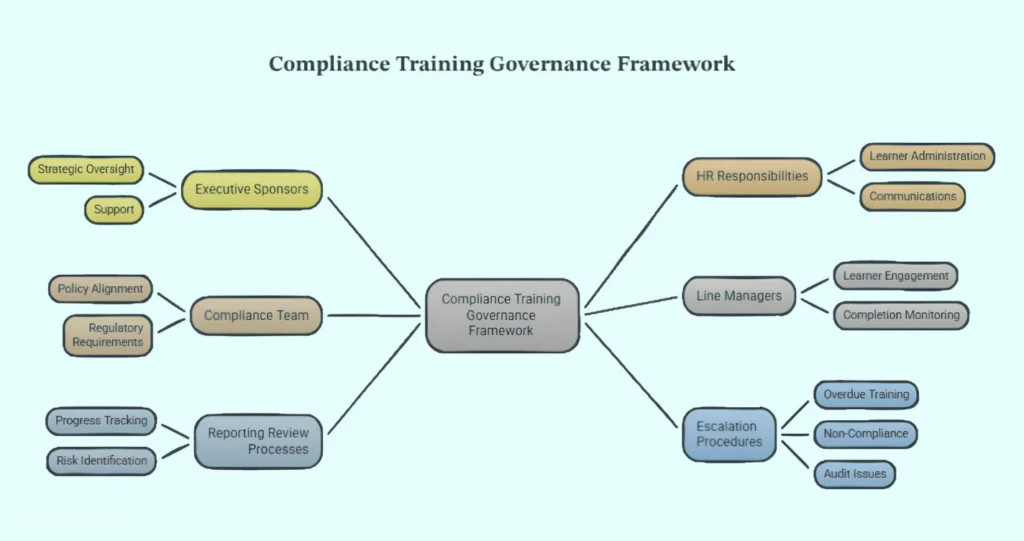
Without defined governance, compliance training programmes can quickly become fragmented, particularly in organisations with multiple departments, locations, or reporting lines. Clear governance helps maintain consistency, reduces duplication of effort, and ensures that compliance responsibilities remain visible across the organisation.
A governance framework should define:
- Executive sponsors responsible for strategic oversight
- HR responsibilities for learner administration and communications
- Compliance team responsibilities for policy alignment and regulatory requirements
- Line manager responsibilities for learner engagement and completion monitoring
- Reporting review processes for tracking progress and identifying risks
- Escalation procedures for overdue training, non-compliance, and audit issues
Strong governance reduces implementation risks and helps maintain consistency across departments, locations, and learner groups. It also strengthens audit readiness by ensuring that compliance activities are monitored, documented, and reviewed on an ongoing basis.
Establish Success Metrics
Completion rates remain an important measure of progress, but they should not be the only indicator of success.
HR and compliance leaders should establish measurable objectives before launch, such as:
- Training completion rates
- Assessment performance
- Reduction in overdue learners
- Policy acknowledgement rates
- Audit readiness
- Improvements in employee training effectiveness
Setting clear metrics from the outset makes it easier to evaluate whether the programme is delivering meaningful outcomes.
Create a Realistic Rollout Timeline
Launching every course at once can overwhelm employees and reduce engagement.
Instead, organisations should create a training schedule that includes:
- Launch dates
- Communication milestones
- Completion deadlines
- Reminder campaigns
- Reporting reviews
- Refresher training cycles
A phased approach often improves participation and gives administrators time to address issues before they affect the wider workforce.
Planning Reduces Problems Later
Many organisations view planning as an administrative task. In reality, it is one of the most important factors in a successful rollout.
When training requirements are clear, responsibilities are defined, and expectations are communicated early, organisations are far better positioned to overcome common training rollout challenges and achieve their compliance objectives.
Once the rollout plan is in place, the next priority is ensuring that training remains accessible and inclusive for every employee, regardless of location, language, or individual learning needs.
Step 2: Build Accessibility Into Online Compliance Training
One of the most overlooked aspects of online compliance training is accessibility. Organisations often focus on content, deadlines, and reporting while assuming all employees will engage with training in the same way.

In reality, modern workforces are increasingly diverse. Employees may speak different first languages, work remotely, use different devices, or require accessibility adjustments to participate fully in learning activities. If these needs are not considered during implementation, completion rates and learning outcomes can suffer.
Building accessibility into the rollout from the beginning helps ensure that every employee has a fair opportunity to complete training and understand their responsibilities.
Support Multilingual Teams
Many organisations operate across multiple regions or employ workers from diverse language backgrounds. Even when English is the primary workplace language, complex compliance terminology can create barriers to understanding.
Where appropriate, organisations should consider:
- Training content in multiple languages
- Subtitles and captions for video-based learning
- Downloadable reference materials
- Plain English explanations of technical concepts
Providing language support can improve engagement and reduce the risk of employees completing training without fully understanding key compliance requirements.
Ensure Training Is Accessible Across Devices
Employees increasingly access learning from a range of devices, particularly in hybrid and remote working environments.
Training should be compatible with:
- Desktop computers
- Laptops
- Tablets
- Smartphones
Mobile accessibility is particularly important for frontline employees, field-based workers, and teams who may not have regular access to a workstation.
A flexible learning experience helps remove practical barriers that often contribute to low completion rates.
Consider Different Learning Needs
Employees absorb information in different ways. Some may prefer written guidance, while others engage more effectively with video content, interactive activities, or real-world scenarios.
A well-designed corporate compliance training programme should include a mix of learning formats where possible. This approach can improve knowledge retention and support employee training effectiveness across a broader range of learners.
Meet Accessibility Requirements
Accessibility is not only about improving the learner experience—it can also help organisations meet legal and ethical responsibilities.
When evaluating training content and corporate training software, consider features such as:
- Screen reader compatibility
- Keyboard navigation
- Adjustable text sizes
- Closed captions
- Audio transcripts
These features help ensure that employees with different accessibility requirements can participate fully in mandatory learning activities.
Accessibility Supports Compliance
Organisations sometimes view accessibility as an additional consideration rather than a core part of compliance package implementation. However, training can only be effective if employees are able to access, understand, and apply what they have learned.
By designing training with accessibility and inclusion in mind, organisations can improve completion rates, strengthen understanding, and create a more effective learning environment for all employees.
Once training is accessible, the next challenge is maintaining engagement and supporting employees throughout the rollout process.
Step 3: Improve Learner Engagement and Training Completion Rates
Even the most accessible training programme can struggle if employees do not receive the support they need to complete it. A common mistake during online compliance training implementation is assuming that once training has been assigned, learners will automatically engage with the content and meet deadlines.

In practice, learner support plays a significant role in the success of any rollout. Clear communication, manager involvement, and timely assistance can help improve participation and reduce common training rollout challenges.
Communicate the Purpose of the Training
Employees are more likely to engage with corporate compliance training when they understand why it matters.
Rather than simply notifying learners that training is mandatory, organisations should explain:
- The purpose of the training
- How it relates to their role
- Completion expectations
- Deadlines and reporting processes
- Where to find support if needed
Providing context can help shift training from a compliance task to a meaningful learning activity.
Involve Managers Early
Line managers often have a significant influence on training completion rates.
Managers can help by:
- Reinforcing the importance of training
- Monitoring progress within their teams
- Addressing questions and concerns
- Supporting employees who may be struggling to complete assignments
When managers actively support the rollout, employees are more likely to prioritise mandatory learning.
Use Automated Reminders and Follow-Ups
Busy workloads are one of the most common reasons employees miss training deadlines.
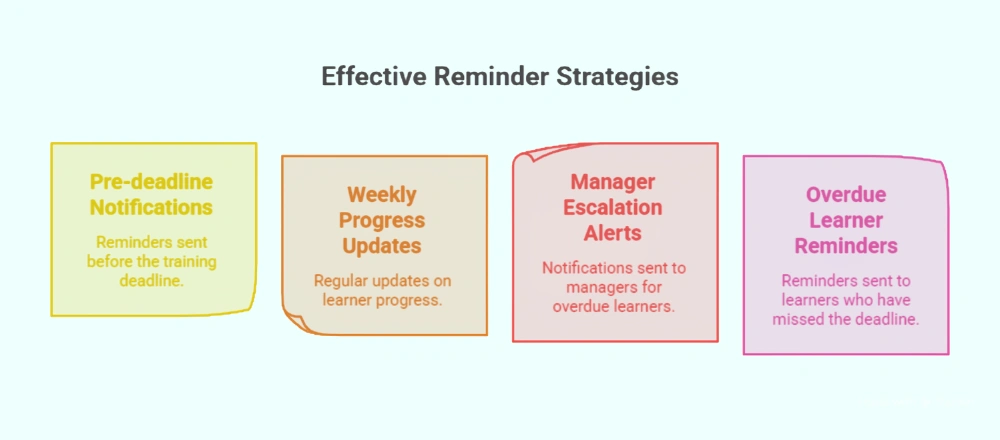
Automated reminders can help keep learners on track without creating additional administrative work for HR and compliance teams.
Effective reminder strategies may include:
- Pre-deadline notifications
- Weekly progress updates
- Manager escalation alerts
- Overdue learner reminders
These communications help maintain momentum throughout the rollout and reduce the number of employees requiring manual follow-up.
Provide Easy Access to Support
Employees should know where to go if they experience technical difficulties or have questions about the training content.
Support may include:
- Frequently asked questions
- User guides
- Helpdesk assistance
- Manager support
- Dedicated compliance contacts
Addressing issues quickly can prevent minor obstacles from becoming barriers to completion.
Reinforce Learning After Completion
Completing a course does not necessarily mean learning has been retained.
Organisations can strengthen employee training effectiveness by reinforcing key messages after training has been completed. This may involve manager discussions, policy reminders, team briefings, or periodic refresher activities.
Regular reinforcement helps employees apply what they have learned and supports a stronger culture of compliance across the organisation.
Engagement Drives Results
Many compliance programmes focus heavily on assigning and tracking courses. However, successful rollouts recognise that employee engagement is equally important.
When learners understand the purpose of training, receive ongoing support, and have access to the resources they need, organisations are more likely to achieve meaningful compliance outcomes rather than simply recording completions.
The next step is ensuring that reporting processes provide clear visibility into progress, performance, and compliance status across the organisation.
Step 4: Use Reporting to Improve Employee Training Effectiveness
Reporting is one of the most important aspects of a successful compliance training rollout. Without accurate data, organisations may struggle to identify overdue learners, demonstrate compliance during audits, or evaluate whether training is achieving its intended outcomes.

Rather than treating reporting as an administrative task, HR and compliance leaders should use it as a tool for continuous improvement.
Track More Than Completion Rates
Completion data provides a useful starting point, but it does not tell the whole story.
To gain a clearer picture of employee training effectiveness, organisations should also monitor:
- Assessment results
- Knowledge check performance
- Policy acknowledgements
- Training completion by department
- Overdue learner trends
These metrics can help identify areas where additional support or refresher training may be required.
Create Visibility for Managers
Managers play a key role in maintaining compliance across their teams.
Providing access to relevant reporting data allows managers to:
- Monitor learner progress
- Identify overdue training
- Support employees who need assistance
- Address compliance risks more quickly
Regular reporting can also encourage greater accountability throughout the organisation.
Maintain Audit-Ready Records
Many organisations only realise the importance of training records when an audit, inspection, or client request occurs.
Maintaining accurate records of course completion, assessment results, certifications, and policy acknowledgements can help demonstrate compliance and reduce the time required to gather evidence when needed.
Use Data to Improve Future Rollouts
Reporting should support decision-making rather than simply documenting activity.
By reviewing trends and learner performance, organisations can identify common training rollout challenges, improve communication strategies, and refine future compliance package implementation plans.
The most effective online compliance training programmes use reporting not only to monitor compliance but also to drive continuous improvement across the organisation.
Step 5: Scale Delivery With Corporate Training Software

As organisations grow, managing compliance training manually becomes increasingly difficult. Assigning courses, sending reminders, tracking completion rates, and maintaining records across multiple locations can create a significant administrative burden.
This is where corporate training software can support a more efficient rollout.
Modern learning platforms can help organisations:
- Automate learner enrolment
- Schedule refresher training
- Send reminder notifications
- Generate compliance reports
- Maintain training records
- Monitor completion rates in real time
For organisations with distributed or multilingual workforces, technology can also improve accessibility by supporting mobile learning, flexible access, and multiple language options.
However, software should support the rollout strategy rather than define it. Even the most advanced platform cannot compensate for poor planning, unclear ownership, or inadequate learner support.
The most successful organisations combine appropriate technology with strong governance, accessible learning experiences, and effective reporting processes to create a sustainable corporate compliance training programme.
Common Training Rollout Challenges and Solutions
Despite careful planning, organisations may still encounter obstacles during implementation. Understanding common challenges can help teams respond quickly and maintain momentum throughout the rollout.
| Challenge | Potential Cause | Practical Solution |
|---|---|---|
| Low completion rates | Poor communication or competing priorities | Explain the purpose of training, involve managers, and use automated reminders |
| Learner disengagement | Generic or irrelevant content | Assign role-specific training and use practical workplace examples |
| Language barriers | Multilingual workforce | Provide translated content, subtitles, and supporting resources where appropriate |
| Accessibility concerns | Training not designed for diverse learner needs | Ensure compatibility with assistive technologies and mobile devices |
| Reporting gaps | Inconsistent data collection | Establish reporting requirements before launch and monitor progress regularly |
| Audit preparation difficulties | Incomplete training records | Maintain accurate, centralised compliance documentation |
While these challenges are common, they can often be prevented through careful planning, ongoing communication, and regular performance monitoring.
Corporate Compliance Training Rollout Checklist for 2026
Before launching your programme, confirm that the following foundations are in place:
- Training requirements have been identified
- Employees have been grouped by role and risk level
- Governance responsibilities have been assigned
- Success metrics have been defined
- Accessibility requirements have been reviewed
- Language support needs have been assessed
- Learner communications have been prepared
- Reporting processes have been established
- Training records can be accessed easily
- Managers understand their responsibilities
- Corporate training software has been configured appropriately
- Support resources are available for learners
Completing these steps can help reduce implementation risks and improve the overall effectiveness of the rollout.
Choosing the Right Compliance Training Partner
Successful implementation depends not only on planning and technology but also on the quality of training content and learner experience.
Training providers should offer:
- Up-to-date compliance courses
- Flexible online delivery
- Mobile accessibility
- Progress tracking
- Certification records
- Support for diverse workforces
Training Express provides a wide range of online compliance training courses designed to help organisations deliver workplace learning efficiently while supporting compliance, employee development, and audit readiness.
Final Thoughts
Rolling out online compliance training in 2026 requires more than assigning mandatory courses and tracking completion rates. Organisations must support diverse workforces, provide accessible learning experiences, maintain accurate reporting, and ensure employees receive the guidance they need throughout the process.
By focusing on planning, accessibility, learner support, reporting, and appropriate use of technology, organisations can overcome common training rollout challenges and build a more effective corporate compliance training programme. The result is not only improved compliance but also stronger employee engagement, better audit readiness, and more sustainable learning outcomes across the organisation.
Ready to Improve Your Compliance Training Rollout?
Whether you are introducing a new compliance programme or improving an existing one, a structured implementation strategy can significantly improve completion rates, learner engagement, and audit readiness.
Training Express offers online compliance training courses covering workplace compliance, health and safety, safeguarding, information security, equality and diversity, and many other essential topics.
Explore the Training Express course library to build a scalable compliance training programme that supports your workforce in 2026 and beyond.
Frequently Asked Questions (FAQ)
What is corporate compliance training?
Corporate compliance training is workplace training that helps employees understand and follow legal, regulatory, and organisational requirements. Common topics include data protection, health and safety, equality and diversity, anti-bribery, information security, and workplace conduct. Effective corporate compliance training helps organisations reduce risk, improve audit readiness, and create a stronger culture of compliance.
How do you roll out online compliance training successfully?
A successful online compliance training rollout begins with clear planning and governance. Organisations should identify training requirements, assign responsibilities, support accessibility needs, communicate expectations clearly, monitor progress through reporting, and provide learner support throughout the programme. Using corporate training software can also help automate administration and improve visibility across the organisation.
Why do compliance training rollouts fail?
Many compliance training rollouts fail because of poor implementation rather than poor content. Common training rollout challenges include unclear ownership, low employee engagement, inadequate communication, accessibility barriers, inconsistent reporting, and limited support for distributed or multilingual teams. Addressing these issues early can significantly improve completion rates and learning outcomes.
How can organisations improve employee training effectiveness?
Employee training effectiveness can be improved by making learning relevant, accessible, and measurable. Organisations should provide role-specific training, support different learning needs, reinforce key messages after course completion, and monitor outcomes using reporting data such as assessment scores, policy acknowledgements, and completion trends.
What features should organisations look for in corporate training software?
When selecting corporate training software, organisations should look for features such as automated enrolment, learner tracking, reporting dashboards, mobile accessibility, reminder notifications, certification management, and multilingual support. The right platform should simplify compliance management while providing clear visibility into training performance.
How often should employees complete compliance training?
The frequency of compliance training depends on regulatory requirements, organisational policies, and the subject matter being covered. Some topics may require annual refresher training, while others may only need updating when regulations or internal procedures change. Organisations should review training schedules regularly to ensure employees remain informed and compliant.
Can online compliance training support remote and hybrid teams?
Yes. Online compliance training is particularly effective for remote and hybrid workforces because it allows employees to access learning materials from different locations and devices. With appropriate planning, accessibility features, reporting tools, and learner support, organisations can deliver consistent training experiences regardless of where employees work.
Why choose Training Express for corporate compliance training?
Training Express offers a wide range of online compliance training courses designed to help organisations develop employee knowledge, support workplace compliance, and maintain accurate training records. With flexible online learning, accessible course delivery, and training across key compliance topics, Training Express can help organisations implement and manage effective workplace learning programmes that support both compliance and professional development.
What is a compliance training rollout plan?
A compliance training rollout plan is a structured framework that outlines how mandatory training will be implemented across an organisation. It typically includes training objectives, employee groups, timelines, communication strategies, governance responsibilities, reporting processes, and success measures. A clear rollout plan helps organisations deliver corporate compliance training consistently while reducing implementation risks.
How long does compliance training implementation take?
The time required to implement compliance training depends on the size of the organisation, the number of employees, and the complexity of training requirements. Smaller organisations may complete implementation within a few weeks, while larger organisations with multiple locations or multilingual workforces may require several months. A phased rollout approach can help organisations manage implementation more effectively.
Who is responsible for compliance training in an organisation?
Responsibility for compliance training is often shared across multiple teams. HR teams may manage learner administration and communications, compliance teams oversee regulatory requirements, line managers support employee participation, and senior leaders provide strategic oversight. Establishing clear governance and accountability helps ensure compliance training is delivered consistently and monitored effectively.

Robert Lawrence
Author | Specialises in Health & Social Care
Robert Lawrence is an e-learning specialist and tutor at Training Express, with experience creating practical resources and strategies to support learners and enhance their professional development.