Food Hygiene
 Health & Safety
 Safeguarding
 First Aid
 Business Skills
 Personal Development

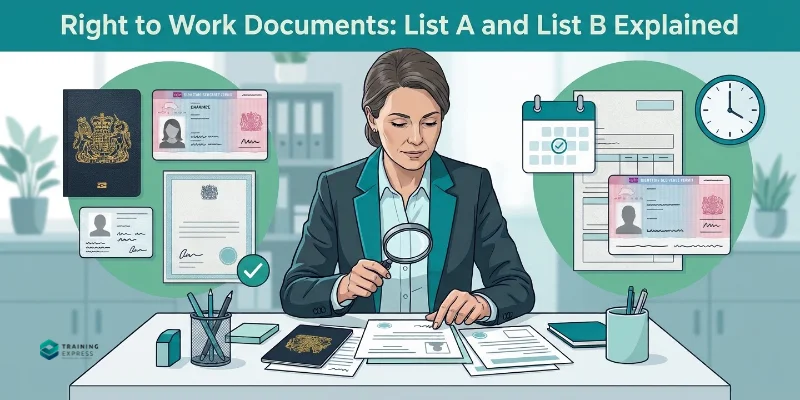

Right to work documents are the original documents a person can show you to prove they are allowed to work in the UK. The Home Office splits them into two lists. List A documents show permanent permission to work. List B documents show permission that runs out, so you need to check again later.
If you check the right document in the right way before someone starts work, you get a legal defence called a statutory excuse. Accept the wrong document, or a photo of the right one, and that defence is gone. This guide lists every acceptable document, explains what each one means, and shows you what to check and copy.
Key takeaways
- List A documents give you a permanent (continuous) excuse, so no follow-up check is needed.
- List B documents give you a time-limited excuse, so you must carry out another check before the permission ends.
- You must check the original document while the person is present, either in person or through a live video call.
- Anyone with an eVisa must prove their right to work online using a share code, rather than presenting physical documents.
- Biometric Residence Permits (BRPs) and EU passports on their own are no longer acceptable proof of the right to work.
What Are Right to Work Documents?
Right to work documents are the specific documents listed by the Home Office that an employer can accept in a manual right to work check. The lists are set out in Annex A of the Home Office employer’s guide to right to work checks.
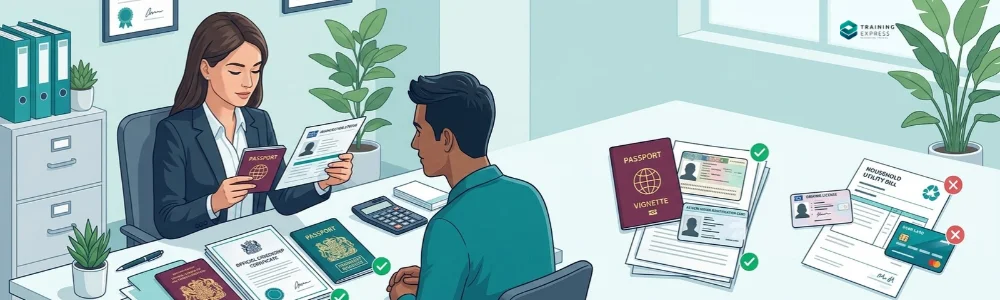
The lists are strict. A document only counts if it is on them. A driving licence, a utility bill or a bank card may prove who someone is, but none of them proves the right to work.
The type of document you see also decides how long your protection lasts:
- Continuous statutory excuse: lasts for the whole of the person’s employment. You get this from List A documents.
- Time-limited statutory excuse: lasts until the person’s permission ends, or for six months in some cases. You get this from List B documents.
For the bigger picture, including the three ways to check and the rules that changed in October 2026, see our complete guide to right to work checks.
Documents or Share Code: Which Applies?
Before you ask for documents, check whether a manual document check is the right method for this person. Many people can no longer prove their right to work with paper documents.
| Person | How They Prove Their Right to Work |
|---|---|
| British Citizen | Manual check of List A documents, such as a British passport (current or expired), or a digital check through a registered provider. |
| Irish Citizen | Manual check of an Irish passport or passport card (current or expired), or a digital check through a registered provider. |
| Anyone with an eVisa, Including EU Settlement Scheme Status | Online check with a right to work share code. Documents are not enough. |
| Someone Waiting on a Home Office Decision Without Valid Evidence | The Employer Checking Service, which may give you a Positive Verification Notice. |
An eVisa is a digital record of someone’s immigration status. It has replaced most physical immigration documents. If a person’s status is held as an eVisa, you must check it online, even if they also show you a physical document.
List A: Documents That Show a Permanent Right to Work
List A documents show that the person has a permanent right to work in the UK. If you check one correctly before they start, you have a statutory excuse for as long as they work for you.
There are eight types of List A document:
| No. | List A document | What it means in practice |
|---|---|---|
| 1 | A passport (current or expired) showing the holder is a British citizen or a citizen of the UK and Colonies with the right of abode | The most common List A document. An expired British passport is still acceptable. |
| 2 | A passport or passport card (current or expired) showing the holder is an Irish citizen | Irish citizens can use a passport or the credit-card-sized passport card, even if expired. |
| 3 | A document issued by Jersey, Guernsey or the Isle of Man, verified as valid by the Employer Checking Service, showing unlimited leave | Rare. You must ask the Employer Checking Service to confirm it. |
| 4 | A current passport endorsed to show the holder is exempt from immigration control or has indefinite leave to remain, the right of abode or no time limit on their stay | An older-style endorsement in a passport. Most people with this status now have an eVisa instead. |
| 5 | A current Immigration Status Document showing indefinite leave, together with an official document giving the person's permanent National Insurance number and name | Must be paired with National Insurance evidence. |
| 6 | A birth or adoption certificate issued in the UK, together with an official document giving the person's permanent National Insurance number and name | Common for British citizens without a passport. The birth certificate alone is not enough. |
| 7 | A birth or adoption certificate issued in the Channel Islands, the Isle of Man or Ireland, together with the same National Insurance evidence | Works the same way as item 6. |
| 8 | A certificate of registration or naturalisation as a British citizen, together with the same National Insurance evidence | For people who became British citizens and don't have a British passport. |
The wording above is a plain-English summary. Always check the full wording in the Home Office right to work checklist before you rely on a less common document.
What Counts as National Insurance Evidence?
Several List A documents only count when you see them with “an official document giving the person’s permanent National Insurance number and their name”. That document must come from a government agency or a previous employer.
Common examples include a letter from HMRC or the Department for Work and Pensions (DWP), a P45, a P60 or a payslip from a previous employer. The name on it must match the name on the other document, or you’ll need evidence explaining the difference.
List B Group 1: Documents That Show Time-Limited Permission
List B Group 1 documents show that the person can work in the UK for a limited time. They give you a statutory excuse until the person’s permission expires.
| No. | List B Group 1 document |
|---|---|
| 1 | A current passport endorsed to show the holder is allowed to stay in the UK and is currently allowed to do the type of work in question |
| 2 | A document issued by Jersey, Guernsey or the Isle of Man, verified as valid by the Employer Checking Service, showing limited leave to enter or remain that allows the work |
| 3 | A current Immigration Status Document containing a photograph, issued by the Home Office, with a valid endorsement allowing the person to stay and do the work, together with an official document giving their permanent National Insurance number and name |
Because the permission has an end date, you must do a follow-up check before it runs out. Put the expiry date in your HR system as soon as you finish the first check, with reminders three months and one month ahead.
List B Group 2: Six-Month Excuse With a Positive Verification Notice
List B Group 2 covers people whose immigration status is still being decided by the Home Office. These documents only work together with a Positive Verification Notice (PVN) from the Employer Checking Service. A PVN is written confirmation from the Home Office that the person can do the work.
| No. | List B Group 2 document |
|---|---|
| 1 | A Home Office document showing the person applied under the EU Settlement Scheme on or before 30 June 2021, with a PVN |
| 2 | A non-digital Certificate of Application from the Home Office, with a PVN |
| 3 | A document from Jersey, Guernsey or the Isle of Man showing an application is pending, with a PVN |
| 4 | An Application Registration Card from the Home Office stating the holder is allowed to take the work, with a PVN |
| 5 | A Positive Verification Notice issued by the Employer Checking Service to you as the employer or prospective employer |
A List B Group 2 check gives you a statutory excuse for six months from the date on the PVN. Set a reminder to check again before the six months end. Our guide to the Employer Checking Service explains how to request a PVN.
List A vs List B: Quick Comparison
| List A | List B Group 1 | List B Group 2 | |
|---|---|---|---|
| What it shows | Permanent right to work | Time-limited right to work | Status confirmed by the Home Office while a decision is pending |
| Statutory excuse | Continuous | Until permission expires | Six months from the PVN date |
| Follow-up check? | No | Yes, before expiry | Yes, within six months |
| Common example | British passport | Endorsed current passport | Application Registration Card with a PVN |
How to Check Right to Work Documents Properly
Seeing an acceptable document is only part of the job. To get a statutory excuse, you must follow the Home Office’s three steps: obtain, check and copy.
Step 1: Obtain the originals
Ask for original documents from List A or List B. You must hold the documents yourself. The person must be present, either in the room or on a live video call, so you can compare them with their photo.
Step 2: Check them
Check each document in the person’s presence. Make sure:
- the photographs are a true likeness of the person in front of you
- dates of birth are the same across all documents and match the person’s apparent age
- expiry dates have not passed, unless the list says expired documents are allowed
- any work restrictions allow the person to do the job you’re offering, including limits on hours
- the document looks genuine, has not been tampered with and belongs to the person
Step 3: Copy and record
Make a clear copy of each document in a format that can’t be altered later, such as a scanned PDF or a photocopy. For a passport, copy the page with the photo and personal details, plus any page with a UK endorsement. For other documents, copy the whole document, front and back.
Record the date you made the check, either on the copy or in your HR system. Keep the copies for as long as the person works for you, plus two years after they leave. Because these are personal records, UK GDPR applies, so store them securely and limit who can see them.
What If the Names Don't Match?
Names often differ between documents, for example after marriage or divorce. This doesn’t automatically mean anything is wrong, but you must see evidence that explains the difference.
Acceptable evidence includes a marriage or civil partnership certificate, a divorce decree or a deed poll. Check the original, copy it and keep it with the right to work record. If the person can’t explain the difference with a document, don’t accept the check until they can.
Documents You Can No Longer Accept
Several documents that used to be common are no longer acceptable on their own. Accepting them is one of the most frequent right to work mistakes.
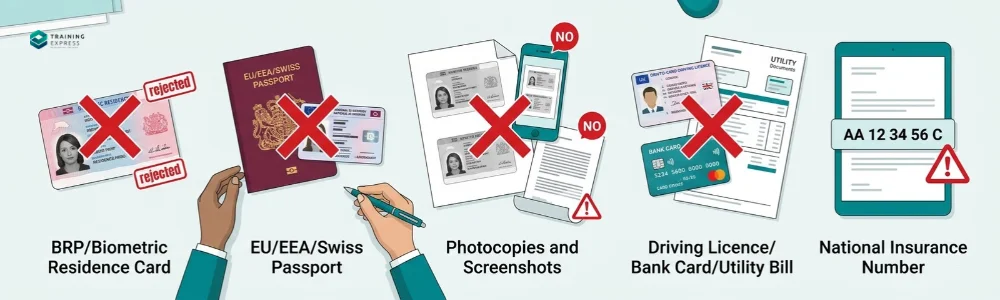
- Biometric Residence Permits (BRPs) and Biometric Residence Cards: no longer acceptable proof of right to work, even if not yet expired. People who held one should have an eVisa and should give you a share code.
- EU, EEA and Swiss passports or ID cards: not enough on their own since 1 July 2021. EU citizens prove their status online with a share code. Irish citizens are the exception.
- Photocopies, scans, screenshots or photos of documents: never acceptable for a manual check. You must hold the original.
- Driving licences, bank cards and utility bills: may help prove identity but are not right to work documents.
- A National Insurance number on its own: it doesn’t prove the right to work. It only counts when paired with one of the List A or List B documents that require it.
Common Mistakes With Right to Work Documents
- Accepting a birth certificate on its own. A UK birth certificate needs official National Insurance evidence to count.
- Using documents for an eVisa holder. If the person has an eVisa, you must do an online check.
- Copying only the photo page. For passports, also copy any page with a UK endorsement.
- Forgetting the date. An undated copy may not give you a statutory excuse.
- Missing the follow-up. List B protection ends on a set date, so diarise it straight away.
- Treating people differently. Ask every candidate for evidence at the same stage, whatever their accent, name or nationality.
Right to Work Documents Checklist
Use this checklist each time you do a manual document check:
- Confirmed that a manual check is the right method (no eVisa)
- Original documents from List A or List B in your hands
- Person present in the room or on a live video call
- Photos and dates of birth match the person and each other
- Documents in date, or within the allowed expiry rules
- Any work restrictions noted, such as limited hours
- Name differences explained with an original document
- Clear, unalterable copies made of every document
- Date of check recorded
- Follow-up date set for List B documents
- Records stored securely for employment plus two years
Train Your Team to Check Documents With Confidence
Most document mistakes happen when a busy manager rushes a check. Anyone who hires or onboards staff should know which documents to accept and how to copy them. Training Express’s UK Employment Law course covers employers’ legal duties, and the HR Management course covers recruitment and onboarding. For safe storage of copies, see our GDPR training.
Frequently Asked Questions (FAQ)
Can I accept an expired British passport?
Yes. List A accepts a British passport whether it is current or expired. The photo must still be a true likeness of the person. The same applies to an Irish passport or Irish passport card.
Is a UK birth certificate enough to prove the right to work?
No, not on its own. A UK birth or adoption certificate only counts alongside official proof of the person’s permanent National Insurance number and name. Examples include a P45, P60, payslip or letter from HMRC.
Can I accept a scan or photo of a right to work document?
No. For a manual check, you must hold the original document. You can see the person on a live video call, but the document itself must be in your hands.
Are BRPs still valid for right to work checks?
No. Biometric Residence Permits are no longer acceptable proof. People who had a BRP should now have an eVisa, so ask them for a right to work share code and do an online check.
Can EU citizens prove their right to work with a passport?
Not since 1 July 2021. EU, EEA and Swiss citizens prove their right to work online with a share code linked to their EU Settlement Scheme status or other eVisa. Irish citizens can still use their passport or passport card.
Do I need to check documents again for List A holders?
No. A correct List A check gives you a continuous excuse for the whole employment, so no follow-up check is needed.

Robert Lawrence
Author | Specialises in E-Learning.
Robert Lawrence is an author at Training Express, with over 5 years of experience creating practical resources and strategies to support learners and enhance their professional & personal development.
Reviewed by: Aftab Ansari, Human Resource Specialist at Training Express