Food Hygiene
 Health & Safety
 Safeguarding
 First Aid
 Business Skills
 Personal Development



If you have ever read anything about health and safety law in the UK, you will almost certainly have come across the phrase “so far as is reasonably practicable”. It appears throughout the Health and Safety at Work Act 1974 and many of the regulations made under it.
Yet it is also one of the most misunderstood phrases in health and safety. Some people think it means employers only have to do their best, while others think it means every possible risk must be removed, no matter the cost. Neither is quite right.
In this article, we explain what “so far as is reasonably practicable” means, where it comes from, how employers can decide what is reasonably practicable and what this looks like in real workplaces.
Table of Contents
What Does "So Far as Is Reasonably Practicable" Mean?
“So far as is reasonably practicable”, often shortened to SFAIRP, means that employers must take any steps to control a risk unless the time, cost and effort involved would be grossly disproportionate to the reduction in risk.
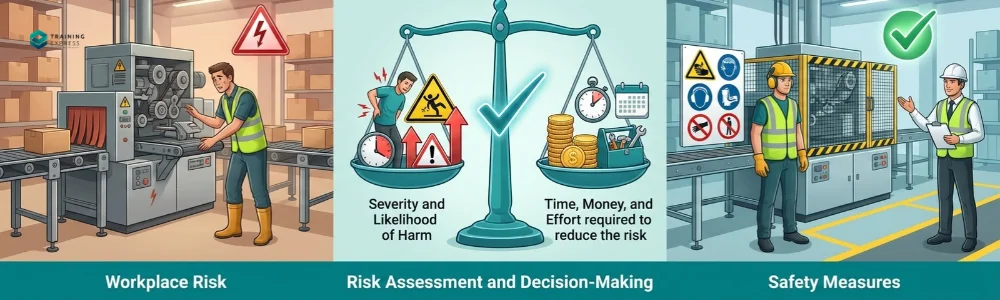
In simple terms, it is a balancing exercise. On one side is the risk: how likely it is that someone will be harmed and how serious the harm could be. On the other side is the sacrifice needed to control it, in money, time and trouble. The more serious the risk, the more an employer is expected to do to control it.
Importantly, the balance is weighted in favour of safety. An employer cannot simply decide that a measure costs slightly more than the benefit it brings. The cost must be grossly out of proportion to the risk before an employer can decide not to take that step.
Where Does the Phrase Come From?
The phrase is used throughout the Health and Safety at Work Act 1974. For example, Section 2 requires every employer to ensure, so far as is reasonably practicable, the health, safety and welfare at work of all their employees. The same wording appears in the duties to people who are not employees (Section 3), people who control premises (Section 4) and manufacturers and suppliers (Section 6).
The way the phrase is interpreted comes from a court case decided before the Act was written: Edwards v National Coal Board (1949). In this case, the Court of Appeal said that “reasonably practicable” is a narrower term than “physically possible”. It explained that the risk should be weighed against the sacrifice needed to avoid it, whether in money, time or trouble. If the sacrifice is grossly disproportionate to the risk, the employer has done what is reasonably practicable.
This test is still used by the courts and by the Health and Safety Executive (HSE) today.
What Is the Difference Between SFAIRP and ALARP?
You may also see the term ALARP, which stands for “as low as reasonably practicable”. HSE explains that SFAIRP and ALARP mean essentially the same thing. Both involve weighing a risk against the trouble, time and money needed to control it.
The main difference is where each term is used. SFAIRP is the wording found in the Health and Safety at Work Act and in regulations, while ALARP is often used by HSE and by people working in higher-risk industries, such as chemicals, energy and nuclear. In everyday use, both phrases describe the same standard.
Absolute, Practicable and Reasonably Practicable Duties
Health and safety law uses different levels of duty, and it helps to understand the difference:
- Absolute duties: these are usually written with words such as “shall” or “must” and no qualification. The duty must be met whatever the cost or difficulty. Some duties in the regulations covering work equipment and electricity are examples of this.
- Practicable duties: the employer must do whatever is technically possible in the light of current knowledge, regardless of cost. This is a higher standard than reasonably practicable.
- Reasonably practicable duties: the employer must take all measures unless the cost, time and effort are grossly disproportionate to the risk.
Most of the general duties in the Health and Safety at Work Act are reasonably practicable duties. However, employers must check the exact wording of any specific regulation that applies to their work, as some duties are stricter.
How Do You Decide What Is Reasonably Practicable?
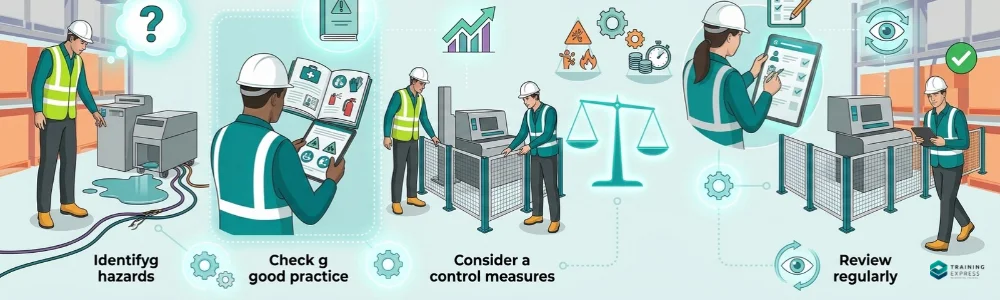
Deciding what is reasonably practicable is part of carrying out a good risk assessment. HSE expects employers to follow a process along these lines:
- Identify the hazard and the risk. Work out what could cause harm, who could be harmed and how serious the harm could be.
- Look at good practice. Check HSE guidance, Approved Codes of Practice and recognised industry standards. Where good practice exists, HSE expects employers to follow it, or to use another approach that is at least as effective.
- Consider what else could be done. Where there is no clear good practice, think about what further measures are possible, starting with removing the risk altogether.
- Weigh the risk against the sacrifice. Compare the reduction in risk with the cost, time and effort of each measure. Put the measure in place unless the sacrifice is grossly disproportionate.
- Record your decisions. Write down what you have done and why, especially where you have decided that a measure is not reasonably practicable.
- Review regularly. What is reasonably practicable can change over time, for example as new equipment becomes cheaper or more widely available.
For most businesses, following recognised good practice is enough. In high-hazard industries, a more formal cost-benefit analysis may be needed.
Examples of "Reasonably Practicable" in the Workplace
The following examples show how the test might work in practice:
- Trailing cables in an office: rerouting cables or using cable covers costs very little and prevents trips. These steps are clearly reasonably practicable.
- Vehicles and pedestrians in a warehouse: marking separate walkways and putting up barriers is well-established good practice. Because people can be seriously injured or killed by forklift trucks, these measures are likely to be expected even where they involve some cost.
- Fragile roof work: falls through fragile roofs can be fatal. Using staging, covers or safety netting is good practice, and the cost is very unlikely to be grossly disproportionate to the risk of death.
- Lifting heavy loads: where workers regularly lift heavy items, providing a trolley, hoist or lifting aid is often reasonably practicable. A small cost can prevent long-term back injuries.
- Noise: handing out ear defenders is cheap, but making sure they are worn may take ongoing supervision. Reducing noise at the source, such as fitting a quieter machine or an enclosure, may be expected where the risk to hearing is high.
- Slippery kitchen floors: cleaning up spills straight away, using suitable cleaning methods and providing slip-resistant footwear are low-cost steps that prevent a very common cause of injury. Fitting a slip-resistant floor during a planned refurbishment may also be reasonably practicable, even if replacing a sound floor right away would not be.
HSE gives a simple illustration of the principle. Spending £1 million to prevent a single worker suffering a minor bruise would be grossly disproportionate. Spending £1 million to prevent a major explosion that could kill 150 people would clearly be proportionate.
Can Cost Be Used as an Excuse?
Cost can be taken into account, but only in a limited way. An employer cannot avoid a safety measure simply because it is inconvenient or because they would prefer not to spend the money. The cost must be grossly disproportionate to the reduction in risk.
The bigger the risk, the more an employer is expected to spend. Where there is a risk of death or serious injury, it will rarely be acceptable to rely on cost as a reason for doing nothing. Being short of money is not a good reason to leave a serious risk uncontrolled.
Who Has to Prove That Something Was Reasonably Practicable?
If a case goes to court, Section 40 of the Health and Safety at Work Act places the burden of proof on the employer. In other words, it is up to the employer to prove that it was not reasonably practicable to do more than they did, rather than up to the prosecution to prove that it was.
This is why records are so important. A clear risk assessment, evidence of following good practice and notes explaining why certain measures were or were not taken can all help an employer to show that they did what was reasonably practicable.
Common Misunderstandings
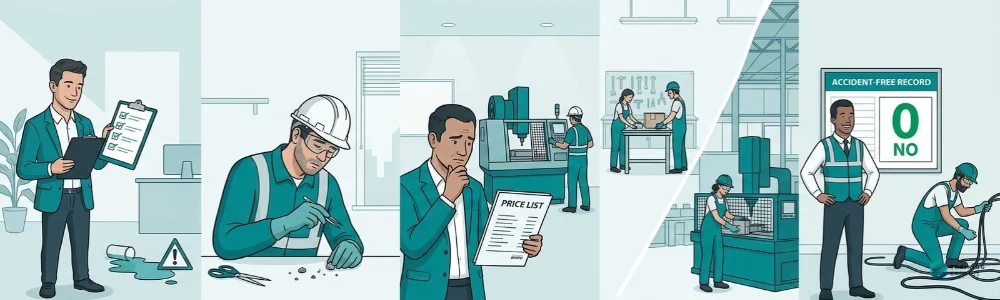
Because the phrase is so widely used, it is often misunderstood. Common misunderstandings include:
- “It means doing your best.” It is an objective test. Doing what you can afford or what seems convenient is not enough.
- “It means removing all risk.” The law does not expect employers to eliminate every risk or prevent every possible accident.
- “It is a simple cost-benefit analysis.” The balance is weighted towards safety. A measure should be taken unless its cost is grossly disproportionate, not just slightly higher than its benefit.
- “Smaller businesses have lower standards.” The test looks at the risk and the measures needed to control it, so the same risk is expected to be controlled to the same standard.
- “If no one has been hurt, the controls must be enough.” A good safety record does not prove that a risk is being controlled properly.
How Can You Show You Have Done What Is Reasonably Practicable?
Employers can show they have met the standard by:
- Carrying out and recording suitable and sufficient risk assessments
- Following HSE guidance, Approved Codes of Practice and recognised industry standards
- Recording the reasons for decisions, especially where a measure has been ruled out
- Consulting employees, who often know the risks of a job best
- Providing training and supervision and keeping records of both
- Reviewing controls after accidents, near misses or changes in the work
Our Introduction to Risk Assessment course explains how to assess risks and decide on sensible controls.
Summary
“So far as is reasonably practicable” is one of the most important phrases in UK health and safety law. It means employers must control risks unless the sacrifice involved in doing so is grossly disproportionate to the risk. The balance is weighted in favour of safety, the bigger the risk the more is expected, and if a case goes to court it is up to the employer to prove they did enough.
We offer a range of courses that help employers and managers assess and control risks, including our Introduction to Risk Assessment, Health and Safety Officer and Advanced Health and Safety courses. You can also browse all of our health and safety courses to find the right training for you and your team.
Frequently Asked Questions (FAQ)
What does SFAIRP stand for?
SFAIRP stands for “so far as is reasonably practicable”. It is the standard used in most of the general duties in the Health and Safety at Work Act 1974.
Is "reasonably practicable" the same as "reasonable and practicable"?
The legal term is “reasonably practicable”. “Reasonable and practicable” is a common way of saying it, but it is not the wording used in the law. The legal test is whether the sacrifice needed to control a risk is grossly disproportionate to the risk
What is the Edwards v National Coal Board case?
Edwards v National Coal Board (1949) is the Court of Appeal case that set out how “reasonably practicable” should be interpreted. It said that the risk must be weighed against the sacrifice needed to avoid it, and that a measure only stops being reasonably practicable if the sacrifice is grossly disproportionate to the risk.
What is the difference between ALARP and SFAIRP?
They mean essentially the same thing. SFAIRP is the wording used in the law, while ALARP, or “as low as reasonably practicable”, is often used by HSE and in higher-risk industries.
Does reasonably practicable mean all risks must be removed?
No. Employers are not expected to remove every risk. They must take all measures to control risks unless the cost, time and effort involved would be grossly disproportionate to the benefit.
Who decides what is reasonably practicable?
The employer must make the first judgement when assessing their risks. If an inspector disagrees, they can take enforcement action, and if a case goes to court, the court will make the final decision based on the evidence, including HSE guidance and recognised good practice.
Can what is reasonably practicable change over time?
Yes. As technology improves and safety equipment becomes cheaper or more widely used, measures that were once grossly disproportionate can become reasonably practicable. This is one reason employers need to review their risk assessments regularly.
Article Reviewed By: Jane Smith, CMIOSH.
Article Written By: Robert Lawrence, Specialices in Health and Safety.