Food Hygiene
 Health & Safety
 Safeguarding
 First Aid
 Business Skills
 Personal Development

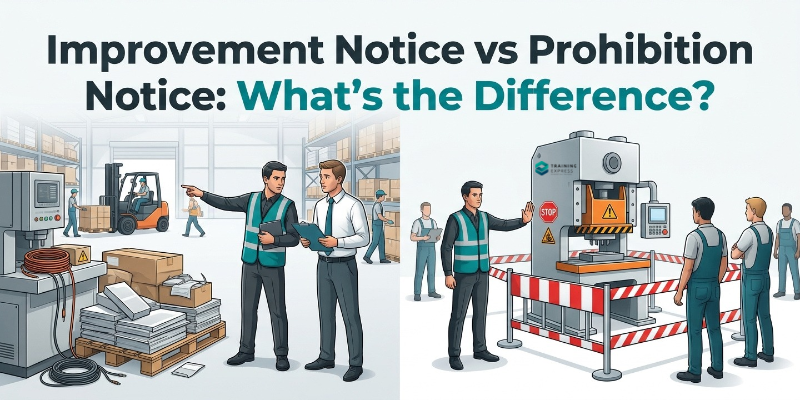

No business wants to receive a visit from a health and safety inspector and be told that something is wrong. But if an inspector finds a serious problem, they have the power to make you put it right, and in some cases to stop work straight away.
The two main tools inspectors use are improvement notices and prohibition notices. Both are legal documents, both must be taken seriously and both can have lasting consequences for a business. However, they are used in different situations and have very different effects.
In this article, we explain the difference between an improvement notice and a prohibition notice, when they are used, what to do if you receive one and how to appeal.
Table of Contents
What Are Health and Safety Enforcement Notices?
Health and safety enforcement notices are formal legal notices that inspectors can serve when they find that health and safety law is being broken, or that an activity creates a risk of serious personal injury. The powers to serve them come from Sections 21 and 22 of the Health and Safety at Work Act 1974.
There are two types of notice:
- Improvement notices, which require a business to put a problem right within a set period of time
- Prohibition notices, which stop a dangerous activity until the risk has been dealt with
Inspectors can serve one or both types of notice, depending on what they find. For example, they may serve a prohibition notice to stop a dangerous activity straight away, and an improvement notice to deal with the underlying failings in the business’s health and safety management.
What Is an Improvement Notice?
An improvement notice is served under Section 21 of the Health and Safety at Work Act. An inspector can serve one if they believe a business is breaking health and safety law, or has broken it in a way that is likely to continue or happen again.
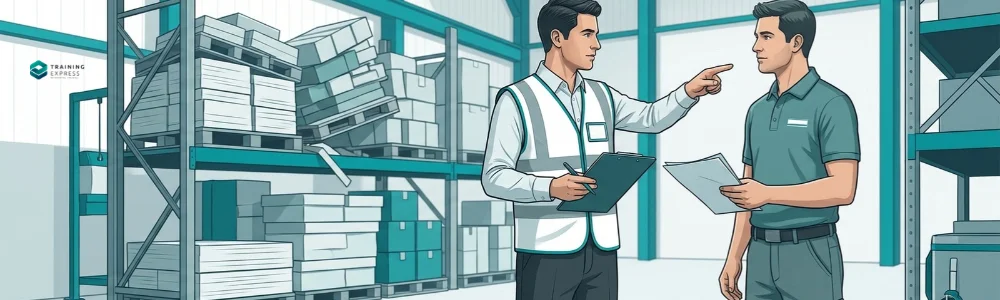
An improvement notice must:
- State the inspector’s opinion that the law is being, or has been, broken
- Name the law that the inspector believes has been broken
- Explain the reasons for the inspector’s opinion
- Require the business to put the problem right
- Give a date by which the problem must be fixed
The period given to comply must be at least 21 days, which is the same as the time allowed to appeal. The work can usually carry on while the improvements are being made. Common examples include notices requiring a business to carry out a proper risk assessment, provide training, put a health and safety policy in place, or service equipment that has not been maintained.
What Is a Prohibition Notice?
A prohibition notice is served under Section 22 of the Health and Safety at Work Act. An inspector can serve one if they believe that an activity is being carried on, or is likely to be carried on, in a way that involves a risk of serious personal injury.
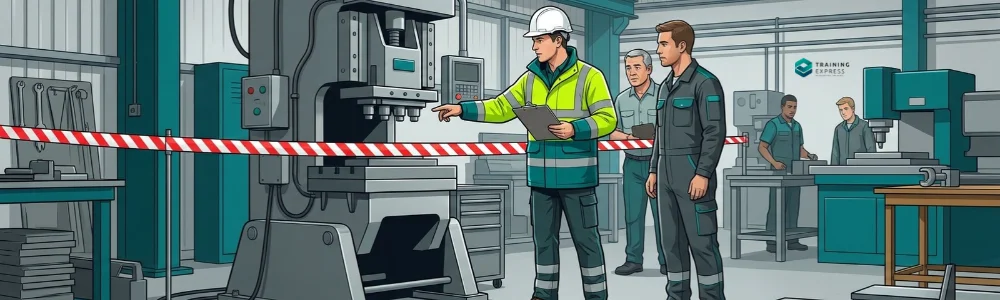
A prohibition notice orders that the activity must not continue until the matters causing the risk have been dealt with. Unlike an improvement notice, it does not have to be based on a breach of the law. The inspector only needs to believe that there is a risk of serious personal injury.
A prohibition notice can take effect in one of two ways:
- Immediately, which is the most common, where the risk needs to be controlled straight away
- Deferred, where stopping the activity immediately would create other risks, for example by interrupting a process halfway through. In this case, the notice takes effect at the end of a set period
Common examples include notices stopping work at height without proper edge protection, the use of a machine with a missing guard, or work in a trench that has not been properly supported.
Improvement Notice vs Prohibition Notice: Key Differences
The table below sets out the main differences between the two types of notice:
| Comparison | Improvement Notice | Prohibition Notice |
|---|---|---|
| Legal Basis | Section 21 of the Health and Safety at Work Act. | Section 22 of the Health and Safety at Work Act. |
| When It Is Used | The law is being, or has been, broken. | An activity involves a risk of serious personal injury. |
| Does There Need to Be a Breach of the Law? | Yes. | No. |
| Can Work Continue? | Usually, while the problem is fixed. | No, the activity must stop. |
| When It Takes Effect | At the end of the compliance period, at least 21 days. | Immediately, or at the end of a set period if deferred. |
| Effect of an Appeal | The notice is suspended until the appeal is decided. | The notice stays in force unless the tribunal decides to suspend it. |
Who Can Issue an Improvement or Prohibition Notice?
Improvement and prohibition notices under the Health and Safety at Work Act can be served by inspectors from the Health and Safety Executive (HSE) and by local authority inspectors, usually Environmental Health Officers. HSE covers higher-risk workplaces such as construction sites, factories and farms, while local authorities cover workplaces such as offices, shops, warehouses, restaurants and leisure centres.
Other types of enforcement notice exist under different laws. For example, fire and rescue authorities can serve fire safety enforcement and prohibition notices, and local authorities can serve hygiene improvement notices in food businesses. These follow their own rules and are not covered in this article.
How Do Inspectors Decide What Action to Take?
Inspectors do not serve a notice every time they find a problem. HSE uses a framework called the Enforcement Management Model to help inspectors decide what action is proportionate to the risk and the seriousness of the breach.
Depending on what they find, an inspector may:
- Give verbal or written advice
- Send a letter, known as a notification of contravention, setting out what the law requires and what needs to be done
- Serve an improvement notice
- Serve a prohibition notice
- Recommend a prosecution in the most serious cases
What Should You Do If You Receive a Notice?
If you receive an improvement or prohibition notice, it is important to act quickly. The following steps will help:
- Read the notice carefully. Check what the inspector says is wrong, which law they believe has been broken and the date by which you must act.
- Stop any prohibited activity immediately. If you have received a prohibition notice, make sure the activity stops and that everyone involved knows not to continue.
- Note the appeal deadline. You have 21 days from the date the notice was served to appeal.
- Get advice if you need it. Speak to your competent person, a health and safety adviser or a solicitor if you are unsure what the notice means or whether to appeal.
- Plan the work needed to comply. Decide what needs to be done, who will do it and by when.
- Keep records. Keep evidence of the work you carry out, such as updated risk assessments, training records, invoices and photographs.
- Contact the inspector. If you need more time to comply, contact the inspector before the deadline. They may agree to extend the compliance period if you can show good reason.
- Look at the wider picture. Check whether the same problem exists elsewhere in your business, and fix it before it leads to another notice.
Can You Appeal an Improvement or Prohibition Notice?
Yes. Both types of notice can be appealed to an employment tribunal. The appeal must normally be made within 21 days of the date the notice was served. A late appeal will only be accepted if the tribunal is satisfied that it was not reasonably practicable to appeal in time.
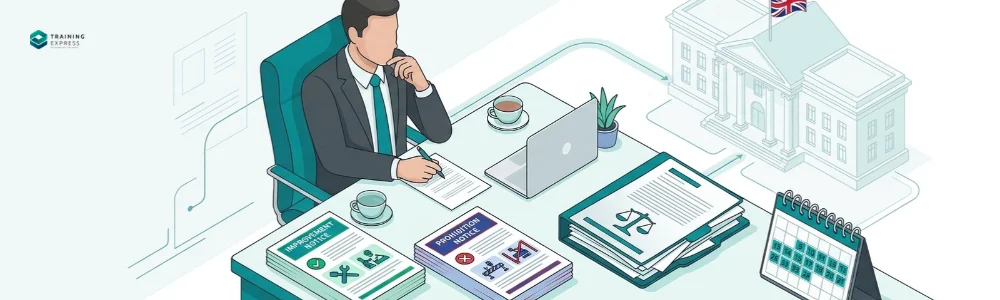
The effect of an appeal is different for each type of notice:
- Improvement notice: making an appeal suspends the notice until the appeal is decided or withdrawn
- Prohibition notice: making an appeal does not suspend the notice. The activity must stay stopped unless you ask the tribunal to suspend the notice and it agrees
The tribunal can cancel the notice, confirm it, or confirm it with changes, such as giving more time to comply. Businesses often appeal where they believe the inspector has got the facts or the law wrong, or where the time allowed to comply is not long enough.
What Happens If You Ignore a Notice?
Failing to comply with an improvement or prohibition notice is a criminal offence under Section 33 of the Health and Safety at Work Act. A business that ignores a notice can be prosecuted, and the courts can impose an unlimited fine. Individuals can also face prison sentences in the most serious cases.
Directors and managers can be prosecuted personally if a company commits an offence with their consent or connivance, or because of their neglect. Ignoring a notice is also likely to lead to further enforcement action and closer attention from inspectors in the future.
Are Enforcement Notices Made Public?
Yes. HSE publishes the improvement and prohibition notices it serves on a public register on its website. Notices are added five weeks after they are served and stay on the register for five years. Many local authorities also publish the notices they serve.
This means customers, insurers and other organisations can see if a business has received a notice. A notice can affect insurance premiums, applications for safety accreditation schemes and the chances of winning contracts, particularly in sectors such as construction.
How Much Does an HSE Visit Cost?
If HSE finds a material breach of health and safety law, it can charge the business a Fee for Intervention (FFI) to recover the cost of its time. A material breach is one serious enough for the inspector to write to the business formally requiring action, such as a notification of contravention or an enforcement notice.
The fee is based on the time HSE spends identifying the problem and helping to put it right, including time on site, writing reports and any follow-up work. The current rate is £188 an hour. Businesses that are complying with the law pay nothing.
How Can You Avoid Enforcement Notices?
The best way to avoid enforcement notices is to manage health and safety properly before an inspector visits. Employers should:
- Carry out suitable and sufficient risk assessments and review them regularly
- Have a written health and safety policy if they employ five or more people
- Maintain equipment, machinery and the workplace in good condition
- Provide information, instruction, training and supervision for employees
- Consult employees and act on their concerns
- Keep records of inspections, maintenance and training
- Check that the controls in place are actually being followed
Our Introduction to Risk Assessment course is a good place to start for anyone responsible for managing risks at work.
Summary
Improvement notices and prohibition notices are two of the most important powers health and safety inspectors have. An improvement notice requires a business to fix a breach of the law within at least 21 days, while a prohibition notice stops a dangerous activity until the risk is controlled. Both can be appealed to an employment tribunal within 21 days, and ignoring either is a criminal offence.
We offer a range of courses that help businesses manage health and safety and stay compliant, including our Health and Safety Officer, Health and Safety Level 2 and Introduction to Risk Assessment courses. You can also browse all of our health and safety courses to find the right training for you and your team.
Frequently Asked Questions (FAQ)
What is the main difference between an improvement notice and a prohibition notice?
An improvement notice requires a business to fix a breach of health and safety law within a set time, and work can usually continue in the meantime. A prohibition notice stops an activity that involves a risk of serious personal injury until the risk has been dealt with.
How long do you have to comply with an improvement notice?
The time allowed must be at least 21 days. The exact date will be stated on the notice and depends on the work needed to put the problem right.
Can a prohibition notice be issued without a breach of the law?
Yes. An inspector only needs to believe that an activity involves a risk of serious personal injury. A breach of the law does not have to be proved.
Can a notice be served on an individual?
Yes. Notices are usually served on the employer, but they can also be served on the person in control of the activity, such as a self-employed contractor or an employee in charge of a process.
How long does a notice stay on the HSE public register?
Notices are published five weeks after they are served and stay on HSE’s public register for five years.
What is a Crown notice?
Crown bodies, such as some government departments, cannot be served with statutory improvement or prohibition notices. Instead, HSE issues non-statutory Crown notices, which cannot be appealed to an employment tribunal.
Article Reviewed By: Jane Smith, CMIOSH.
Article Written By: Robert Lawrence, Specialices in Health and Safety.