Food Hygiene
 Health & Safety
 Safeguarding
 First Aid
 Business Skills
 Personal Development
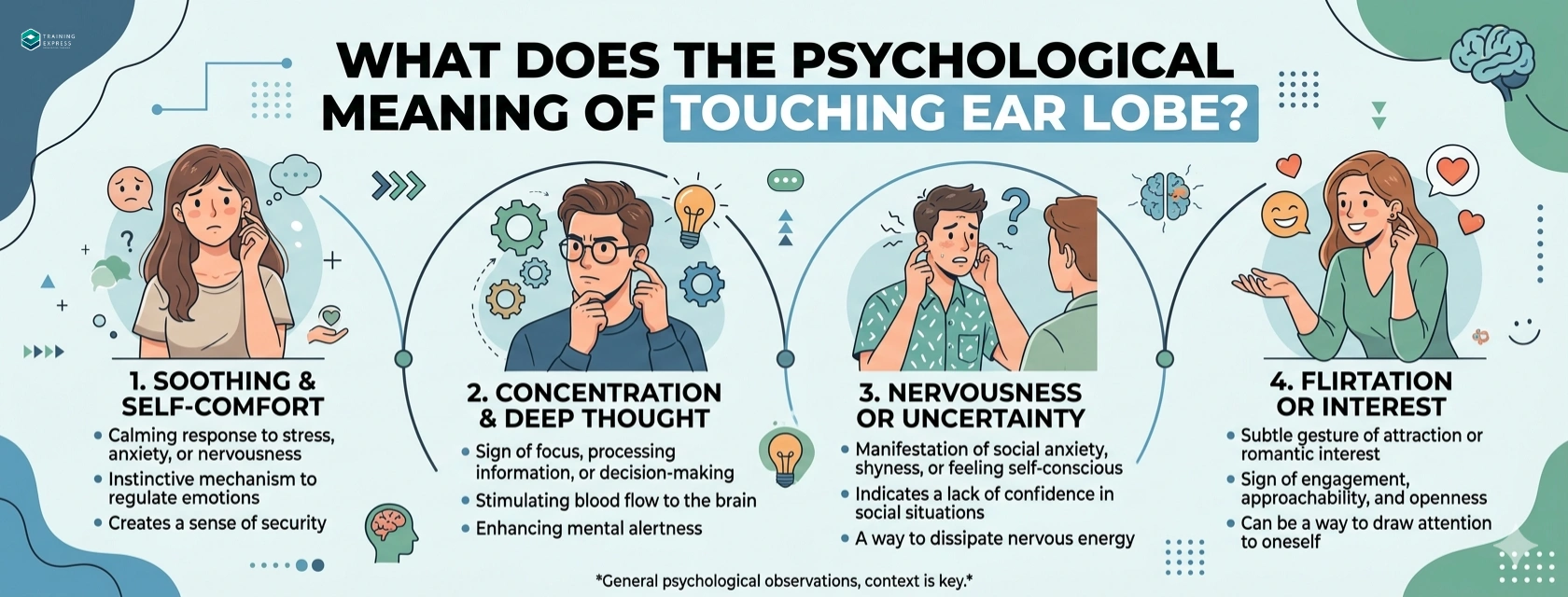

Have you ever noticed someone touching or pulling their earlobe during a conversation and wondered what it means? Small body language cues often reveal more than words, which is why gestures like ear touching attract so much attention.
The psychological meaning of touching the earlobe is commonly linked to stress, anxiety, uncertainty, self-soothing, or deep concentration. However, there is no single explanation for this behaviour. Its meaning depends on the situation, the person’s habits, and other body language signals they display.
In this guide, we’ll explore why people touch their earlobes, what psychologists and body language experts say about the gesture, and how to interpret it accurately in different communication settings.
Table of Contents
What Is Earlobe Touching in Body Language?
Earlobe touching is a non-verbal gesture in which a person touches, rubs, pulls, or holds their earlobe during a conversation or activity. Body language experts often classify it as a self-adaptor behaviour, meaning it may help individuals manage emotions, relieve tension, or focus their attention. While the gesture is commonly associated with stress and uncertainty, its meaning can vary depending on the situation and the individual displaying it.
What Does Touching the Earlobe Mean?
The psychological meaning of touching the earlobe is often connected to a person’s emotions, comfort level, or mental state at a specific moment. Unlike intentional gestures, ear-touching is usually an unconscious habit that people may do without noticing.
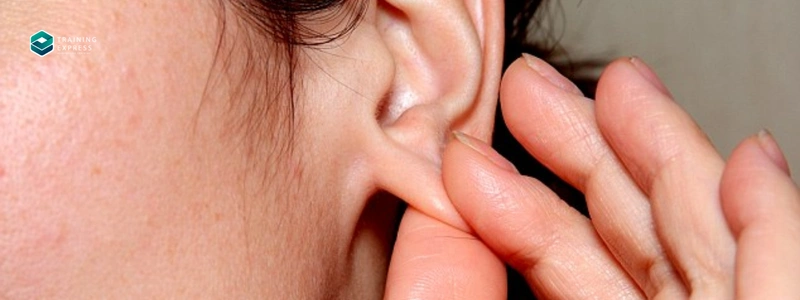
Body language experts often describe ear-touching as a self-adaptor behaviour — a small action people use to comfort themselves, reduce tension, or manage nervous energy. Similar behaviours include:
- Rubbing the neck
- Playing with jewellery
- Touching the face
- Tapping fingers
However, touching the earlobe does not always mean someone is nervous, dishonest, or uncomfortable. Body language should always be understood in context, as one gesture alone cannot accurately explain a person’s feelings or intentions.
Why Do People Touch Their Earlobes? The Psychology Explained
There are several psychological reasons why people touch their earlobes. Understanding these reasons can help you interpret the gesture more accurately during conversations and social interactions.
Stress and Anxiety
One of the most common explanations for earlobe touching is stress or anxiety. When people feel nervous, the body often seeks ways to release tension. Touching the earlobe can provide a calming sensation because the area contains many nerve endings that respond to gentle stimulation.
For example, someone waiting for an interview, delivering a presentation, or answering a difficult question may unconsciously touch their ear as a way of managing nervous feelings.

Self-Soothing Behaviour
Psychologists often describe ear-touching as a self-soothing behaviour. Self-soothing actions help people regulate their emotions when they feel overwhelmed, uncertain, or under pressure.
This behaviour is not limited to stressful situations. People may also touch their earlobes when they are tired, emotionally drained, or trying to remain calm during a challenging conversation. The gesture can act as a subtle source of comfort, similar to taking a deep breath or clasping one’s hands.
Uncertainty and Indecision
Have you ever seen someone touch their ear while deciding between two options? This gesture sometimes appears when a person is uncertain or struggling to make a decision.
The mind may be weighing different possibilities, and the physical act of touching the earlobe can occur as part of this internal thought process. In business meetings, negotiations, or discussions involving important decisions, ear-touching may indicate hesitation rather than confidence.
Discomfort in Social Situations
People occasionally touch their earlobes when they feel uncomfortable or awkward. This discomfort may stem from criticism, disagreement, embarrassment, or a topic they would rather avoid.
For instance, if a conversation becomes emotionally charged, an individual may begin touching their ear while trying to process what is being said. In these situations, the gesture can signal a desire to reduce emotional tension.

Deep Thinking and Concentration
Not every ear-touching gesture is linked to stress. Some people touch their earlobes while concentrating intensely on a problem or analysing information.
Students solving difficult questions, professionals evaluating options, or individuals listening carefully during a discussion may display this behaviour as part of their thinking process. In these cases, the gesture reflects cognitive effort rather than emotional discomfort.
Habitual Behaviour
Sometimes, touching the earlobe has no psychological meaning at all. Many people develop habits that involve touching their face, hair, ears, or hands without any connection to their emotions.
This is why body language experts emphasise the importance of establishing a person’s baseline behaviour. If someone frequently touches their earlobes throughout the day, the gesture may simply be a personal habit rather than a meaningful body language signal.
Does Touching the Earlobe Mean Someone Is Lying?
Many people believe that touching the earlobe is a sign someone is lying, but this is not always true. Body language can provide clues about a person’s emotions, but no single gesture can prove dishonesty.

Ear-touching may happen for many reasons, such as feeling nervous, uncomfortable, stressed, or simply thinking about what to say. A person can show these behaviours while telling the truth, just as someone can lie without showing obvious signs.
Common reasons someone may touch their ear include:
- Feeling anxious or under pressure
- Trying to calm themselves during a conversation
- Feeling uncertain or uncomfortable
- Processing information or thinking carefully
Rather than focusing on one action, experts suggest looking at a combination of body language signals, such as changes in voice, facial expressions, posture, and overall behaviour. In most cases, touching the earlobe says more about a person’s emotional state than whether they are being dishonest.
Touching the Earlobe in Different Communication Situations
The meaning of touching the earlobe can vary depending on the situation. Understanding the context can help prevent misinterpretations and provide a more accurate picture of what someone may be experiencing.
During a Conversation
In everyday conversations, touching the earlobe may indicate that a person is carefully considering what they hear or thinking about how to respond. It can also appear when someone feels uncertain about a topic or disagrees with something but has not yet expressed their opinion.
If the gesture occurs occasionally and naturally, it is usually not a cause for concern. However, repeated ear-touching during specific parts of a conversation may suggest emotional engagement with the topic being discussed.
During a Job Interview
Job interviews often create pressure, even for highly qualified candidates. As a result, interviewees may display self-soothing behaviours, including touching their earlobes, adjusting clothing, or clasping their hands.

In this context, ear-touching is often linked to nervousness rather than a lack of competence. A candidate who briefly touches their ear while answering a challenging question may simply be managing stress or taking time to think through their response.
Interviewers should therefore avoid making assumptions based on a single body language cue and instead focus on the overall quality of the candidate’s communication.
Read Now: What is Effective communication in health and social care?
During Public Speaking
Public speaking is one of the most common situations associated with anxiety. Speakers who feel pressure from being observed by an audience may unconsciously touch their ears, face, or hair while presenting.
This behaviour can occur before speaking, during difficult sections of a presentation, or when responding to unexpected questions. In many cases, it serves as a subtle way of releasing tension and maintaining emotional control.
During Conflict or Disagreement
When conversations become tense, people often display more noticeable body language signals. Touching the earlobe during an argument or disagreement may indicate discomfort, emotional strain, or a desire to avoid confrontation.

For example, a person receiving criticism may touch their ear while processing the information. Similarly, someone who disagrees with a statement but feels reluctant to challenge it may display ear-touching behaviours while deciding how to respond.
Rather than interpreting the gesture as a sign of guilt or dishonesty, it is usually more accurate to view it as a reaction to emotional pressure within the conversation.
During Important Decision-Making
People frequently touch their earlobes when weighing options or making important decisions. Whether choosing between job offers, evaluating business proposals, or considering personal choices, the gesture may appear as part of a broader thinking process.
In these situations, ear-touching often reflects concentration and internal evaluation rather than anxiety. The individual may simply be focused on analysing information before reaching a conclusion.
Other Ear-Related Body Language Signals
Touching the earlobe is only one of several ear-related gestures that can provide insight into a person’s emotional state. Observing these signals alongside other body language cues can help create a more accurate interpretation.
Pulling the Earlobe
Pulling or tugging the earlobe is commonly associated with uncertainty, hesitation, or internal conflict. Some people perform this gesture when they are struggling to make a decision or feeling pressure to respond quickly.

The action may also function as a self-soothing behaviour, helping the individual manage tension during stressful situations.
Rubbing the Ear
Rubbing the outer ear or the area around it can sometimes suggest discomfort, frustration, or mental fatigue. It may appear when someone has been listening for an extended period or is finding a conversation difficult to process.
In certain situations, ear rubbing can indicate a desire for a break from information overload.
Scratching Behind the Ear
This gesture is often linked to uncertainty or confusion. A person may scratch behind their ear when they do not fully understand something or are trying to make sense of conflicting information.
However, it can also be a simple physical response to an itch, highlighting the importance of considering context before assigning meaning.
Covering the Ear
Covering or partially blocking the ear can sometimes signal resistance to information. The gesture may occur when someone hears something upsetting, shocking, or difficult to accept.
Children often display this behaviour openly, while adults tend to show more subtle versions, such as briefly touching the ear or adjusting it while listening.
Tucking Hair Behind the Ear
Although commonly seen as a grooming behaviour, tucking hair behind the ear can also have communication-related meanings. It may indicate attentiveness, self-presentation, or a desire to maintain eye contact during a conversation.
The meaning often depends on the wider context, including the person’s emotional state and the nature of the interaction.
How to Interpret Earlobe Touching Correctly
One of the biggest mistakes people make when analysing body language is assigning a fixed meaning to a single gesture. While touching the earlobe can provide useful clues about a person’s emotional state, it should never be viewed in isolation.
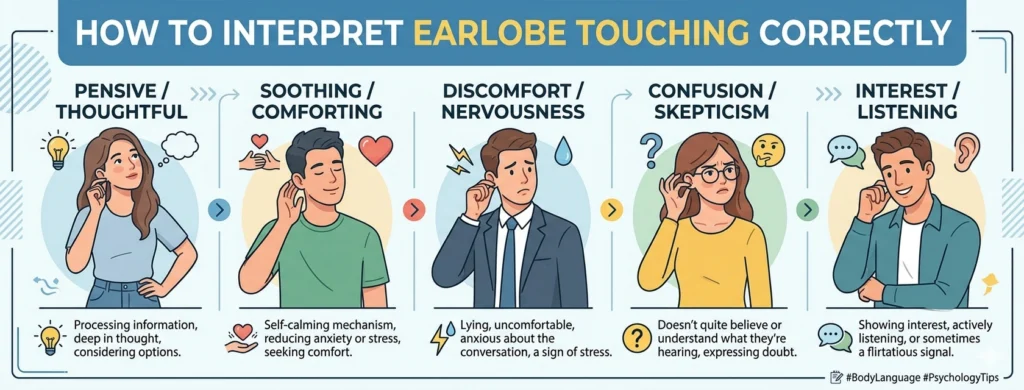
Professional communicators, psychologists, and body language experts generally recommend looking at clusters of behaviours rather than individual actions. For example, if someone touches their earlobe while maintaining relaxed posture, steady eye contact, and a calm tone of voice, the gesture may simply be a habit. On the other hand, if ear-touching occurs alongside fidgeting, tense facial expressions, crossed arms, or visible signs of discomfort, it may indicate stress or uncertainty.
To interpret ear-touching more accurately, consider the following factors:
Consider the Context
The same gesture can have different meanings depending on the situation. A person touching their earlobe during a job interview may be experiencing nervousness, while someone displaying the same behaviour during a casual conversation may simply be concentrating.
Look for Repeated Behaviour
A single touch may not be meaningful. However, repeated ear-touching during specific topics or questions can sometimes indicate emotional significance.
Observe Other Body Language Signals
Facial expressions, posture, hand movements, and eye contact often provide valuable supporting information. The more signals you observe together, the more reliable your interpretation becomes.
Establish a Baseline
Everyone has unique habits and mannerisms. Some people naturally touch their face, hair, or ears more frequently than others. Understanding a person’s normal behaviour helps distinguish meaningful changes from everyday habits.
Common Myths About Earlobe Touching
Body language is often misunderstood because many popular myths oversimplify human behaviour. Here are some common misconceptions about touching the earlobe.
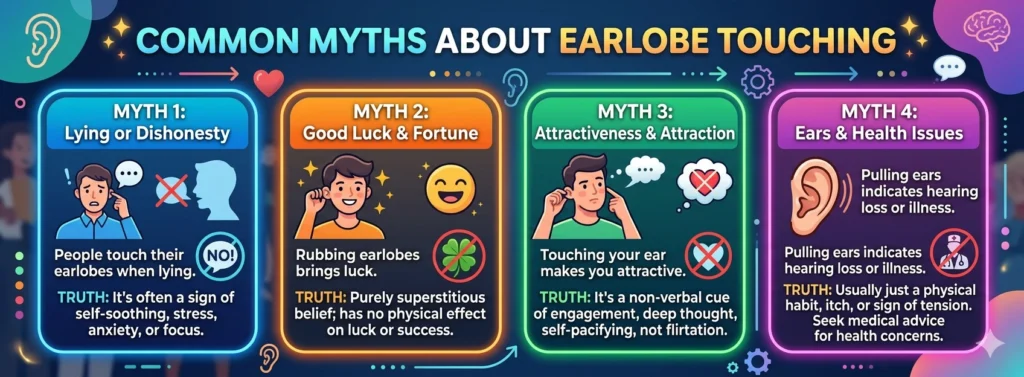
Myth 1: Touching the Earlobe Always Means Someone Is Lying
This is perhaps the most widespread misconception. While a person may touch their ear when feeling nervous about what they are saying, the gesture alone cannot determine whether someone is being truthful or deceptive.
There is no universally reliable body language signal that proves dishonesty.
Myth 2: Ear Touching Always Indicates Anxiety
Although anxiety is a common explanation, people may also touch their earlobes when thinking, listening carefully, making decisions, or simply following a long-standing habit.
Myth 3: Every Gesture Has a Single Meaning
Human communication is highly complex. The same behaviour can have multiple interpretations depending on the individual, the environment, and the circumstances.
Myth 4: Body Language Can Be Read Like a Secret Code
Many people assume body language provides straightforward answers about what someone is thinking. In reality, body language offers clues rather than certainty. Effective interpretation requires observation, context, and critical thinking.
What Body Language Experts Say About Ear Touching
Body language researchers generally agree that ear-touching is most useful when viewed as part of a broader behavioural pattern. Rather than focusing solely on the gesture itself, experts examine what happens before, during, and after the behaviour occurs.
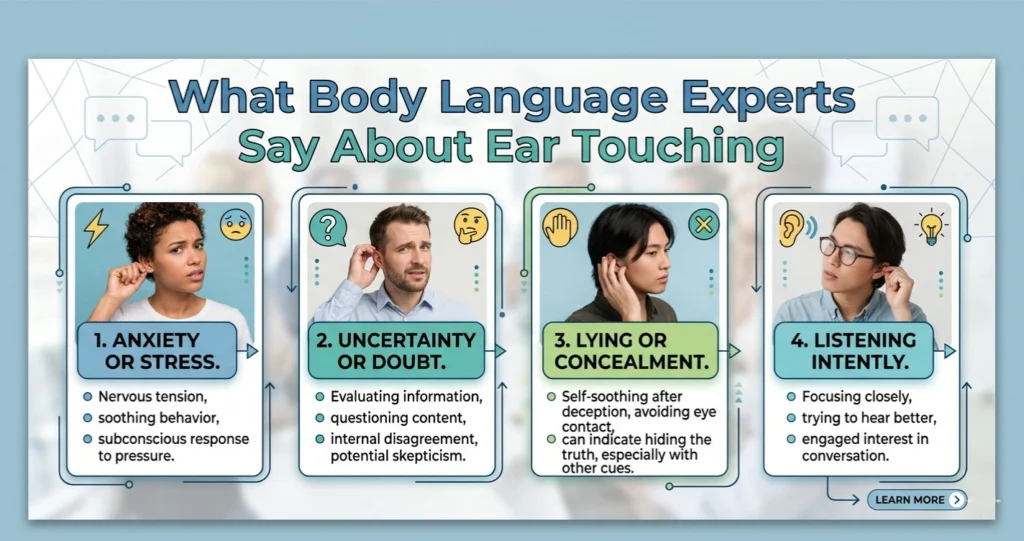
Ear-touching is frequently classified as a self-comforting or self-regulating action. Similar behaviours include rubbing the neck, touching the face, adjusting clothing, or clasping the hands. These actions often emerge when people experience emotional arousal, uncertainty, or cognitive effort.
Experts also caution against making immediate judgments. For example, touching the earlobe during a difficult question does not automatically mean the person is uncomfortable with the topic. They may simply be concentrating, recalling information, or managing the pressure of being observed.
Ultimately, body language analysis is most effective when used to improve understanding rather than make assumptions. Observing patterns can help people become better communicators, listeners, and relationship-builders.
Why Understanding Earlobe Touching Can Improve Communication
Understanding the psychological meaning of touching the earlobe is not about trying to “read minds.” Instead, it can help you become more aware of the emotions and reactions that people may not express verbally.
In many situations, ear-touching can indicate stress, uncertainty, discomfort, or deep thought. Recognising these subtle cues may help you adjust your communication style, ask clarifying questions, or provide reassurance when needed. This can be particularly useful in workplaces, interviews, negotiations, and personal conversations.

However, it is important to avoid making assumptions based on a single gesture. Effective communication involves considering multiple verbal and non-verbal signals together. Facial expressions, posture, eye contact, tone of voice, and gestures often provide a more complete picture of how someone feels.
Developing a better understanding of body language in communication can improve active listening, strengthen interpersonal relationships, and help you respond more effectively to others in both professional and social settings.
Final Words
The psychological meaning of touching the earlobe can vary widely depending on the person and the situation. In many cases, the gesture is associated with stress, anxiety, uncertainty, self-soothing, concentration, or emotional processing. However, it can also be a harmless habit with little psychological significance.
Rather than treating ear-touching as a definitive sign of a particular emotion or intention, it is more helpful to view it as one piece of a larger communication puzzle. Context, facial expressions, posture, tone of voice, and other body language signals all contribute to a more accurate interpretation.
By understanding the potential meanings behind this common gesture, you can develop greater awareness of non-verbal communication and improve your ability to interpret human behaviour in social, personal, and professional settings.
Frequently Asked Questions (FAQ)
Is touching the earlobe a sign of anxiety?
Touching the earlobe can sometimes be associated with anxiety because it may function as a self-soothing behaviour. However, it does not always indicate anxiety and should be interpreted within the wider context of the situation.
Why do people pull their earlobes while talking?
People may pull their earlobes while talking when they feel uncertain, nervous, stressed, or deep in thought. In some cases, the behaviour is simply habitual and carries no particular psychological meaning.
What does touching your ear mean in body language?
In body language, touching the ear may suggest discomfort, concentration, hesitation, emotional processing, or self-soothing. The meaning varies depending on accompanying gestures and the surrounding circumstances.
Does touching the earlobe mean someone is lying?
No. Touching the earlobe is not a reliable indicator of deception. While some people may display this behaviour when feeling nervous, body language experts caution against using a single gesture to determine whether someone is lying.
What is self-soothing body language?
Self-soothing body language refers to behaviours people use to comfort themselves during stressful or emotionally challenging situations. Examples include touching the earlobe, rubbing the neck, clasping the hands, or playing with jewellery.
Why do I touch my earlobe when thinking?
Many people unconsciously touch their earlobes while concentrating or making decisions. The gesture may help regulate attention, release tension, or provide sensory comfort during cognitive tasks.
Is touching the ear a nervous habit?
For some individuals, ear-touching becomes a nervous habit that appears during stressful situations. For others, it may simply be part of their normal behaviour and have no connection to nervousness.
Can body language reveal what someone is thinking?
Body language can provide clues about emotions and reactions, but it cannot reveal a person’s exact thoughts. The most accurate interpretations come from considering multiple verbal and non-verbal signals together.
Why do people touch their ears when nervous?
People often touch their ears when nervous because it can act as a self-soothing behaviour. Similar to rubbing the neck, clasping the hands, or touching the face, ear-touching may help reduce stress and provide comfort during situations that create anxiety or pressure.
Is touching the ear a sign of stress?
Touching the ear can be a sign of stress, particularly when it occurs alongside other body language signals such as fidgeting, avoiding eye contact, or changes in posture. However, stress is not the only explanation, as some people touch their ears out of habit or while concentrating.
What does touching your earlobe while talking mean?
Touching the earlobe while talking may indicate uncertainty, nervousness, deep thought, or emotional processing. In some cases, it can simply be a habitual gesture. The meaning is best understood by considering the wider context of the conversation and other body language cues.
Is ear-touching a form of non-verbal communication?
Yes. Ear-touching is considered a form of non-verbal communication because it can provide clues about a person’s emotional state, comfort level, or thought process. However, it should not be interpreted in isolation, as body language is influenced by many factors.

Robert Lawrence
Author | Specialises in Health & Social Care
Robert Lawrence is an e-learning specialist and tutor at Training Express, with experience creating practical resources and strategies to support learners and enhance their professional development.