Food Hygiene
 Health & Safety
 Safeguarding
 First Aid
 Business Skills
 Personal Development


Have you ever noticed how much you are saying to people even after you are not speaking? Unless you are a master at impersonating, you are constantly sending messages regarding your actual thoughts and feelings whether you are using words or not. Therefore, you should be careful about your body language in communication and follow other body languages also.
Reading people’s body language is not rocket science. According to Wikipedia, ‘Body language is a type of non-verbal communication in which physical behaviours, as opposed to words, are used to express or convey the information’. The signal people send while talking to other people could be intentional or unintentional, also might be positive or negative.
Table of Contents
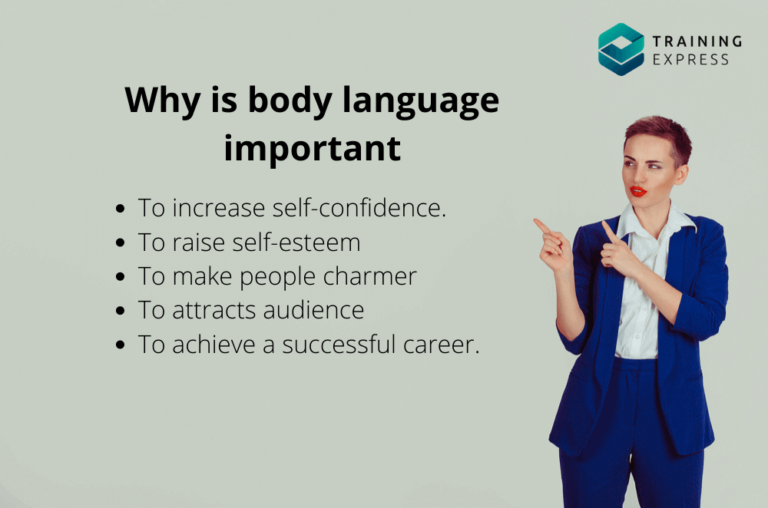
Why is body language so important?
Figuring out body language is both an art and a science and there is no set formula to interpret this language. If you want to know how much your audience is following your speech – whether it can be your classroom, in church, meeting, or family gatherings, the only way to know is to look at them. By looking at people, you can feel them or sense them how responsive they are towards your speech.
In 1967, Dr Mehrabian and Ferris have done the most efficient research projects on non-verbal communication. According to their studies, your words account for only 7% of the message you convey and the remaining 93% is non-verbal. Among this 93%, 55% of communication is based on what people see and the other 38% is transmitted through tone of voice. So, in your spare time just think about your body language.
When you are conversing with people, they can observe and find out what you are not saying just simply following your body language, whether in a business setting or not. You are wasting your time if your non-verbal communication doesn’t tone with your words. This means that you should give more attention to ‘how to say’ than ‘what to say’. However, you shouldn’t neglect anything, since both are required to have a successful career in your respective fields.
Who should have a deep understanding of body language?
You can set “how others see you” depending on your body language, in both a negative and positive light. Body language knowledge can apply to anyone who wants to gain essential non-verbal skills to communicate effectively in the workplace or other aspect of life. It is ideal for those who work in the following professions:
- Sales Executive
- HR Manager
- Secretary
- Personal Assistant
- Customer service Representative
How to Read Body Language
The first step for being the most effective communicator is creating a solid foundation on body language knowledge. How many times, you have given a presentation or interview and thought, “I have no idea how that went?” While giving a lecture, presentation or interview, there are signs everywhere that you can find out how the resonating is going, and make adjustments easily where needed if you know what to look for in the audience.
Here are some non-verbal signals that will help you “read” the room when communicating and conversing:
Let’s start with the head movements.
1. Head movements
When people are talking, you should follow a person’s head movements carefully. Because you can learn a lot about their emotional state and character if you follow their head movement. Here are some signals of body language for head movements while communicating:
- Nodding indicates that you are agreeing with someone or something, usually in the same rhythm.
- It means NO or disapproval when you shake your head sideways. For instance, you are saying and agreeing on something, but while speaking you unintentionally shake the head sideways
- Lip pursuing accompanied by head-nodding suggests disagreement.
- Slowly moving your head suggests that the person likes your speech and wants you to continue the speech.
- If they are nodding their head quickly, this might signal that they are not convinced of what you are saying and want you to finish what you are saying so that they can express their view or leave.
- Spontaneously sweat suggests they are under high stress, for instance, before attending an interview or giving a speech in front of a mass audience.
- Head tilt sideways means that they like what you are saying and interested in your speech. On the other hand, if they move their head backwards, which means that they didn’t like and believe what you are saying.
2. Hair
Our hair indicates so many signals when it comes to non-verbal communication. Hair attracts, entices, conforms, repels, or shocks. It can even communicate something about our careers; as renowned anthropologist David Givens puts it, hair often serves as an “unofficial résumé,” revealing where one ranks in an organization. The common gesture with are :
- Playing with our hair (twirling, twisting, stroking) suggests that good mood (when reading or relaxing), or stress (for instance, in an interview, or an unsmooth flight).
- Ladies play with their hair with the palm facing out to suggest that they're comfy, content and feeling positive around others.
- On a date, if a woman shows the bottom of our wrists suggests that they are comfortable or at ease.
3. The Eyes
The eyes square measure is typically said as “the windows to the soul”. It’s simple to fake a smile, our eyes tend to give away how we are feeling. Watch someone’s eyes when you are communicating with them. Are they making enough eye contact, or do they avert their gaze during the conversation? How are their pupils? Is he/she blinking a lot?
We can easily find out when someone is listening and actively paying attention by simply following their eye contact.
- Maintaining eye contact during oral communication suggests interested and constantly paying attention to what you are saying.
- If eye contact is accompanied with other body language signals suggest intimidation.
- Eye Avoidance suggests that they don’t want to speak to somebody or feel comfortable. People often look down during a conversation when they are nervous or guilty.
- When someone blinks a lot, it signals that they are either uncomfortable or stressed. The high rate of blinking and also touching the face (especially the eyes and mouth) are a strong indication of lying.
- Pupils' dilation suggests that they like something or are interested or comfy around them. It can also be a sign of arousal.
- Our pupils constrict when people face something they don't like or have a negative feeling towards it.
- Gaze direction Often indicates a person's desire or need for something. When we like something or find someone interesting, we can’t look away.
- Eye blocking tends to recommend how one-person real feelings concerning you or the topic when you are talking with them since it happens unconsciously. It can positive or negative.
4. The Ears
Our ears not only help us collect information from sound waves but also have other uses which you may not think before, is to help us find significant body language during oral communication. Here are some more specific signals to watch for:
- Earlobe pulling or massaging the ear indicates the signals that they are under stress. People often pull their ears because it helps them relax.
- Sudden, noticeable flushing of the ear skin, like different parts of the body (face, neck) suggest fear or anxiety. The colour of our skin in our ear changed to pink, red, or purple. Sometimes the ear skin feels hot when you are touching it.
- Active listening suggests the signals that we have an interest, or receptive, or empathy towards the speech.
5. The Nose
The body language related to the nose are:
- People often cover their nose with both hands when they hear or feel something unpleasant, or related to negative emotion. We witness this type of behaviour when a tragic event occurs such as vehicle accidents, natural disasters and also someone receives horrifying news.
- Nose wrinkling (upward) suggests unlikeliness or disgust and skin contracts together along with the underlying muscle called ‘the nasalis’ and it is highly sensitive to negative emotion.
- Index finger to nose suggests the person is preoccupied or concerned with something, they frequently put their index finger beneath the nose or on a side of the nose for a short time.
- Nose brushing suggests the person is feeling stress or in psychological discomfort. Although, it also suggests that they are thinking about something questionable or unsure.
6. Smile
Smiles are quite contagious among the people near them. People use it as a signal for warmth, friendliness, and social harmony, all over the world. Watching someone smile, particularly babies, brings us joy. Smile related body language are:
- True Smile suggests that the person is happy and in a good mood or something positive happened around them. A genuine smile often involves the mouth and the muscles around the eyes.
- False Smile suggests that the person is just trying to appear happy, whereas inside they're feeling something else. The smile is restricted only to the mouth.
- A nervous or tense smile often indicates the people's behaviour who are suffering from anxiety, concern, or stress. The only reason for performing a nervous smile is to make others believe everything is okay.
- People give half-smiles when they are getting away with something, outsmarted someone, or who think someone believes their lies.
7. Face
The behaviour related to the face are given below:
- When a person places their elbows on top of a table and holding their hands together in front of their face is an indication of stress, lack of confidence, or because they don’t like the person they are talking to.
- People often bring their hands or objects over their face to hide their face, usually when they feel shame, embarrassment, fear, anxiety, or nervousness.
- Face touching serves as a signal for multiple purposes. When we want to attract others or relax we touch our face. For example, we often see models touch their face on magazine covers to give attractive looks.
- Facial Incongruence suggests that they are talking about one thing, but their face is already telling another story. For instance, during an exchange of pleasantries, though the person says something nice or offers a polite greeting even though they don’t like the person or are hostile towards them.
8. Lips
Body language related to lips:
- Lip fullness. Our lips change size and dimensions according to our emotional state. When we are under stress our lip size is reduced, on the other hand, it becomes larger when we are comfy. Full, pliable lips indicate relaxation and contentment.
- Lip Biting. This suggests that they are under stress or have a concern about something or someone. They also bite their lips when they want to say something but can’t or shouldn’t. Note that, when someone is angry, they bite their lip so that they can restrain themselves.
- Compressed and narrowed lip. The narrowing of the lips suggest that people are having negative thoughts, concerns, fears, anxiety, or lack of confidence during a meeting, interview or in a presentation.
- Lip Quivering. This means that we are feeling discomfort, concern, fear, or have issues with other persons or places.
- Lip pursing. We purse our lips (pinching them tightly toward the front of the mouth) when we contradict with their idea or thinking of an alternative suggestion. You might see this behaviour when your idea doesn’t align with your audience or they think the idea is wrong.
9. Arm Movements
Arm movement s often indicate a person’s emotional state either they are feeling positive or negative and defensive or offensive. Keep an eye out for behaviours like:
- Arms stiffening. People stiffen their arms when they are scared of something, or overwhelmed by an event or person. You should understand that when a person stiffens their arm means that something negative happened.
- Armpit exposing. This suggests we are comfortable around other people. Women especially might use this behaviour (scratching the back of the head while exposing the axilla directly toward a person of interest) to garner that person’s attention and demonstrate her interest.
- Arm crossing/protection. The ‘arm cross’ is often a gesture of protection, rather than a comforting gesture. People tend to cross their arms when feeling vulnerable, anxious, and uninterested. This also suggests confidence, in control of the situation when it is accompanied by smiling, leaning back, or showing other positive signals.
- Holding arm back. If someone holds their arms behind while talking suggests they are bored or angry. Also, it signals that you are being defensive when crossing your arms in front of you.
- Standing with your arms on your hips can be taken as a sign of positive and being in control.
10. Hands
We often use our hand’s gesture while talking to indicate that the topic is important or have some value. For instance, if you make hand gestures while someone is asking questions, you will be able to answer the question faster. Besides, its common people give signals with their hands if they feel particularly close to them, often without realizing it.
Here are some more specific things to watch for:
- Outstretched hands with palms up suggest a subconscious reflection of easiness.
- Clenched fists indicate their anger or frustration, especially in someone trying to hide these emotions. During that time their facial expression remains unchanged, even relaxed.
- Instinctively touching the cheek might indicate that someone is evaluating something carefully or they are interested in what you’re saying.
- Pointed finger with a closed hand indicates that someone is trying to bend them at their will or dominate them.
- Fidgeting with hands in meetings or other places suggest discomfort, not relaxed or disinterested.
11. Feet
Just like the arms, a person’s feet also give a signal about what is going on inside their head. Since this type of behaviour happens unconsciously knowing how to read the cues is important. You should look for these cues which means:
- If a person is standing or seated, their feet automatically point to the direction they want to go. If their feet are pointed towards you, this means that they admire you and are very interested in what you are saying.
- Their feet pointed towards the door means they can’t wait to get out of there. They might be smiling at what you are saying and faking interest, but deep inside, they really can’t wait for you to finish the conversation.
- When seated a person keeps their legs open suggests that they are feeling comfy with the conversation or you.
- When seated a person's legs are crossed suggests that the person is trying to protect their privacy.
12. Proxemics
The distance individual people maintain between themselves and others is another indicator of what they feel towards the person. What happens during a conversation when someone stands or sits too close to you? I bet you feel uncomfortable, right?
The concept of proxemics, introduced by anthropologist Edward T. Hall, suggests that there are four zones of personal space. These zones are –
a. Intimate distance for embracing, touching or whispering
- Close phase – less than one inch (one to two cm)
- Far phase – 6 to 18 inches (15 to 46 cm)
b. Personal distance for interactions among good friends or family
- Close phase – 1.5 to 2.5 feet (46 to 76 cm)
- Far phase – 2.5 to 4 feet (76 to 122 cm)
c. Social distance for interactions among acquaintances
- Close phase – 4 to 7 feet (1.2 to 2.1 m)
- Far phase – 7 to 12 feet (2.1 to 3.7 m)
d. Public distance used for public speaking
- Close phase – 12 to 25 feet (3.7 to 7.6 m)
- Far phase – 25 feet (7.6 m) or more.
When someone we don’t trust gets inside their personal space, we feel uncomfortable. For instance, if you move close to someone and they move back, it signals that they are not comfortable around you, so you should give them their space to maintain a safe distance.
13. Body Posture
The way people hold themselves isn’t easy to control, which often makes it difficult to read. Although it can be possible to give some insight, especially when it differs from how a person usually carries themselves in a different situation. So, you are interacting with others, you should look for these cues which means:
- Weariness or unconcerned when a person leaning back on a wall or other support.
- Interest or excitement when a person leans into a conversation or toward someone.
- Excitement, eagerness, and confidence when a person standing up straight, sometimes with hands-on-hips
- a willingness to engage and listen when a person standing straight with hands at the sides.
- Boredom or fatigue when a person resting the head in one hand can show interest and when both hands support the head, it might suggest.
14. Gestures
The signals we tend to give with our hands are really obvious and very direct suggests that of non-verbal communication. If someone purposely points at something without saying a word, you’ll straight away understand that they need you to look in that direction.
If you ask someone what percentage of individuals are coming to a social gathering and I raise four fingers, you’ll mechanically understand that four individuals will be coming to the meeting. If I provide you with a thumbs-up, you’ll perceive that I approve of what you’re doing, whereas a thumbs-down implies that I don’t approve.
15. Mirroring
Mirroring someone’s visual communication or facial expressions may be an excellent way to build rapport and engagement. We frequently do it unknowingly anyway (which is why yawns and smiles can often appear contagious). However, when we use our ability to mirror, it helps us form mutual trust. Therefore, when you see someone mirroring your behaviour, it means that they are in sync with you and charmed by the conversation. Also, it makes them more comfortable around you while talking.
How To Project Positive Body Language
In the above section, we’ve checked out several elements of visual communication that you simply should be careful for when communicating with others. In this section, we’ll take a look at how you’ll project positive visual communication and use it to improve what you’re communicating and the way others understand you in different situations.
Confident Body Language for First Impression
There are some tips given below on ‘how to use body language to create a great first impression’:
- Maintain eye contact. This indicates that you are confident and engaged in what you are talking about when you look into people eyes and hold their gaze for a brief moment at a time. But, it might come off as creepy or intimidating if you make too much eye contact.
- Use a firm handshake. When you make a firm shake this suggests that you are confident in yourself. It seems natural and indicates that you are trying too hard while making a handshake.
- Maintain an open posture. This suggests that you are friendly and confident in his skin while interacting with others. It doesn’t matter if you are seated or standing, but you should maintain a relaxed but upright posture and avoid slouching during communicating.
- Don’t touch your face. It is assumed that people tend to lie when they touch their face when talking, so it can present you as a dishonest and untrustworthy person, even if you are not.
Body Language During Public Speaking
when you are speaking or giving a speech in public positive body language helps you project confidence. As a result, you are a more trustworthy person than others.
Below are some tips on ‘how to project positive body language’ during public speech:
- Keep your head up. During a public speech, you should keep your head up and level, and avoid looking downwards. Because this behaviour signals that you are frightened. On the other hand, you present yourself as arrogant if you lean too far backwards.
- Maintain good posture. When you are speaking you should keep your back straight and your shoulders held back which means that relaxed. But, don’t be too rigid as a robot. Avoid the temptation to pocket your hands.
- Use open hand gestures. This type of visual behaviour often presents you as a confident speaker and engaged in your speech. Instead of holding your hand in front, you should keep your hand slightly apart and palms facing towards the audience. Also, indicates your openness and shows your willingness to share ideas with the audience.
Body Language During Interviews and Negotiations
Body language is vital in interviews and negotiations. It can help you present yourself as confident, calm and composed. There are some tips given below on how to use body language in such situations:
Maintain good posture
Keep your back straight and your shoulders back, when you are sitting in a meeting or interview. Maintaining good posture in an interview or negotiation is critical. Because it makes you appear confident.
Relax your body
Try to keep your body relaxed during Interviews and negotiations. This type of situation is often anxiety-inducing. Keep your hands steady in front of you. Avoid the temptation to fidget, fidgeting with hands in meetings or other places suggest discomfort, not relaxed or disinterested.
Use mirroring
In such situations, mirroring the body language of the other person will unconsciously make them feel that the two of you are in synch, which will increase your chances of getting a positive outcome.
Wrap up
Our body language speaks louder than what we say with our words, during conversations. So, it is very important to learn how to encode and decode body language and facial expressions.
Having a better knowledge about the body language will make you good at understanding the gestures others are trying to send and will also improve your ability to communicate effectively. So, the best way to interpret body language effectively is to follow the signals that their body might be giving, as well as the context of what they are saying verbally.
Ryan Bisset
Author | Specialises in E-Learning
Ryan Bisset is an e-learning specialist and tutor at Training Express, with experience creating practical resources and strategies to support learners and enhance their professional development.
Frequently Asked Questions (FAQ)
What is body language?
Body language is the non-verbal way people communicate through their facial expressions, gestures, posture, eye contact, and movements. It often reveals thoughts and feelings that may not be expressed through words. Understanding body language can help improve communication, build stronger relationships, and reduce misunderstandings in both personal and professional settings.
What is the best way to define body language?
The simplest definition of body language is communication without words. It includes everything from the way you stand and sit to your facial expressions and hand movements. Body language can reinforce what someone is saying, contradict their words, or reveal emotions they may not openly express.
What are the 5 best body language tricks?
If you want to appear more confident, approachable, and engaged, these body language techniques can help:
- Maintain appropriate eye contact to show interest and confidence.
- Stand or sit with good posture to appear self-assured.
- Smile naturally to create a positive impression.
- Use open gestures rather than crossing your arms.
- Nod occasionally to show that you are listening and engaged.
These simple habits can make a significant difference in conversations, interviews, meetings, and social interactions.
What is the 7%-38%-55% rule?
The 7%-38%-55% rule is a communication theory developed by psychologist Albert Mehrabian. It suggests that when expressing feelings or attitudes, communication is influenced by:
- 7% words spoken
- 38% tone of voice
- 55% body language
However, this rule is often misunderstood. It applies mainly to situations where spoken words and non-verbal signals conflict, rather than to all forms of communication.
Do autistic people use body language?
Yes, autistic people use body language, but it may differ from neurotypical communication styles. Some autistic individuals may use less eye contact, different facial expressions, or unique gestures. This does not mean they lack emotions or communication skills. Understanding and respecting different communication styles helps create more inclusive and effective interactions.
How do you understand body language?
To understand body language effectively:
- Observe facial expressions and eye contact.
- Notice posture and physical distance.
- Watch for changes in gestures or movements.
- Consider the context of the conversation.
- Compare non-verbal signals with spoken words.
The more you practise observing people in different situations, the easier it becomes to recognise confidence, interest, nervousness, agreement, or discomfort through body language. Understanding these cues can improve communication, strengthen relationships, and help you respond more effectively in everyday interactions.
Related Blogs