Food Hygiene
 Health & Safety
 Safeguarding
 First Aid
 Business Skills
 Personal Development

Functional Skills are practical, real-world qualifications in essential subjects like English, Maths, and ICT/Digital Skills. Instead of testing what you know in theory, they test whether you can actually use that knowledge in everyday life and at work — which is exactly why so many people treat them as a faster, more flexible alternative to GCSEs.
If you left school without the GCSEs you needed, or you’re an adult heading back into learning, you’ve probably come across the term. Here’s what it actually means, how the levels work, and whether it’s the right route for you.
Table of Contents
What Are Functional Skills, Exactly?
At their core, Functional Skills test one thing: can you actually use Maths, English or IT in everyday and workplace situations?
That’s different from a GCSE. A GCSE checks how much you know about a subject. A Functional Skills exam checks whether you can do something with it — work out a budget, write a professional email, or use a spreadsheet correctly.
They’re regulated by Ofqual (the same body that oversees GCSEs and A-levels), so they carry real weight with employers, colleges and universities. You’ll usually see them written as “Functional Skills English Level 2” or “Functional Skills Maths Level 1” — the subject and the level are always named together.
Where Functional Skills Came From
Functional Skills aren’t a recent shortcut — they’ve been around since 2007, when the UK government introduced them as part of a wider push to close the gap between what schools taught and what workplaces actually needed.
Before that, the equivalent qualifications were called Key Skills, and before that, Basic Skills. The idea has stayed the same the whole time: give adults a faster, more practical way to prove they’ve got solid English, Maths and IT ability, without repeating years of school-style study.
The qualifications were reformed in 2019 to make the content more focused on real-life scenarios and less like a mini-GCSE, which is roughly the version you’ll sit today.
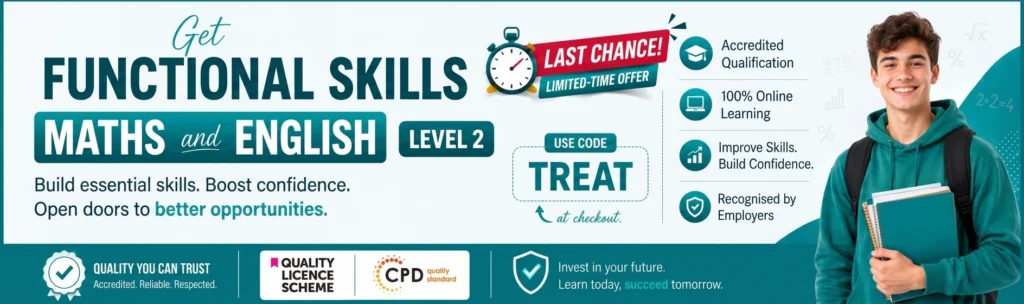
The Three Core Areas: Maths, English and Digital Skills
Every Functional Skills qualification sits under one of three subjects. You take them separately, and most people only need the ones relevant to their goal — you don’t have to do all three.
Functional Skills Maths
You’ll work with whole numbers, percentages, ratios and basic data — the kind of maths you actually use, not algebra or trigonometry.
Typical tasks look like working out a discount, reading a graph, or checking whether a budget adds up. The Level 2 exam is split into a calculator and a non-calculator section, both under exam conditions.
Functional Skills English
This covers reading, writing, and speaking/listening/communication (SLC) as three separate skills, each assessed on its own.
You won’t be analysing poetry. You’ll be asked to read a piece of text and pull out the key information, write something clear and well-structured, or take part in a short discussion or presentation.
Functional Skills Digital (IT)
Digital Functional Skills cover using devices, creating documents, staying safe online, and handling everyday digital tasks like emails and file management.
This is the newest of the three areas and has grown a lot in importance — most jobs now expect at least basic digital confidence, even outside office roles.
Functional Skills Comparison: Maths vs English vs IT
Understanding Maths, English, and IT Functional Skills shows how each supports different everyday and work-related needs. It also helps learners identify strengths and focus on the right areas for improvement.
| Aspect | Maths | English | IT (Information Technology) |
|---|---|---|---|
| Core Focus | Numbers, calculations, and problem-solving | Communication, reading, and writing | Digital skills and technology use |
| Key Skills | Arithmetic, data interpretation, budgeting | Reading, writing, speaking, listening | Using software, emails, online tools |
| Real-Life Use | Managing money, measuring, analysing data | Writing emails, understanding documents | Creating documents, online communication |
| Workplace Relevance | Financial tasks, reports, calculations | Communication with colleagues and clients | Office tasks, digital collaboration |
| Assessment Type | Problem-solving tasks and calculations | Reading, writing, speaking assessments | Practical tasks using computers and software |
| Difficulty Focus | Logical thinking and accuracy | Language understanding and expression | Technical skills and digital confidence |
| Career Benefit | Useful in finance, retail, construction | Essential in all jobs requiring communication | Important for modern digital workplaces |
This table makes it easy to understand how each subject plays a different but equally important role. Together, Maths, English, and IT create a strong skill set for both everyday life and career success
Functional Skills Levels Explained
There are five levels in total, and you don’t have to start at the bottom. Most providers give you a quick initial assessment so you can start at the level that actually matches your ability.
| Level | Roughly Equivalent To | Best For |
|---|---|---|
| Entry Level 1–3 | Below GCSE | Building a foundation from scratch |
| Level 1 | GCSE grade 1–3 (roughly D–G) | Everyday confidence, entry-level jobs |
| Level 2 | GCSE grade 4–9 (roughly C–A*) | Most jobs, apprenticeships, university entry |
Level 2 is the one most people need. It’s the one widely described as “GCSE equivalent,” and it’s usually the minimum requirement for apprenticeships, many degree courses, and jobs that ask for “GCSE Maths and English (or equivalent).”
Functional Skills vs GCSEs: What's Actually Different
They cover similar ground, but they’re built for different situations. Here’s the short version.
| Functional Skills | GCSEs | |
|---|---|---|
| Focus | Practical, real-world use | Broader academic theory |
| Study time | Weeks to a few months | 1–2 years |
| Exam windows | Available year-round | Fixed exam periods |
| Coursework | None — one final assessment | Often includes coursework |
| Best for | Adults, career changers, apprentices | School-age students, A-level progression |
If you need a recognised Maths or English qualification quickly, Functional Skills is almost always the faster route. If you’re 16 and staying in full-time education, GCSEs are usually still the standard path.
How Do Functional Skills Qualifications Work?
The official Functional Skills exam — the one that carries GCSE-equivalent status — is set and awarded by an Ofqual-regulated awarding body, such as Pearson Edexcel, City & Guilds, NCFE, or TQUK.
Getting there usually means two separate things: the learning, where you build the actual maths, English or digital skills, and the exam, where an awarding body formally assesses and certifies you. This is where a good course provider matters — the right one gets you properly prepared and confident before you sit that final assessment.
At Training Express, our Functional Skills Maths and English Level 2 course is built to do exactly that: give you a structured, self-paced path through everything Level 2 covers, so you walk into your exam ready rather than guessing. We also offer standalone Maths, English Level 2, English Level 1, and IT Level 2 courses if you only need one subject.
How Are Functional Skills Assessed?
There’s no coursework — your result comes down to a single controlled assessment per skill, sat under exam conditions.
You can usually choose between an on-screen test (marked faster, often with quicker results) or a traditional paper-based exam, depending on what your provider offers. Many providers now also offer remote-invigilated exams, meaning you can sit the test from home under supervision through a webcam, rather than travelling to a test centre.
For English, the reading, writing, and speaking/listening/communication components are each assessed separately, so you could, in theory, pass one and need to resit another. For Maths, expect a calculator and a non-calculator section within the same sitting.
Are Functional Skills Accepted by Universities and Employers?
Yes — Level 2 Functional Skills English and Maths are widely accepted by universities, colleges and employers as equivalent to a GCSE grade 4 pass.
Most universities will accept them for course entry requirements, though it’s always worth checking the specific entry criteria for competitive courses, since a small number still ask for GCSEs specifically. Employers generally treat a Level 2 pass the same way they’d treat a GCSE grade 4–9, particularly for apprenticeships, which almost always require it in English and Maths.
How Functional Skills Help Your Career

Functional Skills matter to employers because they’re proof you can perform, not just recall. Here’s what that looks like in real jobs:
- Customer service — writing clear emails, working out refunds and discounts accurately
- Retail and warehousing — managing stock counts, checking orders, handling till discrepancies
- Administration — creating documents, organising digital files, communicating with a team
- Healthcare and care work — recording accurate information, following written instructions precisely
In every case, it’s less about the certificate itself and more about what it tells an employer: that you can be handed a task and get it right without hand-holding.
Final Thoughts
Functional Skills give you a fast, practical way to prove you’ve got the Maths, English and Digital ability that employers, colleges and universities actually look for. You don’t need to relive school exams or wait a full academic year to get there.
Whether you’re aiming for an apprenticeship, a career change, or a university place, Level 2 puts you on equal footing with a GCSE grade 4 pass — without the theory you’ll never use again.
The best next step is simple: figure out which level fits where you are right now, and start from there.
Written by Robert Lawrence | E-learning Specialist
Reviewed by Elia Bryant | Functional Skills Maths and English Tutor
Frequently Asked Questions (FAQ)
What are Functional Skills in simple terms?
They’re practical qualifications in Maths, English and Digital/IT that prove you can use these subjects in real life, not just in theory. Level 2 is treated as equivalent to a GCSE grade 4 pass.
Are Functional Skills easier than GCSEs?
Not necessarily easier, just different. They focus on practical application rather than broad academic theory, and they’re assessed through one final controlled test with no coursework, which many adult learners find more manageable to fit around work and life.
Do universities accept Functional Skills instead of GCSEs?
Most do accept Level 2 Functional Skills English and Maths as equivalent to a GCSE grade 4. A small number of highly competitive courses may still ask for GCSEs specifically, so it’s worth checking with the university directly.
How long does a Functional Skills qualification take to complete?
Most learners finish one subject within a few weeks to a few months, depending on their starting level and how much time they can dedicate to studying. There’s no fixed term, since you book your exam when you’re ready.
Can I go straight to Level 2 without doing Level 1 first?
Yes. Most providers use an initial assessment to check your current ability, and if you’re ready, you can start directly at Level 2 without working through the lower levels first.
Can Functional Skills help with further education?
Yes, Functional Skills can support entry into further education and training programmes. Many colleges and apprenticeship schemes accept Level 2 as a requirement. They help learners meet entry criteria without needing GCSEs. This makes them a flexible and accessible pathway for education.

Robert Lawrence
Author | Specialises in E-Learning
Robert Lawrence is an e-learning specialist and tutor at Training Express, with experience creating practical resources and strategies to support learners and enhance their professional development.