Food Hygiene
 Health & Safety
 Safeguarding
 First Aid
 Business Skills
 Personal Development
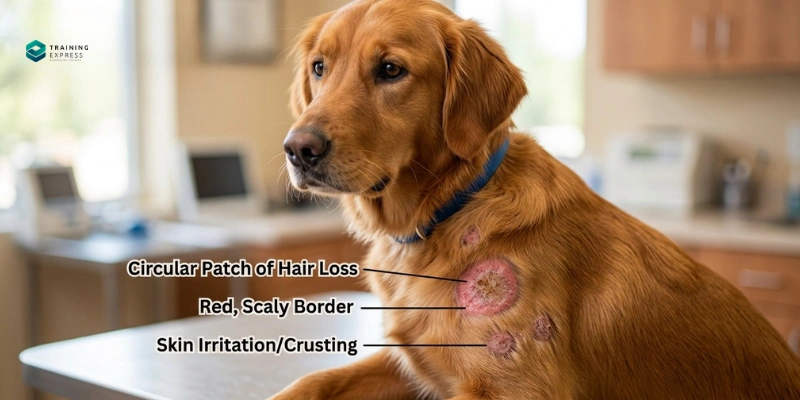

You’ve just spotted a weird bald spot on your dog. Maybe it’s round. Maybe it looks a little crusty or irritated. And now you’re doing exactly what we all do — staring at it, then staring at your phone, trying to figure out if this is ringworm before you panic or book a vet visit.
Good news: you’re in the right place. This guide walks you through exactly what ringworm looks like at different stages, how it’s different from other common skin issues, and what to actually do once you’ve spotted it — including how to keep your dog’s routine (and your sanity) intact while you sort it out.
One thing up front: despite the name, ringworm isn’t a worm at all. It’s a fungal infection — think of it as being in the same family as athlete’s foot, but on your dog. The name comes from the ring-shaped mark it can leave on the skin, not from any actual worm involved.
Table of Contents
What Ringworm Actually Looks Like — Stage by Stage
The short answer: it starts subtle and gets more obvious. Most owners miss the early stage entirely and only notice once it’s more developed.
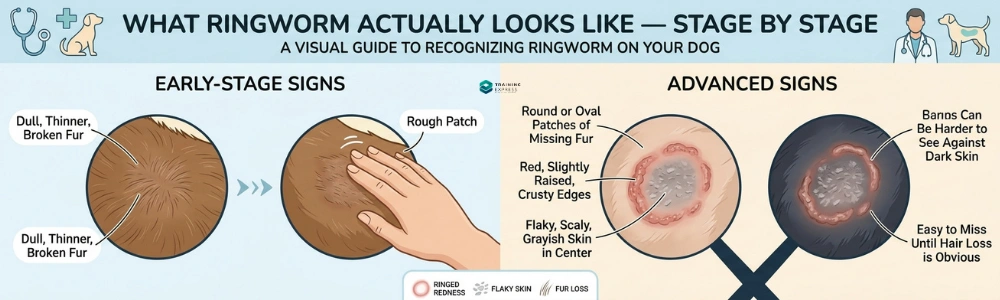
Early-stage signs
In the first few days, ringworm often looks like almost nothing — just a small area where the fur looks a bit dull, thinner, or slightly broken. You might run your hand over it and feel a rough patch before you actually see one. There’s usually little to no redness yet, which is exactly why it gets missed.
Advanced signs
Once it’s established, ringworm typically shows up as:
- A round or oval patch of missing fur
- Red, slightly raised, crusty edges (this ring shape is where the name comes from)
- Flaky, scaly, or grayish skin in the center of the patch
- Occasionally, mild scabbing or dandruff-like buildup around the area
It’s not usually painful, and it may or may not be itchy — some dogs won’t scratch at it at all, which surprises a lot of owners.
Dark coats vs. light coats
On a dog with a dark or black coat, ringworm can be easy to miss until the hair loss is fairly obvious, since the redness underneath is harder to see against dark skin. On lighter or white coats, the red, inflamed ring around the patch tends to stand out much faster, which is often why owners of pale-coated dogs catch it earlier.
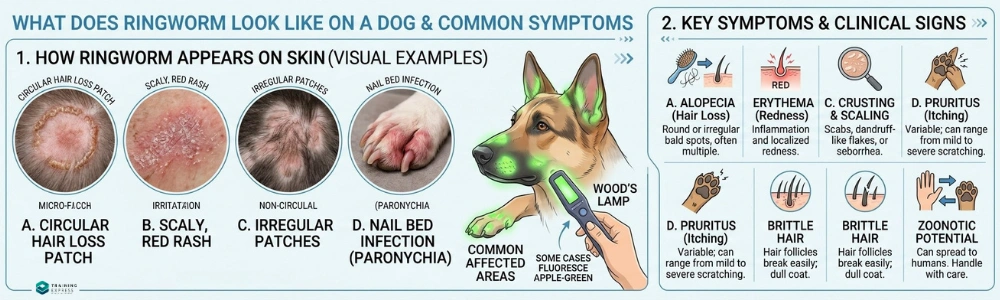
Ringworm vs. Others Look-Alike Conditions
Here’s the problem: several common skin conditions can look a lot like ringworm at a glance. This table should help you get a general sense of what you’re looking at — but treat it as a starting point, not a diagnosis.
| Condition | Shape | Texture | Itchiness | Onset |
|---|---|---|---|---|
| Ringworm | Round or oval, defined ring | Crusty edges, scaly/flaky center | Mild or none, sometimes itchy | Gradual, over days |
| Mange (mites) | Irregular, patchy, can spread widely | Red, sometimes oozing or thickened skin | Often intensely itchy | Can appear suddenly or worsen fast |
| Hot spots | Irregular, moist-looking | Wet, oozing, matted fur around the area | Very itchy — dogs often lick/chew constantly | Sudden, can appear within hours |
| Allergic dermatitis | Irregular, often widespread | Red, inflamed, sometimes bumpy | Usually very itchy | Can be seasonal or triggered by food/environment |
If the patch is round with a defined edge and your dog isn’t obsessively licking or chewing at it, ringworm becomes more likely. If it’s wet, oozing, or your dog seems miserable and can’t leave it alone, a hot spot or allergic reaction is often a better fit. Either way, this table narrows things down — it doesn’t replace a vet exam
Other Symptoms to Watch For Beyond the Skin
Ringworm isn’t always just about the obvious bald patch. Other signs worth watching for include:
- Brittle or broken hairs around the affected area, or hair that comes out in clumps
- Increased dandruff or flaky skin, even outside the main patch
- Darkened patches of skin
- Changes to the nails in more severe or widespread cases
Here’s a detail a lot of owners don’t know: some dogs carry the fungus without showing any symptoms at all. That means a completely normal-looking dog can still spread ringworm to other pets or people in the house — which is part of why vets recommend testing all pets in a household if one is diagnosed.
Why It Happens (Causes & Transmission)
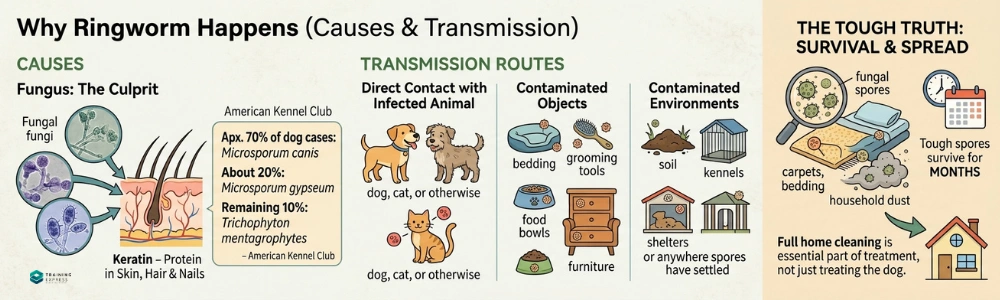
Ringworm is caused by a group of fungi that feed on keratin — the protein found in skin, hair, and nails. According to the American Kennel Club, roughly 70% of ringworm cases in dogs are caused by the fungus Microsporum canis, about 20% come from Microsporum gypseum, and the remaining 10% or so are caused by Trichophyton mentagrophytes.
Your dog can pick it up in a few ways:
- Direct contact with an infected animal (dog, cat, or otherwise)
- Contaminated objects — bedding, grooming tools, food bowls, furniture
- Contaminated environments — soil, kennels, shelters, or anywhere spores have settled
The tricky part is that fungal spores are tough. They can survive in carpets, bedding, and household dust for months, which is why a full clean of the home is usually part of treatment, not just treating the dog.
Is It Contagious to Humans and Other Pets?
Yes — ringworm is zoonotic, meaning it can spread from your dog to you, your kids, or other pets in the house. In people, it typically shows up as a red, circular, itchy rash, most often called “ringworm” or “tinea” depending on where it appears on the body.
This isn’t a reason to panic, but it is a reason to take hygiene seriously while your dog is being treated: wash your hands after handling your dog, avoid letting kids snuggle the affected area, and keep other pets separated until your vet gives the all-clear. If anyone in your household develops a similar rash, it’s worth mentioning to your own doctor that your dog has been diagnosed.
How Vets Diagnose Ringworm

Here’s the part that matters most: you cannot diagnose ringworm from a photo or a Google search — and neither can we. A visual match to everything above just means it’s worth getting checked. Actual diagnosis needs one of a few tests:
- Wood’s lamp exam — a special UV light that some (not all) strains of ringworm will glow under. It’s fast, but it’s not definitive on its own since not every strain reacts.
- Fungal culture — a sample of hair or skin is grown in a lab to confirm the exact fungus. This is considered the gold standard, but according to VCA Animal Hospitals, it can take up to a few weeks to get a result.
- PCR test — a newer option that can identify the fungus’s DNA more quickly than a traditional culture.
Your vet may use a physical exam alongside one or more of these to confirm what’s going on and rule out mange, hot spots, or allergies.
Treatment Overview
If your dog is confirmed to have ringworm, treatment usually involves three things working together:
- Topical treatment — medicated shampoos or lime sulfur dips applied directly to the skin and coat. PetMD notes that lime sulfur dips tend to be more effective than shampoo alone, though both are commonly used.
- Oral medication — antifungal medication (such as itraconazole, terbinafine, or griseofulvin) prescribed by your vet, especially for more widespread or stubborn cases.
- Environmental decontamination — cleaning your home thoroughly, since spores can live in carpets, bedding, and furniture for months. This usually means vacuuming frequently, washing bedding on hot, and disinfecting hard surfaces.
According to VCA Animal Hospitals, dogs on an aggressive treatment plan typically remain contagious for around three weeks, though it can take longer if treatment is less consistent. Most dogs recover fully with proper treatment, but stopping early is one of the most common reasons ringworm comes back — so your vet’s full course matters more than how the skin looks after a week or two.
Managing Your Dog's Behavior & Training During Treatment
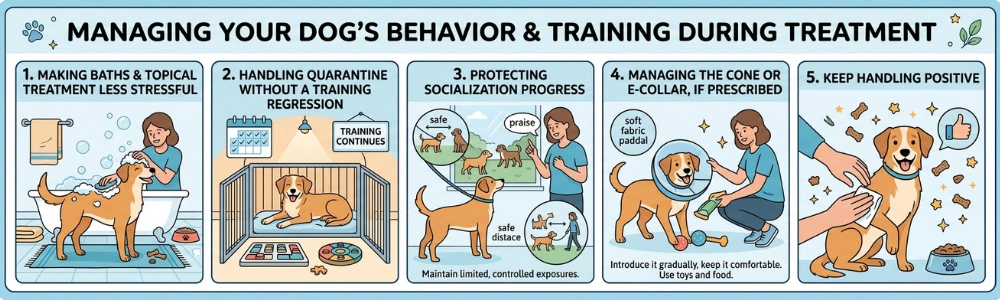
This is the part most guides skip entirely — and it’s where things can quietly go sideways for owners. Treating the skin is only half the job. Keeping your dog calm, cooperative, and on track behaviorally during a multi-week treatment period takes some planning.
- Making baths and topical treatment less stressful. Many dogs aren’t fans of medicated baths or having ointment applied to a sore spot. Go slow the first time — let your dog sniff the product, use a calm, upbeat tone, and pair the process with a high-value treat immediately after. Short, low-drama sessions build cooperation faster than trying to push through resistance.
- Handling quarantine without a training regression. Vets often recommend keeping an infected dog restricted to an easy-to-clean space (like a bathroom or tiled room) for several weeks. That’s a long time for an active dog to be cooped up, and boredom or under-stimulation is where behavior problems creep in. Keep a consistent routine even in a small space: short obedience refreshers, food puzzles, and scent games all work well in confined areas and keep your dog’s brain engaged without needing open space.
- Protecting socialization progress. If your dog was mid-way through socialization work — puppy classes, dog park visits, meeting new people — a few weeks of isolation can cause some backsliding, especially in younger or more anxious dogs. Once your vet gives the all-clear to reintroduce contact, ease back in gradually rather than jumping straight back into a busy class or dog park. A few one-on-one playdates with a known, calm dog is a gentler way to rebuild confidence.
- Managing the cone or e-collar, if prescribed. If your dog needs to wear a cone to stop them licking or scratching a treated area, introduce it in short bursts with treats and praise before expecting them to wear it for hours at a stretch. Fighting the cone usually makes dogs more anxious about the whole treatment process, not less.
- Keep handling positive. Your dog will be touched, bathed, and medicated more than usual during this period. Pair each session with something they enjoy — a favorite treat, a calm scratch in their favorite spot — so treatment doesn’t start to feel like a punishment.
Do Home Remedies Work?
Short answer: proceed with caution, and don’t rely on these alone.
- Tea tree oil — often recommended online, but it can be toxic to dogs in the wrong concentration and shouldn’t be applied without vet guidance.
- Apple cider vinegar — some owners use diluted ACV as a topical rinse, but there’s no strong evidence it clears a fungal infection on its own, and it can irritate already-inflamed skin.
- Bleach or harsh household cleaners directly on skin — never apply these to your dog. Diluted bleach solutions are useful for disinfecting your home environment, not your dog’s fur or skin.
The safest approach: use home remedies as a supplement to vet-prescribed treatment, if at all — never as a replacement for it. Fungal infections that aren’t properly treated can linger for months and keep spreading to other pets or people in the house.
Final Thoughts
If your dog has a round, crusty, or scaly bald patch, ringworm is a reasonable thing to suspect — but it’s genuinely hard to tell apart from mange, hot spots, or allergies just by looking. The safest move is always the same: get it properly checked by a vet, and in the meantime, keep your dog’s routine as normal and stress-free as you can. A little extra patience with baths, handling, and quarantine now goes a long way toward keeping both your dog’s skin and their training progress on track.
Sources referenced:
- American Kennel Club — Ringworm in Dogs: Signs, Symptoms, Treatment
- PetMD — Ringworm in Dogs
- VCA Animal Hospitals — Ringworm in Dogs
- Merck Veterinary Manual — Ringworm (Dermatophytosis) in Dogs
This article is for informational purposes only and is not a substitute for professional veterinary advice, diagnosis, or treatment. Always consult your veterinarian if you suspect your dog has ringworm or any other health condition.
Written by Robert Lawrence, Author —TrainingExpress
Article Reviewed by Amelia Frey, DVM — Veterinarian
Frequently Asked Questions (FAQ)
How long does ringworm last on a dog?
With proper treatment, most dogs stop being contagious within about three weeks, though full recovery can take longer depending on severity. Stopping treatment early is one of the most common reasons it comes back.
Can ringworm go away on its own?
In healthy adult dogs, mild cases can sometimes clear up without treatment, but this isn’t something to count on. Untreated ringworm can spread to other pets, people, and around your home, so it’s worth getting a proper diagnosis rather than waiting it out.
What does ringworm look like when it's healing?
As it heals, the red, crusty border usually fades, the flaky skin clears up, and new fur starts to grow back in the bald patch. Full regrowth can take several weeks even after the infection itself is gone.
Is ringworm an emergency?
No, it’s not an emergency in the urgent-care sense, but it shouldn’t be ignored either. Book a regular vet visit, and in the meantime limit close contact between your dog, other pets, and household members, especially children.

Robert Lawrence
Author | Specialises in e-learning.
Robert Lawrence is an e-learning specialist and author at Training Express, with over 5 years of experience creating practical resources and strategies to support learners and enhance their professional & personal development.