Food Hygiene
 Health & Safety
 Safeguarding
 First Aid
 Business Skills
 Personal Development
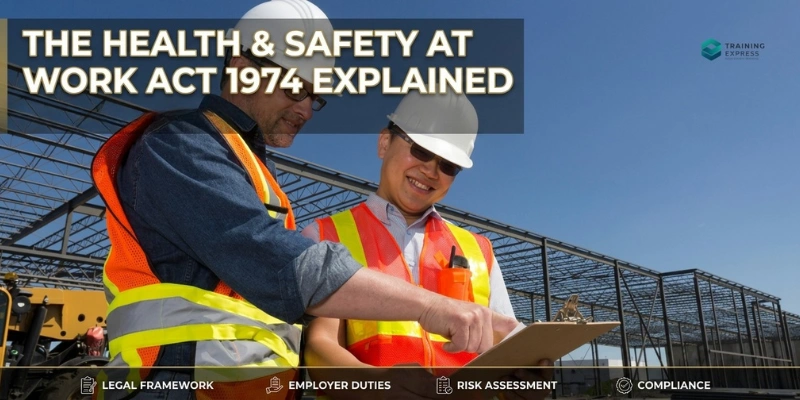

Quick answer: The Health and Safety at Work etc. Act 1974 (HSWA, also called HASAWA or “the 1974 Act”) is the main law governing workplace health and safety in Great Britain. It places a legal duty on employers to protect employees, contractors and the public “so far as is reasonably practicable,” gives employees their own responsibilities, and creates the powers that let the Health and Safety Executive (HSE) inspect, warn and prosecute businesses that don’t comply. Every other UK health and safety regulation — from COSHH to CDM to RIDDOR — was made under the powers this Act created.
If you manage people, sit on a board, or you’re simply the person in the office who gets asked health and safety questions because nobody else will, this guide walks through what the Act says, why it exists, what happens if you ignore it, and how it fits together with the rest of UK safety law.
Table of Contents
What is the Health and Safety at Work Act 1974?
Officially it’s the Health and Safety at Work etc. Act 1974 — that stray “etc.” in the title is easy to miss but it matters, because it signals that the Act was designed to be broad rather than narrow. It received Royal Assent in July 1974 and came into force on 31 July that year.

Before 1974, UK workplace safety was governed by a mess of separate laws: the Factories Act 1961, the Offices, Shops and Railway Premises Act 1963, the Mines and Quarries Act 1954, and various others, each covering a specific type of workplace. If your industry wasn’t named in one of those Acts, you effectively fell through the gaps. There was no single, general duty on employers to keep people safe — just a patchwork of rules that hadn’t kept pace with how British industry had changed.
HSWA fixed that by taking a completely different approach. Instead of listing detailed rules for each type of workplace, it set out broad, goal-based duties that apply to almost everyone at work, in almost any setting. The detail — the specific numbers, procedures and technical standards — was left to regulations made under the Act, which is exactly the structure UK health and safety law still uses today.
The Act covers Great Britain (England, Scotland and Wales). Northern Ireland has its own near-identical legislation, the Health and Safety at Work (Northern Ireland) Order 1978, so if you operate across the UK you’re technically dealing with two parallel laws that work the same way.
Why the Act was introduced
Workplace safety law wasn’t rewritten out of nowhere. Two things pushed it up the political agenda in the years leading up to 1974.
The first was a string of serious industrial disasters. A fire at a factory on James Watt Street in Glasgow killed 22 people in 1968. In 1974 itself, an explosion at the Nypro chemical plant in Flixborough killed 28 workers and injured dozens more, and it happened in the same year the Act came into force — a grim coincidence that underlined exactly why new legislation was needed.
The second, more structural cause was a government-commissioned review. In 1970, a committee chaired by Lord Alfred Robens was asked to look at the state of workplace safety law and came back with a blunt conclusion: the existing system was too complicated, too reactive, and left too many workers unprotected simply because of which industry they happened to work in. The Robens Report, published in 1972, recommended scrapping the old approach in favour of a single Act built around general duties, self-regulation, and a new enforcing authority — which became the HSE.
Parliament largely accepted Robens’ recommendations, and the result was HSWA 1974. Its purpose wasn’t only to protect people doing the work — it was also written to protect the public and anyone else who might be affected by what happens in a workplace.
The general duties: Sections 2 to 9
This is the part most explainers skate over, and it’s where the real substance of the Act sits. Sections 2 to 9 set out who owes a duty to whom, and what that duty actually involves. Knowing which section applies to you is more useful in practice than knowing the Act exists at all.

Section 2 — what employers owe their employees
Section 2(1) is the foundation of the whole Act: every employer must ensure, so far as is reasonably practicable, the health, safety and welfare of their employees at work. Section 2(2) then breaks that general duty into specifics, requiring employers to:
- Provide and maintain plant and systems of work that are safe and don’t put health at risk
- Make safe arrangements for using, handling, storing and transporting articles and substances
- Give employees the information, instruction, training and supervision they need to work safely
- Keep the workplace itself — including entrances, exits and walkways — in a safe condition
- Maintain a working environment that’s safe, healthy, and has adequate welfare facilities
There’s also a practical rule buried in Section 2(3): if you employ five or more people, you’re legally required to have a written health and safety policy and make sure staff know about it. This is the reason nearly every UK business, however small, has a health and safety policy document somewhere in a folder or on an intranet — it isn’t optional once you cross that headcount.
Section 3 — the duty to everyone else
Section 3 extends the same principle beyond your own staff. Employers must run their business in a way that doesn’t put people who aren’t their employees at risk — contractors, delivery drivers, visitors, and members of the public nearby. Self-employed people have the equivalent duty for their own work activities.
This section matters more than people assume. When a member of the public is injured by a company’s work — a falling scaffold pole, an unguarded excavation, a badly stored chemical — the prosecution is usually brought under Section 3, not Section 2, because the injured person was never an employee.
Section 4 — landlords and building controllers
If you’re responsible for non-domestic premises used by people who don’t work for you — think landlords of shared office buildings, or anyone managing common areas in a multi-tenant site — Section 4 puts a duty on you to keep the premises, and any access routes, plant or equipment in them, safe.
Section 6 — designers, manufacturers, importers and suppliers
Safety obligations don’t stop at the factory gate. Section 6 places duties on anyone who designs, makes, imports or supplies equipment or substances used at work, requiring them to make sure the product is safe when properly used, test it as necessary, and provide adequate safety information with it. This is the legal root of things like CE/UKCA marking and instruction manuals that come with work equipment.
Section 7 — what employees themselves must do
The Act isn’t only about what employers owe workers — it also places direct legal duties on employees. Under Section 7, every worker must take reasonable care of their own health and safety and that of anyone else who could be affected by what they do (or fail to do), and must cooperate with their employer on safety matters. In other words, ignoring your training, taking unnecessary risks or refusing to use provided safety equipment isn’t just poor practice — it can be a criminal offence in its own right.
Section 8 — don't interfere with safety equipment
Section 8 makes it an offence for anyone — not just employees — to deliberately or recklessly interfere with, or misuse, anything provided for health and safety purposes. Removing a machine guard, disabling a fire alarm, or ignoring a permit-to-work system all fall under this.
Section 9 — employers can't charge for safety
A short but useful one: Section 9 stops employers passing the cost of legally required safety equipment on to employees. If PPE is specified by law, the employer pays for it — not the worker.
| Section | Who it applies to | What it requires |
|---|---|---|
| Section 2 | Employers | Protect employees' health, safety and welfare so far as reasonably practicable |
| Section 3 | Employers & self-employed | Protect non-employees affected by the work |
| Section 4 | Landlords / premises controllers | Keep shared/non-domestic premises safe |
| Section 6 | Designers, manufacturers, suppliers | Ensure equipment/substances are safe to use |
| Section 7 | Employees | Take reasonable care of self and others; cooperate with employer |
| Section 8 | Everyone | Don't interfere with or misuse safety equipment |
| Section 9 | Employers | Can't charge employees for required safety provisions |
"So far as is reasonably practicable" — what it actually means
This phrase appears throughout the Act, and it’s the single most misunderstood part of it. People often read it as “employers just have to try their best,” which isn’t quite right, or as “employers must eliminate every risk regardless of cost,” which is also wrong.

The correct interpretation comes from a court case decided decades before the Act existed but adopted as the definitive test for it: Edwards v National Coal Board (1949). The court set out a kind of balancing exercise — weigh the size of the risk against the cost, time and effort needed to remove it. If the cost of the precaution is grossly out of proportion to the risk it prevents, then it isn’t “reasonably practicable” and the law doesn’t demand it. But the bar for “grossly disproportionate” is high — cost alone, or mild inconvenience, won’t excuse an employer from taking an obvious precaution against a serious risk.
There’s a legal quirk worth knowing here too: in a prosecution under the Act, the burden of proof effectively flips. Once it’s shown that a risk existed, it’s up to the employer to prove that doing more wasn’t reasonably practicable — not up to the prosecution to prove that it was. That reversal is a big part of why conviction rates under HSWA are so high once a case reaches court.
How the Act connects to everything else in UK health and safety law
HSWA is often described as “enabling legislation,” and that’s the detail a lot of explainers skip. The Act itself doesn’t spell out how many lux of lighting you need in a warehouse, or exactly how to assess manual handling risk — it gives government ministers the power (under Section 15) to create detailed regulations that do. Nearly every specific H&S regulation UK employers deal with day to day was made using that power, including:
- Management of Health and Safety at Work Regulations 1999 (MHSWR) — turns the general Section 2 duty into a concrete requirement to carry out risk assessments
- Control of Substances Hazardous to Health Regulations 2002 (COSHH) — chemical and hazardous substance controls
- Construction (Design and Management) Regulations 2015 (CDM) — safety duties on construction projects
- Manual Handling Operations Regulations 1992 — lifting, carrying and manual handling risk
- Personal Protective Equipment at Work Regulations 1992 — PPE provision
- Working at Height Regulations 2005 — fall prevention
- Provision and Use of Work Equipment Regulations 1998 (PUWER) — machinery and equipment safety
- Reporting of Injuries, Diseases and Dangerous Occurrences Regulations 2013 (RIDDOR) — accident and incident reporting
Think of HSWA as the constitution and these regulations as the statute book that fills in the practical detail. Both carry equal legal weight, and breaching either is a criminal matter — HSWA just sets the principle, the regulations set the method.
Who enforces the Act, and how
Two types of body enforce HSWA, and which one deals with your business depends on your sector:
- The Health and Safety Executive (HSE) covers higher-risk sectors — construction, manufacturing, agriculture, mining, chemicals, and larger industrial or technical workplaces.
- Local authorities, usually through Environmental Health Officers, cover lower-risk premises such as offices, shops, warehouses, hospitality and most service businesses.
Both have the same legal powers under the Act: they can enter premises without notice, examine equipment and records, take samples, and seize anything they consider dangerous. If they find a breach, they can issue an improvement notice (giving you a deadline to fix a problem) or, for anything posing a risk of serious injury, a prohibition notice that stops the activity immediately until it’s resolved. Ignoring either is itself a criminal offence.
Penalties for breaching the Act
Penalties are set out under Section 33 and have been strengthened more than once since 1974. As it stands, conviction for most offences can carry an unlimited fine in either the magistrates’ court or the Crown Court, plus up to 12 months’ imprisonment on summary conviction or up to two years on indictment.
Fines have risen sharply since the Sentencing Council’s 2016 guideline came into force, which links fine size to both the seriousness of the harm and the size (turnover) of the organisation. For larger companies involved in fatal or very serious incidents, fines running into seven figures are now common rather than exceptional, and some cases have exceeded £10 million.
How the Act has evolved since 1974
The core of the Act — Sections 2 to 9 — has barely changed in fifty years, but the law around it has moved:
- Corporate Manslaughter and Corporate Homicide Act 2007 introduced a separate offence for organisations whose senior management failures lead to a death, sitting alongside (not replacing) HSWA prosecutions.
- Health and Safety (Offences) Act 2008 widened the availability of prison sentences and increased fine limits in the magistrates’ courts.
- Sentencing Council Guideline (2016) pushed up fine levels significantly for larger organisations, tying penalties more directly to turnover.
- Fee for Intervention (FFI) rules now let the HSE recover its investigation costs directly from businesses found in material breach — meaning a serious incident can cost a company money in HSE fees even before any fine is handed down.
Why the Act still matters — the current numbers
It’s tempting to think of HSWA as a piece of history that’s already done its job, but the latest figures from the HSE show why it’s still very much needed.

In 2024/25, 124 workers died in work-related accidents in Great Britain — a welcome fall from 138 the year before, and one of the lowest fatality rates ever recorded. But that positive trend doesn’t tell the whole story. Around 680,000 workers reported suffering a non-fatal injury at work in the same period, up noticeably on the year before, and an estimated 1.9 million people were dealing with work-related ill health — the highest figure on record, driven largely by stress, depression and anxiety. Between injuries and ill health, the HSE estimates the annual cost to the UK economy at close to £23 billion.
Those numbers are the clearest possible argument for why the duties in HSWA aren’t a box-ticking exercise. Falls from height remain the single biggest cause of workplace deaths, year after year, and most of the incidents behind these statistics come down to exactly the kind of failure the Act was written to prevent: no risk assessment, no training, no maintained equipment, or nobody willing to stop unsafe work.
The bottom line
The Health and Safety at Work Act 1974 is short, principle-based, and over fifty years old — and it’s still the single most important piece of legislation shaping how UK workplaces operate. Understanding it properly means going beyond “it makes employers responsible for safety” and actually knowing which section applies to your role, what “reasonably practicable” allows and doesn’t allow, and how the Act ties into the regulations that spell out your day-to-day obligations.
If you’re responsible for health and safety in your organisation — whether that’s a formal part of your job title or something you’ve inherited by default — proper training is what turns this from legal theory into something your business can actually demonstrate compliance with.
Frequently Asked Questions (FAQ)
Is the Health and Safety at Work Act 1974 still in force?
Yes. It’s still the primary piece of UK workplace safety legislation, and the general duties in Sections 2 to 9 remain largely as originally written.
Who does the Act apply to?
Almost everyone connected to a workplace: employers, employees, the self-employed, people in control of premises, and designers, manufacturers and suppliers of equipment used at work. It also protects visitors, contractors and members of the public affected by work activity.
Does it apply to the self-employed?
Yes, under Section 3(2), self-employed people have a duty not to expose others to risk through their work. A narrower exemption exists for self-employed people whose work poses no potential risk to anyone else, introduced by regulations in 2015 — but most trades remain covered.
What's the difference between HSWA 1974 and the Management of Health and Safety at Work Regulations 1999?
HSWA sets the general legal duty — keep people safe so far as reasonably practicable. MHSWR is a regulation made under HSWA that turns that general duty into a specific requirement: carry out and record risk assessments, and put management arrangements in place to control the risks you find.
What does "so far as is reasonably practicable" mean in plain English?
It means weighing the risk against the cost, time and effort of removing it. If a precaution would cost vastly more than the risk justifies, the law doesn’t require it — but the threshold for that is high, and cost alone rarely excuses ignoring an obvious hazard.
What are the penalties for breaching the Act?
Unlimited fines in either court, plus up to 12 months’ imprisonment (magistrates’ court) or two years (Crown Court), depending on the offence and its seriousness.
Who enforces the Act — the HSE or the police?
The HSE and local authority Environmental Health Officers, not the police, are the main enforcers, though police may be involved where a death has occurred and manslaughter is being considered.
Article Reviewed By: Jane Smith, CMIOSH.
Article Written By: Robert Lawrence, Specialices in Health and Safety.

Robert Lawrence
Author | Specialises in Health and Safety.
Robert Lawrence is an e-learning specialist and author at Training Express, with over 5 years of experience creating practical resources and strategies to support learners and enhance their professional & personal development.