Food Hygiene
 Health & Safety
 Safeguarding
 First Aid
 Business Skills
 Personal Development



Most of us expect certain basics when we arrive at work: a building that is warm enough, enough light to see what we are doing, clean toilets and somewhere to eat lunch. These things can feel so normal that it is easy to forget they are actually legal requirements.
The Workplace (Health, Safety and Welfare) Regulations 1992 set out the minimum standards that employers must meet for the physical working environment. They cover everything from temperature and lighting to floors, windows, toilets, drinking water and rest areas.
In this article, we explain what the Workplace Regulations 1992 are, who they apply to, what they require and how employers can make sure their premises comply.
Table of Contents
What Are the Workplace Regulations 1992?
The Workplace (Health, Safety and Welfare) Regulations 1992, often called the Workplace Regulations, are a set of regulations made under the Health and Safety at Work Act 1974. They came into force on 1 January 1993 and set the standards for the workplace itself, rather than for the work being done.
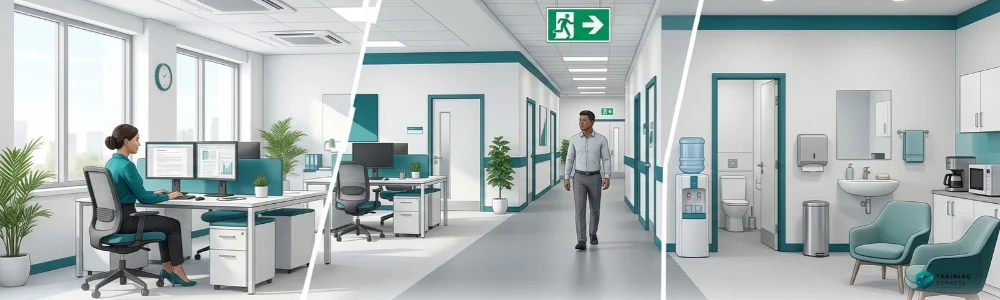
The regulations are usually grouped into three areas:
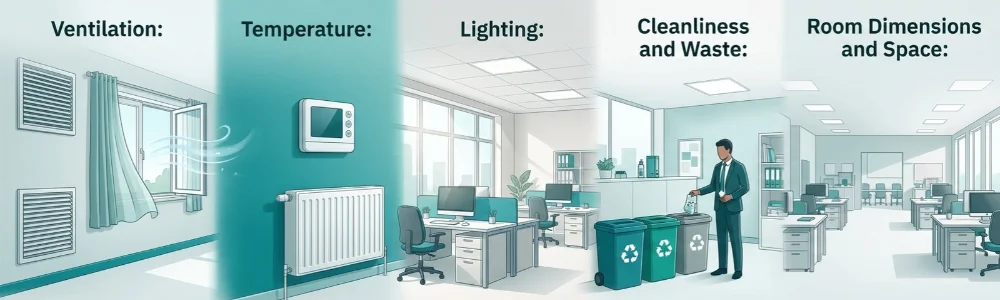
- Health: ventilation, temperature, lighting, cleanliness, room space and workstations
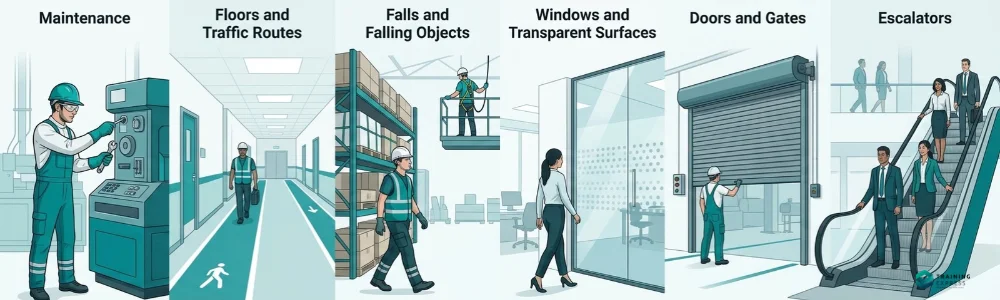
- Safety: maintenance, floors and traffic routes, falls, windows, doors, gates and escalators
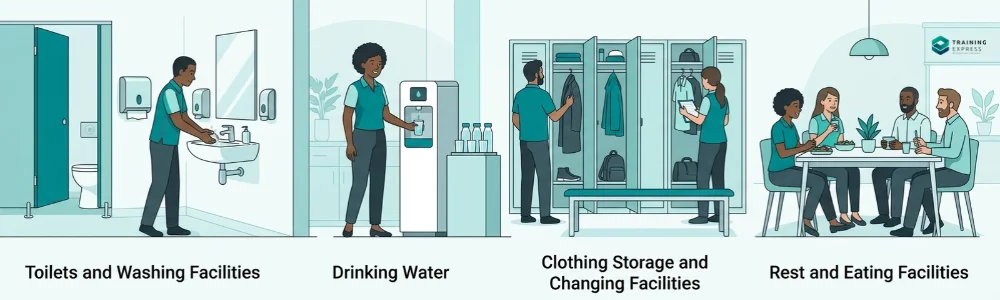
- Welfare: toilets, washing facilities, drinking water, changing facilities and rest areas
Many of the requirements apply “so far as is reasonably practicable”, which means employers must weigh up the risk against the time, cost and effort needed to meet the standard.
Who Do the Workplace Regulations Apply To?
The Workplace Regulations apply to almost all workplaces in Great Britain, including offices, shops, factories, warehouses, schools, hospitals, hotels and places of entertainment. The main duty falls on employers, but people who control a workplace, such as landlords of shared buildings, also have duties for the parts they control.
The regulations do not apply to:
- Domestic premises, such as a worker’s own home
- Ships and other means of transport
- Construction sites, which are covered by the Construction (Design and Management) Regulations 2015
Some of the regulations only partly apply to temporary work sites and to farm or forestry land away from the main buildings.
What Is the Workplace Approved Code of Practice (L24)?
HSE publishes an Approved Code of Practice (ACOP) for the Workplace Regulations, known as L24. The ACOP gives practical advice on how to comply with the law, including many of the figures employers look for, such as the minimum recommended temperature and the minimum space per person.
Following the ACOP is not compulsory. However, if a business is prosecuted for breaking the regulations and has not followed the ACOP, it will need to show that it complied with the law in another way that was just as effective.
Health Requirements
Ventilation
Under Regulation 6, enclosed workplaces must be ventilated by a sufficient quantity of fresh or purified air. This can be natural ventilation, such as opening windows, or mechanical ventilation, such as air conditioning. Any mechanical ventilation system must be properly maintained and should have a warning device if failure could put health at risk.
Temperature
Regulation 7 says that the temperature inside a workplace must be reasonable during working hours. The law does not set an exact figure, but the HSE Approved Code of Practice recommends a minimum of 16°C for most indoor workplaces, or 13°C where the work involves a lot of physical effort.
There is no legal maximum temperature. However, employers must still assess the risks of working in hot conditions and take reasonable steps to keep people comfortable, such as providing fans, relaxing dress codes or allowing extra breaks. Employers must also provide enough thermometers so that workers can check the temperature.
Lighting
Under Regulation 8, every workplace must have suitable and sufficient lighting, which should be natural light where reasonably practicable. Emergency lighting must also be provided where people would be put in danger if the normal lights failed.
Cleanliness and Waste
Regulation 9 requires workplaces, furniture and fittings to be kept sufficiently clean. Floors, walls and ceilings must be capable of being kept clean, and waste must not be allowed to build up, except in suitable bins or containers.
Room Dimensions and Space
Regulation 10 says workrooms must have enough floor area, height and unoccupied space for health, safety and welfare purposes. The HSE Approved Code of Practice recommends at least 11 cubic metres of space per person. This is worked out by dividing the total volume of the empty room by the number of people normally working in it. Any part of the room higher than 3 metres is counted as 3 metres.
The 11 cubic metres figure is a minimum. If much of the room is taken up by furniture or equipment, more space may be needed.
Workstations and Seating
Under Regulation 11, every workstation must be suitable for the person using it and the work being done. Where work can be done sitting down, a suitable seat must be provided, along with a footrest if needed. Outdoor workstations should provide protection from bad weather where reasonably practicable.
Safety Requirements
Maintenance
Regulation 5 requires the workplace, and certain equipment, devices and systems, to be maintained in efficient working order and good repair. Where appropriate, this should include a system of regular maintenance, such as servicing lifts, checking emergency lighting and inspecting ventilation systems.
Floors and Traffic Routes
Under Regulations 12 and 17, floors and traffic routes must be suitable for their purpose, in good condition and free from obstructions and anything that could cause someone to slip, trip or fall. Traffic routes must be organised so that pedestrians and vehicles can move around safely, for example by marking separate walkways in warehouses and loading areas.
Falls and Falling Objects
Regulation 13 requires suitable measures to prevent people falling a distance or being struck by falling objects. This can include fencing, guard rails and covers for openings. Tanks, pits and other structures containing dangerous substances must also be securely fenced or covered. Work at height itself is covered by the Work at Height Regulations 2005.
Windows and Transparent Surfaces
Under Regulations 14 to 16, transparent or translucent doors, walls and partitions must be made of safety material or protected against breakage, and marked so that people can see them. Windows, skylights and ventilators must be safe to open, close and adjust, and must not create a hazard when open. Windows must also be designed so that they can be cleaned safely.
Doors, Gates and Escalators
Regulations 18 and 19 require doors and gates to be suitably built and fitted with any necessary safety devices. For example, sliding doors must have a stop to prevent them coming off the track, and doors that swing both ways should have a clear viewing panel. Escalators and moving walkways must work safely, have the necessary safety devices and be fitted with easily identifiable emergency stop controls.
Welfare Requirements
Toilets and Washing Facilities
Regulations 20 and 21 require employers to provide suitable and sufficient toilets and washing facilities. Facilities should be well lit and ventilated, kept clean, and include hot and cold or warm running water, soap and a way to dry hands. Separate facilities should be provided for men and women unless each toilet is in a separate room with a lockable door.
The HSE guidance sets out the minimum number of toilets and washbasins for mixed or women-only workforces:
| Number of People at Work | Toilets | Washbasins |
|---|---|---|
| 1 to 5 | 1 | 1 |
| 6 to 25 | 2 | 2 |
| 26 to 50 | 3 | 3 |
| 51 to 75 | 4 | 4 |
| 76 to 100 | 5 | 5 |
Separate figures, including urinals, apply to toilets used only by men. Facilities should also meet the needs of disabled workers.
Drinking Water
Under Regulation 22, employers must provide an adequate supply of clean drinking water that is easy to reach. Mains water is preferred, but bottled water dispensers can be used as a secondary supply. Cups should be provided unless the water comes from a drinking fountain.
Clothing Storage and Changing Facilities
Regulations 23 and 24 require suitable storage for workers’ own clothing that is not worn at work, and for special clothing that is kept at work. Where workers need to change into special clothing, changing facilities must be provided. These should offer privacy and be separate for men and women where necessary.
Rest and Eating Facilities
Under Regulation 25, employers must provide suitable rest facilities, including somewhere to eat meals where food would otherwise be likely to get contaminated. Rest areas should have enough seats and tables, and a way to heat food or make hot drinks where reasonable. Suitable facilities must also be provided for pregnant workers and breastfeeding mothers to rest, including somewhere to lie down if necessary.
How Do the Workplace Regulations Link to the Health and Safety at Work Act?
The Health and Safety at Work Act 1974 requires employers to provide a safe working environment with adequate welfare facilities, so far as is reasonably practicable. The Workplace Regulations explain in more detail what this means for the building and facilities.
The Workplace Regulations work alongside other regulations made under the Act, such as the Management of Health and Safety at Work Regulations 1999, which require employers to carry out risk assessments, and the Display Screen Equipment Regulations 1992, which cover computer workstations.
What Happens If Employers Do Not Comply?
The Workplace Regulations are enforced by HSE and local authority Environmental Health Officers. If an inspector finds that the regulations are not being met, they can give advice, write to the employer setting out what needs to be done, serve an improvement notice or, where there is a risk of serious personal injury, serve a prohibition notice.
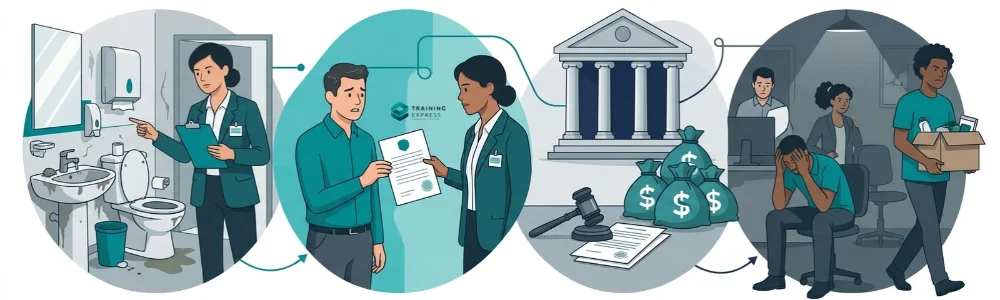
Breaking the regulations is a criminal offence, and serious or repeated failures can lead to prosecution and unlimited fines. Poor welfare facilities can also affect staff morale, sickness absence and staff turnover.
Workplace Regulations Checklist
Employers can use the following checklist to review their workplace:
- Is the workplace well ventilated, and is any ventilation equipment maintained?
- Is the indoor temperature reasonable, with thermometers available?
- Is there enough natural or artificial light, including emergency lighting?
- Are floors, walls and ceilings clean, and is waste removed regularly?
- Is there enough space for each person, with at least 11 cubic metres per person?
- Are workstations and seats suitable for the people using them?
- Are floors and walkways in good condition and free from trip hazards?
- Are pedestrians and vehicles kept apart where needed?
- Are glass doors and partitions made of safety material and clearly marked?
- Are there enough clean toilets and washbasins for the number of workers?
- Is clean drinking water easy to reach?
- Are there suitable rest and eating areas, including a place for pregnant and breastfeeding workers to rest?
Final Words
The Workplace (Health, Safety and Welfare) Regulations 1992 set the minimum standards for the physical working environment in Great Britain. They require employers to provide a workplace that is properly ventilated, at a reasonable temperature, well lit, clean and spacious, with safe floors, windows and doors, and suitable toilets, drinking water and rest areas.
We offer a range of courses that help employers and employees understand their workplace health and safety duties, including our Workplace Health and Safety, Health and Safety at Work and Health and Safety Level 2 courses. You can also browse all of our health and safety courses to find the right training for you and your team.
Frequently Asked Questions (FAQ)
What is the minimum temperature in a workplace in the UK?
The law says the temperature must be reasonable. The HSE Approved Code of Practice recommends at least 16°C for most indoor work, or 13°C for work involving a lot of physical effort.
Is there a maximum workplace temperature in the UK?
No. There is no legal maximum temperature, but employers must assess the risks of working in hot conditions and take reasonable steps to keep workers comfortable and safe.
How many toilets does a workplace need?
Under HSE guidance, a workplace with 1 to 5 people needs at least 1 toilet and 1 washbasin. This rises to 2 for 6 to 25 people, 3 for 26 to 50 people, 4 for 51 to 75 people and 5 for 76 to 100 people.
How much space should each worker have?
The HSE Approved Code of Practice recommends at least 11 cubic metres per person, worked out by dividing the volume of the empty room by the number of people normally working in it.
Do the Workplace Regulations apply to people working from home?
No. The Workplace Regulations do not apply to domestic premises. However, employers still have duties under the Health and Safety at Work Act and other regulations, such as assessing home workstations and managing the risks of lone working.
Do employers have to provide free drinking water?
Yes. Employers must provide an adequate supply of wholesome drinking water that is easily accessible to all workers.
Article Reviewed By: Jane Smith, CMIOSH.
Article Written By: Robert Lawrence, Specialices in Health and Safety.
Related Blogs