Food Hygiene
 Health & Safety
 Safeguarding
 First Aid
 Business Skills
 Personal Development

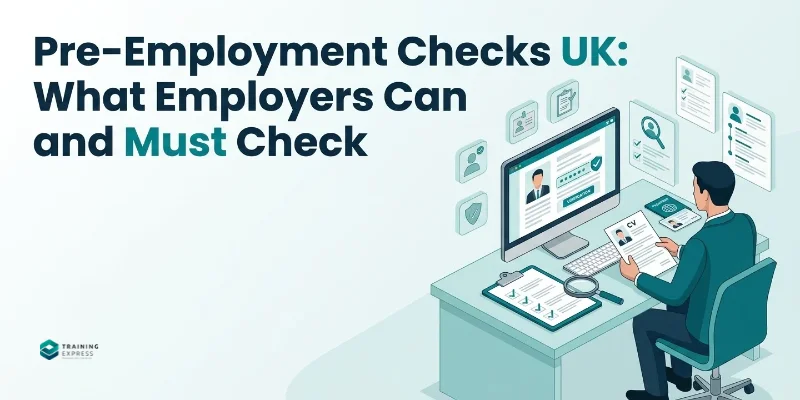

Pre-employment checks are the checks an employer makes before someone starts work. They confirm who the person is, that they can legally work in the UK and that they suit the job. Only one check is required by law for every job in the UK: the right to work check. Others, such as DBS checks, are required for certain roles, and the rest are up to you.
Done well, pre-employment checks protect your business, your staff and your customers. Done badly, they can break data protection rules or lead to discrimination claims. This guide explains each common check, when to do it and how to stay within the law.
Key takeaways
- Every employer must check that a new starter has the right to work in the UK before they start work.
- Basic criminal record checks are available for all roles, but more detailed DBS checks are only permitted for eligible roles.
- Employers generally cannot ask health-related questions before making a job offer, except in limited circumstances.
- Most other checks, including references, are best made conditional on a job offer.
- All pre-employment checks involve personal data. Tell candidates what you are checking, why you need it and keep only the information necessary.
What Are Pre-Employment Checks?
Pre-employment checks, sometimes called pre-employment screening, are the checks you carry out on a preferred candidate before they start work. They help you confirm that what the person has told you is true and that they can legally and safely do the job.
The checks you need depend on the role. A café hiring a barista will need far fewer checks than a care home hiring a support worker, or a bank hiring a financial adviser. The key is to decide in advance which checks each role needs, and then apply them to every candidate for that role in the same way.
Which Pre-Employment Checks Are Required by Law?
Here’s a quick view of the most common checks and when they’re needed:
| Check | Required by law? | When it applies |
|---|---|---|
| Right to work | Yes, for every job | Before the person starts work |
| Criminal record (DBS) check | Required for some roles | Roles in regulated activity with children or adults, and some regulated sectors |
| Professional registration | Required for regulated professions | For example nurses, doctors, social workers and security staff |
| Driving licence | Needed where the job involves driving | Delivery drivers, sales staff with company cars |
| Identity | Part of other checks | Always, as part of right to work and DBS checks |
| References | No (except some regulated sectors) | Usually a condition of the job offer |
| Qualifications | No | Where a qualification is essential for the job |
| Health checks | Only if the job requires it | After a job offer, for example eyesight tests for drivers |
| Credit and social media checks | No | Only where clearly relevant to the role |
The Main Pre-Employment Checks Explained
Identity Checks
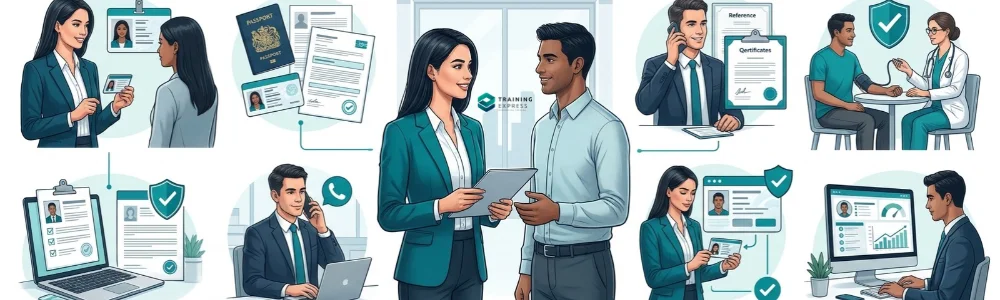
An identity check confirms the person is who they say they are. It usually happens as part of the right to work check and any DBS check, using documents such as a passport. Check that photos match the person, names and dates of birth are consistent, and any name changes are explained, for example with a marriage certificate.
Right to Work Checks
A right to work check is the one check every UK employer must do for every new starter, whatever their nationality. You must check before the person starts work. There are three methods: an online check with a share code, a digital check through a registered provider, or a manual check of original documents.
Get it right and you have a legal defence called a statutory excuse. Get it wrong and you could face a fine of up to £45,000 per illegal worker, or £60,000 for a repeat breach. Since 1 October 2026, the duty also covers some workers, subcontractors and platform-based arrangements. Our complete guide to right to work checks explains each step, and our guide to right to work documents lists what you can accept.
Criminal Record (DBS) Checks
In England and Wales, criminal record checks are carried out by the Disclosure and Barring Service (DBS). There are four levels:
- Basic check: shows unspent convictions and conditional cautions. You can ask for one for any role.
- Standard check: shows spent and unspent convictions and cautions. Only for eligible roles.
- Enhanced check: shows the same as a standard check, plus any information local police think is relevant. Only for eligible roles, such as many jobs in healthcare and education.
- Enhanced check with barred lists: also shows whether the person is barred from working with children or adults. Only for roles in regulated activity.
You can’t choose a higher level just because you’d like more information. Standard and enhanced checks are only allowed where the law makes the role eligible. If you’re unsure, ask the DBS.
In Scotland, checks are carried out by Disclosure Scotland, which runs the Protecting Vulnerable Groups (PVG) scheme. In Northern Ireland, checks are carried out by AccessNI.
Under the Rehabilitation of Offenders Act 1974, many convictions become “spent” after a set time. Unless the role is eligible for a standard or enhanced check, it is against the law to refuse to employ someone because of a spent conviction.
References
References help you check someone’s work history and conduct. There’s generally no legal duty on a previous employer to give a reference, although some regulated sectors, such as financial services, have their own rules.
Ask the candidate for permission before you contact referees. Many employers ask for references only after making an offer, so the candidate’s current employer doesn’t find out too early. Make the offer conditional on satisfactory references, and decide in advance what “satisfactory” means.
Keep in mind that many employers now give only factual references, such as job title and dates of employment. A short reference isn’t a bad sign on its own.
Qualifications and Professional Registration
If a qualification is essential for the job, check it. Ask to see original certificates, and contact the awarding body if anything looks wrong. For UK degrees, the Higher Education Degree Datacheck (HEDD) service can verify them. For overseas qualifications, UK ENIC can tell you how they compare to UK levels.
For regulated professions, check the official register. For example, nurses must be on the Nursing and Midwifery Council register, and many security roles need a Security Industry Authority licence.
Health Checks
Under section 60 of the Equality Act 2010, you generally can’t ask candidates about their health or disability before you offer them a job. There are limited exceptions, such as asking whether they need reasonable adjustments for the interview, or whether they can carry out a function that is essential to the job.
After you’ve made an offer, you can make it conditional on a health check, but only if a health check is genuinely needed for the role. For example, the law requires eyesight checks for some professional drivers. Mention any health check in the offer letter.
If you want a report from the candidate’s doctor, you must get their written consent first. Under the Access to Medical Reports Act 1988, they also have the right to see the report.
Driving Licence Checks
If the job involves driving, check the candidate’s licence. The candidate can create a check code on the DVLA’s “View or share your driving licence information” service and give it to you. The check code is valid for 21 days and lets you see the vehicles they can drive and any penalty points or disqualifications.
Credit and Social Media Checks
Credit checks and social media checks are not required by law for most jobs. Only use them where they are clearly relevant, such as a credit check for a role handling large sums of money.
Be careful with both. A blanket credit check could unfairly exclude some groups, and social media profiles can reveal protected characteristics, such as religion or sexual orientation, that must not affect your decision. If you do these checks, tell candidates in advance and keep them proportionate.
When Should You Carry Out Pre-Employment Checks?
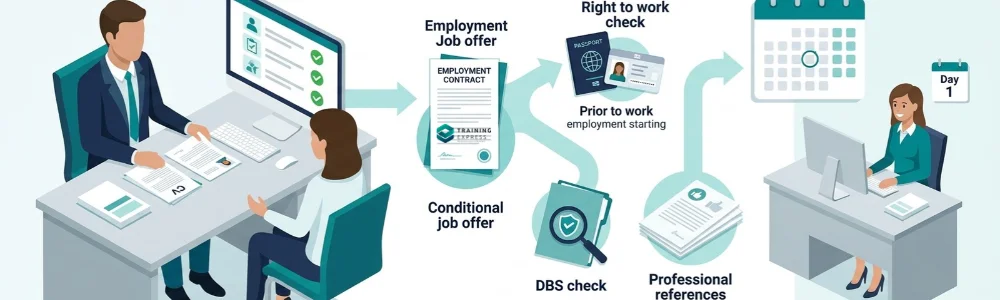
Most checks happen after you’ve chosen your preferred candidate and made a conditional job offer. That way, you don’t collect personal data from every applicant, and you only check people you actually want to hire.
The exception is the right to work check, which must be completed before the person starts work. You can do it earlier, even before an offer, as long as you check every candidate at the same stage in the same way.
Allow time for checks in your recruitment timetable. A right to work check can take minutes, but a DBS check or a slow reference can take days or weeks.
How to Make a Conditional Job Offer
A conditional job offer is an offer that only becomes final once certain checks are complete. Put the conditions in writing in the offer letter. For example:
“This offer is conditional on: proof of your right to work in the UK, two satisfactory references, a satisfactory enhanced DBS check, and evidence of your qualifications. We may withdraw this offer if any of these conditions is not met.”
Be clear about which checks apply, and avoid conditions you won’t actually check. If the candidate accepts, keep a copy of the signed offer with their records.
Pre-Employment Checks and Data Protection
Every pre-employment check involves personal data, so UK GDPR and the Data Protection Act 2018 apply. In practice, this means:
- Tell candidates which checks you’ll carry out and why, usually in a privacy notice.
- Only collect what you need for the role.
- Take extra care with criminal record and health information, which have stricter rules.
- Keep data secure and limit who can see it.
- Don’t keep it longer than needed. Delete unsuccessful candidates’ data after a set period. Keep right to work records for the length of employment plus two years.
The Information Commissioner’s Office (ICO) publishes guidance on recruitment and data protection. Our guide to the General Data Protection Regulation (GDPR) explains the basics, and GDPR training can help your team handle candidate data safely.
How to Avoid Discrimination in Pre-Employment Checks
Pre-employment checks must not discriminate against candidates because of protected characteristics under the Equality Act 2010, such as race, religion, disability or age.
- Decide which checks each role needs, and apply them to every candidate for that role.
- Never check someone’s right to work only because they “seem foreign”.
- Don’t ask health questions before an offer, except in the limited cases allowed.
- Judge criminal records against the role, not as an automatic bar.
Discrimination compensation has no upper limit, so consistency is worth the effort.
What Happens If a Candidate Fails a Check?
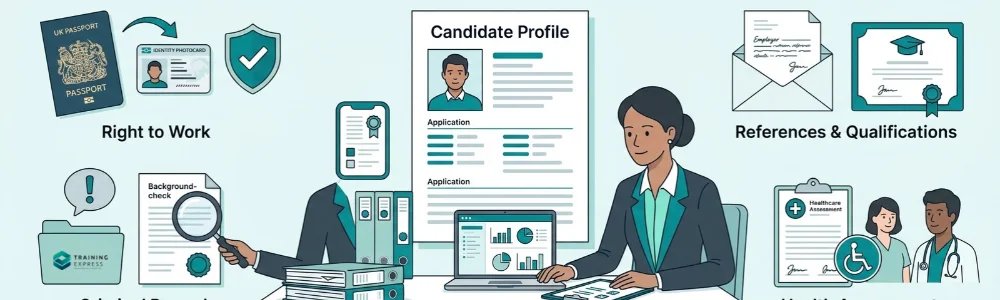
If a candidate fails a check, you can usually withdraw a conditional offer. How you do it matters:
- Right to work: if the person can’t prove their right to work, you must not employ them.
- Criminal record: consider whether the offence is relevant to the job, how long ago it happened and what the person says about it. Don’t reject people because of spent convictions unless the role is eligible.
- References or qualifications: talk to the candidate first. There may be a simple explanation, such as a former employer’s policy of giving short references.
- Health: consider reasonable adjustments before withdrawing an offer on health grounds.
Explain your decision in writing and keep a record of your reasons.
Pre-Employment Checks Checklist
- Checks decided for the role in advance
- Candidates told which checks you’ll make
- Conditional offer letter lists every check
- Right to work check completed and saved before day one
- Correct DBS level, if the role is eligible
- References received and recorded
- Essential qualifications and registrations verified
- Health check, if needed, done after the offer with consent
- Driving licence checked, if the job involves driving
- Records stored securely, with deletion dates set
Build Safe, Fair Hiring Into Your Business
Pre-employment checks work best when everyone who hires follows the same process. Training Express’s HR Management course covers recruitment and onboarding, and the UK Employment Law course covers employers’ legal duties, from right to work to discrimination.
Frequently Asked Questions (FAQs)
What pre-employment checks are legally required in the UK?
Only the right to work check is required by law for every job. Other checks, such as DBS checks and professional registration, are required for certain roles. The rest, such as references, are up to the employer.
Can someone start work before checks are complete?
Not before the right to work check is complete. For other checks, it depends on the role and sector rules. For example, roles in regulated activity usually need DBS clearance first. Wherever possible, finish all checks before the start date.
How long do pre-employment checks take?
A right to work check can take minutes. References and DBS checks can take from a few days to several weeks, depending on how quickly referees and the DBS respond.
Can I ask candidates about their health?
Generally not before you offer them a job. After an offer, you can make it conditional on a health check if the role genuinely needs one, and you need written consent before asking for a doctor’s report.
Do all jobs need a DBS check?
No. You can ask for a basic DBS check for any role, but you don’t have to. Standard and enhanced checks are only allowed for eligible roles, such as many jobs working with children or vulnerable adults.
How long should I keep pre-employment check records?
Only as long as you need them. Keep right to work records for the length of employment plus two years. Set clear retention periods for other checks and for unsuccessful candidates’ data.

Robert Lawrence
Author | Specialises in E-Learning.
Robert Lawrence is an author at Training Express, with over 5 years of experience creating practical resources and strategies to support learners and enhance their professional & personal development.
Reviewed by: Aftab Ansari, Human Resource Specialist at Training Express