Food Hygiene
 Health & Safety
 Safeguarding
 First Aid
 Business Skills
 Personal Development

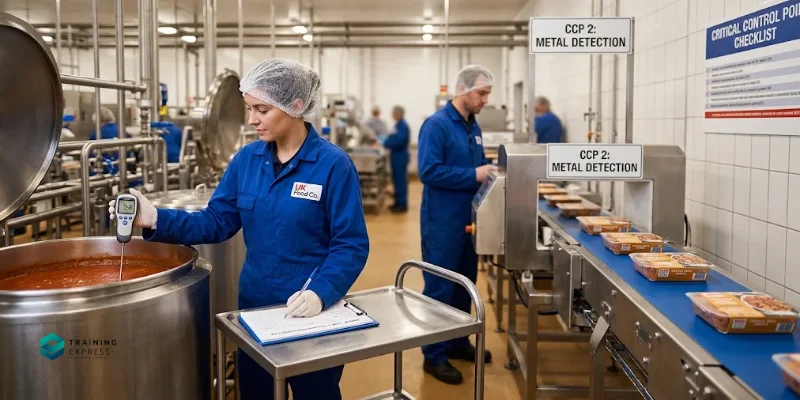

Most kitchens don’t have too few critical control points. They have too many.
It’s easy to see why. Cooking, chilling, cleaning, deliveries, allergens: it all feels critical, so it all gets labelled a CCP. But when every step is “critical”, the few checks that really stop people getting ill get lost in the paperwork. An EHO will also notice quickly if those checks have no measurable limits.
This guide shows you how to tell the difference. You’ll get a plain-English definition, the decision tree the Food Standards Agency (FSA) points to, a table of UK critical limits, a worked example for a single dish, and the records an Environmental Health Officer (EHO) actually wants to see.
Table of Contents
What is a critical control point?
The FSA’s MyHACCP guidance defines a critical control point (CCP) as a step where control can be applied and is essential to prevent or eliminate a food safety hazard, or reduce it to an acceptable level.
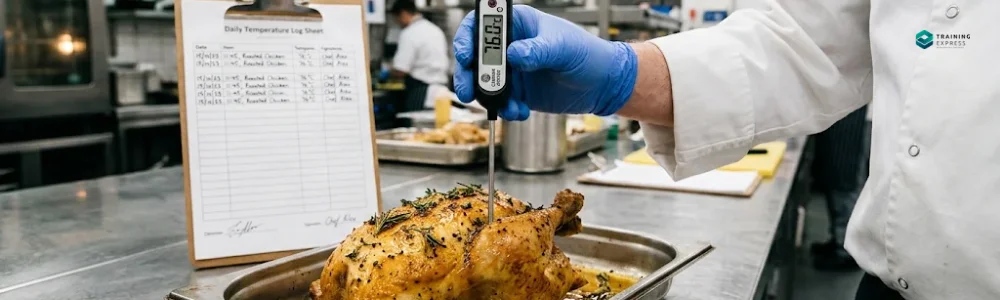
The word doing the heavy lifting there is essential. A CCP is your last reliable chance to deal with a hazard. Miss it, and nothing later in the process will save the food.
Cooking raw chicken is the textbook case. If the core never gets hot enough, Salmonella or Campylobacter survive, and plating, garnishing and serving won’t change that. Wiping down a prep table matters too. But it’s rarely a CCP, because other controls back it up.
CCPs exist to control four kinds of hazard:
- Biological: bacteria, viruses, parasites and moulds. The big one in most kitchens.
- Chemical: cleaning chemical residues, pesticides, the wrong preservative dose.
- Physical: glass, metal, hard plastic, stones in pulses.
- Allergens: technically a chemical hazard, but most businesses treat them as their own category, because even a trace can cause a severe reaction. The UK requires the 14 major allergens to be declared.
Control point vs critical control point: the difference that matters
This is the distinction that decides whether your HACCP plan is useful or just long.
| Factor | Control Point (CP) | Critical Control Point (CCP) |
|---|---|---|
| What it is | Any step where a hazard is managed. | A step where control is essential and no later step removes the hazard. |
| If it fails | A later step can usually still catch the problem. | Unsafe food can reach the customer. |
| Typical examples | Handwashing, cleaning schedules, pest control and checking deliveries. | Cooking, cooling, metal detection and pasteurisation. |
| Paperwork | Covered by prerequisites and routine checks. | Needs a critical limit, monitoring, corrective action and records. |
Here’s a quick test I use. Ask: “If this step went wrong today and nobody noticed, would a later step still make the food safe?” If the answer is yes, it’s a control point. If it’s no, you’re probably looking at a CCP.
Where CCPs sit in your HACCP plan
HACCP stands for Hazard Analysis and Critical Control Point. In UK law, Article 5 of Regulation 852/2004 (now assimilated law in Great Britain) requires food businesses to put in place, implement and maintain food safety procedures based on HACCP principles.
CCPs aren’t just principle 2. They run through all seven:
- Conduct a hazard analysis. List what could go wrong at each step.
- Determine the critical control points. Decide which steps are essential.
- Establish critical limits. Set the measurable line between safe and unsafe for each CCP.
- Establish monitoring. Decide who checks what, how and how often.
- Establish corrective actions. Plan what happens when a limit is missed.
- Validate and verify. Prove the limits work, then keep checking that the system does.
- Keep documents and records. If it isn’t written down, an inspector will assume it didn’t happen.
Two newer points are worth knowing. The Codex Alimentarius revision of its General Principles of Food Hygiene in 2020 now asks for validated critical limits, meaning you should be able to show why your number keeps food safe, not just that you picked one. It also introduced the idea of good hygiene practices that need greater attention. Cleaning a surface that touches ready-to-eat food, for example, deserves more focus than cleaning walls, without necessarily becoming a CCP.
That second point is the key to a short, sharp CCP list. Plenty of important things are prerequisites (cleaning, pest control, staff hygiene, supplier checks) rather than CCPs. They still matter. They just don’t need to be dressed up as CCPs.
How to find your CCPs with a decision tree
The FSA says CCPs should be decided through experience and judgement, and a decision tree can help. MyHACCP offers two: the Codex tree and the Campden BRI tree. You can use either, or your own.
Run every significant hazard at every process step through these questions. This is the Codex version, with the FSA’s guidance in brackets:
Codex decision tree
Is this step a CCP?
Tap YES or NO to follow the path for one hazard at one step.
Start here
Do control measures exist for this hazard?
Is control at this step necessary for safety?
Is this step specifically designed to eliminate the hazard or reduce it to an acceptable level?
FSA tip: Think about the step, not the controls.
Could contamination happen, or the hazard increase, to an unacceptable level?
FSA tip: Ask, “What if we lost control here?”
Will a later step eliminate the hazard or reduce it to an acceptable level?
Based on the Codex decision tree in the FSA’s MyHACCP guidance.
Codex or Campden BRI? The Campden BRI tree (six questions) doesn’t flag steps where hazards are already controlled well by prerequisites, so it usually produces fewer CCPs. The FSA gives glass as an example: the Codex tree would make it a CCP, while Campden BRI wouldn’t, provided your prerequisite controls for glass are working. Fewer CCPs only works if those prerequisites are genuinely solid.
Three rules from the FSA that save a lot of arguments:
- Record your answers and your reasons for each hazard, and keep a copy of the tree you used.
- If you’re unsure, assume the worst until you have evidence otherwise.
- If the tree finds no CCPs at all, check your answers again. It’s rare for a food process to have none.
Critical control point examples with UK critical limits
A critical limit is the measurable value that separates safe food from unsafe food. “Cook thoroughly” is not a critical limit. “Core temperature 75°C for 30 seconds” is.
These are the limits most UK food businesses build their CCPs around:
| CCP | Hazard | Typical UK Critical Limit | How It's Monitored |
|---|---|---|---|
| Cooking | Bacteria surviving | Core 70°C for 2 minutes, or 75°C for 30 seconds (60°C/45 min, 65°C/10 min and 80°C/6 sec are equivalent). | Probe the thickest part, every batch. |
| Cooling | Spore-forming bacteria multiplying | Aim for below 8°C within 90 minutes. | Probe and time each batch. |
| Hot Holding | Bacteria growing in held food | 63°C or above; below 63°C for up to 2 hours, once only. | Probe at set times during service. |
| Reheating | Bacteria grown since cooking | Steaming hot all the way through, once only; at least 82°C in Scotland (legal requirement). | Probe each portion or batch. |
| Chilled Storage (if your tree makes it a CCP) |
Bacteria growing | 8°C maximum by law in England, Wales and NI; fridges set at 5°C or below. | Air or product temperature, twice daily. |
| Pasteurisation (manufacturing) |
Pathogens in milk | 72°C for 15 seconds. | Continuous chart recorder. |
| Metal Detection (manufacturing) |
Metal fragments | Detector rejects test pieces of the set size every time. | Test-piece check at start, set intervals and end of run. |
A note on allergens: some businesses make allergen segregation a CCP with a zero-tolerance limit. Many others manage allergens through prerequisites such as separate equipment, labelling checks and staff training. Either can be valid. What matters is that the hazard analysis justifies the choice.
Worked example: one dish from delivery to plate
Theory only gets you so far. Here’s a single dish, a carvery roast chicken, run through a hazard analysis. I’ve shown a typical outcome, but your own decision tree answers make the final call.
| Step | Main Hazard | Control | CCP? |
|---|---|---|---|
| 1. Delivery | Warm or damaged chilled goods | Approved supplier, check temperature on arrival. | No: prerequisite. |
| 2. Chilled Storage | Bacterial growth | Fridge at 5°C or below, raw below ready-to-eat. | Usually no: prerequisite (Codex may say yes). |
| 3. Preparation | Cross-contamination from raw chicken | Separate boards, handwashing, cleaning. | No: prerequisite. |
| 4. Cooking | Salmonella and Campylobacter surviving | Core 75°C for 30 sec, probed every batch. | Yes: CCP 1 |
| 5. Hot Holding | Bacteria growing during service | 63°C or above, probed every hour. | Yes: CCP 2 |
| 6. Cooling Leftovers | Spore-formers multiplying as meat cools | Below 8°C within 90 minutes, then refrigerate. | Yes: CCP 3 |
| 7. Reheating | Bacteria grown since cooking | Steaming hot, once only. | Often yes in practice; check your tree. |
Seven steps, three or four CCPs. That’s a plan a team can actually run on a busy Sunday. Compare it with a plan that lists every step as a CCP, where the cooking check ends up getting the same attention as the delivery check. That’s how mistakes slip through.
Monitoring, corrective action and records that stand up to inspection
Monitoring: who, what, when
Monitoring is the planned observation or measurement that tells you a CCP is under control. For each CCP, write down who checks it, what they measure, how (which probe, where in the food) and how often.
Frequency depends on the risk. Every batch for cooking. Set intervals for hot holding. Twice a day for fridges. Checking at the same points each day makes patterns easier to spot, for example a fridge that creeps up every afternoon.
Check your probe, too. A CCP check is only as good as the thermometer behind it. The FSA’s Safer Food, Better Business pack suggests putting a digital probe in iced water, where it should read between -1°C and 1°C, and in boiling water, where it should read between 99°C and 101°C. If it’s outside that range, replace it or send it for calibration.
Corrective action: when a limit is missed
A missed critical limit is called a deviation. Your plan should say exactly what happens next, so nobody has to improvise mid-service:
- Hold the food. Stop anything produced since the last good check from going out.
- Decide its fate. Can it be made safe (for example, cooked for longer)? If not, throw it away.
- Fix the cause. Faulty oven, overloaded fridge, rushed staff, a missing step in the method.
- Record it. What went wrong, what you did, and what will stop it happening again.
Records: what a good CCP log looks like
Inspectors don’t want a novel. They want evidence that checks happen and problems get handled. A simple CCP log is enough:
Example monitoring log
CCP 1Cooking (roast chicken)
Critical limitCore 75°C for 30 sec
| Date | Batch | Core temp | Checked by | OK? | Action taken |
|---|---|---|---|---|---|
| 10/11 | Chicken x6 | 78°C | JS | ✓Yes | –None needed |
| 10/11 | Chicken x4 | 71°C | JS | ✗No | Back in oven 10 min, re-probed 79°C ✓ |
| 11/11 | Chicken x6 | 76°C | AK | ✓Yes | –None needed |
Any reading below the critical limit needs a corrective action, recorded on the same line.
That second line is the most valuable one on the page. It shows a deviation was noticed, fixed and written down. An EHO would much rather see that than a log where every entry is a suspiciously perfect tick.
Verification and review
Verification asks whether the whole system is working. Is someone senior checking the logs each week? Are probes being tested? The FSA also says your CCP decisions should be reviewed whenever something changes: a new dish, a new ingredient, new equipment or a change to the process. Most councils also suggest reviewing your plan at least once a year.
Seven mistakes that make CCPs useless
- Calling everything a CCP. It dilutes attention. Prerequisites belong in prerequisites.
- Limits you can’t measure. “Cook until done” and “keep cold” can’t be checked. Numbers can.
- An unchecked probe. If it reads 3°C high, every “pass” on your log might be a fail.
- No planned corrective action. Staff improvise, and improvisation rarely gets written down.
- Perfect logs. Pages of identical readings completed at the end of the week tell an inspector the checks didn’t really happen.
- A template nobody adapted. A downloaded plan for a burger bar won’t fit your sushi counter.
- Never reviewing it. The menu changed in spring. The HACCP plan still describes last year’s kitchen.
Do small food businesses need formal CCPs?
Every food business in the UK needs food safety procedures based on HACCP principles. How formal they are depends on what you do.
- Caterers and small retailers in England and Wales can use the FSA’s free Safer Food, Better Business (SFBB) pack. It’s built on HACCP principles but uses “safe methods” rather than formal CCP language, which suits simple processes.
- Businesses in Northern Ireland can use Safe Catering, the equivalent pack.
- Businesses in Scotland can use Food Standards Scotland’s CookSafe. Remember Scotland’s rules differ in places, including the legal 82°C minimum for reheated food.
- Manufacturers and complex processes usually need a full HACCP plan. The FSA’s free MyHACCP tool walks you through it, decision tree included.
The pack isn’t the point, though. The point is that the people doing the checks understand why each check exists. A chef who knows that cooling is a CCP because of spore-forming bacteria is far less likely to leave a tray of rice on the side “to cool down a bit”
What to do now
Three things, in this order:
- Draw your process as a simple flow, from delivery to service, for your highest-risk dish.
- Run each hazard through the decision tree and write down your answers. You’ll probably end up with fewer CCPs than you expected, and that’s a good sign.
- Give every CCP a number, a check and a plan B. A measurable limit, a named person, a log and a written corrective action.
If you want your team to understand the thinking behind CCPs rather than just filling in sheets, our Level 2 HACCP Training covers the principles for food handlers. For supervisors and managers who build and review the plan, Level 3 HACCP Training goes deeper into hazard analysis, critical limits and verification.
Frequently Asked Questions (FAQ)
What are critical control points in food safety?
A critical control point (CCP) is a step in your food process where control can be applied and is essential to prevent or eliminate a food safety hazard, or reduce it to an acceptable level. Cooking raw chicken is the classic example: if it doesn’t reach a safe core temperature, nothing later in the process will kill the bacteria. Each CCP needs a measurable critical limit, regular monitoring, a planned corrective action and records.
What are examples of critical control points?
Common critical control points include cooking (a core temperature of 70°C for 2 minutes, or 75°C for 30 seconds), cooling cooked food quickly, hot holding at 63°C or above, and reheating until steaming hot (at least 82°C in Scotland). In manufacturing, metal detection and pasteurisation (for example, milk at 72°C for 15 seconds) are typical CCPs. Your own hazard analysis decides which apply to you.
What is the difference between a control point and a critical control point?
A control point is any step where you manage a hazard, such as handwashing or cleaning. A critical control point is a step where control is essential and no later step will remove the hazard. If a control point fails, something further on can usually still catch the problem. If a critical control point fails, unsafe food can reach the customer, so it needs a measurable limit, monitoring and records.
How many critical control points should a HACCP plan have?
There is no set number. The Food Standards Agency says it depends on how complex your process is and how many hazards you are controlling. A small café might have two or three, while a factory could have many more. Too many CCPs is a warning sign, because it usually means good hygiene practices are being labelled as CCPs and the truly critical steps get less attention.
Is food storage a critical control point?
It can be, but it often isn’t. Chilled storage is usually controlled by prerequisite practices such as setting fridges at 5°C or below and checking them daily, with 8°C as the legal maximum in England, Wales and Northern Ireland. Using the Codex decision tree may flag it as a CCP, while the Campden BRI tree usually won’t if those prerequisites are working. Either answer is fine if you record your reasoning.

Robert Lawrence
Author | Specialises in E-Learning.
Robert Lawrence is an author at Training Express, with over 5 years of experience creating practical resources and strategies to support learners and enhance their professional & personal development.
Reviewed by: Amelia Frey, Food Hygiene & Safety Specialist at CupStory