Food Hygiene
 Health & Safety
 Safeguarding
 First Aid
 Business Skills
 Personal Development
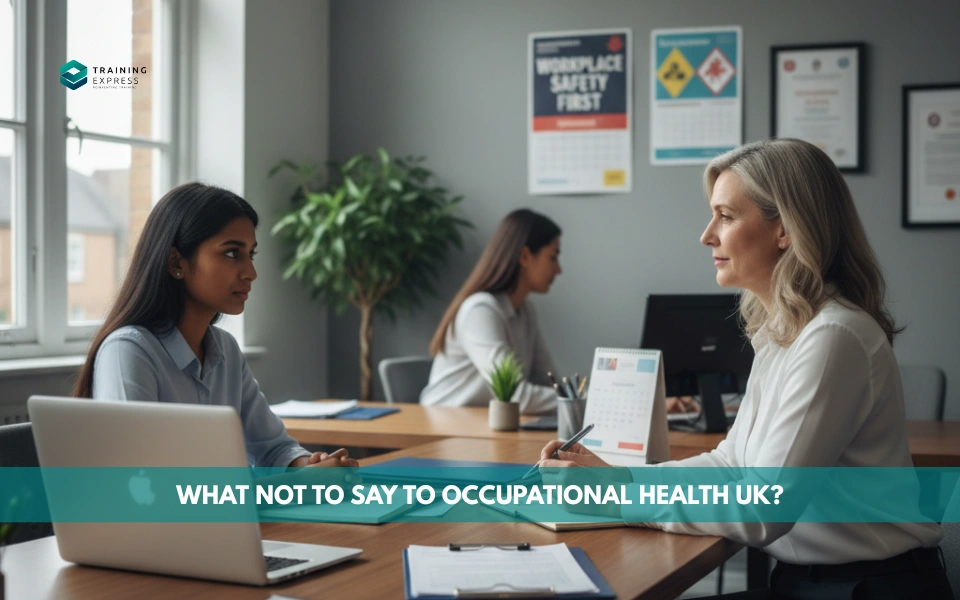

Navigating conversations with Occupational Health in the UK can feel intimidating, especially if you’re unsure about what to say—or what not to say. Many employees walk into assessments thinking they need to defend themselves, downplay their condition, or even vent about their workplace struggles. But here’s the truth: Occupational Health is not there to get you into trouble, nor are they your enemy. They exist to bridge the gap between your health and your ability to work safely and effectively.
That’s why your words matter. Saying the wrong thing can misrepresent your situation, lead to inaccurate reports, and even prevent you from getting the support or reasonable adjustments you’re entitled to. This article will break down what not to say to Occupational Health in the UK, why communication matters, and what to say instead. By the end, you’ll understand not only how to approach these conversations but also how to ensure your needs are fairly considered.
Table of Contents
What Not To Say and What To Say Instead
This section highlights common phrases people may use when speaking to occupational health and provides safer, more appropriate alternatives. It helps you understand what to avoid saying, why it matters, and how to communicate your concerns more effectively in a professional UK workplace setting.
| What Not To Say | What To Say Instead | Reason to Avoid | Benefits |
|---|---|---|---|
| “It’s just a minor issue.” | “I’d like to discuss a health concern that may affect my work.” | Minimizes the issue | Ensures the concern is taken seriously |
| “I don’t need any adjustments.” | “I may need some support or adjustments to perform effectively.” | Can seem dismissive of your own needs | Ensures proper workplace support |
| “My colleague had the same issue, and they…” | “I’m experiencing a similar issue and would like guidance.” | Assumes OH should act the same | Gets personalised advice |
| “My boss is the problem.” | “I’m experiencing challenges at work and need advice on managing them.” | Can appear accusatory | Encourages practical solutions |
| “I’m fine, it’s nothing serious.” | “I’ve noticed health issues affecting my work and would like guidance.” | May delay necessary support | Early intervention |
| “It’s just stress; I can handle it.” | “I am experiencing work-related stress and need support.” | Minimizes mental health concerns | Access to mental health resources |
| “I don’t want anyone to know about this.” | “I’d like to discuss this confidentially and explore options.” | Can restrict OH from offering solutions | Maintains privacy |
| “I can’t do my job anymore.” | “I’m currently struggling with certain aspects of my role and would like support or adjustments.” | Too absolute, may create unnecessary concern | Encourages support without escalation |
| “This job is making me ill.” | “I’ve noticed my health is being affected and would like to discuss possible contributing factors.” | Can sound accusatory or definitive | Opens constructive assessment |
| “Nothing can help me.” | “I’m not sure what support is available, but I’d like to explore options.” | Shows hopelessness, limits solutions | Keeps conversation solution-focused |
| “I need to be moved immediately.” | “I’d like to discuss whether a temporary or alternative adjustment might be possible.” | Demands action without assessment | Encourages flexible planning |
| “I’ve been off because of anxiety.” | “I’ve been experiencing anxiety and would like guidance on managing it at work.” | Over-disclosure without context | Focuses on support and adjustments |
| “Work is toxic.” | “I’m finding my work environment challenging and would like advice on coping strategies.” | Emotionally loaded language | Promotes constructive discussion |
| “I’m not coping at all.” | “I’m finding some aspects of my workload difficult and would like support.” | May sound absolute or alarming | Provides clarity without escalation |
| “It’s probably nothing serious.” | “I’m unsure how serious this is, but I’d like to get it checked.” | May delay assessment | Encourages early intervention |
| “I just need time off forever.” | “I may need time off or adjustments depending on medical advice.” | Unrealistic framing | Keeps options open and realistic |
| “I don’t trust HR/Occupational Health.” | “I want to understand how Occupational Health can support me.” | Creates resistance | Builds collaborative tone |
What Occupational Health Really Means
Occupational Health (OH) is often misunderstood, but its core purpose is clear: to support both employees and employers in managing health-related issues that affect work. Unlike your GP, OH isn’t primarily about diagnosing illnesses or prescribing treatment. Instead, it focuses on how your health condition interacts with your job, what adjustments may be required, and how you can continue to perform safely and productively.

For example, if you’re recovering from surgery, OH might recommend reduced hours or modified duties until you’re fit for full-time work again. If you live with a long-term condition like diabetes or anxiety, OH could suggest reasonable adjustments under the Equality Act 2010, ensuring you have the tools and environment needed to thrive at work.
The aim isn’t to “judge” you but to help create a safe and balanced workplace. Think of OH as a mediator between your health needs and the organisation’s ability to support you.
Why Your Words Matter During an Occupational Health Assessment
When you walk into an OH assessment, every word you say helps shape the advisor’s report. This doesn’t mean you need to be overly cautious or rehearsed, but it does mean thinking carefully about how you describe your situation. Some phrases, even if said casually, can send the wrong message and limit your access to support.

Let’s explore some of the most common mistakes employees make:
“It’s just a minor issue.”
Downplaying your condition may sound like humility, but it can work against you. If OH records that your issue is “minor,” your employer may assume no adjustments are necessary, leaving you to struggle silently at work.
Instead, describe how the issue impacts your daily tasks, even if it feels small. For example: “I can complete my duties, but sitting for long periods worsens my back pain, and it affects my concentration.” This frames the issue in practical terms without exaggeration.
“I don’t need any adjustments.”
This phrase can shut down the entire process. Even if you think you don’t need adjustments now, you may need them in the future—or there may be small changes that would make a big difference. Saying you don’t need adjustments might result in OH reporting that no support is required, leaving you with fewer options later.
Instead, consider phrasing it like: “I’m managing for now, but small adjustments could make my work easier.”
“My colleague had the same issue, and they…”
Comparing your condition or circumstances to a colleague’s experience is one of the most unhelpful things you can say during an Occupational Health (OH) assessment. Every individual is unique, and the way a health issue affects one person can be completely different from how it affects another. By bringing up colleagues, you risk making the conversation less about your needs and more about office gossip or comparisons that aren’t relevant.
OH professionals need specific, personal, and factual details about your situation, not second-hand stories. For example, two people with back pain might require entirely different workplace adjustments depending on their role, workload, and underlying medical causes.
Instead of saying, “My colleague had the same issue, and they didn’t need any changes,” try something more focused:
- “This is how my condition affects my daily tasks.”
- “These are the situations that make it harder for me to work comfortably.”
By keeping the focus on yourself, you ensure that the assessment is tailored to your unique needs, not someone else’s.
“My Boss is the Problem”
It’s natural to feel frustrated with management if workplace pressures have worsened your condition, but framing your health issue as solely a conflict with your boss is risky. OH is not a disciplinary body, nor is it there to resolve personal disputes. Making your manager the central focus can shift attention away from your genuine health needs and make you appear confrontational.
Instead, describe your challenges in neutral, work-focused language. For example:
- Avoid: “My boss keeps overloading me with tasks, and that’s why I’m stressed.”
- Try: “High workloads and tight deadlines worsen my anxiety symptoms, and I’d benefit from adjustments to manage this.”
By framing the issue around working conditions rather than personalities, you keep the conversation constructive and ensure the OH advisor can make actionable recommendations.
What To Say Instead – Constructive Communication Tips
If you’re unsure how to approach an Occupational Health assessment, the key is to balance honesty, professionalism, and clarity. Here are some practical tips on what to say instead of the common mistakes we’ve just covered.
Be Honest, But Professional

Honesty is critical, but so is the way you present it. Being truthful about your condition doesn’t mean venting frustrations or oversharing unrelated personal problems. Keep the focus on how your health directly affects your work.
For example:
- Honest but professional: “I experience chronic fatigue, and it affects my ability to concentrate for long periods.”
- Unhelpful: “I’m exhausted all the time because my partner snores, and my manager doesn’t care.”
The first example gives OH something concrete to work with. The second mixes personal issues with workplace frustrations, which may dilute your message.
Stick to Work-Related Challenges

Your assessment isn’t about every detail of your personal life—it’s about how your health condition interacts with your job. Keep your responses tied to your duties, responsibilities, and workplace environment.
Instead of: “I’m just tired all the time.”
Say: “I struggle with fatigue, which makes it difficult to focus during long meetings or complete tasks that require sustained concentration.”
This helps OH understand your challenges in a way that can be addressed through practical workplace solutions.
Provide Examples of How Your Health Affects Work

Concrete examples strengthen your case. OH advisors and employers need to see the link between your condition and your role to recommend meaningful adjustments.
For instance:
- “My arthritis makes it painful to type for long periods, which slows down my ability to complete reports.”
- “Standing for extended shifts worsens my back pain, so I need more frequent breaks.”
Such examples help translate medical issues into workplace realities, making it easier for OH to recommend targeted adjustments.
Ask About Reasonable Adjustments

Don’t be afraid to ask questions. Many employees assume they can’t request adjustments unless OH suggests them, but being proactive shows that you’re engaged in the process.
Some good questions to ask might include:
- “What adjustments would you recommend based on my role?”
- “Are there temporary measures that could help while I recover?”
- “How can I prevent my condition from worsening at work?”
This shows initiative and helps ensure you don’t leave the assessment without discussing potential solutions.
The Role of Occupational Health in the Workplace
Employers use Occupational Health services for several reasons, including:
- Reducing absenteeism – By finding ways for employees to remain in work where possible.
- Supporting return-to-work plans – Helping staff ease back into duties after illness or injury.
- Promoting health and wellbeing – Offering advice on lifestyle changes, stress management, and ergonomics.
- Ensuring compliance with legislation – Protecting both employee rights and employer responsibilities under UK law.
A common mistake employees make is assuming that OH is there to protect the employer only. In reality, OH sits in the middle: they must consider both sides and provide recommendations that are fair and legally compliant.
So, when you sit down with an OH advisor, remember—they’re not there to “catch you out.” They’re there to understand your condition in relation to your work and to suggest practical ways forward.
Why Proper Communication Matters
Proper communication matters because it ensures Occupational Health understands your needs accurately, helping you receive the right support and adjustments at work.
Building Trust Between Employee and Employer

Good communication during an OH assessment builds trust. If you come across as honest and cooperative, the OH advisor is more likely to recommend adjustments that genuinely support you. On the other hand, being vague, defensive, or dismissive can create unnecessary barriers.
Employers often rely heavily on OH reports when making decisions about workplace adjustments, sickness absence management, or even capability reviews. That means your ability to clearly explain your situation has a direct impact on the support you receive.
Think of it like this: if you’re not clear, OH can only fill in the gaps with assumptions—and those assumptions may not work in your favour.
How Miscommunication Can Affect Your Work Situation

Miscommunication with OH can create long-term consequences. For instance:
- If you downplay symptoms, your employer might think you’re fit for full duties when you’re not.
- If you exaggerate issues, it could raise doubts about your credibility and make management more cautious about trusting your word.
- If you vent about unrelated problems (e.g., “my boss is toxic”), OH may not be able to use that information constructively, and it could overshadow your genuine health concerns.
Clear, factual, and work-focused communication ensures that OH reports reflect the reality of your situation. Remember: the way you present your health story can influence whether you receive helpful adjustments or find yourself facing unnecessary workplace challenges.
Common Misconceptions About Occupational Health

Many employees approach Occupational Health with misunderstandings that can create unnecessary fear or resistance. These misconceptions often lead people to withhold information, feel defensive, or assume the worst about the process. By clearing up these myths, you can approach your assessment with confidence and focus on getting the right support.
“They’re here to get me fired”
One of the biggest fears employees have is that OH is secretly working with the employer to find reasons to terminate their employment. While OH reports can inform employer decisions, the purpose is not to remove employees but to suggest solutions. Dismissing staff without exploring adjustments is often unlawful under the Equality Act 2010.
“They’re the same as my GP”
Another misconception is treating OH like your personal doctor. Unlike your GP, OH isn’t there to diagnose or prescribe treatment. Their expertise lies in connecting health with work demands, not providing medical care.
“It’s just a tick-box exercise”
Some employees see OH appointments as pointless, assuming nothing meaningful comes from them. In reality, OH assessments are often the first step toward workplace adjustments. Whether it’s ergonomic equipment, flexible hours, or phased returns, these changes can significantly improve both health and job satisfaction.
The Legal and Ethical Side of Occupational Health
Occupational Health (OH) in the UK isn’t just about advice and assessments—it also sits within a legal and ethical framework. Understanding your rights, protections, and the responsibilities of OH professionals can make you feel more confident during the process.
Confidentiality in Occupational Health

One of the most important things to know is that OH operates under strict confidentiality rules. The details you share in your assessment are considered medical information and cannot be shared freely with your employer. Instead, OH produces a report with relevant recommendations—not a full disclosure of your health history.
For example, if you share that you have a mental health condition, OH will not provide your employer with every detail of your diagnosis. Instead, the report might state: “The employee may benefit from reduced workload pressures and flexible scheduling.”
This confidentiality builds trust. It allows you to be open about your condition without fear that private details will be used against you. However, OH must also balance this with providing employers enough information to make informed decisions.
Equality Act 2010 and Reasonable Adjustments

The Equality Act 2010 is central to occupational health discussions. It protects employees from discrimination based on disability or long-term health conditions. If your condition qualifies as a disability under the Act, your employer has a legal duty to make reasonable adjustments to help you continue working.
Examples of reasonable adjustments include:
- Flexible working hours.
- Ergonomic equipment such as special chairs or keyboards.
- Adjusted duties or reduced workload.
- A phased return-to-work plan after illness or injury.
OH plays a key role here by identifying adjustments that meet both your needs and the employer’s operational requirements. Your words in the assessment help OH decide what adjustments to recommend—another reason why communication is so important.
Your Rights During the Process

Many employees worry that attending an OH assessment means they’ll be forced into decisions they don’t want. In reality, you still hold rights throughout the process. Some of the key ones include:
- Consent: OH cannot share their report with your employer without your consent. You usually get the chance to review it before it’s sent.
- Right to refuse: While refusing an OH assessment may affect how your employer manages your case, it’s still your choice.
- Right to request adjustments: You’re entitled to suggest or request adjustments if you believe they would help.
- Right to fair treatment: Employers cannot dismiss you purely because of a medical condition without first exploring adjustments.
By knowing your rights, you approach OH assessments with confidence, ensuring you’re an active participant in shaping the recommendations rather than feeling powerless.
Case Studies – Real-Life Scenarios of What Went Wrong
Sometimes, the best way to learn what not to do is through real examples. These scenarios highlight how poor communication during an OH assessment can lead to negative outcomes.
Employee Who Downplayed Condition

Imagine an employee suffering from chronic migraines. During the OH assessment, they said: “It’s just a minor headache now and then.”
Because the issue was downplayed, OH recorded that no adjustments were needed. As a result, the employee continued struggling with frequent absences, worsening symptoms, and poor workplace performance. Eventually, their employer initiated capability procedures, which could have been avoided if the condition had been explained honestly.
Lesson: Don’t minimise your health problems. If an issue affects your work, even if it feels small, explain it clearly.
Employee Who Overstated Problems

On the flip side, another employee overstated their condition, saying: “I can’t do any of my duties because of back pain.”
While they did experience pain, this statement created the impression that they were completely unable to work. OH concluded that they might not be fit for their role at all, which led to discussions about redeployment and possible dismissal.
In reality, the employee could have continued working with simple adjustments like a supportive chair and regular breaks. But because they exaggerated, they ended up in a worse position.
Lesson: Avoid exaggeration. Be truthful, provide examples, and suggest ways your condition can be managed.
Final Words
Speaking to Occupational Health in the UK doesn’t have to be daunting. The key is knowing what not to say and replacing unhelpful phrases with constructive, work-focused communication. Downplaying your condition, exaggerating symptoms, blaming your boss, or insisting you don’t need adjustments can all lead to misleading reports that don’t serve your best interests.
Instead, approach OH conversations with honesty, professionalism, and a willingness to explore solutions. Remember your rights under the Equality Act 2010, trust that confidentiality protects your private details, and focus on how your health interacts with your role.
By choosing your words carefully, you not only protect yourself but also increase the chances of receiving meaningful support and adjustments that allow you to thrive in the workplace.
Frequently Asked Questions (FAQ)
Is Occupational Health the same as my doctor?
No. Your GP diagnoses and treats medical conditions, while OH focuses on how your health affects your ability to work and what adjustments may be needed.
Can Occupational Health recommend I be dismissed?
No. OH does not dismiss employees. They provide advice to employers. Decisions about dismissal are made by employers, often after considering OH input and legal obligations.
Do I have to follow Occupational Health advice?
You’re not legally bound to follow OH recommendations, but your employer may rely on their advice when making workplace decisions. It’s usually in your best interest to cooperate.
What should I bring to my appointment?
Bring any medical documents, GP notes, or hospital letters that explain your condition. These help OH create a more accurate report.
Can I refuse to attend Occupational Health?
Yes, but refusing may limit your employer’s ability to support you. It could also affect how they manage your absence or health-related performance issues.

Robert Lawrence
Author | Specialises in Health & Social Care
Robert Lawrence is an e-learning specialist and tutor at Training Express, with experience creating practical resources and strategies to support learners and enhance their professional development.