Food Hygiene
 Health & Safety
 Safeguarding
 First Aid
 Business Skills
 Personal Development
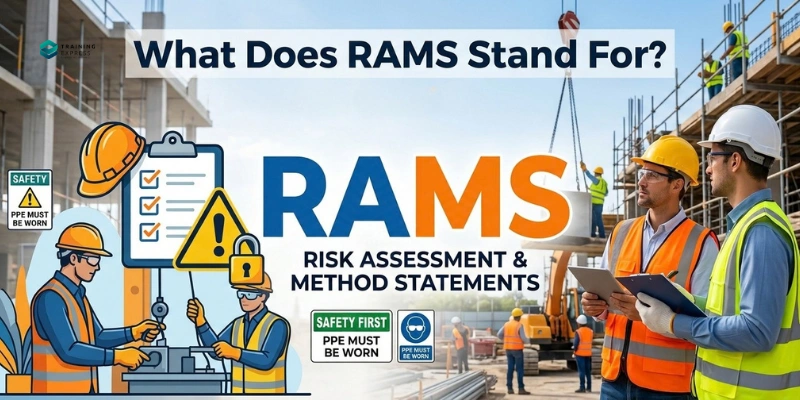

If a client or principal contractor has just asked you for “your RAMS”, they want to see that you’ve thought the job through before anyone sets foot on site. This guide explains what goes in a RAMS, when you need one, who should write it, what the law actually says, and includes a full worked example you can adapt.
Table of Contents
What does RAMS stand for?
RAMS is an acronym for Risk Assessment and Method Statement — two separate documents that are usually produced and submitted together as one pack.

Risk Assessment
A risk assessment identifies what could cause harm during a task, who might be harmed, and what you’ll do about it. It looks at each hazard, judges how likely it is to cause injury and how serious that injury could be, then records the control measures that reduce the risk to an acceptable level.
Under the Management of Health and Safety at Work Regulations 1999, employers and the self-employed must carry out a “suitable and sufficient” assessment of the risks to workers and anyone else affected by the work.
Method Statement
A method statement explains how the job will be done safely, in order, from arrival on site to final clean-up. It turns the controls listed in the risk assessment into practical instructions: who does what, in what sequence, with what equipment, and what happens if something goes wrong.
Think of it this way — the risk assessment is the diagnosis, the method statement is the treatment plan.
"Risk Assessment Method Statement" or "Risk Assessments and Method Statements"?
You’ll see both. Neither is wrong, and no official body defines the “correct” version.
“Risk Assessment and Method Statement” (singular) is the most common expansion and describes a single pack covering one task. “Risk Assessments and Method Statements” (plural) is used when a submission covers several activities — a fit-out contractor might submit one pack containing four risk assessments and three method statements. “Risk Assessment Method Statement”, without the “and”, is simply a shortened spoken form that has stuck in writing.
Other meanings of RAMS
RAMS means something different in other sectors, so it’s worth checking context:
| Sector | RAMS stands for |
|---|---|
| Health and safety / construction | Risk Assessment and Method Statement |
| Rail and systems engineering | Reliability, Availability, Maintainability and Safety (see BS EN 50126 for railway applications) |
| Healthcare and research | Used in the names of clinical scales, including dementia and bladder function assessments |
The rest of this article covers the health and safety meaning.
What is a RAMS document?
A RAMS document is a task-specific and site-specific safety pack, made up of two parts bound together: the risk assessment and the method statement.
Technically it’s two documents, presented as one. Most contractors use a single template with the risk assessment table near the front and the numbered method statement behind it.
RAMS are used across construction, maintenance, facilities management, engineering, cleaning, utilities and events — anywhere a contractor works on someone else’s premises or alongside other trades. The audience is usually wider than people expect:
- The site team who will be briefed on it and expected to follow it
- The principal contractor or site manager, who reviews it before granting access
- The client or building owner, particularly in occupied premises
- Insurers, auditors and HSE inspectors after an incident
Why are RAMS documents important?
RAMS matter because they force the thinking to happen before the work does, not after an incident.

A well-written RAMS reduces the chance of someone being hurt, because hazards are identified while there’s still time to design them out. It also removes ambiguity on site — when three trades are working in the same area, a clear sequence of work prevents the misunderstandings that cause most near misses.
There’s a commercial side too. RAMS are routinely requested at tender stage, and prequalification schemes such as CHAS, SafeContractor and Constructionline (all SSIP members) may ask to see example documents as evidence of your health and safety arrangements. Weak or obviously generic RAMS can cost you the job before you’ve priced it.
Finally, if something does go wrong, your RAMS is part of the evidence that you planned and managed the work properly.
When do you need RAMS?
You’ll typically need RAMS when a task carries significant risk, when someone else’s rules require them, or when the work is complex enough that the sequence needs to be agreed in advance.
High-risk activities
Certain activities almost always warrant a written RAMS because specific regulations require the work to be properly planned:
- Working at height — planning and organisation are required under the Work at Height Regulations 2005
- Hot work such as welding, grinding or torch-on roofing
- Confined space entry — a safe system of work and emergency arrangements are required under the Confined Spaces Regulations 1997
- Lifting operations — must be planned by a competent person under LOLER 1998
- Work with asbestos — a written plan of work is required under the Control of Asbestos Regulations 2012
- Live or isolated electrical work
- Excavation, particularly near buried services
When a client or principal contractor asks
On most commercial and construction sites, no RAMS means no access. That’s a contractual and site-management requirement rather than a statutory one, but the practical effect is the same.
Complex or multi-trade jobs
Where several contractors share a work area, or the job runs over multiple phases, RAMS give everyone a common reference point for the sequence and the interfaces between trades.
When you don't need a full RAMS
Low-risk, routine tasks in low-risk environments — general office work, basic administrative activity, light cleaning — rarely justify a full RAMS. You still need a risk assessment covering the work, but a detailed method statement adds paperwork without adding safety. Judge it on the activity, not the job title.
Risk assessment vs RAMS: what's the difference?
A risk assessment is one component; RAMS is the risk assessment plus the method statement.
| Risk assessment | RAMS | |
|---|---|---|
| Purpose | Identify hazards and decide controls | Identify hazards and set out how the work will be done |
| Scope | Can cover an activity generally or a whole workplace | Usually specific to one task on one site |
| Detail | What could go wrong and what we do about it | Adds sequence, roles, equipment, emergency arrangements |
| Main audience | Employer, employees, safety team | Site team, principal contractor, client |
| When written | Before work begins; reviewed regularly | Before mobilising to a specific site or task |
| Legal basis | Required by MHSWR 1999 (and topic-specific regulations) | Not named in law; supports duties under HSWA 1974, MHSWR 1999 and CDM 2015 |
RAMS vs safe system of work vs permit to work
These three terms overlap, which is why they get muddled. Here’s how they differ:
| Term | What it is | Typical form |
|---|---|---|
| Safe system of work | The overall planned way of working that reduces risk — the concept the law expects | Procedures, training, supervision, documents |
| RAMS | The document that records a safe system of work for a specific task | Written pack submitted before work starts |
| Permit to work | A formal, time-limited authorisation to begin a specific high-risk task, issued and signed by an authorised person | Permit issued on the day, closed out on completion |
In practice, the RAMS describes the method, and the permit authorises it to start on a particular day under stated conditions. High-risk work such as hot work or confined space entry often needs both.
What should be included in a RAMS?
There’s no legally prescribed format, but principal contractors expect to see the following sections.
- Project and task details — client, site address, task description, dates, contractor details and document version.
- Hazards and who might be harmed — including operatives, other trades, visitors, building occupants and members of the public.
- Risk rating — most RAMS use a simple matrix multiplying likelihood by severity to give a score before and after controls:
| Likelihood ↓ / Severity → | Minor (1) | Moderate (2) | Major (3) |
|---|---|---|---|
| Unlikely (1) | 1 – Low | 2 – Low | 3 – Medium |
| Possible (2) | 2 – Low | 4 – Medium | 6 – High |
| Likely (3) | 3 – Medium | 6 – High | 9 – High |
- Control measures and PPE — be specific. “Wear appropriate PPE” tells nobody anything; “cut-resistant Level D gloves and EN 166 eye protection” does.
- Step-by-step sequence of work — numbered, in the order it will happen.
- Plant, equipment and materials — including inspection and certification requirements, such as LOLER thorough examination reports.
- Training and competence — cards, tickets and qualifications relevant to the task (for example IPAF, PASMA, CSCS).
- Emergency and first aid arrangements — rescue plans, first aiders, nearest A&E, spill or fire procedures.
- Monitoring, supervision and review — who supervises, how often, and what triggers a review.
- Briefing record and signatures — proof that the people doing the work were briefed and understood it.
RAMS example: a worked example step by step
Here’s a simplified RAMS for replacing damaged roof tiles on a two-storey domestic property using a mobile access tower.
Risk assessment extract
| Hazard | Who's at risk | Control measures | Residual risk |
|---|---|---|---|
| Fall from height | Operatives | PASMA-trained erectors only; tower erected to manufacturer's instructions; guardrails and toe boards fitted; tower inspected before use and after adverse weather; access via internal ladder only | Low (3) |
| Falling tiles or tools | Public, operatives | Exclusion zone with barriers and signage; debris netting; tools tethered; no throwing materials down | Low (2) |
| Tower overturning | Operatives, public | Tower erected on firm level ground; outriggers fitted; stabilisers checked; work stops if wind exceeds manufacturer's limit | Low (3) |
| Manual handling of tiles | Operatives | Tiles raised in small batches by gin wheel; two-person lift for battens; no carrying loads up the tower | Low (2) |
| Contact with overhead cables | Operatives | Pre-start survey; tower positioned minimum distance from services; DNO contacted if clearance can't be achieved | Low (3) |
| Adverse weather | Operatives | Daily weather check; work suspended in high winds, ice or heavy rain | Low (2) |
Method statement
- Site set-up: park compliantly, unload materials, brief the team on the RAMS and record signatures.
- Survey the work area for overhead services, ground conditions and public access routes.
- Establish the exclusion zone using barriers, cones and warning signage.
- Erect the mobile tower in accordance with the manufacturer’s instructions, using PASMA-trained operatives, fitting stabilisers, guardrails and toe boards.
- Complete and display the tower inspection record before first use.
- Access the tower internally. Remove damaged tiles by hand and place them in a container on the platform.
- Lower removed tiles using the gin wheel to a second operative inside the exclusion zone.
- Raise replacement tiles in batches, fit and secure them, and check the surrounding tiles for movement.
- Lower all tools and materials. Never drop items from height.
- Dismantle the tower in reverse order, remove barriers, clear debris and hand back the area.
- Record completion, note any deviations from the method, and report any near misses to the supervisor.
Emergency arrangements: trained first aider on site; incidents reported immediately to the site supervisor; in the event of a fall, call 999 and do not move the casualty unless there is immediate further danger.
How to write a RAMS in 7 steps
- Gather the task information. Get the scope, drawings, site rules, access arrangements and any client requirements. Visit the site if you can.
- Identify the hazards. Walk the task through in your head, from arrival to hand-back. Include hazards created by others working nearby.
- Assess the risk. Judge likelihood and severity for each hazard, using your matrix.
- Set the controls. Follow the hierarchy: eliminate the hazard first, then substitute, then engineering controls, then administrative controls, and PPE last.
- Write the sequence of work. Number the steps in the order they’ll happen and keep sentences short. Write it for the person doing the job.
- Consult and brief the workers. The people doing the task usually spot gaps a desk-based author misses. Record the briefing.
- Review and sign off. Have it checked by a competent person, add a version number and review date, then issue it.
Who is responsible for writing RAMS?
The employer or contractor carrying out the work is responsible for producing the RAMS for that work. You can’t delegate that to the client or the principal contractor.
- The employer or contractor owns the document because they control the method, the equipment and the people. If you’re a subcontractor, you write RAMS for your own scope.
- The competent person does the actual writing. Competence means a combination of training, knowledge, experience and the ability to recognise the limits of what you know. A qualified health and safety adviser can support the process, but the detail usually needs input from someone who understands the trade in practice.
- Who reviews and approves them — on CDM 2015 projects, the principal contractor plans, manages and monitors the construction phase and coordinates the contractors working on site, which in practice means reviewing incoming RAMS before granting access. Their acceptance doesn’t transfer responsibility back to them; the contractor remains responsible for the accuracy of their own document and for working to it.
Are RAMS a legal requirement?
RAMS aren’t specifically named in UK law. However, the Health and Safety at Work Act 1974 requires employers to provide safe systems of work, and a method statement is simply one way of recording that.
The Management of Health and Safety at Work Regulations 1999 also require a suitable and sufficient risk assessment — recorded in writing if you employ five or more people — along with proper planning and monitoring of your safety measures.
On construction sites, CDM 2015 requires contractors to plan their work safely, and RAMS are usually how that gets evidenced. So RAMS aren’t a legal requirement themselves, just the industry’s way of meeting one.
How often should RAMS be reviewed?
Review a RAMS whenever something material changes, and at set intervals — many organisations use 12 months as a default backstop for standing documents.
Trigger a review when:
- The task, method or sequence changes
- Site conditions change — new access arrangements, weather, adjacent works
- The people change, including new starters or a change of supervisor
- Equipment or materials change
- There’s an incident, near miss or dangerous occurrence
- New information emerges, such as updated HSE guidance, a revised safety data sheet or new legislation
Record the review date and version number so everyone knows which copy is current. Superseded versions should be removed from site.
How to make sure workers actually follow RAMS
A RAMS only works if the people doing the job know what’s in it. That means treating the briefing as part of the job, not paperwork to be signed in the van.

Brief the team before work starts and again whenever the document changes. Use a toolbox talk to cover the key hazards and the sequence in plain language, and give people the chance to challenge anything that won’t work in practice. Keep a sign-on sheet as evidence, but remember the signature isn’t the point — understanding is.
Write the document so a new operative can read it and know what to do. If your method statement needs a health and safety qualification to decode, it won’t be followed. Supervisors should then spot-check that the work matches the method, and stop the job if it doesn’t.
Common RAMS mistakes to avoid
- Generic copy-and-paste documents. A RAMS with another site’s address in it tells a principal contractor everything they need to know about your planning.
- Length over substance. A 40-page RAMS for a half-day job won’t be read. Depth should match risk.
- Missing or vague emergency arrangements. “Call the emergency services” is not a rescue plan for a confined space.
- No briefing. An unbriefed RAMS protects nobody.
- Never reviewing it. A document that hasn’t changed in five years probably doesn’t describe how you actually work.
- PPE as the first control. PPE sits at the bottom of the hierarchy, not the top.
Benefits of using RAMS
- Fewer incidents, because hazards are identified before work starts
- Clearer instructions for the people doing the job
- Better coordination between trades
- Evidence of planning for clients, insurers and inspectors
- Stronger tender submissions and prequalification applications
- A consistent, repeatable way of managing risk across projects
Free RAMS checklist
Use the checklist below to sense-check any RAMS before you submit it:
- Site-specific details correct and current
- All significant hazards identified, including those affecting others
- Risk ratings shown before and after controls
- Controls follow the hierarchy, with PPE last
- Sequence of work numbered and in plain English
- Equipment inspection and certification recorded
- Competence and training requirements listed
- Emergency and rescue arrangements specific to the task
- Supervision and monitoring named
- Version number, author, review date and briefing record included
How we can help
Writing a credible RAMS depends on understanding the risks you’re assessing. Our Risk Assessment, Working at Height and COSHH courses give the practical grounding needed to identify hazards properly, apply the hierarchy of control and write documents that hold up on site — and in an investigation.
Frequently Asked Questions (FAQ)
What does RAMS mean in construction?
Risk Assessment and Method Statement — a combined document setting out the hazards of a construction task, the controls that will manage them, and the step-by-step method the work will follow.
Is RAMS one document or two?
Two documents, normally issued as one pack. The risk assessment and the method statement serve different purposes but are read together.
Do RAMS need to be signed?
There’s no legal requirement to sign a RAMS, but signatures are standard practice. The author or competent person signs to approve it, and operatives sign to confirm they’ve been briefed. Most principal contractors won’t accept an unsigned document.
How long should a RAMS be?
As long as the risk requires and no longer. A single-trade maintenance task might need three or four pages; a complex lift or confined space entry will need considerably more.
Can I use a RAMS template?
Yes, and most contractors do. A template gives you a consistent structure — but it must be tailored to the actual task, site and team. Submitting an untailored template is one of the most common reasons RAMS are rejected.
Who approves RAMS on a construction site?
Usually the principal contractor or site manager, who reviews submissions before granting access. On smaller projects it may be the client or building owner. Approval doesn’t transfer responsibility away from the contractor who wrote it.
Do small businesses need RAMS?
If you carry out higher-risk work, yes — the duty to assess risk applies regardless of size. Employers with fewer than five employees don’t have to record the significant findings of their risk assessment in writing, but if you want to work on commercial or construction sites you’ll be asked for written RAMS anyway.
What happens if you don't have RAMS?
Commercially, you’ll usually be refused site access or excluded from tenders. From an enforcement perspective, the absence of RAMS itself isn’t an offence — but failing to assess risks or provide a safe system of work is, and after an incident you’d have little evidence that you planned the work properly.

Robert Lawrence
Author | Specialises in E-Learning.
Robert Lawrence is an author at Training Express, with over 5 years of experience creating practical resources and strategies to support learners and enhance their professional & personal development.
Reviewed by: Orion Stewart, Healt and Safety Specialist at Training Express
Related Blogs