Food Hygiene
 Health & Safety
 Safeguarding
 First Aid
 Business Skills
 Personal Development
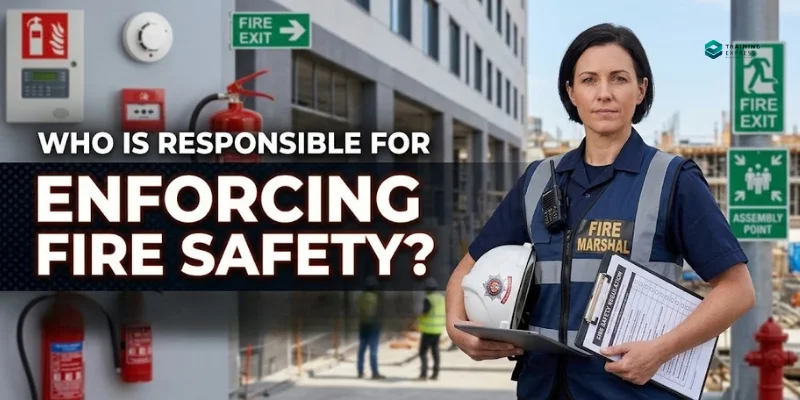

Nobody at the fire brigade is responsible for your fire safety. You are.
That’s the part most business owners get backwards. They picture the fire service as the party that “handles” fire safety, when its role is to check that you did. Below is the split between who owes the duty and who polices it, plus what happens when the two meet. It covers England and Wales. Scotland and Northern Ireland run on their own rules.
Table of Contents
Two questions, two different answers
“Who is responsible for enforcing fire safety?” is really two questions wearing one coat.
Who owes the duty? The responsible person, defined in the Regulatory Reform (Fire Safety) Order 2005.
Who checks you did it? The local fire and rescue authority, mostly.
Blur them and you end up assuming the inspector will flag problems before they matter. They won’t. They show up, review what you’ve done, and act on the gaps. The duty was yours long before they arrived.
Who counts as the responsible person
The Order defines it by control, not job title. On GOV.UK the list runs from employers and owners through landlords and occupiers to “anyone else with control of the premises”, such as a facilities manager, building manager, managing agent or risk assessor.
Most of the time that means the employer. If you run a shop, an office, a workshop or a B&B with paying guests, it’s you.
A few situations trip people up:
- Shared buildings. More than one person can be responsible. They’re required to coordinate, not each assume the other has it handled. For common areas, it’s typically the landlord, freeholder or managing agent.
- Tenants. Leasing a floor doesn’t hand the whole problem to your landlord. You still need to be satisfied the escape routes from your space to the exit are adequate.
- Companies. The responsible person is often an organisation, not a human. A store manager can run the daily checks, but the company carries the responsibility.
- Visiting workers. A maintenance engineer on someone else’s site isn’t the responsible person there. The building’s responsible person has to tell them about the risks and precautions.
And the delegation question, since it comes up constantly. You can hand off the tasks. You can’t hand off the blame. Hire a competent assessor, appoint fire marshals, let a manager run the checklist. The legal duty stays exactly where the Order put it.
What the duty actually asks of you
Strip out the legal wording and there are seven jobs:
- Carry out a fire risk assessment, and review it regularly
- Act on the risks it finds — remove them or reduce them
- Tell staff (or their representatives) what those risks are
- Provide and maintain sensible fire safety measures, from alarms to extinguishers
- Keep escape routes and exits clear and usable
- Plan for emergencies, including people who’ll need help getting out
- Give staff information, instruction and training
One detail worth pinning to the wall: with five or more employees, you must record the significant findings of the assessment in writing. Under five, you technically needn’t, but an assessment you can’t show anyone is hard to defend. Write it down anyway.
Also — review it after a change. New layout, new use of the space, new equipment. A risk assessment from three years ago describing a different floor plan is just paper.
Running a residential block? Extra rules apply, including the Fire Safety (England) Regulations 2022 and, for taller buildings, regular fire door checks.
Who enforces it: your local fire and rescue authority
The main enforcer is the local fire and rescue authority. Its fire safety officers inspect non-domestic premises, look over your risk assessment and prevention measures, and take action if they think what you’ve got isn’t good enough.

Officers can enter premises, ask for documents and question the responsible person or staff. Inspections can be planned or unannounced.
Other bodies can hold jurisdiction depending on the building type, including the Health and Safety Executive, Defence Fire Services, local authorities and, for higher-risk buildings, the Building Safety Regulator. For a standard shop or office, though, expect the fire and rescue authority.
Here’s the reassuring bit. GOV.UK says officers should help you understand the rules and comply with them. First contact is often informal, such as suggested improvements. Formal action is the next step, not the first.
Three notices, three levels of trouble
When the authority moves to formal action, it uses one of three tools:
- Alterations notice — for premises with high safety risks, or that will have them if their use changes. Think of it as a heads-up with teeth.
- Enforcement notice — for a serious risk that isn’t being managed. It spells out what to fix and by when.
- Prohibition notice — the nuclear option. It takes effect immediately and restricts or blocks access to the premises because the risk is judged too great.
A prohibition notice doesn’t wait for your convenience. If customers are walking out the door on an ordinary Tuesday and you get one, that’s revenue gone the same day.
Fines, prison and the 21-day appeal window
Per GOV.UK, minor penalties can go up to £5,000. Major ones mean unlimited fines and up to two years in prison. Prosecution tends to follow serious or repeated failures, not a single missed extinguisher check.
If you disagree with a notice, you have options:
- Ask the authority for an informal review
- Appeal to the magistrates’ court within 21 days of receiving the notice
- In some disputes, request a determination from the Home Secretary
That 21 days runs from receipt. Put the date in your calendar the moment a notice lands.
Four things to do this week
Skip the theory. Here’s the practical version:
- Confirm who the responsible person is. For each building you touch — owned, leased or shared — write down the name or the company. If two parties share control, write down how you’ll coordinate.
- Find your latest fire risk assessment. If you can’t put your hands on it in two minutes, that’s your answer. If you have five or more staff, check it’s written down and dated.
- Walk your escape routes. Blocked doors and cluttered corridors are the cheapest problems to fix and the most damaging to ignore.
- Check your training records. The Order requires staff information, instruction and training. If there’s no evidence it happened, treat it as if it didn’t.
None of this needs a consultant on day one. It needs a name, a document, a walk-through and a folder.
This post is general information, not legal advice. For complex buildings, high-risk premises or a live notice, talk to a qualified fire risk assessor or a solicitor, and check the current official guidance on GOV.UK.
If you’re building systems to keep compliance tasks like this from slipping through the cracks — reminders, records, review dates — that’s exactly the kind of thing we dig into inside the Knox Community.
Frequently Asked Questions (FAQ)
Who is responsible for enforcing fire safety in the UK?
The local fire and rescue authority enforces fire safety in most non-domestic premises in England and Wales. Its inspectors can visit, review your risk assessment and issue formal notices. The legal duty to comply, though, sits with the “responsible person”, usually the employer, owner, landlord or whoever controls the building.
Who is the responsible person for fire safety at work?
It’s whoever has control of the premises: typically the employer, but also the owner, landlord, occupier, facilities manager or managing agent. Where several people share control, they must coordinate and cooperate. Organisations can be the responsible person, not just individuals.
Can I delegate fire safety responsibility to someone else?
You can delegate tasks, such as hiring a competent fire risk assessor or appointing fire marshals. You can’t delegate the legal responsibility itself. If something goes wrong, enforcement lands on the responsible person, even if a manager handled the day-to-day work.
What are the penalties for breaking fire safety rules?
According to GOV.UK, minor penalties can reach £5,000. Major penalties carry unlimited fines and up to two years in prison. The fire and rescue authority can also issue alterations, enforcement or prohibition notices, and a prohibition notice can shut off access to your premises immediately.
Can I appeal a fire safety notice?
Yes. You may be able to request an informal review from the fire and rescue authority first. You can also appeal to your local magistrates’ court within 21 days of receiving the notice. In some disputes, either side can ask the Home Secretary for a determination.

Robert Lawrence
Author | Specialises in E-Learning.
Robert Lawrence is an author at Training Express, with over 5 years of experience creating practical resources and strategies to support learners and enhance their professional & personal development.
Reviewed by: Orion Stewart, Health and Safety Specialist at Training Express
Related Blogs