Food Hygiene
 Health & Safety
 Safeguarding
 First Aid
 Business Skills
 Personal Development


A personal development plan (PDP) is a short document that sets out what you want to get better at, how you’ll do it and when. Below you’ll find a free template you can download or copy, a fully completed example, and simple steps to write your own.
Maybe your manager has asked for one before your appraisal. Maybe your university wants one, or you just want a clearer plan for your career. Either way, you don’t need to start from a blank page.
Short on time? Download the template, look at the completed example, then read Step 3 on writing SMART objectives. You can have a solid first draft in about 20 minutes.
In this blog
What is a personal development plan (PDP)?
A personal development plan (PDP) is a written plan of the skills, knowledge or habits you want to develop, the steps you’ll take, the help you’ll need and the dates you’ll aim for. It turns “I’d like to get better at…” into a short list of goals you can act on and track.

In UK higher education, the Quality Assurance Agency (QAA) describes personal development planning as “a structured and supported process undertaken by an individual to reflect upon their own learning, performance and/or achievement and to plan for their personal, educational and career development” (QAA, 2009). In plain English: look at where you are, decide where you want to be, and plan how to get there.
You’ll usually come across a PDP in one of three places:
- At work — often as part of an appraisal (a regular review of your performance with your manager).
- At university — many UK universities ask students to reflect on their skills and plan their development.
- In regulated professions — some professional bodies make a PDP part of CPD, which stands for continuing professional development: the ongoing learning you do to stay good at your job. For example, the General Dental Council requires dental professionals to have a PDP as part of their CPD record (GDC guidance).
Why it’s worth doing: a PDP makes your goals specific, and specific goals tend to work better than good intentions. A major review of 35 years of goal-setting research found that “specific, difficult goals consistently led to higher performance than urging people to do their best” (Locke & Latham, 2002). The same review found goals work best when you also get regular feedback on your progress — which is exactly what a PDP’s review dates are for.
What should a personal development plan include?
A good personal development plan includes seven things for each goal:
- Development goal — the skill or area you want to improve.
- Why it matters — how it helps your job, studies or career.
- SMART objective — the goal written so it’s clear and checkable (more on SMART in Step 3).
- Actions — the specific things you’ll do.
- Resources and support — people, time, money or tools you’ll need.
- Success measure — how you’ll know you’ve done it, and what evidence you’ll keep.
- Target and review dates — when you’ll finish, and when you’ll check in.
Most plans also start with a quick personal SWOT. That’s a short list of your Strengths, Weaknesses, Opportunities and Threats — it helps you pick the right goals.
Keep it short. Three to five goals on one or two pages is plenty. A plan you actually use beats a long one you forget about.
Free personal development plan template
You can use our free personal development plan template in three ways: download it in Word, download it as a fillable PDF, or copy the table below into any document. There’s no sign-up and no email needed.
Download the free template (Word or PDF)
- [Download the Word template (.docx)] — best if you want to edit freely, add rows for extra goals or share it with your manager. Opens in Microsoft Word, Google Docs (File > Open) or LibreOffice.
- [Download the PDF template] — best for printing or filling in on screen.
Both versions have the same 6 pages. The PDF is fillable, so you can type straight into the boxes and save it, or print it and fill it in by hand. It works in free PDF readers such as Adobe Acrobat Reader and most web browsers.
What's inside (6 pages):
- Page 1 — How to use it: the six steps, what to write in each column, and vague vs SMART goal examples.
- Page 2 — About you and your personal SWOT: your details and four SWOT boxes.
- Page 3 — Your development plan: room for 5 goals, with a drop-down status for each.
- Page 4 — Review log: space for four reviews and the evidence you’ve kept.
- Pages 5–6 — Completed example: Sam’s SWOT and full development plan (the same example shown below).
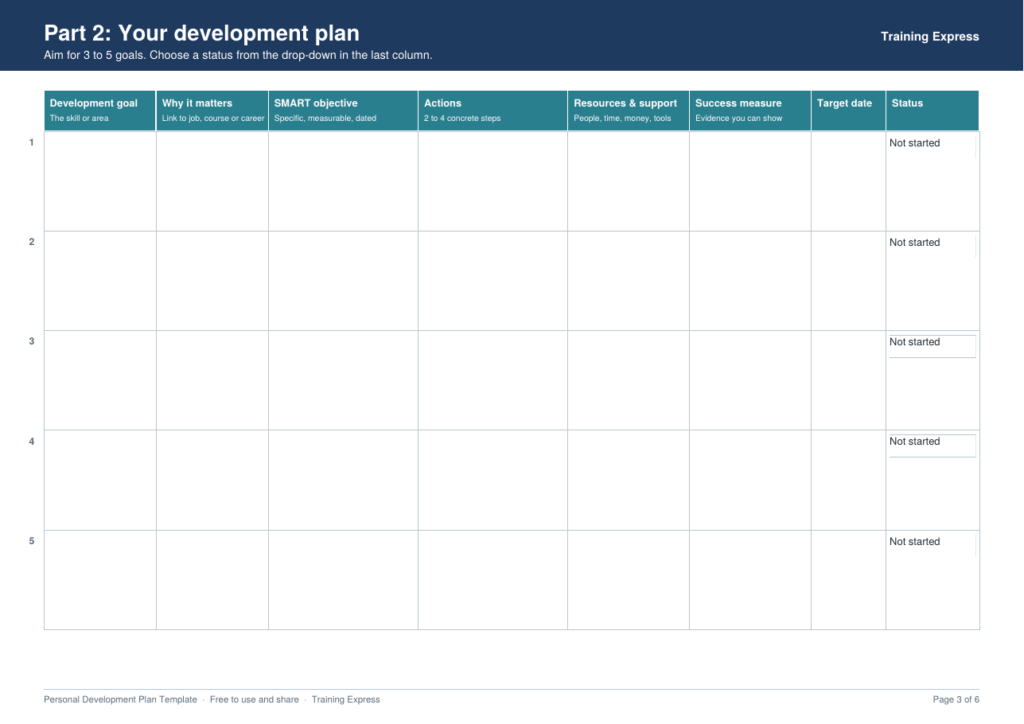
Prefer to work in another document? Copy the blank table below and paste it in.
Blank PDP template (copy and paste)
Name: · Role or course: · Date started: · Next review date:
Part 1: Personal SWOT
| Strengths (what you do well) | Weaknesses (what holds you back) |
|---|---|
| Opportunities (chances you could use) | Threats (things that could get in the way) |
Part 2: Development plan
| Development goal | Why it matters | SMART objective | Actions | Resources and support | Success measure | Target date | Status |
|---|---|---|---|---|---|---|---|
| 1. | |||||||
| 2. | |||||||
| 3. |
Part 3: Review notes
what went well, what didn’t, and what you’ll change.
How to fill in each column
| Column | What to write | Example |
|---|---|---|
| Development goal | One skill or area, in a few words | Presenting to groups |
| Why it matters | The link to your job, course or career goal | Team leaders present updates every month |
| SMART objective | A clear goal with a measure and a date | Deliver two 10-minute team updates by 31 March |
| Actions | Two to four concrete steps | Watch two colleagues present; rehearse with a mentor |
| Resources and support | Who or what will help | Line manager, 1 hour a fortnight with a mentor |
| Success measure | Evidence someone else could check | Manager feedback score of 4/5 or higher |
| Target date | A real date, not "soon" | 31 March |
| Status | Not started, On track, At risk or Done | On track |
Personal development plan example (completed)
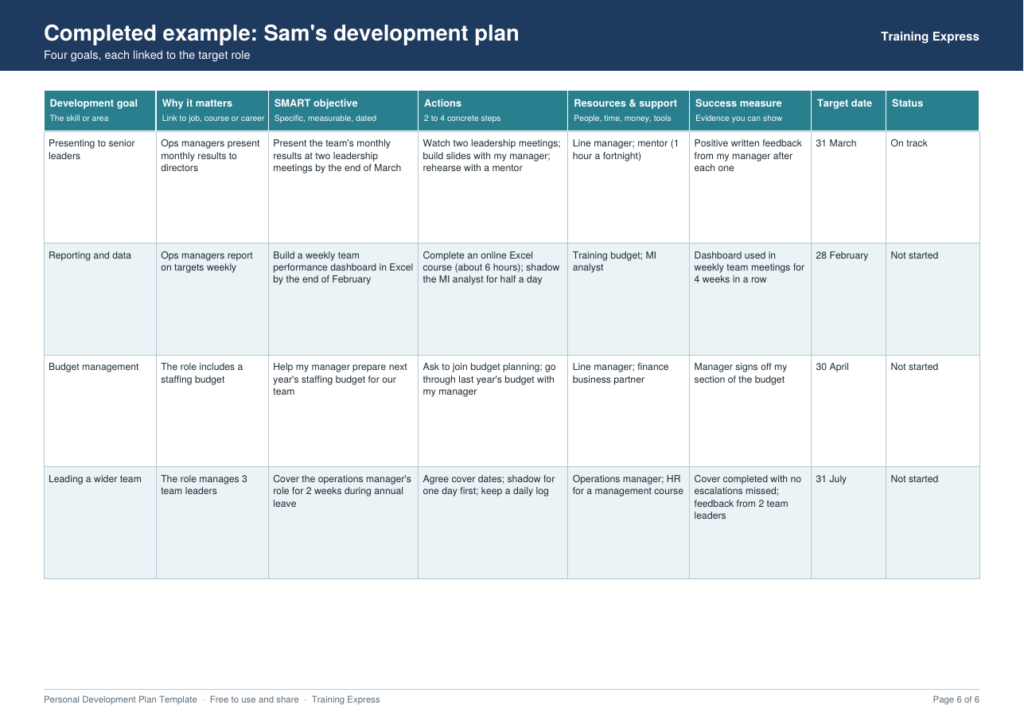
Here’s what a finished personal development plan looks like. Sam is a customer service team leader who wants to be ready to apply for an operations manager role within 18 months.
This is an illustrative example. Use it to see the level of detail to aim for — then write goals that fit your own job.
Name: Sam · Role: Customer Service Team Leader (team of 8) · Started: October · Next review: January
Sam's personal SWOT
| Strengths | Weaknesses |
|---|---|
| Calm with upset customers; team trusts me; strong on processes | Nervous presenting to senior managers; little experience with budgets; avoid spreadsheets |
| Opportunities | Threats |
| Company is opening a second contact centre; manager has offered mentoring; training budget available | Busy peak season Nov–Jan; other team leaders may apply for the same role |
Sam's development plan
| Development goal | Why it matters | SMART objective | Actions | Resources and support | Success measure | Target date | Status |
|---|---|---|---|---|---|---|---|
| 1. Presenting to senior leaders | Ops managers present monthly results to directors | Present the team's monthly results at two leadership meetings by the end of March | Watch two leadership meetings; build slides with my manager; rehearse with a mentor | Line manager; mentor (1 hour a fortnight) | Positive written feedback from my manager after each one | 31 March | On track |
| 2. Reporting and data | Ops managers report on targets weekly | Build a weekly team performance dashboard in Excel by the end of February | Complete an online Excel course (about 6 hours); shadow the MI analyst for half a day | Training budget; MI analyst | Dashboard used in weekly team meetings for 4 weeks in a row | 28 February | Not started |
| 3. Budget management | The role includes a staffing budget | Help my manager prepare next year's staffing budget for our team | Ask to join budget planning; read last year's budget with my manager | Line manager; finance business partner | Manager signs off my section of the budget | 30 April | Not started |
| 4. Leading a wider team | The role manages 3 team leaders | Cover the operations manager's role for 2 weeks during annual leave | Agree cover dates; shadow for one day first; keep a daily log | Operations manager; HR for a management course | Cover completed with no escalations missed; feedback from 2 team leaders | 31 July | Not started |
Why this example works:
- Each goal links to the target role. Sam looked at the operations manager job description and picked the gaps.
- It mixes ways of learning. There’s one course, but most actions are real tasks and help from people.
- The measures are things someone else could check. Feedback, a dashboard in use, a signed-off budget — not “feel more confident”.
How to write a personal development plan in 6 steps
To write a personal development plan, follow these six steps:
- Review where you are now.
- Choose what to develop.
- Turn each goal into a SMART objective.
- Plan your actions and support.
- Set dates and success measures.
- Track, review and update your plan.
Each step fills in part of the template, so you can work through it column by column.
Step 1: Review where you are now
Start by taking an honest look at your current skills. The quickest way is a personal SWOT: list your strengths, weaknesses, opportunities and threats in the four boxes of the template.

Don’t rely on memory alone. Look at your last appraisal, feedback from colleagues or tutors, and any comments from customers. Then ask yourself:
- What do people come to me for?
- What tasks do I put off or find hard?
- What feedback have I heard more than once?
- What’s changing in my job, team or industry?
- What could stop me making progress this year?
Step 2: Choose what to develop
Pick three to five goals that close the gap between where you are and where you want to be. This gap is often called a skills gap — simply the difference between the skills you have and the skills you need.
If you’re aiming for a new role, find a job description for it. Highlight the skills you already have, then circle the ones you don’t. The circled ones are your strongest candidates.
If you’re staying in your role, ask your manager what “great” looks like in your job. Students can use their course learning outcomes or the skills graduate employers ask for.
Try to include at least one strength to build on, not just weaknesses to fix. Getting even better at something you’re good at can matter just as much.
Step 3: Turn each goal into a SMART objective
A SMART objective is a goal written so that anyone could tell whether you’ve achieved it. SMART stands for:
- Specific — clear about what you’ll do.
- Measurable — you can count or check it.
- Achievable — realistic with the time and help you have.
- Relevant — linked to your job, course or career goal.
- Time-bound — has a deadline.
Here’s how vague goals become SMART ones:
| Vague goal | SMART objective |
|---|---|
| Get better at presenting | Give two 10-minute presentations at team meetings by 31 March, and ask for feedback after each |
| Learn Excel | Complete an online Excel course and use pivot tables to build a monthly sales report by the end of February |
| Be more organised | Plan each week every Monday using a task list, and miss no deadlines for 8 weeks in a row |
| Get promoted | Apply for the next senior role that opens, after leading two projects from start to finish by September |
Notice the last one. You can’t control whether you’re promoted, but you can control the steps that make you a strong candidate. Write goals around what you can do.
Step 4: Plan your actions and support
For each goal, list two to four actions. Courses are useful, but they shouldn’t be your only action.
A helpful rule of thumb is the 70-20-10 model. It suggests people learn mostly from doing (around 70%), then from other people (around 20%), and less from formal courses (around 10%). It comes from 1990s work by Morgan McCall, Michael Lombardo and Robert Eichinger, who asked successful executives how they had learned. The numbers aren’t a proven formula, but they’re a good reminder to mix your methods:
- Learn by doing: take on a stretch task, lead a small project, cover for someone.
- Learn from people: find a mentor, shadow a colleague, ask for feedback.
- Learn from courses: an online course, a workshop, a qualification or reading.
Then fill in the resources and support column. Who can help? Do you need time, money or software? If you need your manager’s agreement, note it here.
Step 5: Set dates and success measures
Give every goal a real target date. As a guide:
- Short-term goals: up to 12 months.
- Medium-term goals: 1 to 3 years.
- Long-term goals: 3 years or more.
Most workplace PDPs focus on the next 12 months, with one or two longer goals in the background.
For the success measure, write down evidence someone else could see. Good examples are feedback, a finished piece of work, a certificate, or a task you’ve now done on your own.
Step 6: Track, review and update your plan
Review your plan about every three months, and rewrite it once a year or when your role changes. Put the review dates in your calendar now so they don’t slip.

Use the status column to see progress at a glance: Not started, On track, At risk or Done. Keep your evidence together too — certificates, feedback emails and examples of your work. This makes appraisals and job applications much easier. If you work in a regulated profession, it can also feed your CPD record.
At each review, ask yourself:
- What have I achieved since the last review?
- What got in the way?
- Is each goal still relevant?
- Do I need different support?
- What’s my next step for each goal?
It’s normal for plans to change. Updating a goal isn’t failing — it’s the plan doing its job.
Personal development plan examples for 7 situations
The right personal development plan depends on what you’re working towards. Below are seven common situations, each with one example goal using the same columns as the template. Copy the structure, then change the details to fit you.
Employee aiming for promotion
You want to be ready for the next step up. Focus on the skills in the job description for that role — not just doing your current job well.
| Goal | SMART objective | Actions | Support | Success measure |
|---|---|---|---|---|
| Project leadership | Lead one cross-team project from start to finish by the end of June | Volunteer for the next project; agree scope with my manager; run fortnightly check-ins | Line manager; project sponsor | Project delivered on time; written feedback from the sponsor |
Improving communication and presentation skills
This is one of the most common PDP goals. Make it measurable by counting real presentations and collecting feedback.
| Goal | SMART objective | Actions | Support | Success measure |
|---|---|---|---|---|
| Confident presenting | Present at four team meetings by the end of May, reducing reliance on notes each time | Rehearse with a colleague; record a practice run; ask one person for feedback each time | Colleague; manager | Average feedback score of 4/5 by the fourth presentation |
New or aspiring manager
Moving into management means getting results through other people. Goals around feedback, delegation and one-to-ones are a good place to start.
| Goal | SMART objective | Actions | Support | Success measure |
|---|---|---|---|---|
| Giving feedback | Hold monthly one-to-ones with each team member and give one piece of specific feedback in each, for six months | Learn a simple feedback model; book recurring meetings; keep short notes | Own manager; HR; a management course | All one-to-ones held; team survey shows people know how they're doing |
Time management and organisation
Time management goals work best when they’re tied to a visible result, such as meeting deadlines.
| Goal | SMART objective | Actions | Support | Success measure |
|---|---|---|---|---|
| Managing workload | Meet every agreed deadline for 8 weeks in a row, starting next month | Plan the week every Monday; block 2 hours a day for focus work; flag risks early | Manager for priorities; a task app | Deadline log shows 100% on time over 8 weeks |
Technical and digital skills
Pick one tool or skill that would save time or open doors in your role, and attach it to a real piece of work.
| Goal | SMART objective | Actions | Support | Success measure |
|---|---|---|---|---|
| Data skills | Use Excel pivot tables and charts to produce the team's monthly report on my own by the end of March | Complete a short online course; build a practice report; shadow whoever does it now | Training budget; colleague | Report produced without help for two months running |
Career changer or returner to work
If you’re changing careers or coming back after a break, start by spotting your transferable skills. These are skills you already have that work in many jobs, like organising, problem-solving or dealing with people. The National Careers Service has a free skills assessment that can help.
| Goal | SMART objective | Actions | Support | Success measure |
|---|---|---|---|---|
| Move from retail into HR | Gain an entry-level HR qualification and apply for five HR administrator roles within 9 months | Research HR roles; start a recognised HR course; volunteer to help with rotas or training at work | Careers adviser; a contact working in HR | Qualification started; five applications sent; at least one interview |
University student or graduate
Students often use a PDP to build employability skills alongside their degree. Link your goals to placements, part-time work or the skills graduate employers ask for.
| Goal | SMART objective | Actions | Support | Success measure |
|---|---|---|---|---|
| Work experience | Secure a summer placement or internship in my field by the end of March | Update CV with the careers service; attend two careers fairs; apply to 10 roles | University careers service; personal tutor | Placement offer, or detailed feedback from at least two applications |
Personal development goals for work: 12 ideas
Not sure where to start? Here are 12 development goals people often include in a work PDP. Pick one or two that fit your role, then make them SMART.
Working with people
- Give clearer feedback to colleagues
- Handle difficult conversations calmly
- Build relationships with another team or department
- Mentor a newer colleague
Getting things done
- Manage your time and priorities
- Run better meetings
- Lead a project from start to finish
- Delegate more tasks
Skills and knowledge
- Improve your data or spreadsheet skills
- Learn a new tool your team uses
- Gain a recognised qualification in your field
- Present with more confidence
How to use your PDP at work
Your personal development plan works best when your manager knows about it. Share it before your appraisal or a one-to-one, so you can agree goals and the support you’ll need.
Here’s how to make that conversation easy:
- Send it a few days early. It gives your manager time to think about opportunities for you.
- Link your goals to team goals. Show how your development helps the team, not just you.
- Be specific about what you need. “Two hours a month with a mentor” is easier to agree to than “more support”.
- Agree review dates together. Then put them in both your calendars.
- Bring evidence to each review. Feedback, examples of work and certificates show progress better than words.
Your PDP belongs to you. Your manager can guide and support it, but you’re the one who owns and updates it.
If you manage people
If a team member has asked you to review their PDP, your job is to support, not to take over. A few tips:
- Ask what they want to achieve before suggesting goals.
- Help them find on-the-job chances to learn, not just courses.
- Be honest about what support, time or budget is realistic.
- Check in on their plan at regular one-to-ones, not only at the yearly appraisal.
Personal vs professional development plan: what's the difference?
A personal development plan can cover any area of your life, while a professional development plan focuses only on your job and career. In practice, most work PDPs are a mix of both — and many people use the two terms to mean the same thing.
| Area | Personal development plan | Professional development plan |
|---|---|---|
| Focus | You as a whole: skills, habits, wellbeing and career | Your job, career and professional skills |
| Typical goals | Confidence, time management, a new hobby, fitness, a qualification | Leadership, technical skills, a promotion, a professional qualification |
| Who drives it | You | You, often with your manager or employer |
| Timeframe | Any — often 1 to 5 years | Usually 6 to 12 months, linked to appraisals |
| Where it's used | Self-improvement, university, career planning | Appraisals, CPD, workplace development |
Two related terms you might see:
- Individual development plan (IDP) — a term used more in the US and by HR teams. It’s essentially the same as a work-focused PDP.
- CPD (continuing professional development) — the ongoing learning you do to stay skilled in your job. Your PDP is the plan; your CPD record is the log of what you actually did.
7 common PDP mistakes (and how to avoid them)
Most personal development plans fail for simple, fixable reasons. Watch out for these:
- Too many goals. Ten goals means none get done. Stick to three to five.
- Vague goals. “Improve my skills” can’t be measured. Make every goal SMART.
- Only listing courses. A course alone rarely changes how you work. Add real tasks and help from people.
- No success measure. If you can’t say what “done” looks like, you won’t know when you get there.
- No review dates. Without check-ins, plans drift. Book reviews every three months.
- Copying an example word for word. Examples show the format, not your goals. Your plan should sound like you.
- Writing it once and filing it away. A PDP is a working document. Update it as things change.
Start your personal development plan today
You now have everything you need: a free template, a completed example and six simple steps. Start small — pick one goal, make it SMART, and book your first review date.
References
- Quality Assurance Agency for Higher Education (2009). Personal development planning: guidance for institutional policy and practice in higher education.
- Locke, E. A. and Latham, G. P. (2002). Building a practically useful theory of goal setting and task motivation: a 35-year odyssey. American Psychologist, 57(9), 705–717.
- General Dental Council (2024). Enhanced CPD guidance for dental professionals.
- National Careers Service. Skills assessment.
- McCall, M., Lombardo, M. and Eichinger, R. (1996). The Career Architect Development Planner. Lominger (origin of the 70-20-10 model).
Frequently Asked Questions (FAQ)
How often should you review a personal development plan?
Review your personal development plan about every three months, and rewrite it once a year. Also update it whenever something big changes, like a new role, a new manager or finishing a course. Regular reviews keep your goals relevant and help you spot problems early.
How long should a personal development plan be?
One or two pages is usually enough. Aim for three to five goals, each with clear actions, a measure and a date. A short plan is easier to remember, share and actually use.
What are the 5 steps of a personal development plan?
Different guides split the process in different ways. Most cover the same ground: review where you are, set goals, plan actions, carry them out and track progress. Our six steps add a separate step for choosing what to develop, which helps you pick the right goals.
Is a PDP the same as an IDP?
Mostly, yes. An individual development plan (IDP) is the term often used in the US and by HR teams. A PDP can also include personal goals outside work, but a work-focused PDP and an IDP do the same job.
Who should see my personal development plan?
That’s up to you, unless your employer or course requires it. Sharing it with your manager, tutor or mentor usually helps, because they can offer support and opportunities. Keep any very personal goals in a separate section if you’d rather not share them.
What are the main areas of personal development?
Common areas include communication, leadership, time management, technical skills, confidence, wellbeing and career planning. You don’t need to cover them all. Choose the areas that matter most for where you want to go next.
Can I use a PDP for personal goals outside work?
Yes. The same template works for goals like learning a language, getting fitter or saving for a course. Just keep the goals SMART and set review dates, as you would for work.
Do I need a PDP for CPD?
It depends on your profession. Some UK regulators require one — for example, the General Dental Council asks dental professionals to keep a PDP as part of their CPD. Check your own professional body’s current rules.

Robert Lawrence
Author | Specialises in E-Learning.
Robert Lawrence is an author at Training Express, with over 5 years of experience creating practical resources and strategies to support learners and enhance their professional & personal development.
Reviewed by: Oliver George, Personal Development Specialist at Training Express
Other Blogs