How to Get a PAT Testing Certificate
Getting a PAT testing certificate means building the knowledge to keep electrical equipment safe, then proving it in an assessment. Here's what that journey looks like.
1
Match the Course to Your Role
Decide whether you'll be doing user checks, formal visual inspections or full inspection and testing with a PAT tester. Then choose a course that matches your responsibilities.
2
Learn the Law Behind PAT
Understand how the Electricity at Work Regulations 1989 and PUWER 1998 apply to work equipment, and who is responsible for keeping electrical equipment safe.
3
Learn to Inspect Equipment
Learn to assess risk, identify appliance classes and carry out visual inspections that can catch electrical safety defects before they cause harm.
4
Learn to Test and Record
Understand earth continuity, insulation resistance and polarity tests. Learn how to record results, label equipment and deal with faulty items.
5
Pass the Assessment
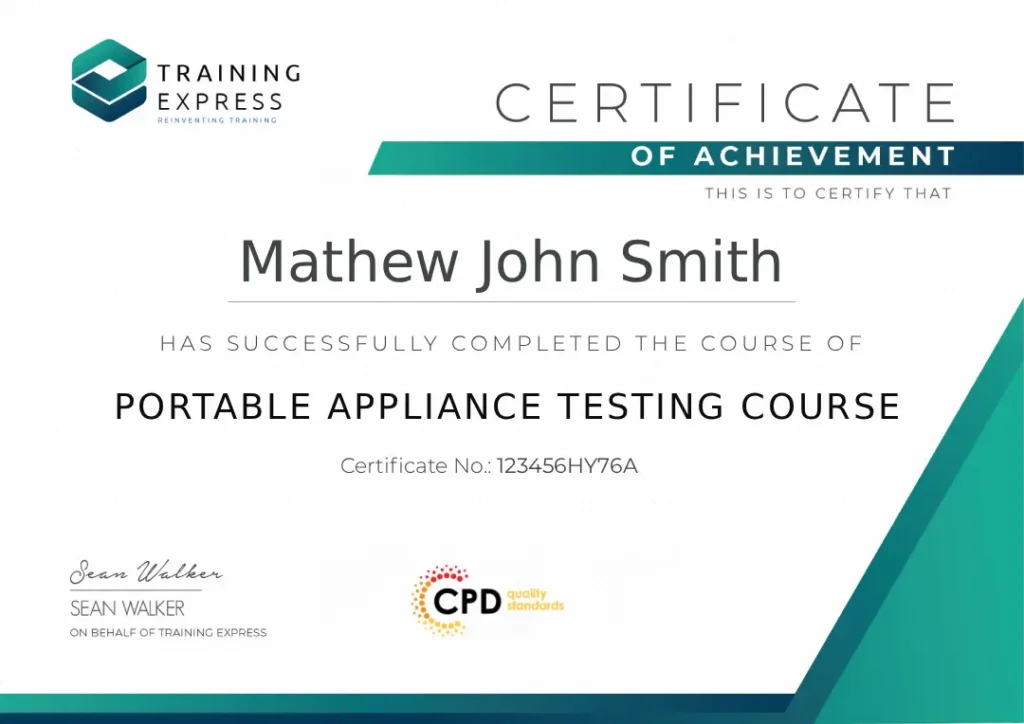
Complete the online multiple-choice assessment. Once you pass, your CPD PAT testing certificate is ready to download straight away.
Need a certificate for your appliances? A competent person inspects and tests each item, then records the results and usually labels the equipment as passed or failed. Many workplaces train a member of staff to carry out this work in-house.
How Long Does a PAT Certificate Last?
A PAT training certificate has no fixed expiry date. Once you pass, it stays valid as a record of the training you completed. We recommend refreshing your training every three years to keep up with best practice.
A PAT test result for an appliance doesn't have a legal expiry either. The HSE says how often equipment needs inspecting and testing depends on the type of equipment and where it's used. A construction-site power tool needs checking far more often than a hotel bedside lamp.
✓
Every Three Years
A practical refresh period for your PAT training, helping you maintain your knowledge and stay familiar with current safety practices.
↻
When Guidance Changes
Refresh your knowledge sooner when the IET Code of Practice or HSE guidance is updated and affects how you carry out PAT inspections and testing.
↗
When Your Role Changes
Moving from simple user checks to combined inspection and testing requires additional knowledge, practical ability and experience.
!
Employer or Insurer Requirements
Some employers, insurers and HMO licences set their own testing or training schedules. These are internal or contractual requirements, not fixed legal expiry dates.
Not sure when to retest your equipment? Base the interval on a risk assessment, then review it using the results of previous inspections and tests. Equipment used in higher-risk environments may need more frequent checks.
Which PAT Course Do You Need?
The right course depends on what you'll actually be doing with electrical equipment. More advanced isn't automatically better; it needs to match your responsibilities.
| Your Role |
Recommended Course |
|
Office, school, care or retail staff doing user checks before using equipment
|
PAT – Portable Appliance Testing Training Course
|
|
Office managers, caretakers and facilities staff running in-house PAT
|
PAT Testing Course or PAT – Portable Appliance Testing Level 3
|
|
Electricians and maintenance staff wanting wider electrical safety knowledge
|
Advanced Electrical Safety & Portable Appliance Testing Training
|
|
Career changers building towards electrical compliance work
|
PAT Testing – Essential Skills or Electrician – Essential Skills
|
|
Duty holders, landlords and H&S officers managing a PAT programme
|
PAT – Portable Appliance Testing Training Course + Health and Safety Level 3
|
01
User Checks & Awareness
For anyone who uses portable electrical equipment at work. Learn to spot damaged plugs, cables and casings before switching on, and understand what to do when equipment fails a check.
02
Formal Visual Inspection
For staff carrying out scheduled inspections. The HSE notes that most electrical safety defects can be found through visual examination, making this an important part of an effective PAT programme.
03
Combined Inspection & Testing
For anyone using a PAT tester. This requires suitable test equipment, the ability to operate it correctly and the knowledge to understand and interpret the results.
04
Managing a PAT Programme
For duty holders and managers responsible for deciding which equipment needs inspecting and testing, setting suitable intervals, and recording and reviewing results.
Note: Your CPD certificate shows you've completed structured, accredited PAT training. Requirements for PAT roles vary by employer, so check the job listing or your employer's policy to see what's expected for your role.
 Food Hygiene
 Health & Safety
 Safeguarding
 First Aid
 Business Skills
 Personal Development







 Reviews






















Well presented course filled with necessary information..