Food Hygiene
 Health & Safety
 Safeguarding
 First Aid
 Business Skills
 Personal Development

If you work in health or social care, you’ve probably heard “person-centred care” so often it’s started to sound like background noise. But it’s worth pausing on, because it’s not a vibe — it’s a working method, and in England it’s backed by law.
There are 8 values that make up person-centred care: individuality, independence, privacy, partnership, choice, dignity, respect, and rights. Each one answers a different question about how you treat the person in front of you. Together, they’re the difference between caring for someone and caring about them.
Let’s go through each one — what it means, what it looks like on shift, and where it tends to break down.
Table of Contents
The 8 Person-Centred Values, One at a Time
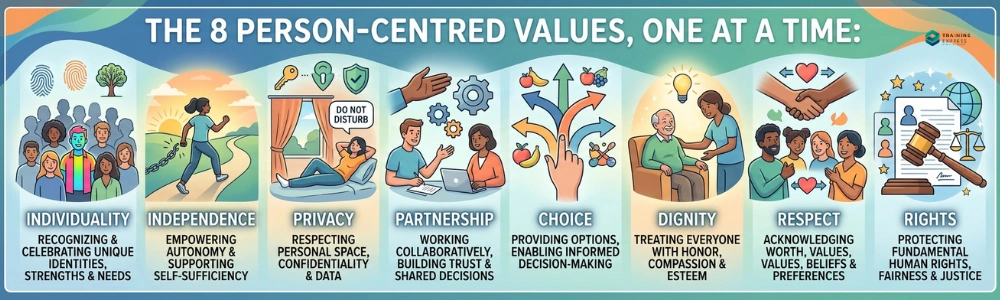
Here they are — not as a list to memorise, but as eight small shifts in how you treat someone. Once you see them in action, you’ll start noticing when they’re missing too.
Individuality
Individuality means treating someone as a person first, not a diagnosis or a room number. Two people with the same condition can need completely different care, because they’ve lived completely different lives.
In practice, this means actually learning who someone is — their routines, their history, what used to matter to them before they needed support.
Take John. He’s living with dementia and spent thirty years as a gardener. Staff at his care home noticed that time in the garden calms him in a way nothing else does — not because it’s on his care plan, but because it’s who he is.
Where it goes wrong: rushed handovers. If new staff only ever read a folder and never talk to the person, individuality becomes a box-ticking exercise instead of something real.
Independence
Independence means letting people do what they can still do — even if it’s slower, messier, or less convenient than doing it for them.
It’s tempting to just get on with a task yourself when someone’s struggling. But every time you take over unnecessarily, you chip away at someone’s confidence and sense of control.
Sarah, for example, can still prepare parts of her own meals. Her support worker resists the urge to do it faster herself, because the point isn’t a tidy kitchen — it’s Sarah staying capable.
The tension worth naming: independence and safety don’t always agree. Letting someone struggle with a task can look risky, especially under time pressure or if a family member is watching. Good person-centred practice means having that conversation openly, not quietly overriding someone’s choice “for their own good.”
Privacy
Privacy means someone’s body, information, and space are treated as theirs — not the service’s.
This shows up in small moments: knocking before entering, closing curtains during personal care, not discussing someone’s health in a corridor where others can hear.
A carer who asks permission and closes the door before helping with personal care isn’t just following protocol. They’re telling the person: this is still your dignity to control, not mine.
Partnership
Partnership means care is built with people, not handed to them. That includes the individual, their family, and the wider care team all pulling in the same direction.
David’s family are involved in decisions about his daily routine — not as a courtesy, but because they know things about David that no care plan captures on its own.
Watch out for: partnership tipping into the family making all the decisions while the person themselves gets talked over. Real partnership keeps the individual’s voice loudest, even when others are in the room.
Choice
Choice means people get to decide things about their own lives — including the small stuff, which matters more than it sounds.
Choosing what to eat or how to spend an afternoon isn’t trivial when so much of someone’s day is already decided for them. In care homes that get this right, residents pick their meals and activities instead of following one fixed timetable for everyone.
Where it’s hardest: when someone’s choice conflicts with what staff think is “best” for them — refusing medication, wanting to skip a meal, choosing a risk. Person-centred care doesn’t mean removing all boundaries. It means starting from respect for the choice, then having an honest conversation about risk, rather than simply overruling it.
Dignity
Dignity means someone always feels like a person, never a task to get through.
It’s there in how you speak to someone, not just what you do for them. A nurse who explains a procedure directly to the patient — rather than only briefing the family in front of them — is protecting dignity in a way that costs nothing extra but changes everything about how the moment feels.
Respect
Respect means valuing someone’s beliefs, culture, and opinions, even when they’re not your own.
A care provider adjusting meals to meet religious dietary needs is respect in action. So is genuinely listening when someone disagrees with you, instead of just waiting for them to stop talking.
Rights
Rights are the legal protections everyone keeps, regardless of the support they need — equality, privacy, freedom from discrimination.
This one’s less about daily kindness and more about making sure the basics are never quietly skipped. A service ensuring wheelchair users have the same access to activities as everyone else is upholding rights, not doing someone a favour.
From Values to Practice: What Goes in a Person-Centred Care Plan
Knowing the 8 values is one thing. Getting them onto paper — in a document someone actually uses on shift — is another. This is usually where good intentions either stick or fall apart.

What a Person-Centred Care Plan Actually Includes
A person-centred care plan is specific, not generic. It should read like it was written about one particular person, not copied from a template and lightly edited.
Compare these two lines:
- Generic: “Client has mobility issues. Assist as needed.”
- Person-centred: “John has limited mobility following his hip operation. He prefers his walker over his walking stick and should always have it within reach.”
The second version tells a carer who’s never met John exactly what to do and why. That’s the test for every line in the plan — would a stranger reading it understand this person a little better?
A solid care plan usually covers:
- Needs — physical, emotional, mental, social, and cultural, not just the medical basics
- Preferences — routines, food, communication style, what helps and what doesn’t
- Goals — what the person wants to get out of their care, in their own words where possible
- Who was consulted — the individual, family, GP, previous carers, anyone with useful context
Who Should Be Involved in Writing It
This is where the “Partnership” value stops being an idea and becomes a process. A care plan written for someone, without them in the room, is rarely person-centred no matter how well-intentioned it is.
Good practice means consulting the individual first, then bringing in family, previous carers, and GPs to fill in the gaps. Everyone adds a different piece of the picture — but the person receiving care should always have the final say on what matters most to them.
A Quick Note on Digital Care Plans and AI
Most services now manage care plans digitally rather than on paper, mainly because updates are faster and everyone on shift can see the latest version.
One caution worth knowing: don’t paste someone’s personal details into a general-purpose AI writing tool to draft a care plan. That data can end up stored outside your organisation’s control, which risks a GDPR breach. Purpose-built care planning software is a different matter — it’s designed to keep that information secure.
Why These Values Aren't Just Optional Extras — CQC Regulation 9
Here’s the part a lot of guides skip: in England, person-centred care isn’t only good practice. It’s a legal requirement under Regulation 9 of the Health and Social Care Act 2008.

Regulation 9 says care and treatment must be appropriate, meet the person’s needs, and reflect their preferences. It’s one of the areas the Care Quality Commission actively inspects, sitting underneath all five of the CQC‘s key questions — Safe, Effective, Caring, Responsive, and Well-led.
What that means for you day-to-day: if a care plan was written for someone instead of with them, that’s not just a missed opportunity — it’s a compliance gap an inspector can flag. If you can’t show that someone was involved in decisions about their own care, the value of “choice” stops being a value and becomes a risk.
So these 8 values aren’t abstract ethics. They’re the practical evidence inspectors look for, and the plain-language version of what the law already asks of you.
Values vs. Principles — Why You'll See Different Numbers
If you’ve read around this topic, you may have seen “4 principles of person-centred care” mentioned somewhere else, alongside these 8 values. That’s not a contradiction — they’re just answering slightly different questions.
The 8 values describe the attitude behind good care — individuality, choice, dignity, and so on.
The 4 principles, often credited to the Health Foundation, describe the structure of how care should be delivered:
| Principle | What It Means in Practice |
|---|---|
| Respect for values, preferences, and needs | Listening to what someone wants, not just what's clinically indicated |
| Coordination and integration of care | Making sure different professionals are actually talking to each other |
| Information, communication, and education | Giving people what they need to make informed decisions |
| Physical comfort and emotional support | Treating comfort and reassurance as part of the job, not an extra |
Think of the 4 principles as the framework, and the 8 values as what that framework looks like when a real person is standing in front of you.
You might also see “compassion” or “empowerment” listed instead of one of the 8 values above — some sources group things slightly differently. The substance doesn’t change much; it’s the same underlying idea described with different labels.
Why Person-Centred Care Is Harder Than It Sounds
Most guides make this sound simple: apply the values, get better care. In practice, providers across the sector consistently report the same sticking points.

Heavy workloads and understaffing are the biggest one. It’s hard to offer someone a real choice about their morning routine when you have twelve other people to see in the next hour.
Unsupportive leadership is another. Person-centred care needs to be modelled from the top — if managers treat it as a paperwork exercise, staff will too.
Resistance to change matters as well. Habits built around efficiency and routine are hard to unlearn, even when everyone agrees the person-centred approach is better.
None of this means the values are unrealistic. It means embedding them takes more than a training session — it takes leadership buy-in, realistic staffing, and permission for staff to slow down when it matters.
The Bottom Line
Person-centred care comes down to one shift in thinking: stop asking “what does this person need done to them,” and start asking “what does this person want, and how do we support that.”
The 8 values give you the language for it. Regulation 9 gives you the legal backbone. But the real test isn’t whether you can list all eight — it’s whether the person receiving care would say they felt heard today.
Frequently Asked Questions (FAQ)
How many values support person-centred care?
Eight — individuality, independence, privacy, partnership, choice, dignity, respect, and rights.
Is person-centred care a legal requirement in the UK?
Yes. In England it’s set out in Regulation 9 of the Health and Social Care Act 2008, and it’s actively assessed by the CQC during inspections.
What's the difference between the 8 values and the 4 principles of person-centred care?
The values describe the attitude behind good care; the principles describe how that care should be structured and delivered. They overlap rather than compete.
What's the most common barrier to person-centred care?
Time and staffing pressure. Teams that understand the values well can still struggle to apply them consistently when they’re stretched thin.
Why is person-centred care important?
It leads to better outcomes and higher satisfaction because care is built around what actually matters to the individual, not a fixed routine. People are also more likely to trust and engage with care they had a say in.
What is the difference between person-centred care and patient-centred care?
They’re mostly the same idea with different labels. “Patient-centred” tends to appear in clinical/NHS settings, while “person-centred” is used more broadly across social care, reflecting that someone is a person first, not just a patient.
Who is responsible for delivering person-centred care?
Everyone involved in someone’s support — carers, nurses, and social workers day-to-day, but also managers and services, since Regulation 9 makes it a provider-level responsibility, not just an individual one.
What is an example of person-centred care in dementia support?
Learning a person’s history and using it to guide care — like encouraging a former gardener to spend time outdoors because it’s familiar and calming, rather than following a generic activity schedule.
How do you show person-centred care values in a job interview?
Use a specific example, not the value’s definition. Describe a real moment where you gave someone a genuine choice, respected their privacy, or adjusted your approach to fit who they are — assessors want evidence, not a recited list.

Robert Lawrence
Author | Specialises in Health and Social Care.
Robert Lawrence is an e-learning specialist and author at Training Express, with over 5 years of experience creating practical resources and strategies to support learners and enhance their professional & personal development.
Related Blogs