Food Hygiene
 Health & Safety
 Safeguarding
 First Aid
 Business Skills
 Personal Development

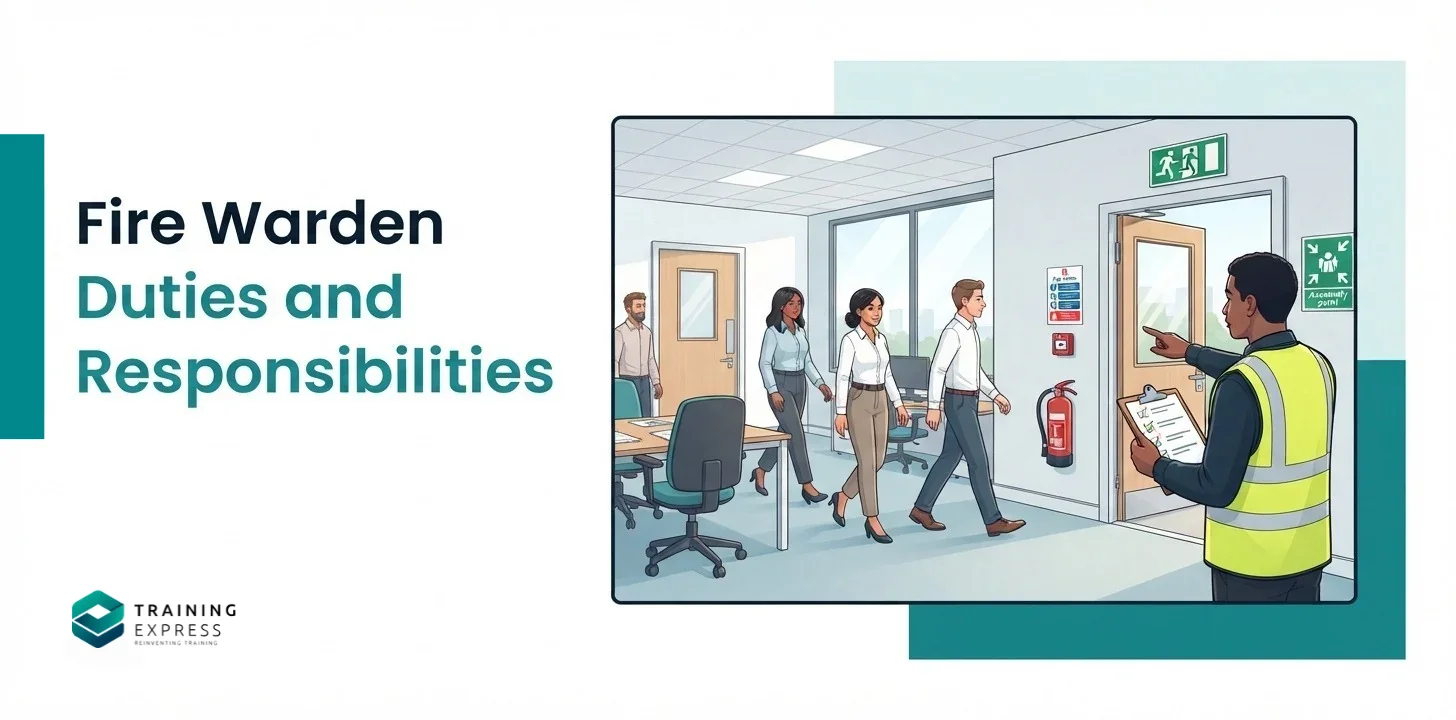

A fire warden’s duties are to help prevent fires at work and, if the alarm sounds, to help everyone in their area get out safely. In the UK, a fire warden and a fire marshal are the same role, appointed by the employer or whoever controls the building.
This guide covers the everyday checks, what to do when the alarm sounds, what the law says and where a fire warden’s responsibilities stop.
Table of Contents
What is a fire warden?
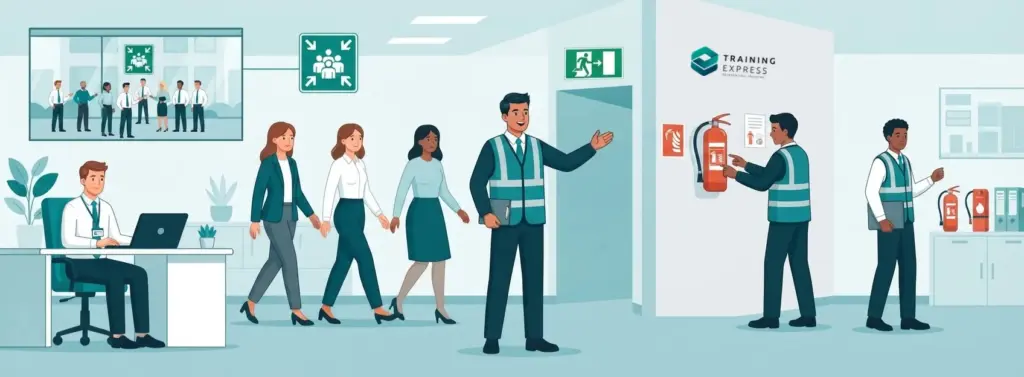
A fire warden is a trained member of staff who helps with fire prevention and evacuation in a set area of a building. They watch for fire risks day to day and, when the alarm sounds, make sure people in their area leave and report at the assembly point.
Most fire wardens do the role alongside their normal job, for example an office manager or shift supervisor covering their floor.
Is a fire warden a legal requirement?
The law doesn’t use the words “fire warden” or “fire marshal”, but it does require people to do the job. In England and Wales, the Regulatory Reform (Fire Safety) Order 2005 (the Fire Safety Order) places duties on the “responsible person”, usually the employer:
- Article 15 says the responsible person must “nominate a sufficient number of competent persons” to carry out the procedures for evacuating people from the premises.
- Article 13 says they must, where necessary, nominate competent persons to carry out firefighting measures, with enough people, training and equipment.
- Article 18 says they must appoint one or more competent persons to help with fire safety measures.
A “competent person” means someone with enough training, experience or knowledge to do the task properly. Most workplaces meet these duties by appointing fire wardens.
Fire warden vs fire marshal: is there a difference?
No. In the UK they’re the same role, and GOV.UK guidance uses both terms together. Some large sites split the titles, for example calling floor staff “wardens” and the person co-ordinating the evacuation the “marshal”. Your fire procedure should say who does what. In the US, “fire marshal” usually means a fire inspector, which is a different job.
Fire warden duties and responsibilities at a glance
Fire warden duties fall into prevention, emergency response and records.
| Area of duty | What it involves | How often |
|---|---|---|
| Escape routes and fire doors | Check routes are clear and fire doors close properly | Daily walk-round |
| Fire equipment | Check alarm panel, call points, extinguishers and emergency lighting look in order; report faults | As set out in your log book |
| Hazards | Spot and report fire hazards in your area | Ongoing |
| Drills and briefings | Help run fire drills and brief new starters | At every drill and new start |
| Alarm sounds | Raise the alarm, guide people out, sweep your area if safe | Every alarm |
| After evacuation | Report at the assembly point | Every alarm |
Day-to-day fire warden duties (fire prevention)
Day to day, a fire warden stops small problems turning into fires and keeps escape routes usable, mostly through a quick walk round their area.
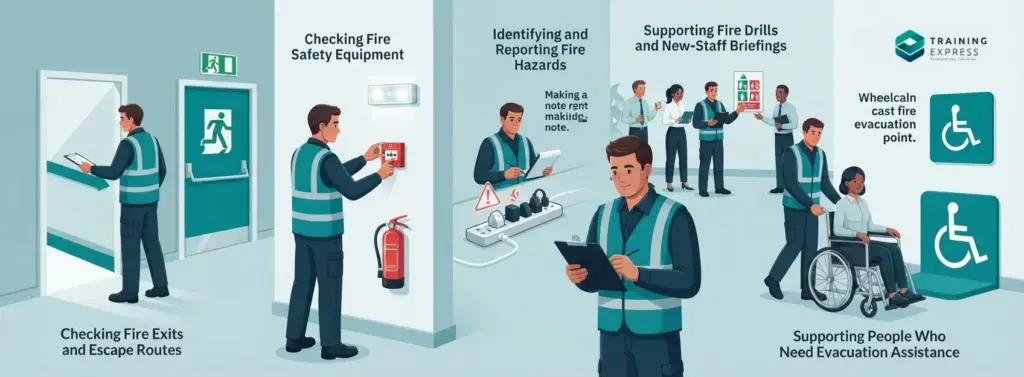
Checking escape routes, fire exits and fire doors
Check corridors, stairs and fire exits are clear and final exit doors open easily. In a typical office, routes get blocked by deliveries, chairs and boxes stacked by fire exits. Check fire doors aren’t wedged open and that self-closers shut them fully.
Checking fire alarms, call points, extinguishers and emergency lighting
Look for obvious faults: a damaged or blocked call point, a missing or used extinguisher, or an emergency light that isn’t working. Fire and rescue services recommend a daily alarm panel check and a weekly alarm test from a different call point each time. For every test and how often to do it, see our guide to keeping a fire safety log book.
Spotting and reporting fire hazards
Watch for rubbish building up, overloaded extension leads, heaters near paper, damaged cables, badly stored flammable liquids and smoking in the wrong places. Report anything you can’t fix straight away, and follow up if nothing happens.
Supporting fire drills and new-starter fire briefings
Fire wardens often help run drills, time the evacuation and note what went wrong. Many also show new starters the escape routes, call points and assembly point on day one.
Helping with PEEPs for colleagues who need help to evacuate
Some people need help to get out, such as a wheelchair user on an upper floor. They should have a personal emergency evacuation plan (PEEP): a written plan agreed with them setting out their route, the help they need and who gives it. Fire wardens often have a named role in it. Our guide to personal emergency evacuation plans explains how they work.
What does a fire warden do when the fire alarm sounds?
When the alarm sounds, a fire warden makes sure the alarm has been raised, guides people out by the nearest safe route, checks their area if it’s safe and reports at the assembly point. Their own safety comes first.
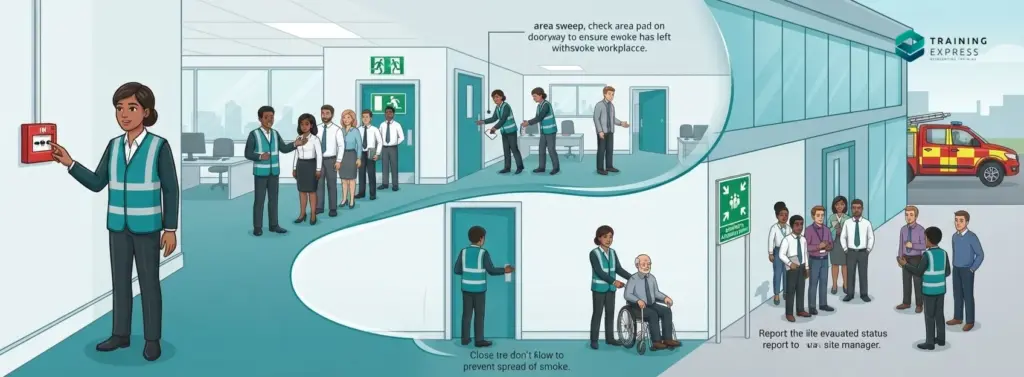
- Raise the alarm and call 999. If you discover a fire, operate the nearest call point. Make sure someone calls 999, following your site’s procedure.
- Tell people to leave by the nearest safe exit without stopping for belongings.
- Sweep your agreed area only if it’s safe. Don’t go beyond it or towards smoke or fire.
- Close doors behind you to slow the spread of fire and smoke.
- Help people with PEEPs and visitors as your plan says.
- Report at the assembly point: your area is clear, or which rooms you couldn’t check and who may be missing.
- Never go back into the building. Only the fire and rescue service decides when it’s safe to return.
Raising the alarm and calling 999
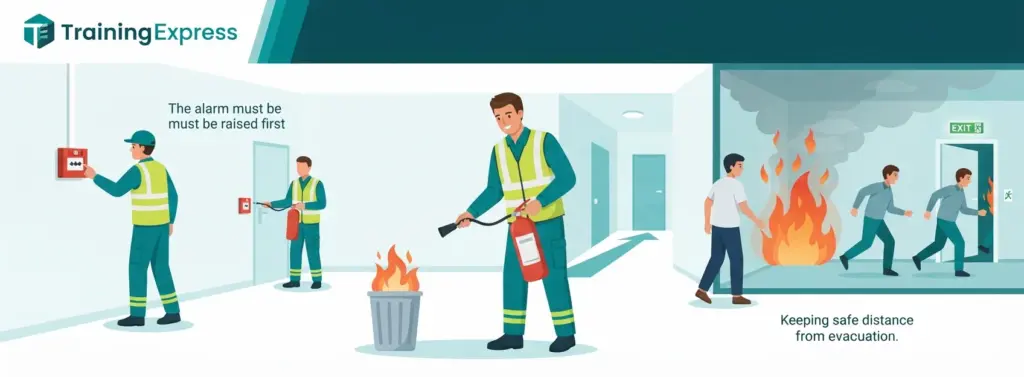
Raising the alarm always comes before any thought of tackling a fire. GOV.UK guidance says that if in doubt, staff should simply raise the alarm, leave and call the fire and rescue service. Even if your alarm calls the fire service automatically, your procedure may still ask someone to call 999.
Guiding people out and sweeping your area
A sweep is a quick check that nobody is left behind. A common order is your main area, then toilets, store rooms, kitchens and meeting rooms, finishing at your exit. Call out and move on. If you meet smoke or fire, stop and leave by another route.
Two-stage alarms: what changes
Some larger buildings use a phased or two-stage alarm. Typically the first signal (often an intermittent tone) is an alert and the second (a continuous tone) means evacuate. Know which signal means what in your building.
Typical example: a 3-floor office has a warden and deputy per floor and a second-floor colleague who uses a wheelchair and has a PEEP. On the alert tone, wardens get their vests and torches and the second-floor warden goes to their colleague. On the evacuate tone, wardens send people to the stairs and sweep their floor. The second-floor warden and a trained helper take their colleague to the refuge and follow the PEEP, never leaving them alone. At the assembly point, that warden tells the fire and rescue service where the refuge is.
Helping people with PEEPs and visitors
Follow each PEEP exactly. That might mean taking a colleague to a refuge (a protected waiting area on the escape route) and staying until the planned help arrives. Never use a normal lift in a fire. Only specially designed evacuation lifts may be used, as part of a planned strategy.
At the assembly point: roll call and reporting to the fire service
Report to the person in charge as soon as you arrive. If someone is missing or refused to leave, tell the fire and rescue service who, and where they were last seen. Never go back in for them.
Should a fire warden use a fire extinguisher?
Only if they’re trained, the alarm has been raised, the fire is small and they have a clear way out behind them. GOV.UK guidance says people with no training should not be expected to try to put out a fire, and no one has to fight a fire.
Don’t tackle the fire if:
- you haven’t been trained to use the extinguisher
- the alarm hasn’t been raised
- the fire is spreading or bigger than a small, contained fire
- the room is filling with smoke
- the fire is between you and your way out
- you’re not sure it’s the right extinguisher, or you don’t feel confident
If in doubt, close the door on the fire and get out. Different fires need different extinguishers, and our guide to classes of fire explains which one to use and when. For the basic technique, see what PASS stands for.
What a fire warden is not responsible for
A fire warden isn’t the responsible person. The legal duty stays with the employer or whoever controls the premises. A fire warden also doesn’t have to do the fire risk assessment, enforce the law or fight fires.
| Role | Who it usually is | Main responsibility |
|---|---|---|
| Responsible person | The employer, owner, landlord or occupier | Legal duty for fire safety, including the fire risk assessment |
| Competent person | Anyone appointed for a fire safety task, such as a fire risk assessor | Carries out the task they're appointed for |
| Fire warden | A trained member of staff | Prevention checks and helping people evacuate their area |
| All staff | Everyone at work | Take reasonable care, co-operate and report dangers |
For the full picture, read our guide to who is responsible for fire safety.
Fire warden equipment
Keep a small kit where you can grab it on the way out:
- A high-visibility vest or tabard so people can spot you
- A torch, in case lights fail or rooms are dark
- A plan of your area and a sweep checklist
- A phone or radio and a visitor list, if your site uses them
How many fire wardens does a workplace need?
There’s no fixed number in law. Article 15 asks for a “sufficient number”, set by your fire risk assessment. Our guide on how many fire marshals you need shows how to work it out.
Fire warden training: what it covers and how often to refresh it
Training should cover your role, the law, how fires start and spread, hazards, your evacuation procedure, PEEPs and when (and when not) to use an extinguisher. There’s no legal expiry date.
Article 21 of the Fire Safety Order says training must be given when staff start, when their risks change, and “repeated periodically where appropriate”. So refresh it when your fire risk assessment, building, role or team changes. Some fire and rescue services suggest refreshers at least once a year. A briefing on your own building matters as much as any certificate.
Our fire marshal training covers fire marshal duties, fire safety law, fire risk assessments, evacuation procedures and PEEPs.
Fire warden duties in Scotland and Northern Ireland
The role is the same across the UK, but the law differs. In Scotland, the Fire (Scotland) Act 2005 and Fire Safety (Scotland) Regulations 2006 apply, and Scottish Government guidance calls those with duties “dutyholders”. In Northern Ireland, the Fire and Rescue Services (NI) Order 2006 and Fire Safety Regulations (NI) 2010 apply, and the duty sits with the “appropriate person”.
Ready to take on the fire warden role?
If you’ve been asked to be a fire warden, good training helps you feel confident about what to check and what to do when the alarm sounds. Our fire marshal training covers the duties, the law and evacuation planning, at your own pace.
Frequently Asked Questions (FAQs)
What are the main duties of a fire warden?
A fire warden checks escape routes, fire doors and equipment and reports hazards. When the alarm sounds, they make sure it has been raised, guide people out, check their area if it’s safe and report at the assembly point. They also help with drills and support colleagues who have a personal emergency evacuation plan.
Is being a fire warden a legal requirement?
The job title isn’t in the law, but the role is. In England and Wales, the Fire Safety Order requires the responsible person to nominate enough competent people to carry out evacuation procedures (article 15) and, where needed, firefighting measures (article 13). Most workplaces meet these duties by appointing trained fire wardens or fire marshals.
Do fire wardens get paid more?
There’s no legal requirement to pay fire wardens extra and no national rate, so it’s up to each employer. Some pay an allowance and others treat it as part of the job. If you’re asked to take it on, ask what training, support and time you’ll get to do it properly.
Can a fire warden refuse to tackle a fire?
Yes. No one has to fight a fire. A fire warden’s priority is raising the alarm and getting people out. An extinguisher is only for trained people, on a small fire, after the alarm is raised and with a clear escape route. If you’re unsure, close the door, get out and leave it to the fire and rescue service.
How long is fire warden training valid for?
The law doesn’t set an expiry date. The Fire Safety Order says training must be repeated periodically where appropriate and updated when risks change, such as a new role or building changes. Some fire and rescue services suggest refreshers at least once a year. Check what your fire risk assessment says.
What should a fire warden do if someone refuses to leave?
Tell them clearly they must leave now, then carry on with your evacuation. Don’t argue, force them or stay behind. Note where they are and report it to the person in charge and the fire and rescue service at the assembly point, so firefighters can deal with it.