Food Hygiene
 Health & Safety
 Safeguarding
 First Aid
 Business Skills
 Personal Development
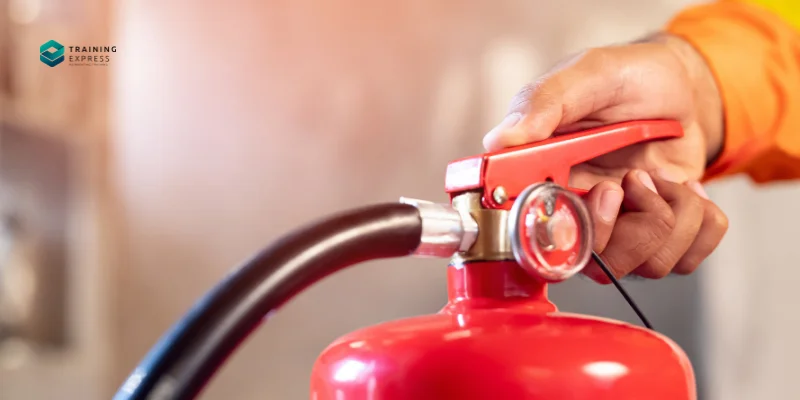

PASS stands for Pull, Aim, Squeeze, Sweep. It’s the simple four-step method for using a fire extinguisher.
- Pull the pin.
- Aim low, at the base of the fire.
- Squeeze the handle slowly and evenly.
- Sweep from side to side until the fire is out.
PASS gives you an easy order to follow when panic sets in.
But the steps are only half the job. You also need the right extinguisher, and you need to know when to leave instead.
Table of Contents
How to use a fire extinguisher with PASS
Hold the extinguisher upright and stand about 2–3 metres from the fire.
1. Pull
Pull out the safety pin. You may need to twist it to break the plastic tamper seal. Point the nozzle away from you.
2. Aim
Aim the nozzle or hose low, at the base of the fire. The base is where the fuel is burning. Spraying the flames higher up won’t put the fire out.
3. Squeeze
Squeeze the handle slowly and evenly to release the contents. Let go of the handle to stop the flow. Most portable extinguishers empty in well under a minute, so don’t waste any.
4. Sweep
Sweep the nozzle from side to side across the base of the fire. Move closer as the flames shrink. Keep going until the fire is out, then watch in case it starts again.
Top tip: Once the fire is out, back away slowly. Never turn your back on a fire, even one that looks dead.
Before you use PASS: a quick safety check
Only tackle a fire if you can say yes to all five of these:
- The fire alarm has been raised and someone has called 999.
- The fire is small, no bigger than a waste paper bin.
- You have a clear escape route behind you.
- You have the right extinguisher for what’s burning.
- You’ve been trained to use it.
If the answer to any of these is no, leave the building.
When not to fight a fire
Get out, close the door behind you and call 999 if:
- The fire is spreading or getting bigger.
- The room is filling with smoke.
- The fire is between you and your exit.
- You don’t know what’s burning.
- Your extinguisher runs out and the fire is still going.
Remember: your safety comes first. Buildings and belongings can be replaced. You can’t.
Which fire extinguisher should you use?
Using the wrong extinguisher can make a fire worse.
In the UK, all fire extinguishers have a red body. A coloured label shows the type, under the BS EN 3 standard.
| Type | Label colour | Use on | Never use on |
|---|---|---|---|
| Water | Red | Wood, paper and fabric (Class A) | Electrical equipment, cooking oil and flammable liquids |
| Foam | Cream | Solids and flammable liquids such as petrol (Classes A and B) | Cooking oil and live electrical equipment unless specifically marked as safe |
| CO2 | Black | Electrical equipment and flammable liquids (Class B) | Cooking oil; generally ineffective on wood or paper fires |
| Dry powder | Blue | Solids, liquids, gases and electrical equipment (Classes A, B and C) | Cooking oil; avoid use in small, enclosed rooms where possible |
| Wet chemical | Yellow | Cooking oil and fat (Class F) | Electrical equipment unless the extinguisher is specifically approved for that use |
Under BS EN 2, Class D fires (burning metals) need a specialist powder extinguisher.
Electrical fires don’t have their own class. Electricity is a hazard, not a fuel.
Safety warnings for specific extinguishers
- CO2: Don’t hold the horn. It gets cold enough to cause frost burns. In a small room, leave once the fire is out, as the gas lowers oxygen levels.
- Chip-pan fires: Never use water or foam. Water makes burning oil explode outwards. Turn off the heat if it’s safe, then use a fire blanket or wet chemical extinguisher.
- Dry powder: The cloud makes it hard to see and breathe. Avoid using it in small, enclosed spaces.
Common PASS mistakes to avoid
- Aiming at the flames. Always aim at the base of the fire.
- Standing too close. Start 2–3 metres back and move in slowly.
- Stopping too early. Keep sweeping until the fire is fully out.
- Forgetting the pin. The handle won’t squeeze until the pin is out.
- Turning your back. Walk backwards away from the fire.
PASS vs RACE: what's the difference?
RACE is your wider plan for responding to a fire. PASS is how you carry out one part of it.
| RACE step | What it means |
|---|---|
| Rescue | Help anyone in immediate danger, if it's safe. |
| Alarm | Raise the alarm and call 999. |
| Confine | Close doors to slow the fire's spread. |
| Extinguish or Evacuate | Use PASS on a small fire, or get out. |
PASS and the law in UK workplaces
In England and Wales, the Regulatory Reform (Fire Safety) Order 2005 sets out fire safety duties. Scotland and Northern Ireland have their own similar laws.
The “Responsible Person” is usually the employer. They must provide suitable firefighting equipment and give staff enough training to use it safely.
Want your team to feel confident? Our Fire Extinguisher Training course covers PASS, extinguisher types and when to walk away.
The key takeaway
PASS helps you act fast: Pull, Aim, Squeeze, Sweep. But the most important skill is knowing when not to use it. If a fire is too big, or you’re unsure, get out and call 999.
Sources
- The Regulatory Reform (Fire Safety) Order 2005, Article 13 – legislation.gov.uk
- Fire safety in the workplace: who’s responsible – GOV.UK
- Fire (Scotland) Act 2005 – legislation.gov.uk
- The Fire Safety Regulations (Northern Ireland) 2010 – legislation.gov.uk
- Portable fire extinguishers: fire extinguisher use – OSHA
- UK fire extinguisher colours explained – Fire Protection Online
- What fire extinguisher should not be used in confined spaces? – Fire Protection Association
- Firefighters issue safety warning after woman injured in chip pan fire – Essex County Fire and Rescue Service
Frequently Asked Questions (FAQ)
What does P.A.S.S. stand for?
P.A.S.S. stands for Pull, Aim, Squeeze, Sweep. It’s the same acronym as PASS, just written with full stops. Each letter is one step in using a fire extinguisher: pull the pin, aim at the base, squeeze the handle and sweep side to side.
What does PASS stand for in fire safety?
In fire safety, PASS stands for Pull, Aim, Squeeze, Sweep. It’s a memory aid that helps you use a fire extinguisher correctly under pressure. Only use PASS on a small fire, after the alarm has been raised and you have a clear exit.
Does PASS work on all fire extinguishers?
PASS works on most portable fire extinguishers, including water, foam, CO2 and dry powder. Wet chemical extinguishers, used on cooking oil fires, need a gentler touch. Apply them slowly so the burning oil doesn’t splash. Always check the label matches the fire first.
How far away should you stand from a fire?
Stand about 2–3 metres (6–8 feet) away when you start. This keeps you clear of the heat while the spray still reaches the base of the fire. Move closer slowly as the flames shrink, and keep a clear exit behind you.Yes, PASS is widely used in the UK and the US. It’s taught on many UK fire safety, fire warden and fire marshal courses. UK training adds local details, such as BS EN 3 colour codes and calling 999 first.
Who should see my personal development plan?
That’s up to you, unless your employer or course requires it. Sharing it with your manager, tutor or mentor usually helps, because they can offer support and opportunities. Keep any very personal goals in a separate section if you’d rather not share them.
Is PASS used in the UK?
Yes, PASS is widely used in the UK and the US. It’s taught on many UK fire safety, fire warden and fire marshal courses. UK training adds local details, such as BS EN 3 colour codes and calling 999 first.
Do I need training to use a fire extinguisher at work?
Yes. You shouldn’t use a fire extinguisher at work without training. In England and Wales, the Regulatory Reform (Fire Safety) Order 2005 requires employers to give staff suitable fire safety training. This covers which extinguisher to use and when to evacuate instead.

Robert Lawrence
Author | Specialises in E-Learning.
Robert Lawrence is an author at Training Express, with over 5 years of experience creating practical resources and strategies to support learners and enhance their professional & personal development.
Reviewed by: Jhon Stephen, Fire Marshal at Training Express