Food Hygiene
 Health & Safety
 Safeguarding
 First Aid
 Business Skills
 Personal Development

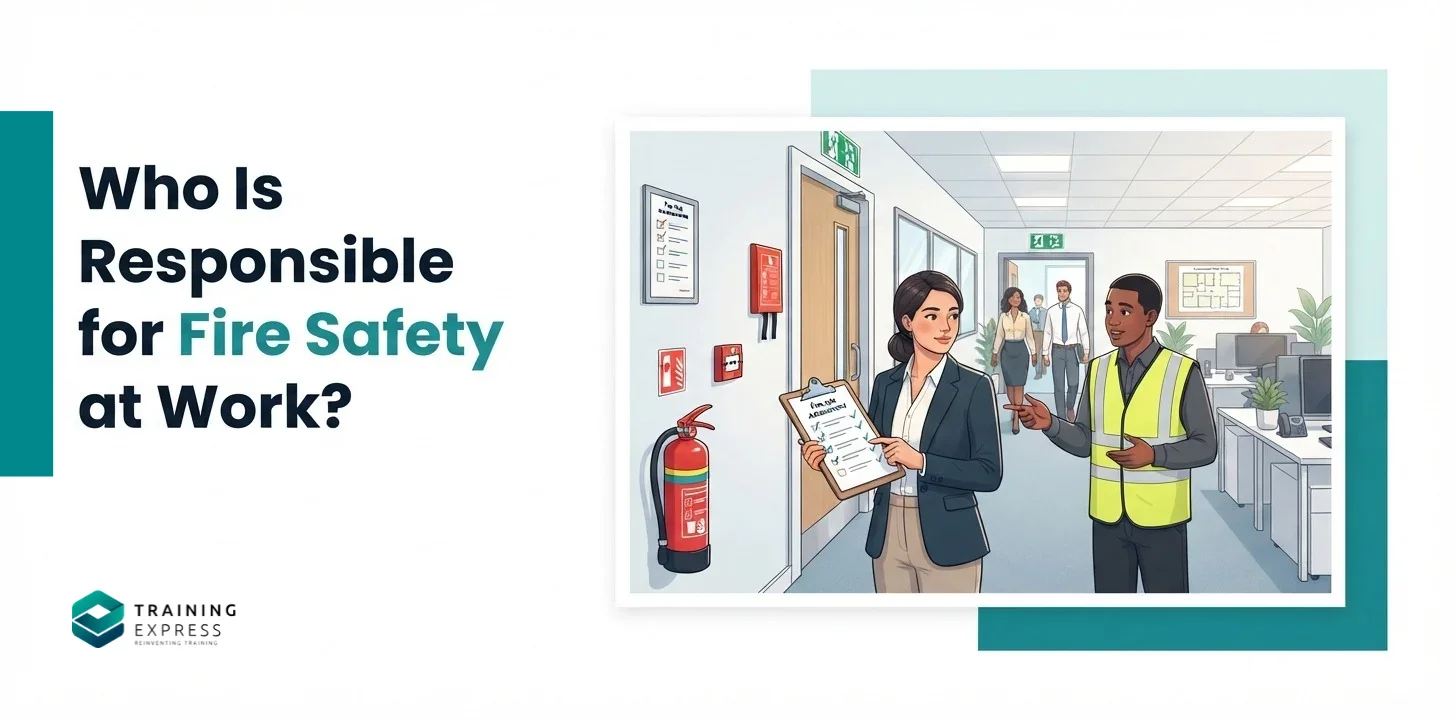

In England and Wales, the “responsible person” is legally responsible for fire safety in a workplace. That’s usually the employer, or the owner, landlord or occupier for other premises. So if you’re asking who is responsible for making a fire risk assessment, the answer is the responsible person. They can appoint others to help, but the legal duty stays with them.
This guide explains who the responsible person is, what they must do, and what fire wardens, staff and enforcing authorities are responsible for.
Table of Contents
Who is the responsible person for fire safety?
The responsible person is whoever the Regulatory Reform (Fire Safety) Order 2005 (the Fire Safety Order) puts in charge of fire safety for a building. Article 3 says it’s the employer for a workplace they control. For other premises, it’s the person in control of the premises for their business or undertaking, or the owner.
The responsible person is often an organisation, such as a limited company, rather than one named individual. Article 5 also places duties on anyone else who has control of the premises to any extent, such as a facilities manager or managing agent, for the matters within their control.
Workplaces (the employer)
If you employ people and the workplace is under your control, you’re the responsible person. GOV.UK guidance notes that, depending on the lease, the employer and the landlord may share responsibility.
Premises without an employer (owner or person in control)
If nobody employs staff there, such as an empty shop or the common parts of a block of flats, the responsible person is whoever controls the premises in connection with their business, or the owner.
Shared buildings and common areas
Where several businesses share a building, there will usually be several responsible persons. GOV.UK says the landlord, freeholder or managing agent is usually the responsible person for common or shared areas. Article 22 says each responsible person must co-operate, co-ordinate their fire safety measures and tell the others about risks from their work.
Typical example: a GP surgery leases the ground floor of a building with offices above. The surgery is responsible for its own area. The landlord is responsible for the shared entrance, stairs and fire alarm. They agree one evacuation plan, share alarm test results and tell each other about changes, such as building work.
Who is responsible for making a fire risk assessment?
The responsible person is responsible for making a fire risk assessment. GOV.UK says the responsible person must carry out and regularly review a fire risk assessment of the premises. They can do it themselves or appoint someone competent to help, but the duty stays with them.
A fire risk assessment is a structured look at your premises to find fire hazards, the people at risk and what’s needed to keep them safe. Since 1 October 2023, every responsible person must record the fire risk assessment in full, including all its findings, whatever the size of the business. The local fire and rescue authority may give advice, but GOV.UK says it can’t carry out the assessment for you.
Using a fire risk assessor: the Building Safety Act 2022 added article 9A to the Fire Safety Order, which says the responsible person must not appoint someone to help with the assessment unless they are competent. As of November 2026, this article has not been brought into force. In practice, you should still choose an assessor with the right training, experience and knowledge for your type of building. The responsible person remains responsible for making sure the assessment is suitable and sufficient.
Who is responsible for completing a fire risk assessment in the NHS or a care home?
The responsible person: the NHS trust or care provider that controls the premises. Your organisation will usually have a named fire safety manager or appointed fire risk assessor who carries it out. Staff help by following the fire procedures and reporting hazards. Care homes and hospitals usually need a specialist fire risk assessment, because many people need staff help to evacuate.
What the responsible person must do
The responsible person must assess the fire risks, put the right precautions in place, plan for emergencies, train staff and keep everything maintained. GOV.UK sums it up as carrying out and reviewing a fire risk assessment, putting in place and maintaining fire safety measures, planning for an emergency, and giving staff information, instruction and training.
| Duty | What it means | Fire Safety Order |
|---|---|---|
| Fire risk assessment | Assess the risks, record it in full and review it | Article 9 |
| Fire safety arrangements | Plan, organise, control, monitor and review the measures, and record them | Article 11 |
| Firefighting and detection | Provide equipment where needed and nominate competent people | Article 13 |
| Emergency procedures | Set procedures and drills, and nominate enough competent people for evacuation | Article 15 |
| Maintenance | Keep premises and equipment in efficient working order and good repair | Article 17 |
| Safety assistance | Appoint competent people to help | Article 18 |
| Information and training | Inform staff of risks and train them | Articles 19 and 21 |
| Co-operation | Work with other responsible persons in shared premises | Article 22 |
What changed on 1 October 2023
Section 156 of the Building Safety Act 2022 added new duties for every responsible person in England and Wales. GOV.UK lists them as:
- record the fire risk assessment in full, including all the findings
- record the name (and, where applicable, the organisation) of anyone who helps make or review it
- record your fire safety arrangements, showing how fire safety is managed
- record your contact details, including a UK address, and share them with other responsible persons and, where relevant, residents
- take reasonable steps to find out if there are other responsible persons, and co-operate with them
- when you stop being the responsible person, pass all relevant fire safety information to the new one
Buildings with two or more homes, and higher-risk residential buildings, have extra duties, such as giving residents fire safety information.
Fire wardens and other competent persons
Fire wardens (also called fire marshals) are staff the responsible person appoints to help with fire prevention and evacuation. They support the responsible person but don’t take over their legal duty. Articles 13, 15 and 18 require the responsible person to nominate or appoint competent persons, and most workplaces meet this by training fire wardens.
A fire warden checks their area, guides people out and reports at the assembly point. They don’t have to carry out the fire risk assessment or fight fires. Read our guide to fire warden duties for the full role, and our guide on how many fire marshals you need.
Who is responsible for using a fire extinguisher?
People who have been trained to use it. GOV.UK guidance says people with no training should not be expected to try to put out a fire. Even trained staff should only use an extinguisher on a small fire, after the alarm is raised, with a clear way out behind them.
Everyone else should raise the alarm, leave and call 999. GOV.UK guidance for small premises says that if in doubt, staff should not put themselves or anyone else at risk. No one has to fight a fire.
Under article 13, the responsible person must provide suitable firefighting equipment where necessary and nominate competent people to use it. Our guide to classes of fire explains which extinguisher suits which fire, and our fire extinguisher course covers when and how to use each type.
Who is responsible for using a fire extinguisher in the NHS?
The same answer applies: staff who have been trained and feel confident to use it, on a small fire, when it’s safe. Your trust’s fire procedure will say who is trained and what everyone else should do.
What responsibilities do all staff have during a fire?
All staff must follow the fire procedure, leave by the nearest safe route and help keep others safe. Article 23 of the Fire Safety Order says every employee must, while at work:
- take reasonable care for their own safety and others who may be affected by what they do
- co-operate with their employer so the employer can meet its fire safety duties
- tell their employer (or a colleague with safety responsibilities) about serious dangers and any gaps in fire safety arrangements
During a fire, that means raising the alarm if you find a fire, leaving straight away without collecting belongings, closing doors behind you, following your fire warden’s instructions, going to the assembly point and never going back in.
Who is responsible for fire safety awareness?
Everyone has a part to play, but the responsible person must provide the training. Article 21 says employees must get adequate safety training when they start, when their risks change, and repeated periodically where appropriate. Staff then use that training to spot and report hazards.
Who is responsible for enforcing fire safety?
For most premises, the local fire and rescue authority enforces fire safety law. Article 25 of the Fire Safety Order lists a few exceptions:
- the Health and Safety Executive for construction sites and ships under construction or repair
- the Office for Nuclear Regulation for nuclear sites
- Crown fire inspectors for Crown premises, such as government buildings and prisons
- the defence fire service for armed forces sites
- the local authority for designated sports grounds and regulated stands
Inspections, notices and penalties
Fire safety officers can visit to check your fire risk assessment and precautions. GOV.UK says they should help you understand and meet the rules, and may first suggest changes informally. If needed, they can issue:
- an alterations notice where premises have high safety risks, or would if their use changed
- an enforcement notice where there’s a serious risk that isn’t being managed (article 30 gives at least 28 days to put it right)
- a prohibition notice that restricts or bans use of the premises when the risk is serious enough, which can take effect immediately
You can appeal to your local magistrates’ court within 21 days of receiving a notice. GOV.UK says minor penalties can be up to £5,000, and major penalties can be an unlimited fine and up to 2 years in prison.
Who is responsible for fire safety at a glance
| Role | Who it usually is | Main duties | Legal basis |
|---|---|---|---|
| Responsible person | Employer, owner, landlord or occupier | Fire risk assessment, precautions, emergency plan, training | Articles 3, 8 to 22 |
| Others with control | Facilities manager, managing agent | Duties for matters in their control | Article 5 |
| Competent person | Fire risk assessor, fire wardens | The fire safety tasks they're appointed for | Articles 13, 15, 18 |
| Employees | All staff | Take care, co-operate, report dangers | Article 23 |
| Enforcing authority | Usually the fire and rescue authority | Inspect, advise, issue notices, prosecute | Article 25 |
Fire safety responsibility in Scotland and Northern Ireland
The principles are similar, but the law and terms differ. In Scotland, the Fire (Scotland) Act 2005 and the Fire Safety (Scotland) Regulations 2006 apply. Employers and anyone who controls the premises have duties, and Scottish Government guidance calls them “dutyholders”. In Northern Ireland, the Fire and Rescue Services (NI) Order 2006 and the Fire Safety Regulations (NI) 2010 apply, and the duty sits with the “appropriate person”.
The October 2023 recording duties, article 9A and the England-only rules for blocks of flats described in this guide don’t apply in Scotland or Northern Ireland.
Understand your role in fire safety
Whatever your role, it helps to know who does what before an emergency happens. Our fire marshal course covers fire safety law, fire risk assessments, fire marshal duties and evacuation planning, so you can support your responsible person with confidence.
Frequently Asked Questions (FAQs)
Is the fire warden the responsible person?
No. The responsible person is usually the employer or the person or organisation that controls the premises. A fire warden is a member of staff appointed to help with fire prevention and evacuation in their area. The legal duty for fire safety, including the fire risk assessment, stays with the responsible person even after they appoint fire wardens.
Can there be more than one responsible person?
Yes. Shared buildings often have several, for example each tenant business for its own area and the landlord or managing agent for the common parts. Under article 22 of the Fire Safety Order, they must co-operate, co-ordinate their fire safety measures and tell each other about risks. Since October 2023, they must also share contact details.
Who is responsible for fire safety in a rented property or block of flats?
In a block of flats, the Fire Safety Order covers the common parts, and the responsible person is usually the landlord, freeholder or managing agent. The Fire Safety Act 2021 confirmed it also covers the structure, external walls and flat entrance doors. In England, the Fire Safety (England) Regulations 2022 add duties such as fire door checks in buildings over 11 metres.
What happens if the responsible person doesn't do a fire risk assessment?
Failing to meet fire safety duties can be an offence under article 32 of the Fire Safety Order, particularly where it puts people at risk of death or serious injury. The fire and rescue authority can give advice, issue an enforcement notice setting a deadline to fix it, or issue a prohibition notice if the risk is serious. Serious breaches can be prosecuted, and GOV.UK says major penalties can be an unlimited fine and up to 2 years in prison.
Does a small business need a written fire risk assessment?
Yes, in England and Wales. Before October 2023, only some businesses, such as those with five or more employees, had to record their significant findings. Since 1 October 2023, every responsible person must record the full fire risk assessment and their fire safety arrangements, whatever the size of the business.
Related Blogs