Food Hygiene
 Health & Safety
 Safeguarding
 First Aid
 Business Skills
 Personal Development


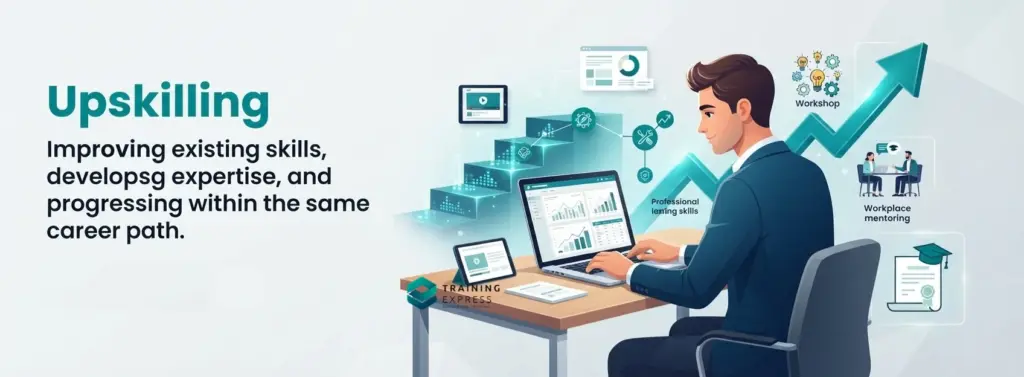
Upskilling means learning new skills, or building on the ones you already have, so you can do your current job better or move up in your field. It’s different from reskilling, which means training for a different job altogether.
You might hear the word in an appraisal, a job advert or the news. This guide explains what it means in practice, with real examples, why it matters right now, and simple ways to start, including free ones.
Key takeaways
- Upskilling builds on your existing skills to progress in your current role or career, while reskilling prepares you for a new one.
- According to the World Economic Forum, 39% of workers' core skills are expected to change by 2030.
- Upskilling can involve short online courses, on-the-job learning, mentoring or gaining a recognised qualification.
- Fewer UK employers are providing workplace training than before, making it increasingly important to take the initiative in developing your skills.
- Many employers may fund relevant training if you can demonstrate how it supports your role and meets the needs of the business.
What Does Upskilling Mean?
Upskilling is learning that takes you further in the direction you’re already going. You keep your role, or your field, and get better at it. The “up” is the clue: you’re adding depth or moving to the next level, not changing track.
Say you work in admin and use spreadsheets every day. Learning advanced Excel, so you can build reports instead of copying numbers, is upskilling. You’re still in admin, but you’re more useful, more efficient and better placed for a senior role.
Upskilling can happen in lots of ways:
- short online courses
- training days or workshops
- shadowing a colleague or being mentored
- taking on a new task or project at work
- a formal qualification, such as a Level 3 diploma
Upskilling Examples
Here’s what upskilling looks like in everyday jobs:
| Job | New skill | What it can lead to |
|---|---|---|
| Care assistant | Dementia care, medication awareness, a Level 3 diploma in health and social care | Senior carer or team leader |
| Office administrator | Advanced Excel and data reporting | Office manager or data role |
| Retail supervisor | Leadership and people management | Store or area manager |
| Warehouse operative | Health and safety, manual handling, forklift training | Shift lead or safety representative |
| Marketing assistant | Data analysis and AI tools | Digital marketing executive |
| Teaching assistant | Special educational needs (SEN) training | SEN teaching assistant or specialist support role |
In each case, the person stays in their field but becomes more skilled, more confident and more promotable.
Why Does Upskilling Matter in 2027?
Because the skills employers want are changing fast. The World Economic Forum’s Future of Jobs Report 2025 says employers expect 39% of workers’ core skills to change by 2030.

The same report looked at what that means for a typical group of 100 workers by 2030:
- 59 will need some training
- 29 of them can be upskilled in their current roles
- 19 will be reskilled and moved into other roles within their organisation
- 11 will need training but are unlikely to get it
That last group matters. In the UK, the Department for Education’s Employer Skills Survey 2024 found that 59% of employers provided training for staff in the previous year, down from 66% in 2017. It also found that 12% of employers had staff who weren’t fully proficient in their jobs, affecting around 1.26 million workers.
The takeaway? Around four in ten employers didn’t provide training. If yours is one of them, you may need to take charge of your own learning.
What Are the Benefits of Upskilling?
For you
- Better chances of promotion. You can show you’re ready for the next step, not just say it.
- More job security. Up-to-date skills make you harder to replace when roles change.
- More confidence. Knowing how to do something properly makes work less stressful.
- A stronger CV. Recent, relevant learning stands out to recruiters.
For employers
- Fewer skills gaps. It’s often quicker to train someone who knows the business than to hire.
- Better retention. Staff who see a future are more likely to stay.
- Safer, better work. Training in areas like health and safety or safeguarding reduces risk.
Upskilling vs Reskilling: What's the Difference?
Reskilling means learning new skills so you can do a different job. Upskilling deepens your skills in the job or field you’re already in. Here’s a side-by-side view:
| Upskilling | Reskilling | |
|---|---|---|
| Goal | Get better at your current role or move up | Move into a different role or career |
| Typical time | Hours to months | Months to a year or more |
| Cost | Often low, sometimes free | Often higher, especially if you need a qualification |
| Risk | Low: you build on what you know | Higher: you're starting again in a new area |
| Who usually pays | Often the employer | Often you, unless your employer is redeploying you |
| Example | A carer takes a dementia care course | A hospitality worker trains for IT support |
A few more reskilling examples: a retail worker training as a teaching assistant, a lorry driver moving into logistics planning, or a receptionist retraining in bookkeeping.
Which one do you need?
Answer these four questions:
- Do you enjoy your field? If yes, upskilling is probably your route.
- Is your role changing or shrinking? If automation or restructuring is affecting it, upskilling may keep you ahead. If the role is disappearing, think about reskilling.
- Does the job you want need a licence or qualification? If yes, you’re likely reskilling, and you’ll need that specific qualification.
- How much time and money can you spare? Upskilling fits around a busy life more easily. Reskilling often needs a bigger commitment.
Many people do both over a career. You might upskill for a few years, then reskill when your interests or the job market change.
Other Terms You Might Hear
- Cross-skilling: learning skills from a neighbouring role so you can cover for colleagues or work across teams. A receptionist who learns basic payroll is cross-skilling.
- Micro-credentials: short, focused courses that certify one specific skill. They’re a popular way to upskill quickly.
- Lifelong learning: the idea that learning carries on throughout your working life, not just at school or university.
- CPD: continuing professional development, the structured learning many professionals must log each year. See our guide to CPD points.
How to Upskill: 5 Steps
- Spot your gaps. Look at job adverts for the role you want next. Which skills come up again and again that you don’t have yet? Your last appraisal is another good clue.
- Talk to your manager. Ask which skills would help the team most. You’ll learn what’s valued, and you may get funding or time to study.
- Pick short, targeted learning. Choose one skill at a time. A focused online course you finish beats a long programme you abandon.
- Use it straight away. Apply what you learn at work within a week or two. That’s how new skills stick.
- Show it. Add the course to your CV and LinkedIn, and mention it in your next appraisal. Our guide on how to list certifications on your CV shows you how.
How to Fit Upskilling Around Work and Family
Time is the biggest barrier for most people. These habits make it manageable:
- Go small and regular. Twenty minutes, four times a week, adds up to more than five hours a month.
- Choose self-paced online learning. You can study on your lunch break, on the train or after the kids are in bed.
- Book it like a meeting. Put study time in your calendar so it doesn’t get squeezed out.
- Learn at work when you can. Ask to shadow a colleague or take on a task that stretches you. It’s upskilling on paid time.
- Finish one thing before starting another. A finished short course is worth more than three half-done ones.

Common Upskilling Mistakes
- Learning without a goal. Pick skills linked to your job or your next role, not whatever is trending.
- Not applying it. If you don’t use a new skill within a few weeks, you’ll forget much of it.
- Keeping it quiet. If your manager doesn’t know, it can’t help your appraisal or promotion chances.
- Paying for the wrong course. If a job needs a specific qualification or licence, a short course won’t replace it. Check first.
How to Ask Your Employer to Pay for Upskilling
Many employers will pay for training if they can see what’s in it for the business. Keep your request short and practical. Cover what the course is, what it costs, how long it takes and how it will help your team.
Here’s a simple message you can adapt:
“Hi Sam, I’d like to take an online course in advanced Excel. It costs £X and takes about 10 hours, which I can fit around my work. It would help me build our monthly reports faster and cut down manual errors. Could the team’s training budget cover it? Happy to share what I learn with the rest of the team.”
If the answer is no, ask whether you could have study time instead, or whether it could go in your development plan for later in the year.
Can You Upskill for Free?
Yes, there are good free options, especially for getting started:
- Skills Bootcamps (England): free, flexible courses of up to 16 weeks for people aged 19 and over. When you finish, you’re offered a job interview with an employer.
- Free online courses: many universities and platforms offer free introductory courses.
- Learning at work: shadowing, mentoring and stretch projects cost nothing but time.
- Your local library and council: many run free digital skills and adult learning sessions.
Free has limits, though. Some free courses don’t give a certificate, aren’t accredited, or only cover the basics. If you need evidence for your CV or CPD hours, a low-cost CPD-accredited course can be worth the small outlay
Which Skills Are Worth Learning in 2027?
The World Economic Forum names AI and big data as the fastest-growing skills, followed by networks and cybersecurity, and technological literacy. Creative thinking, resilience, flexibility, curiosity and lifelong learning are also rising in importance.
You don’t need to become a data scientist. Here’s how those trends translate into practical courses:
| Growing skill area | Practical skills to learn | Where to start |
|---|---|---|
| Technology and AI | Microsoft Office, Excel, using AI tools safely, cyber security basics | IT and software courses |
| Leadership and business | Management, project basics, customer service | Business skills courses |
| Care and support | Dementia care, safeguarding, mental health awareness | Health and social care courses |
| Safety and compliance | Health and safety, fire safety, manual handling | Health and safety courses |
| Resilience and personal skills | Time management, communication, stress management | Personal development courses |
Start Upskilling Today
Upskilling doesn’t have to be a big commitment. Pick one skill that would make your job easier or move you closer to your next role, and start there. Browse all Training Express courses to find a short, flexible option. Still weighing it up? Our honest guide on whether online courses are worth it can help you decide.
Frequently Asked Questions (FAQs)
What is an example of upskilling?
A care assistant taking a dementia care course to become a senior carer is upskilling. So is an office administrator learning advanced Excel to produce reports. In both cases, they’re building on their current role.
Is upskilling the same as training?
Training is one way to upskill, but upskilling is the wider goal. You can also upskill through mentoring, new projects or teaching yourself.
What's the difference between upskilling and reskilling?
Upskilling improves your skills for your current job or field. Reskilling teaches you new skills for a different job.
How long does upskilling take?
Anything from a few hours to a year. A short online course might take an afternoon, while a diploma can take several months. Start small and build up.
Is it worth upskilling at 40 or 50?
Yes. With skills changing quickly, experienced workers who keep learning are well placed. Your experience plus new skills is a strong mix that younger candidates can’t easily match.
Who pays for upskilling, you or your employer?
Either. Employers often pay for training linked to your current role. If it’s for a career move, you may need to fund it yourself or use free options such as Skills Bootcamps.

Robert Lawrence
Author | Specialises in E-Learning.
Robert Lawrence is an author at Training Express, with over 5 years of experience creating practical resources and strategies to support learners and enhance their professional & personal development.
Other Blogs