Food Hygiene
 Health & Safety
 Safeguarding
 First Aid
 Business Skills
 Personal Development

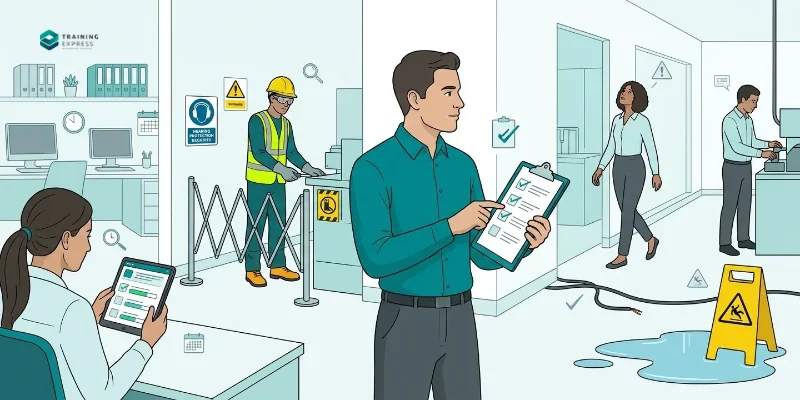

Every business has its own way of keeping people safe, whether that means checking equipment, training new staff or knowing what to do if there is a fire. A health and safety policy brings all of this together in one place, so that everyone knows what is expected of them and who is responsible for what.
For many businesses, having a health and safety policy is also a legal requirement. If you employ five or more people, the law says your policy must be written down and shared with your staff.
In this article, we explain what a health and safety policy is, who needs one, what it should include and how to write your own. We have also included a free health and safety policy template that you can copy and adapt for your business.
Table of Contents
What Is a Health and Safety Policy?
A health and safety policy is a document that sets out how a business manages health and safety. It explains the business’s commitment to keeping people safe, who is responsible for different parts of health and safety, and the practical arrangements that are in place to control risks.
A good health and safety policy is not just a document to keep in a drawer. It should reflect what really happens in the business and act as a guide for managers and staff. When it is written clearly and kept up to date, it helps to prevent accidents, shows that the business takes its legal duties seriously and gives employees confidence that their safety matters.
Is a Health and Safety Policy a Legal Requirement?
Yes. Section 2(3) of the Health and Safety at Work Act 1974 requires every employer with five or more employees to have a written health and safety policy, and to bring it to the attention of their employees. The policy must also be revised as often as necessary.
If you employ fewer than five people, you do not have to write your policy down. However, you still need to manage health and safety properly, and many small businesses choose to write a short policy anyway. It is a simple way to show customers, insurers and inspectors that you have thought about the risks in your business.
The Management of Health and Safety at Work Regulations 1999 also require employers with five or more employees to record their health and safety arrangements and the significant findings of their risk assessments. In most businesses, these records form part of the health and safety policy or are kept alongside it.
What Should a Health and Safety Policy Include?
The Health and Safety Executive (HSE) recommends that a health and safety policy is split into three parts. Together, these explain what the business is trying to achieve, who will do what, and how it will be done.
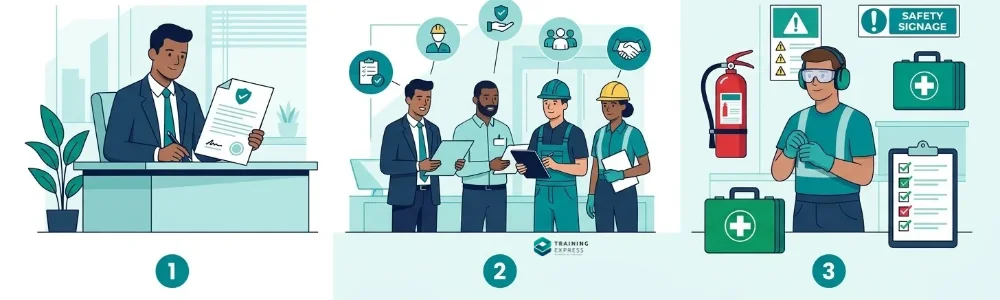
Part 1: Statement of Intent
The statement of intent sets out the business’s general approach to health and safety. It explains the organisation’s commitment to managing health and safety and what it aims to achieve, such as preventing accidents and cases of work-related ill health.
The statement of intent should be signed by the most senior person in the business, such as the owner, managing director or chief executive. This shows that health and safety is taken seriously at the top of the organisation. It should also be reviewed regularly and signed again when it is updated.
Part 2: Responsibilities for Health and Safety
The responsibilities section lists the people who have specific health and safety duties, along with their job titles and what they are responsible for. This normally includes:
- The person with overall responsibility for health and safety, usually the owner or a director
- Managers and supervisors who are responsible for health and safety in their area
- The competent person or adviser who helps the business meet its duties
- People with specific roles, such as first aiders, fire marshals and those responsible for checking equipment
- The duties of all employees, such as following their training and reporting hazards
Some businesses include a simple organisation chart to show who reports to whom on health and safety matters.
Part 3: Arrangements for Health and Safety
The arrangements section explains the practical steps the business takes to meet the aims in its statement of intent. This is usually the longest part of the policy. Depending on the type of business, it may cover:
- Risk assessments and how often they are reviewed
- Consultation with employees on health and safety
- Health and safety training, including induction training for new starters
- First aid, including the names of first aiders and where the first aid kit is kept
- Fire safety and emergency procedures, including evacuation and fire drills
- Accident and incident reporting, including RIDDOR reporting
- Maintenance and inspection of equipment and machinery
- Hazardous substances and COSHH assessments
- Manual handling, work at height and display screen equipment
- Lone working, contractors and visitors
- Health surveillance, where required
- How the policy and safety performance are monitored and reviewed
The arrangements should describe what really happens in your business. There is no need to include sections on risks that do not apply to your work.
How to Write a Health and Safety Policy
Writing a health and safety policy does not have to be complicated. The following steps will help you put together a policy that meets the law and works in practice:
- Carry out your risk assessments first. Your policy should be based on the real risks in your business, so start by identifying the hazards and deciding how to control them.
- Write a short statement of intent. Keep it clear and specific to your business, and ask the most senior person to sign and date it.
- Decide who is responsible for what. List names or job titles, and make sure each person knows and agrees to their responsibilities.
- Set out your arrangements. Explain how you manage each significant risk, using plain language that everyone can understand.
- Consult your employees. Ask staff or their representatives for their views. They often know the risks of a job better than anyone.
- Get it signed off. The policy should be approved by the person with overall responsibility for health and safety.
- Share it with your staff. Make sure everyone knows where to find the policy and what it means for them.
- Set a review date. Decide when the policy will next be checked and who is responsible for doing it.
Free Health and Safety Policy Template
You can copy the template below and adapt it for your business. Replace the text in square brackets with your own details, and remove any sections that do not apply to your work. HSE also publishes an example policy and a blank template on its website.
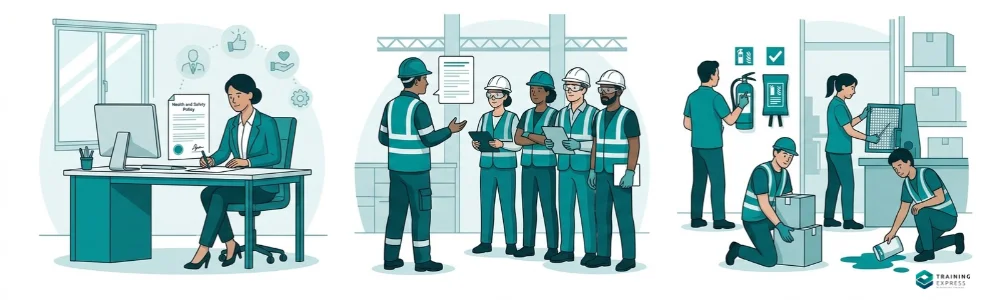
Part 1: Statement of Intent
[Business name] is committed to providing a safe and healthy working environment for all employees, and for visitors, contractors and members of the public who may be affected by our work. We will, so far as is reasonably practicable:
- Assess the risks to health and safety and put suitable controls in place
- Consult our employees on matters affecting their health and safety
- Provide and maintain safe equipment and safe systems of work
- Ensure the safe handling and use of substances
- Provide information, instruction, training and supervision for our employees
- Prevent accidents and cases of work-related ill health
- Maintain safe and healthy working conditions
- Review and revise this policy at least once a year, or sooner if needed
Signed: [Name], [Job title]. Date: [Date]. Review date: [Date].
Part 2: Responsibilities
- Overall responsibility for health and safety: [Name, job title]
- Day-to-day responsibility for ensuring this policy is put into practice: [Name, job title]
- Competent person or health and safety adviser: [Name or company]
- First aiders: [Names]
- Fire marshals: [Names]
- All employees must cooperate with supervisors and managers on health and safety, take reasonable care of themselves and others, follow their training, and report any health and safety concerns to [Name or job title].
Part 3: Arrangements
- Risk assessment: Risk assessments will be carried out by [Name] and reviewed every [12 months] or when work changes. Findings will be shared with employees.
- Consultation: Employees will be consulted on health and safety through [team meetings or employee representatives].
- Training: All new employees will receive health and safety induction training on their first day. Job-specific training will be provided by [Name], and training records will be kept by [Name].
- Equipment: All equipment will be checked and maintained by [Name]. Problems should be reported to [Name].
- Hazardous substances: COSHH assessments will be carried out by [Name] and reviewed every [12 months].
- First aid and accidents: The first aid kit is kept at [location]. All accidents and near misses must be recorded in the accident book, which is kept at [location]. [Name] is responsible for reporting incidents under RIDDOR.
- Emergency procedures: Escape routes will be checked by [Name] every [week]. Fire drills will take place every [6 months], and fire extinguishers will be serviced every [12 months].
- Monitoring: [Name] will check that this policy is being followed and will report to [Name] every [period].
Health and Safety Policy Examples for Different Workplaces
Every policy should be tailored to the business it covers. Here are some examples of what different workplaces may need to include in their arrangements:
- Offices: display screen equipment assessments, slips and trips, electrical safety, fire evacuation, stress and lone working for home workers
- Warehouses: forklift trucks and vehicle routes, manual handling, racking inspections, work at height and loading bays
- Care homes: moving and handling of residents, infection control, hazardous substances, violence and aggression, and medication handling
- Schools: supervision of pupils, school trips, science and technology rooms, contractors on site and visitor management
- Cafés and restaurants: hot surfaces and burns, knives, slips on wet floors, cleaning chemicals, gas safety and food safety
- Gyms: equipment maintenance, manual handling, slips, first aid cover and cleaning chemicals
How Often Should a Health and Safety Policy Be Reviewed?

The law says a health and safety policy must be revised as often as necessary, but it does not set a fixed timescale. As good practice, most businesses review their policy at least once a year.
You should also review your policy whenever there is a significant change, such as:
- A move to new premises or a major change to the building
- New equipment, substances or work processes
- A change in the people who have health and safety responsibilities
- An accident, near miss or case of work-related ill health
- A change in health and safety law
- Advice or action from an inspector
How Should You Share Your Policy With Staff?
The law requires employers to bring their health and safety policy to the attention of their employees. In practice, this means making sure every employee knows the policy exists, knows where to find it and understands what it means for their role.
Common ways to share the policy include going through it during induction training, keeping a copy on the staff intranet or noticeboard, discussing changes in team meetings and asking staff to confirm they have read it. This is separate from the requirement to display the HSE health and safety law poster or give employees the equivalent leaflet.
Common Mistakes to Avoid
Many businesses have a health and safety policy but still fall short. Common mistakes include:
- Copying a template without changing it to reflect the real risks in the business
- Naming people who have left the business or no longer have the role
- Making the policy so long and complicated that nobody reads it
- Writing arrangements that do not match what actually happens
- Forgetting to review the policy after a change or an accident
- Failing to share the policy with staff
What Happens If You Do Not Have a Health and Safety Policy?
If a business with five or more employees does not have a written health and safety policy, it is breaking the law. Inspectors from HSE or the local authority can take enforcement action, which may include an improvement notice requiring the business to put a policy in place by a set date. Failing to comply with a notice is a criminal offence.
A missing or out-of-date policy can also make things more difficult after an accident. It may suggest that health and safety is not being managed properly, which can affect enforcement decisions, insurance claims and the reputation of the business.
Summary
A health and safety policy explains how a business manages health and safety, who is responsible for what and the arrangements in place to control risks. Employers with five or more employees must have a written policy, share it with their staff and keep it up to date. Using the three-part structure of statement of intent, responsibilities and arrangements makes it easier to write a clear and useful policy.
We offer a range of courses that help managers write and put health and safety policies into practice, including our Health and Safety Officer, Advanced Health and Safety and Introduction to Risk Assessment courses. You can also browse all of our health and safety courses to find the right training for you and your team.
Frequently Asked Questions (FAQ)
What are the three parts of a health and safety policy?
The three parts of a health and safety policy are the statement of intent, the responsibilities for health and safety, and the arrangements for health and safety.
Who should sign a health and safety policy?
The statement of intent should be signed by the most senior person in the business, such as the owner, managing director or chief executive.
Do I need to display my health and safety policy?
There is no legal requirement to display the policy itself, but you must bring it to the attention of your employees. Many businesses display the statement of intent on a noticeboard. You must also display the HSE health and safety law poster or give each employee a copy of the leaflet.
Do sole traders need a health and safety policy?
Sole traders with no employees do not need a written health and safety policy. They still have legal duties to manage risks that could affect other people, such as customers and members of the public.
What is the difference between a health and safety policy and a procedure?
A health and safety policy sets out the overall approach, responsibilities and arrangements. A procedure gives step-by-step instructions for a particular task, such as how to evacuate the building or how to use a piece of equipment.
Can I use a template for my health and safety policy?
Yes. A template is a good starting point, but you must adapt it to reflect the real risks and arrangements in your business. A policy that does not match what happens in practice will not meet your legal duties.
Article Reviewed By: Jane Smith, CMIOSH.
Article Written By: Robert Lawrence, Specialices in Health and Safety.
Related Blogs