Food Hygiene
 Health & Safety
 Safeguarding
 First Aid
 Business Skills
 Personal Development


Early childhood is a crucial stage in a child’s development. During the first five years of life, children develop important skills that influence their learning, behaviour, communication, and social interactions. In the UK, early years education is guided by the Early Years Foundation Stage (EYFS) framework, which provides standards for learning, development, and care for children from birth to five years old.
The EYFS framework helps childcare professionals create environments where children can learn through play, exploration, and structured activities. It outlines key developmental goals and ensures that children receive the support they need to grow emotionally, socially, and intellectually.
At the heart of the EYFS framework are the 7 areas of learning, which form the foundation of early childhood education in nurseries, preschools, and reception classes. Understanding these areas is essential for anyone working in childcare or early years education.
This guide explains the seven areas of learning in the EYFS framework and why they are important for supporting children’s development.
Table of Contents
Use Coupon Code:
Use this coupon at Checkout
Quick Overview of the 7 Areas of Learning in EYFS
The EYFS framework identifies seven key areas of learning and development that support children’s growth.
These areas are divided into two groups:
Prime Areas
- Communication and Language
- Physical Development
- Personal, Social and Emotional Development
Specific Areas
- Literacy
- Mathematics
- Understanding the World
- Expressive Arts and Design
The 7 Areas of Learning in the EYFS Framework
| Category | Area of Learning | Focus |
|---|---|---|
|
Prime Area |
Communication and Language |
Listening, understanding, and speaking skills |
|
Prime Area |
Physical Development |
Movement, coordination, and health |
|
Prime Area |
Personal, Social and Emotional Development |
Confidence, relationships, and emotional wellbeing |
|
Specific Area |
Literacy |
Reading and writing development |
|
Specific Area |
Mathematics |
Numbers, counting, shapes, and problem-solving |
|
Specific Area |
Understanding the World |
Exploring people, communities, nature, and technology |
|
Specific Area |
Expressive Arts and Design |
Creativity through art, music, movement, and role play |
1. Communication and Language
Communication and language development is one of the most important aspects of early childhood learning. It focuses on helping children develop the ability to listen, understand, and express themselves.
This area encourages children to build confidence in speaking and interacting with others. Through conversations, storytelling, songs, and group discussions, children gradually develop vocabulary and communication skills.
Key aspects of communication and language include:
- Listening and attention
- Understanding instructions and conversations
- Speaking clearly and expressing ideas
Childcare professionals support communication development by encouraging children to participate in conversations, ask questions, and share their thoughts during daily activities.
Strong communication skills help children build relationships, express emotions, and prepare for learning in later stages of education.
2. Physical Development
Physical development focuses on improving children’s movement, coordination, and overall health. During early childhood, children develop both gross motor skills and fine motor skills, which are essential for everyday activities.
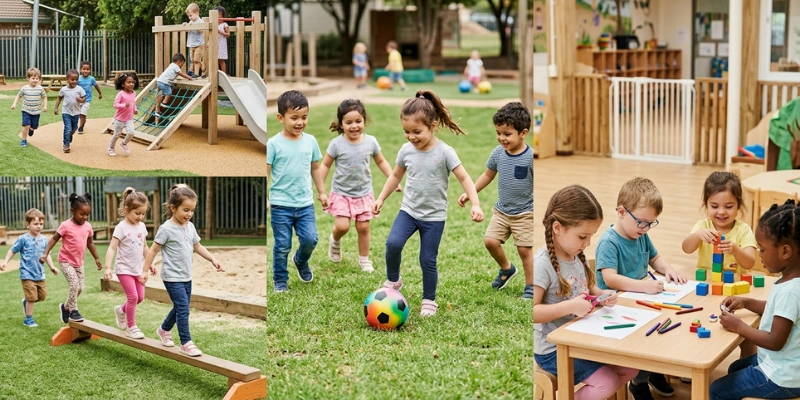
Gross motor skills involve larger body movements such as running, jumping, climbing, and balancing. These activities help children develop strength, coordination, and confidence.
Fine motor skills involve smaller movements, such as using pencils, building with blocks, or manipulating small objects. These skills are important for tasks like writing, drawing, and using tools.
Childcare settings often encourage physical development through:
- Outdoor play
- Movement games and sports
- Creative activities such as drawing and crafts
Supporting physical development helps children build healthy habits and develop the coordination needed for school readiness.
3. Personal, Social and Emotional Development
Personal, social and emotional development helps children understand themselves, build relationships, and manage their emotions. This area focuses on developing confidence, independence, and positive interactions with others.
Children learn important social skills such as sharing, cooperating, and respecting others. They also begin to understand their emotions and develop strategies for managing feelings like frustration or excitement.
Key aspects of this area include:
- Building self-confidence and independence
- Forming positive relationships with peers and adults
- Learning to manage behaviour and emotions
Childcare professionals support emotional development by creating safe and supportive environments where children feel valued and respected.
Developing these skills helps children build strong relationships and prepares them for learning in group settings such as school.
4. Literacy
Literacy development introduces children to reading and writing skills in a fun and engaging way. In early years settings, literacy is often supported through storytelling, books, songs, and creative activities.
Children learn to recognise letters, understand sounds, and develop early reading skills. They also begin experimenting with writing by drawing shapes, forming letters, and expressing ideas through marks and symbols.
Literacy development typically includes:
- Listening to stories and discussing books
- Recognising letters and sounds
- Early writing and mark-making activities
Childcare professionals play a key role in encouraging children to develop an interest in books and language, which helps build strong foundations for future learning.
5. Mathematics
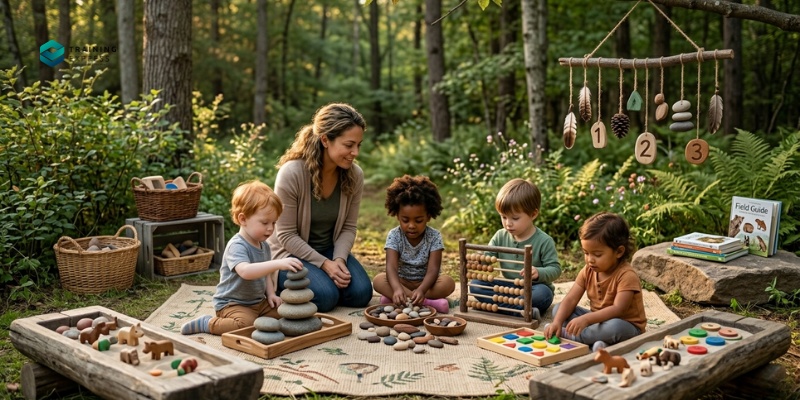
Mathematics in early childhood focuses on helping children understand numbers, patterns, shapes, and basic problem-solving skills.
Rather than formal lessons, early years mathematics is usually introduced through everyday activities and play-based learning.
Children learn mathematical concepts through activities such as:
- Counting objects
- Recognising numbers and patterns
- Sorting shapes and sizes
- Exploring measurements and comparisons
For example, children might count toys during playtime, compare the sizes of blocks, or identify shapes during creative activities.
These experiences help children develop logical thinking and problem-solving skills that are important for future education.
6. Understanding the World
The “Understanding the World” area encourages children to explore their environment and learn about the people, places, and communities around them.
Through observation and exploration, children begin to understand how the world works. They learn about nature, technology, culture, and everyday life.
Activities supporting this area may include:
- Exploring nature and outdoor environments
- Learning about different cultures and traditions
- Using simple technology such as tablets or computers
- Observing changes in seasons and weather
These experiences help children develop curiosity and a sense of discovery while building knowledge about their surroundings.
7. Expressive Arts and Design
Expressive arts and design encourages creativity, imagination, and self-expression. Through creative activities, children learn to explore ideas and communicate their thoughts in different ways.
This area includes activities such as:
- Drawing and painting
- Music and singing
- Dancing and movement
- Role-play and storytelling
Creative activities help children develop imagination, confidence, and emotional expression. They also support communication skills and encourage children to experiment with new ideas.
Childcare professionals support this area by providing materials, resources, and opportunities for children to explore creativity freely.
How Childcare Professionals Use the EYFS Learning Areas in Practice
In early years settings, the 7 areas of learning in the EYFS framework are integrated into daily activities rather than taught as separate subjects. Childcare professionals design play-based learning experiences that encourage children to explore, communicate, and develop skills naturally.
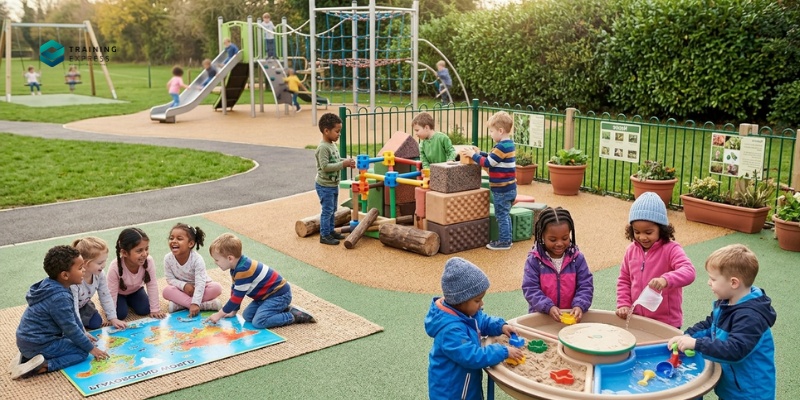
For example, storytelling and group discussions help support communication and language development, while activities such as drawing, building, and crafts strengthen fine motor skills and creativity. Outdoor play and movement games contribute to physical development, while group activities help children build social confidence and emotional awareness.
Early years practitioners observe children’s behaviour, interests, and progress to ensure learning activities match their developmental needs. By combining structured guidance with play-based exploration, childcare professionals help children develop the skills needed for future learning and school readiness.
Final Thoughts
The seven areas of learning in the EYFS framework form the foundation of early years education in the UK. These areas help children develop important skills that support their learning, communication, creativity, and emotional wellbeing.
Understanding the EYFS learning areas is essential for childcare professionals who want to create effective learning environments for young children. By supporting communication, physical development, emotional wellbeing, literacy, mathematics, exploration, and creativity, practitioners can help children build strong foundations for future education.
For individuals working in childcare or planning to enter the early years sector, learning about the EYFS framework is an important step toward supporting children’s growth and development.
Frequently Asked Questions (FAQ)
What are the 7 areas of learning in the EYFS framework?
The seven areas are communication and language, physical development, personal social and emotional development, literacy, mathematics, understanding the world, and expressive arts and design.
Why are the EYFS learning areas important?
They support children’s overall development and prepare them for school by developing communication, social, physical, and cognitive skills.
What are the prime areas of learning in EYFS?
The prime areas are communication and language, physical development, and personal, social and emotional development.
What are the specific areas of learning in EYFS?
The specific areas are literacy, mathematics, understanding the world, and expressive arts and design.
Who uses the EYFS framework?
The EYFS framework is used by nurseries, preschools, early years settings, and reception classes in England to guide early childhood education.

Robert Lawrence
Author | Specialises in Health and Social Care
Robert Lawrence is an e-learning specialist and tutor at Training Express, with experience creating practical resources and strategies to support learners and enhance their professional development.