Food Hygiene
 Health & Safety
 Safeguarding
 First Aid
 Business Skills
 Personal Development


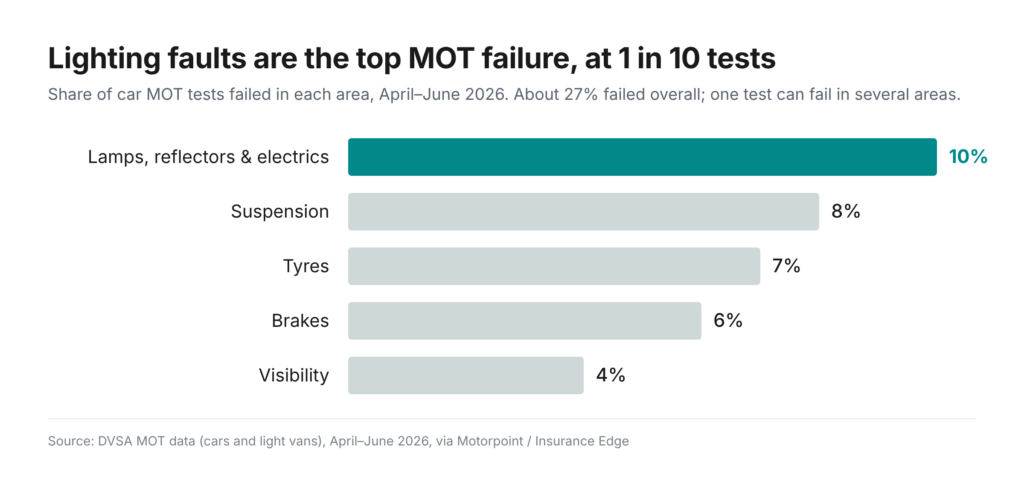
Roughly one in four cars fails its MOT first time. In DVSA data for April to June 2026, about 27% of more than 7.8 million tests ended in a fail, and most of the faults behind them were things a driver could have spotted at home (Insurance Edge / Motorpoint).
This car maintenance checklist shows you exactly what to check, how often, and what to leave to a mechanic. You don’t need a garage full of tools. Most checks take five minutes and a torch.
Table of Contents
Why regular car maintenance matters
A well-kept car is safer, cheaper to run and easier to sell. Small habits stop small problems becoming big bills.
- Safety. Worn tyres, weak brakes and broken lights are among the top MOT failure causes, and they are the parts that keep you on the road.
- Staying legal. Driving with a bald tyre can cost you up to £2,500 and 3 penalty points per tyre (National Tyres).
- Lower running costs. Correct tyre pressures and clean oil help fuel economy and slow engine wear.
- Better resale value. A full service history is one of the first things buyers ask for.
If you want to understand why each of these checks matters — how engines, brakes and cooling systems actually work — a short vehicle maintenance course gives you that foundation.
Weekly car checks: the FORCES routine
Once a week, and before any long journey, run through FORCES. It takes about five minutes on a level driveway with the engine off and cool. (Some drivers learn it as POWDER — Petrol, Oil, Water, Damage, Electrics, Rubber. Same checks, different order.)
| Letter | Check | What "good" looks like |
|---|---|---|
| F | Fuel | Enough for your trip, plus a buffer. Running near empty can draw sediment into the fuel system. |
| O | Oil | Level between the min and max marks on the dipstick. |
| R | Rubber (tyres and wiper blades) | Correct pressures, no cuts or bulges, tread above 1.6mm. Wipers clear the screen without smearing. |
| C | Coolant | Level between the min and max marks on the expansion tank. |
| E | Electrics | All lights, indicators and the horn work. No warning lights stay on after start-up. |
| S | Screenwash | Reservoir topped up with screenwash, not plain water. |
How to check your tyre pressures
- Find the correct pressures in your handbook, inside the fuel flap or on the driver’s door sill.
- Check when the tyres are cold — before driving, or after a short trip to a nearby garage.
- Remove the valve cap, press the gauge on firmly and read the figure.
- Inflate or let air out to match, then refit the cap.
- Increase pressures when the car is fully loaded, as the handbook shows.
How to check your lights on your own
Reverse up to a garage door or shop window at dusk and look in the mirror for brake lights and reverse lights. Or ask someone to walk around the car while you work each switch. Lighting faults are the single biggest MOT failure category, at around 10% of tests (Insurance Edge / Motorpoint).
Monthly car maintenance checks
Once a month, go a little deeper. These checks catch slow leaks and wear before they turn into breakdowns.
1. Engine oil: level and condition
Park on level ground and wait 10 minutes after driving. Pull the dipstick, wipe it, push it fully back in, then pull it out again. The oil should sit between the two marks and look amber to dark brown. Black, gritty or milky oil means it is time for a service — milky oil can point to a head gasket problem.
Top up only with the grade in your handbook (for example 5W-30), a little at a time. Overfilling is as harmful as running low.
2. Tyre tread depth
The legal minimum for cars is 1.6mm across the central three-quarters of the tread, all the way round the tyre (West Yorkshire Police). Many experts suggest replacing tyres at 3mm, because grip in the wet drops sharply below that.
- Quick test: push a 20p coin into the main grooves. If you can see the coin’s outer band, the tread may be close to the limit — get it measured.
- Better test: use a tread depth gauge (a few pounds online).
- Also look for: uneven wear on one edge (a sign of poor wheel alignment), cuts, bulges and objects stuck in the tread.
3. Brake fluid
The reservoir sits near the back of the engine bay, on the driver’s side in most cars. The level should be between min and max. A slowly falling level is normal as pads wear; a sudden drop can mean a leak. If it is low, have the brakes checked rather than just topping up.
4. Battery
Look for white or green corrosion on the terminals and make sure the clamps are tight. Most car batteries last 3 to 5 years. Slow cranking on a cold morning is the classic early warning.
5. Windscreen and bodywork
Check for chips and cracks. A chip in the driver’s line of sight can fail an MOT, and a small chip is cheap to repair before it spreads. Walk around the car for new scratches or rust bubbles, especially on wheel arches and sills.
Car maintenance schedule: what to do and when
Beyond weekly and monthly checks, your car needs regular servicing. The intervals below are typical for a modern petrol or diesel car. Always follow your handbook first — many newer cars use variable service intervals shown on the dashboard.
| Interval | Maintenance job | DIY or garage? |
|---|---|---|
| Every 6 months or 6,000 miles | Interim service: oil and oil filter change, fluid top-ups, tyre and light checks | Garage (oil change is DIY for the confident) |
| Every 12 months or 12,000 miles | Full service: interim jobs plus air filter, brake inspection, suspension and steering checks | Garage |
| Every 12 months | Cabin (pollen) filter | DIY on most cars |
| Every 12 months (from year 3 in Great Britain) | MOT test | Approved MOT centre |
| Every 2 years | Brake fluid change (it absorbs moisture over time) | Garage |
| Every 24 months or 24,000 miles | Major service: full service plus spark plugs, fuel filter (diesel) and more | Garage |
| Every 2–5 years | Coolant / antifreeze flush | Garage |
| Every 3–5 years | Battery replacement | DIY on many cars |
| As specified in the handbook (often 40,000–100,000 miles) | Timing belt and water pump | Garage — a snapped belt can wreck the engine |
Keep every receipt and get the service book stamped. A complete history can add hundreds of pounds when you sell.
Seasonal car maintenance for UK weather
British weather is hard on cars: wet, salty winters and the occasional summer heatwave. Two quick seasonal checks prevent most weather-related breakdowns.
Winter car checklist (October–November)
- Battery: cold weather is the top cause of flat batteries. Get it tested free at many garages and parts shops if it is over three years old.
- Antifreeze: make sure the coolant mix protects to at least -25°C. A cheap hydrometer will tell you.
- Screenwash: use a winter mix rated to -10°C or lower so it doesn’t freeze.
- Tyres: consider all-season or winter tyres if you live somewhere rural or hilly. Keep at least 3mm of tread.
- Wipers: replace blades that judder or streak.
- Emergency kit: ice scraper, de-icer, torch, blanket, phone charger and a high-vis vest.
- Wash underneath: rinse road salt off the underbody and wheel arches to slow rust.
Summer car checklist (May–June)
- Air conditioning: if it isn’t blowing cold, it may need a re-gas.
- Coolant: engines run hotter in traffic and heat; top up to the max line when cold.
- Tyre pressures: adjust for heavy holiday loads, roof boxes and caravans.
- Pollen filter: replace it if the cabin smells musty or hay fever is bad.
Never open a hot radiator or expansion tank cap — the coolant is under pressure and can scald.
DIY car maintenance vs going to a garage
You can safely do most routine checks and simple replacements yourself. Anything involving brakes, steering, fuel lines or lifting the car is best left to a trained mechanic.
| Usually Safe to DIY | Leave to a Garage |
|---|---|
| Checking and topping up oil, coolant and screenwash | Brake pads, discs and fluid changes |
| Tyre pressures and tread checks | Timing belt and water pump |
| Replacing wiper blades | Suspension and steering repairs |
| Changing bulbs (on most older cars) | Anything that needs the car jacked up without axle stands |
| Replacing the cabin and air filters | Air conditioning re-gas |
| Cleaning battery terminals | Diagnosing engine warning lights |
The more you understand how your car works, the more you can do yourself — and the harder it is for anyone to overcharge you. Knowing what a warning light means, or what a worn brake sounds like, helps you explain a fault clearly and judge a quote fairly.
Want to go further?
The Level 2 Light Vehicle Maintenance course from Training Express covers every system in this checklist in more depth: workshop safety and tools, dashboard warning lights, tyres, engine oil, the cooling, fuel and electrical systems, the drive train and brakes. It is self-paced, takes around 7.5 hours online and is CPD accredited — useful for car owners, apprentices and anyone thinking about a career in the motor trade.
Warning signs your car needs attention
Your car usually tells you something is wrong before it breaks down. Book it in promptly if you notice any of these:
- Squealing or grinding when braking — worn brake pads or discs.
- The car pulls to one side — tyre pressure, alignment or a sticking brake.
- A red warning light that stays on — stop when safe. Red usually means a serious fault, such as low oil pressure or overheating.
- An amber engine management light — the car is drivable but has logged a fault. Get it diagnosed soon.
- Sweet smell or steam from the bonnet — a coolant leak.
- Blue or thick white exhaust smoke — burning oil or coolant.
- Knocking or clunking over bumps — worn suspension parts.
- Puddles under the car — green, pink or orange is coolant, brown or black is oil, clear and slippery may be brake fluid.
The most common MOT failures
The same few areas cause most MOT fails — and every one of them appears in the checklist above.
Make car maintenance a habit
You don’t need to be a mechanic to keep your car in good shape. Five minutes of FORCES checks each week, a deeper look once a month and a service on schedule will catch most problems early, keep you legal and give you a far better chance of passing your next MOT first time.
Bookmark this car maintenance checklist and come back to it each season. And if you’d like to understand what’s going on under the bonnet — whether for your own car or a future career — you can learn light vehicle maintenance online at your own pace.
Car maintenance FAQs
How often should I service my car?
Most cars need a full service every 12 months or 12,000 miles, whichever comes first. High-mileage drivers may also need an interim service every 6 months. Your handbook or dashboard service indicator has the exact schedule.
What are the basic car maintenance checks?
The basics are fuel, oil, tyres, coolant, lights and screenwash — remembered as FORCES. Do them weekly and before long journeys.
Is a service the same as an MOT?
No. An MOT is a legal annual test of roadworthiness and emissions for cars over three years old in Great Britain. A service is maintenance that keeps the car running well. Many drivers book both at the same time.
What is the minimum legal tyre tread depth in the UK?
1.6mm across the central three-quarters of the tread, around the whole tyre. Each illegal tyre can bring a fine of up to £2,500 and 3 penalty points.
How often should I check my engine oil?
At least once a month and before any long trip. Older cars, or cars that burn oil, may need checking every fortnight.
Can I learn car maintenance online?
Yes. Online courses teach how each system works, how to carry out routine checks and how to spot faults early. Practical skills still improve with hands-on time on a real car.
Do I need training to use a fire extinguisher at work?
Yes. You shouldn’t use a fire extinguisher at work without training. In England and Wales, the Regulatory Reform (Fire Safety) Order 2005 requires employers to give staff suitable fire safety training. This covers which extinguisher to use and when to evacuate instead.

Robert Lawrence
Author | Specialises in E-Learning.
Robert Lawrence is an author at Training Express, with over 5 years of experience creating practical resources and strategies to support learners and enhance their professional & personal development.
Reviewed by: Ashton Grey is a Mechanic and author of Light Vehicle Maintenance & Car Mechanic courses at Training Express
Other Blogs