Food Hygiene
 Health & Safety
 Safeguarding
 First Aid
 Business Skills
 Personal Development

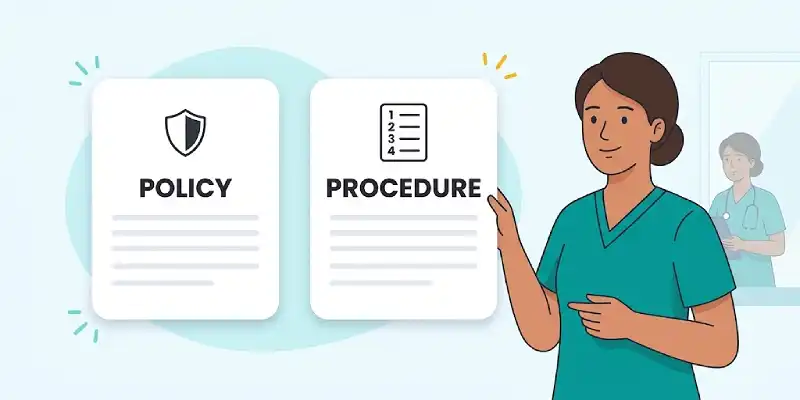

In health and social care, a policy sets out what an organisation expects and why. A procedure sets out exactly how staff carry that expectation out, step by step.
For example, a medicines policy commits a care home to managing medicines safely. The medication administration procedure tells a care worker how to check, give and record each dose.
Put simply: the policy is the “what” and “why”; the procedure is the “how”, “who” and “when”.
This guide is for care workers, Care Certificate learners and health and social care diploma students who need to understand the difference, apply it on shift or explain it in an assessment. It covers:
- Policy vs procedure at a glance
- What a policy is, and what a procedure is
- How both relate to “agreed ways of working”
- A medication example traced from law to practice
- How protocols and guidelines fit in
- How law, regulation and policy connect across the UK
- Who writes and reviews them, and what care workers must do
- A model exam answer and FAQs
Policy vs Procedure: Key Differences at a Glance
The quickest way to see the difference is side by side.
| Feature | Policy | Procedure |
|---|---|---|
| Focus | What the organisation expects, and why. | How a specific task is carried out. |
| Nature | A statement of intent, principles and rules. | A set of ordered, practical steps. |
| Flexibility | Sets the direction; leaves room for professional judgement in how it is met. | Prescriptive; staff follow the steps unless told otherwise or it is unsafe to do so. |
| Who writes and approves it | Senior leaders, the registered manager or the board. | Managers, team leads or specialists, in line with the policy. |
| How often it changes | Less often, e.g. when law, regulation or strategy changes. | More often, e.g. when equipment, systems or practice change. |
| Safeguarding example | The service will protect adults from abuse and neglect and act on every concern. | Who to tell, how quickly, what to record and when to contact the local authority. |
| Medication example | Medicines will be stored, given and recorded safely and lawfully. | How to check the MAR chart, prepare and give the dose, and sign the record. |
Scroll horizontally to view all columns.
The two work as a pair. A policy without procedures leaves staff unsure what to do. A procedure without a policy has no clear purpose or authority behind it. Some organisations put the procedure inside the policy document, while others keep them separate; either is fine, as long as staff can find and follow both.
What Is a Policy in Health and Social Care?
A policy is a formal statement of an organisation’s position on a particular area of care or work. It explains what the organisation is committed to, what it expects from staff and why.
Policies don’t try to cover every task in detail. Instead, they set the framework that day-to-day decisions and procedures must fit within.

What a policy usually includes
- Purpose: why the policy exists and what it aims to achieve
- Scope: who and which services it applies to
- Principles: the values behind it, such as dignity, choice and safety
- Roles and responsibilities: who is accountable for what
- Legal and regulatory basis: the laws, regulations or guidance it reflects
- Related documents: the procedures and protocols that put it into practice
- Review arrangements: who owns it, when it was approved and when it will be reviewed
Common policies in care settings
Most care providers have policies on safeguarding, medicines management, infection prevention and control, health and safety, confidentiality and data protection, equality and diversity, complaints, whistleblowing, and moving and handling. For a fuller list, see our guide to the list of policies and procedures in health and social care.
For example, a confidentiality policy sets the expectation that people’s personal information is protected and shared only when there is a lawful reason. Understanding confidentiality in health and social care helps staff see why the rules are so specific.
What Is a Procedure in Health and Social Care?
A procedure is a set of step-by-step instructions that shows staff how to put a policy into practice. If the policy is the rule, the procedure is the method.
Procedures matter most where consistency and safety matter. They reduce guesswork, support training and help a service show that care is delivered the same safe way every time.

What a procedure usually includes
- Who carries out the task, and what training or competence they need
- When the task happens or what triggers it
- The steps, in order
- Records to complete and where to keep them
- Escalation: who to tell if something goes wrong or doesn’t fit the steps
- Checks: how the task is signed off or audited
For example, an information-sharing procedure might set out who can access care records, how to confirm a caller’s identity, and what to do if a confidentiality concern comes up.
A good procedure is practical. A care worker should be able to follow it on a busy shift without having to guess what comes next.
Policies, Procedures and "Agreed Ways of Working"
If you are studying the Care Certificate or a health and social care diploma, you will often see the phrase agreed ways of working. It means your employer’s policies and procedures, including formal written documents and less formal arrangements that have been agreed with you, such as instructions in a person’s care plan.
In practice, working within agreed ways of working means you:
- Know which policies and procedures apply to your role
- Follow them, and the person’s care plan, when you give care
- Stay within your training and competence
- Ask your supervisor when something is unclear
- Report concerns through the correct route
The Care Certificate standards set out the knowledge, skills and behaviours expected of new care workers. They were updated in 2025 and now include 16 standards. Many of those standards expect learners to show they understand and follow agreed ways of working, which is why the difference between a policy and a procedure comes up so often in induction and assessment.
Worked Example: Medication From Law to Practice
The clearest way to understand the difference is to follow one topic down through every level. Medication is a good example, because each level does a different job.
| Level | Example in a care home in England | The question it answers |
|---|---|---|
| Law and regulation | Regulation 12 of the Health and Social Care Act 2008 (Regulated Activities) Regulations 2014 requires the proper and safe management of medicines (Reg 12(2)(g)). | What must the provider achieve by law? |
| Policy | The home's medicines policy commits it to ordering, storing, giving, recording and disposing of medicines safely, with only trained and assessed staff giving them. | What does this organisation expect, and why? |
| Procedure | The medication administration procedure: check the person's identity, check the Medication Administration Record (MAR), prepare the dose, give it, watch it taken, sign the MAR, report refusals or errors. | How do staff do the task, step by step? |
| Protocol | A "when required" (PRN) protocol for one person's pain relief: what signs to look for, the dose, the minimum gap between doses and when to call the GP. | Exactly what happens in this defined situation? |
Scroll horizontally to view all columns.
What this looks like on shift
A resident tells a care worker she has a headache. The policy means only a trained worker can respond. The PRN protocol tells the worker whether pain relief can be offered and how much. The procedure tells them how to give it and record it on the MAR.
If the resident’s symptoms don’t match the protocol, the worker doesn’t improvise. They escalate to the senior on shift or a health professional, as the procedure says.
That is the difference in action: the law sets the duty, the policy sets the organisation’s commitment, and the procedure and protocol turn it into safe, consistent care.
More Examples of Policies and Procedures in Health and Social Care
The same pattern runs through every area of care.
Safeguarding
- Policy: the organisation will protect adults at risk from abuse, neglect and improper treatment, and will act on every concern.
- Procedure: how to recognise signs of abuse, what to record, who to report to and how quickly, and when the local authority safeguarding team is contacted.
- On shift: a care assistant notices unexplained bruising. The policy means the concern must be taken seriously. The procedure tells them to record what they saw, report it to the named safeguarding lead straight away, and not investigate on their own.
Infection prevention and control
- Policy: the service will prevent and control the spread of infection to protect people and staff. In England, Regulation 12 requires providers to assess the risk of infections and to prevent, detect and control their spread (Reg 12(2)(h)).
- Procedure: when and how to wash hands, which personal protective equipment (PPE) to use for each task, how to clean equipment and how to handle soiled laundry and waste.
- On shift: before giving personal care, a support worker follows the hand hygiene and PPE steps for that task. Infection prevention and control training helps staff apply these steps correctly.
Confidentiality
- Policy: people’s personal information will be protected and shared only when there is a lawful reason.
- Procedure: how to confirm who is asking, what can be shared and with whom, and how to store records securely.
- On shift: a caller says they are a resident’s nephew and asks about her health. The policy says the information must be protected. The procedure tells staff how to check whether the caller is authorised before sharing anything.
Policy vs Procedure vs Protocol vs Guideline
Care organisations also use protocols and guidelines. Each one answers a different question, and each allows a different amount of personal judgement.
| Document | What it answers | Room for judgement | Care example |
|---|---|---|---|
| Policy | What do we expect, and why? | Sets the direction; judgement in how it is met. | Medicines management policy. |
| Procedure | How is this task done, step by step? | Low: follow the steps. | Medication administration procedure. |
| Protocol | Exactly what happens in this defined situation? | Very low: a fixed pathway. | PRN protocol for one person's pain relief. |
| Guideline | What is recommended good practice? | High: informs professional judgement. | National guidance on managing medicines in care homes. |
Scroll horizontally to view all columns.
- Policy = direction. It sets the organisation’s position.
- Procedure = method. It gives the approved steps for routine tasks.
- Protocol = exact response. It is used where risk is high, timing matters or several people must act the same way, such as choking, a fall or a medical emergency.
- Guideline = recommended approach. It supports decisions where care has to be tailored to the person. A guideline only becomes mandatory if the organisation formally adopts it into a policy or procedure.
You may also hear process. A process is the overall series of activities, such as admission to a care home. Procedures give the detailed steps for individual tasks within that process.
How Do Legislation, Policies and Procedures Work Together?
Legislation, policies and procedures are linked, but they are not the same thing.
Legislation → organisational policy → workplace procedure
- Legislation and regulations set legal duties that apply to every provider.
- Policies explain how this organisation will meet those duties, in its own services.
- Procedures tell staff exactly what to do so the policy works in practice.
Not every instruction in a procedure is a legal requirement, and not every law needs its own policy. Understanding legislation in health and social care, and the key UK legislation behind your role, helps you see why certain steps are fixed.
Regulators across the UK
Care is regulated separately in each nation, so policies must reflect the rules where the service operates.
| Nation | Social care regulator | What providers are measured against |
|---|---|---|
| England | Care Quality Commission (CQC) | Health and Social Care Act 2008 (Regulated Activities) Regulations 2014. |
| Wales | Care Inspectorate Wales (CIW) | Regulation and Inspection of Social Care (Wales) Act 2016 and its regulations. |
| Scotland | Care Inspectorate | Health and Social Care Standards. |
| Northern Ireland | Regulation and Quality Improvement Authority (RQIA) | Northern Ireland care regulations and minimum standards. |
Scroll horizontally to view all columns.
In England, Regulation 17: Good governance requires providers to have effective systems and processes to monitor and improve the quality and safety of care. Written policies are part of that evidence, but inspectors also look at whether staff understand them and whether practice matches what is written.
Who Writes, Approves and Reviews Policies and Procedures?
In most care organisations, policies are approved by senior leaders, such as the registered manager, directors or the board, because they carry organisational accountability. Procedures are usually written by managers or specialists who know the task, then checked against the policy.
Every policy and procedure should have:
- A named owner
- An approval date and version number
- A review date
- Links to the documents it depends on
There is no single legal rule on how often they must be reviewed. Many providers review them at least once a year, and local authority guidance often recommends this. Documents should also be reviewed whenever something changes: new legislation or guidance, an incident or near miss, an inspection or audit finding, or a change to services or equipment.
What Should Care Workers Do About Policies and Procedures?
Knowing the difference is only the start. Care workers are expected to:
- Read the relevant policies and procedures during induction, and again when they are updated.
- Know where to find the current approved version.
- Follow the procedures for their role, training and competence, alongside each person’s care plan.
- Ask a senior or supervisor when an instruction is unclear.
- Report concerns, errors and near misses through the correct route.
Following agreed procedures is part of your duty of care: taking reasonable steps to keep the people you support safe from harm.
What if a procedure is unclear, outdated or unsafe?
Don’t guess, and don’t quietly work around it. Raise it with your manager so the document can be checked and updated. If there is an immediate risk to someone’s safety, act to keep them safe and escalate straight away. If concerns are ignored, your organisation’s whistleblowing policy explains how to raise them further.
Model Answer: "Explain the Difference Between a Policy and a Procedure"
Assessments often ask this question. A short, strong answer defines both terms, shows how they connect and gives one example.
“A policy is a written statement of an organisation’s intentions, principles and rules for a particular area, such as safeguarding. It explains what the organisation expects and why. A procedure is the step-by-step instruction for carrying out that policy in practice. It explains how, by whom and when tasks are done. For example, a safeguarding policy commits a care service to protecting adults from abuse, while the safeguarding procedure tells a care worker who to report a concern to, how quickly and what to record.”
Tips for marks: use the words what/why and how, mention that procedures put policies into practice, and choose an example from your own workplace if you can.
“Build your knowledge of care policies and practice. Our Level 3 Diploma in Health and Social Care covers the principles, responsibilities and policies that shape everyday care, with flexible online study. It is CPD-accredited and QLS-endorsed, and supports, but does not replace, the induction, supervised practice and competence checks your employer provides.“
Final Thoughts
The difference between a policy and a procedure comes down to purpose. A policy sets the expectation and the reason for it; a procedure sets out the steps that make it happen. Protocols add an exact response for defined high-risk situations, and guidelines support professional judgement.
Together, they help care workers give safe, consistent and person-centred care, and help providers show regulators that good practice is built into everyday work.
Frequently Asked Questions (FAQ)
Is a procedure the same as a policy?
No. A policy sets out what an organisation expects and why. A procedure explains the steps staff follow to meet that expectation. They work together, but they do different jobs.
What is the difference between a policy and a process?
A policy states the rule or commitment. A process is the overall series of activities used to achieve something, such as admitting a new resident. Procedures give the detailed steps for each task within that process.
What is the difference between a policy, a standard and a procedure?
A standard describes the level of quality or behaviour that must be met, such as the Care Certificate standards or Scotland’s Health and Social Care Standards. A policy sets out how the organisation commits to meeting standards and the law. A procedure gives the steps staff follow to do it.
What is the difference between a policy and an SOP?
A standard operating procedure (SOP) is a type of procedure: documented steps for doing one activity the same way every time. A policy sets broader expectations, while an SOP focuses on the practical steps.
Are policies a legal requirement in health and social care?
Some are. For example, in Great Britain, employers with five or more employees must have a written health and safety policy. Regulators such as the CQC mostly require effective systems and processes rather than listing every policy, but in practice, written policies and procedures are how providers show those systems exist.
What happens if you don't follow a procedure?
People could be put at risk of harm, and you could face disciplinary action or breach your duty of care. If you believe a procedure is wrong or unsafe, raise it with your manager instead of ignoring it.
Does every policy need a separate procedure?
Not always. Some organisations include the steps inside the policy document. Others keep separate procedures for complex or higher-risk tasks. What matters is that staff can find and follow them.
Does every policy need a separate procedure?
Not always. Some organisations include the steps inside the policy document. Others keep separate procedures for complex or higher-risk tasks. What matters is that staff can find and follow them.
What is an example of a procedure in health and social care?
A shift handover procedure is a common example. It sets out what information staff pass on, how care updates are recorded and who receives them, so nothing important is missed between shifts.
What are the main types of policies in health and social care?
Common policies cover safeguarding, medicines, infection prevention and control, health and safety, confidentiality and data protection, equality and diversity, complaints and whistleblowing. See our full list of policies and procedures in health and social care.

Robert Lawrence
Author | Specialises in Health and Social Care
Robert Lawrence is an author at Training Express, with over 5 years of experience creating practical resources and strategies to support learners and enhance their professional & personal development.
Other Blogs