Food Hygiene
 Health & Safety
 Safeguarding
 First Aid
 Business Skills
 Personal Development



The code of conduct for healthcare support workers is a set of 7 standards that describe how healthcare support workers and adult social care workers in England should behave at work. Skills for Care and Skills for Health published it in 2013. It covers accountability, dignity, teamwork, communication, confidentiality, learning and equality.
If you’re new to care, or working towards the Care Certificate, this guide explains each standard in plain English, with a typical example from a care setting. It also covers who the code applies to, how it fits with your workplace policies, and what can happen if it’s breached.
Table of Contents
What is the Code of Conduct for Healthcare Support Workers and Adult Social Care Workers?
The code is a national set of standards for unregistered care and support staff in England. Its full name is the Code of Conduct for Healthcare Support Workers and Adult Social Care Workers in England, and it was published in 2013 as part of the government’s response to the Francis report into failings at Mid Staffordshire NHS Foundation Trust.
The code has two jobs. It tells you what good conduct looks like, and it tells the people you support what they can expect from you.
The code isn’t law. The Skills for Care guide for the public says plainly that there is no legal requirement for employers to use it. In practice, though, many employers build it into job descriptions, induction, supervision and disciplinary policies, so it can still affect your job. Healthcare support workers (HCSWs) in England aren’t on a statutory register, which is why a shared code matters.

Who does the code apply to?
The code applies to healthcare support workers and adult social care workers in England. The code lists:
- healthcare support workers, including assistant practitioners, who report to a registered nurse or midwife
- adult social care workers, including personal assistants and staff in residential care, supported living, day services and home care (domiciliary care).
It doesn’t apply to social work assistants, or to healthcare support workers who report to other healthcare professionals. Registered professionals such as nurses, doctors and social workers already follow their own regulator’s code, so this one doesn’t apply to them:
- registered nurses, midwives and nursing associates follow the NMC Code (NMC is the Nursing and Midwifery Council)
- HCPC registrants, such as physiotherapists and paramedics, follow the HCPC standards of conduct, performance and ethics (HCPC is the Health and Care Professions Council)
- social workers in England follow Social Work England’s professional standards.
Code of conduct vs the Care Certificate
The code describes how you should behave. The Care Certificate describes what you should know and be able to do when you start in care. Employers often use the two together during induction.
| Comparison | Code of Conduct | Care Certificate |
|---|---|---|
| What it covers | Behaviour and attitudes at work | Knowledge and skills for new care workers |
| How many parts | 7 standards | 16 standards (updated March 2025) |
| Who assesses it | Your employer, through supervision and appraisal | A workplace assessor, who checks knowledge and observes practice |
| Is it a qualification? | No | The standards aren't a qualification, but the Level 2 Adult Social Care Certificate is a regulated qualification based on them |
The Care Certificate standards were updated in March 2025. There are now 16 standards, including a new one on awareness of learning disability and autism. At the same time, the Level 2 Adult Social Care Certificate became available as a regulated qualification built on those standards.
The 7 standards of the code of conduct
The code has 7 standards. In the code’s own words, as a healthcare support worker or adult social care worker in England you must:
- Be accountable by making sure you can answer for your actions or omissions.
- Promote and uphold the privacy, dignity, rights, health and wellbeing of people who use health and care services and their carers at all times.
- Work in collaboration with your colleagues to ensure the delivery of high quality, safe and compassionate healthcare, care and support.
- Communicate in an open and effective way to promote the health, safety and wellbeing of people who use health and care services and their carers.
- Respect a person’s right to confidentiality.
- Strive to improve the quality of healthcare, care and support through continuing professional development.
- Uphold and promote equality, diversity and inclusion.

Here’s what each standard looks like on a normal shift.
1. Be accountable
Being accountable means you can explain and stand behind what you did, and what you didn’t do. The code expects you to work within your job description and your competence, and to ask for help when a task is beyond your training.
- Only do tasks you’ve been trained and signed off for.
- Follow your employer’s agreed ways of working (see agreed ways of working).
- Report mistakes straight away, including your own.
Typical example: on a morning medication round you realise you gave a tablet 30 minutes late. You tell the senior on shift, record it, and follow the medication error procedure. You don’t fix the time on the chart.
Linked policy: medication policy, incident reporting policy.
2. Promote and uphold privacy, dignity, rights, health and wellbeing
This standard is about treating each person as an individual, with choice and respect. It includes getting consent before you give care.
- Knock and wait before you enter someone’s room.
- Offer choices, even small ones, such as what to wear.
- Support people to do as much as they can for themselves.
Typical example: during personal care you keep the person covered, close the curtains and talk them through each step. When they say they’d prefer a wash later, you respect that and record it.
Linked policy: dignity and privacy policy, consent and Mental Capacity Act (MCA) policy. Read more in our guide to duty of care in health and social care.
3. Work in collaboration
Collaboration means working as part of a team that includes colleagues, managers, families and other professionals such as GPs and district nurses.
- Share information at handover, accurately and on time.
- Follow care plans written by other professionals.
- Respect other people’s roles and expertise.
Typical example: the district nurse asks you to reposition a person every 2 hours. You follow the plan, record each turn on the chart and tell the nurse when you spot redness on the skin.
Linked policy: care planning policy, handover and record keeping procedures.
4. Communicate in an open and effective way
Good communication keeps people safe. This standard covers how you speak, listen and write, and how quickly you pass on concerns.
- Use the person’s preferred way of communicating, such as pictures, large print or an interpreter.
- Write clear, factual records.
- Report changes in someone’s health or behaviour to a senior straight away.
Typical example: a person who’s usually chatty is quiet and isn’t eating. You tell the senior carer, note what you saw in the daily record, and the senior arranges a GP review.
Linked policy: communication policy, record keeping policy.
5. Respect a person's right to confidentiality
The people you support share private information with you. This standard means you only share it with people who need to know, and in line with your employer’s policy and data protection law.
- Don’t discuss people you support in public places or on social media.
- Keep records secure, including on work phones and tablets.
- Know when confidentiality can be broken, for example to protect someone from harm.
Typical example: a neighbour asks you in the supermarket how “Mrs B” is getting on. You politely say you can’t talk about the people you support.
Linked policy: confidentiality and data protection policy. See our full guide to confidentiality in health and social care.
6. Strive to improve through continuing professional development
Continuing professional development (CPD) means keeping your knowledge and skills up to date throughout your career.
- Complete your mandatory training and refreshers on time.
- Use supervision to reflect on what went well and what you could do better.
- Ask for training when your role changes.
Typical example: you start supporting someone who uses a hoist. You ask for moving and handling training on that hoist before you use it, rather than learning from a colleague on the job.
Linked policy: training and development policy, supervision policy.
7. Uphold and promote equality, diversity and inclusion
This standard means treating everyone fairly and challenging discrimination when you see it.
- Respect people’s culture, faith, language, gender identity and sexual orientation.
- Make reasonable adjustments so people can take part.
- Speak up if a colleague makes a discriminatory comment.
Typical example: a person you support fasts during Ramadan. You work with the team to change meal and medication times, after checking with the pharmacist or GP.
Linked policy: equality, diversity and inclusion policy.

The 7 standards at a glance
Use this table as a quick reminder of each standard and the workplace policy that usually supports it.
| Standard | In practice | Linked policy (typical) |
|---|---|---|
| 1. Be accountable | Work within your competence, report errors | Medication, incident reporting |
| 2. Privacy, dignity, rights, health and wellbeing | Consent, choice, privacy during care | Dignity, consent and MCA |
| 3. Work in collaboration | Handover, follow care plans | Care planning, record keeping |
| 4. Communicate openly and effectively | Report changes, clear records | Communication, record keeping |
| 5. Respect confidentiality | Share on a need-to-know basis | Confidentiality and data protection |
| 6. Continuing professional development | Training, supervision, reflection | Training and supervision |
| 7. Equality, diversity and inclusion | Fair treatment, challenge discrimination | Equality, diversity and inclusion |
What care workers must not do under the code
The code doesn’t give a single “do not” list, but its standards rule out certain behaviour. Your employer’s policies will usually spell these out. Based on the code’s standards, you shouldn’t:
- carry out tasks you aren’t trained or competent to do
- give care without the person’s consent, unless the law allows it (for example, a best interests decision under the Mental Capacity Act 2005)
- share personal information without a valid reason
- hide or cover up mistakes, accidents or near misses
- treat anyone less favourably because of who they are
- accept gifts, money or favours against your employer’s policy, or form personal relationships with the people you support.
That last point is about professional boundaries. We cover it in full, with real-world examples, in our guide to professional boundaries in health and social care.
How the code fits with policies, procedures and the law
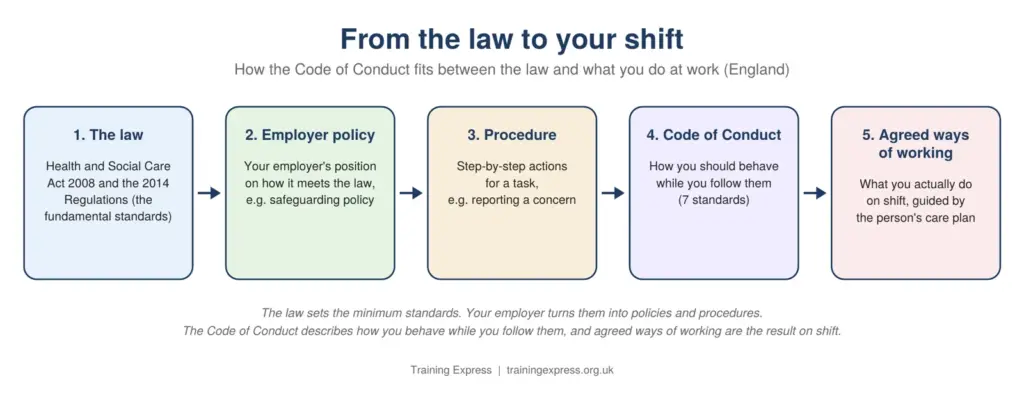
The code sits between the law and your daily work. The law sets the minimum standards providers must meet. Your employer turns those into policies and procedures. The code describes the behaviour expected of you while you follow them.
In England, care providers registered with the Care Quality Commission (CQC) must meet the fundamental standards set out in regulations under the Health and Social Care Act 2008. We explain these in our guide to the Health and Social Care Act 2008. For how policies and procedures work in care settings, read our main guide to policies and procedures in health and social care.
What happens if you breach the code?
Because the code isn’t law, breaching it isn’t a criminal offence in itself. But it can still have serious results, because your employer can use it to judge your conduct.
Depending on how serious the breach is, your employer might:
- talk it through with you in supervision and agree how to put it right
- arrange extra training or closer support
- start a disciplinary process under its own policy
- dismiss you for serious misconduct.
Some breaches also involve the law. For example, abuse or neglect is a safeguarding matter, and some acts are crimes. If you’re worried that someone is being harmed, follow your safeguarding policy and tell your manager straight away. In an emergency, call 999. Our guide to safeguarding in health and social care explains more.
Referral to the DBS barred lists
A small number of serious cases lead to a referral to the Disclosure and Barring Service (DBS). Employers who provide regulated activity have a legal duty to refer someone when both of these conditions are met:
- they removed the person from regulated activity, or would have done if the person hadn’t left
- they did so because the person harmed, or posed a risk of harm to, a child or vulnerable adult.
This doesn’t apply to every breach of the code. A late record or a missed refresher course won’t lead to a DBS referral. Making the referral is the employer’s job, and the DBS decides whether to bar someone.
How employers use the code
Employers use the code as a shared benchmark for behaviour. Skills for Care’s guidance for employers suggests using it alongside the Care Certificate as a measurable way to check that staff work to the same standard.
In practice, employers often use the code to:
- write job descriptions and recruitment questions
- plan induction alongside the Care Certificate
- structure supervision and appraisal conversations
- show CQC inspectors how staff are supported to behave well (a good practice approach, not a CQC requirement).
The code also works best when your employer’s agreed ways of working and policies and procedures match it. If they don’t, raise it in supervision.
Codes of conduct in Wales, Scotland and Northern Ireland
The code covered in this article applies to England only. The other UK nations have their own codes, and in Wales, Scotland and Northern Ireland many social care workers must also register with a workforce regulator.
| Nation | Code | Published by |
|---|---|---|
| Wales (social care) | Code of Professional Practice for Social Care Workers (new version in force from 1 July 2026) | Social Care Wales |
| Wales (NHS) | Code of Conduct for Healthcare Support Workers in Wales | NHS Wales (now supported by HEIW) |
| Scotland (social services) | Codes of Practice for Social Service Workers and Employers (2024 edition) | Scottish Social Services Council (SSSC) |
| Scotland (NHS) | Code of Conduct for Healthcare Support Workers (mandatory since 31 December 2010) | Scottish Government |
| Northern Ireland (social care) | Standards of Conduct and Practice for Social Care Workers | Northern Ireland Social Care Council (NISCC) |
Learn more with Training Express
If you’re new to care or preparing for your Care Certificate assessment, our Care Certificate Course: Standards (1 to 15) covers the theory behind the standards, including your role, duty of care and communication. It doesn’t award the Care Certificate itself, which needs a workplace assessment.
Frequently Asked Questions (FAQs)
What are the 5 codes of conduct?
The Code of Conduct for Healthcare Support Workers and Adult Social Care Workers in England has 7 standards, not 5. They are: be accountable; promote privacy, dignity, rights, health and wellbeing; work in collaboration; communicate openly and effectively; respect confidentiality; keep developing through CPD; and uphold equality, diversity and inclusion. Some employers summarise them in fewer points, but the official code lists 7.
What are 5 responsibilities of a support worker in care?
Five key responsibilities are: keeping people safe and reporting concerns; giving person-centred care that respects dignity and choice; following care plans and your employer’s policies; keeping clear, accurate records; and protecting people’s confidential information. Your job description sets out your exact duties. The Code of Conduct describes how you should behave while you carry them out.
What are care workers not allowed to do?
Care workers shouldn’t carry out tasks they aren’t trained for, give care without consent (unless the law allows it), share confidential information without good reason, hide mistakes or treat anyone unfairly. Most employers also ban accepting gifts or money and forming personal relationships with the people you support. Your employer’s policies set the exact rules, so check your staff handbook.
What is the easiest high paying job?
No high paying job is easy in every way. Jobs that are quicker to get into, such as HGV driving (median £41,735) or sales (median £58,743 for sales accounts and business development managers), come with trade-offs like long hours, nights away or targets. Choose the trade-off that suits your life best.
Do you need a degree to be a police officer?
Not always. In England and Wales, forces can recruit through degree routes (PCDA and DHEP) and the Police Constable Entry Programme (PCEP), introduced in April 2024 for people who don’t want a degree. Each force decides which routes it offers. Police officers (sergeant and below) earn a median full-time salary of £52,569 (ONS 2026).
Does the code of conduct apply to nurses?
No. Registered nurses, midwives and nursing associates follow the NMC Code from the Nursing and Midwifery Council. Other registered professionals follow their own regulator’s code, such as the HCPC’s standards or Social Work England’s professional standards. The Code of Conduct for Healthcare Support Workers covers unregistered staff, such as care workers, HCSWs and assistant practitioners.
Related Blogs