Food Hygiene
 Health & Safety
 Safeguarding
 First Aid
 Business Skills
 Personal Development


There’s no fixed legal interval for PAT testing. How often you test depends on the equipment, how it’s used and where. In low-risk workplaces, HSE suggests a formal visual inspection of earthed (Class I) items like kettles every 6 to 12 months and a combined test every 1 to 2 years. Construction tools need checking far more often.
How often should PAT testing be done? Ask five PAT firms and you may get five answers, from every year to every five years. The reason is simple: the law doesn’t set a date. It asks you to keep electrical equipment safe and leaves the timing to you.
Below, you’ll find HSE’s suggested intervals and a simple way to set your own schedule. If you’re new to the topic, start with what PAT testing is.
Table of Contents
Is There a Legal Time Limit for PAT Testing?

No. No law in Great Britain or Northern Ireland says how often you must PAT test. The Electricity at Work Regulations 1989 (regulation 4(2)) require electrical systems, including equipment, to be maintained to prevent danger, so far as is reasonably practicable. Northern Ireland has the same duty under the Electricity at Work Regulations (Northern Ireland) 1991.
HSE’s PAT FAQs put it plainly: the regulations don’t say what needs to be done, by whom or how often. That’s for the duty holder (the person in control of the equipment, usually the employer) to decide.
An insurer, licence, venue or contract may still set its own dates. Those are conditions you agree to, not general law. Our guide to whether PAT testing is a legal requirement explains the full legal picture, including who can do the testing.
The Three Levels of PAT Checks
Good maintenance uses three levels of check: quick user checks, formal visual inspections and combined inspection and testing. Most of the work is looking, not testing.
| Check | Who does it | What it involves | Typical frequency (low risk) |
|---|---|---|---|
| User check | The person using the item | A quick look at the plug, cable and casing before use. Faults are reported and the item is taken out of use. | Before use, for items that are moved or handled |
| Formal visual inspection | A trained member of staff | A planned, recorded check. Where the plug can be opened, it includes the fuse, cord grip and wire connections. | Every 6 months to 4 years, depending on the item |
| Combined inspection and testing | A competent person with a PAT tester | A visual inspection plus electrical tests, such as earth continuity and insulation resistance | Every 1 to 5 years, for items that need it |
Earth continuity checks the earth path from the plug to any metal casing. Insulation resistance checks that the insulation keeps electricity where it should be.
HSE’s guidance HSG107 says users should look for damaged cables and plugs, taped joints, loose parts, burn marks and signs of water or heavy dirt. Our electrical safety tips cover the everyday habits that go with them.
Always unplug equipment before you check it. If an item fails any check, stop using it, label it and take it out of use until it’s repaired or replaced.
PAT Testing Frequency Table (UK)
HSE’s suggested starting intervals for low-risk workplaces, such as offices, shops and hotels, are below. They come from HSE’s leaflet INDG236.
| Equipment | User checks | Formal visual inspection | Combined inspection and test |
|---|---|---|---|
| Battery-powered (under 40 V) | No | No | No |
| Extra-low voltage (under 50 V AC), such as phone equipment and low-voltage desk lamps | No | No | No |
| Desktop computers, screens, photocopiers and fax machines (rarely moved) | No | Every 2 to 4 years | Not needed if double insulated; otherwise up to every 5 years |
| Class II (double insulated), moved now and then but not hand-held, such as fans and table lamps | No | Every 2 to 4 years | No |
| Class II hand-held, such as some floor cleaners and kitchen equipment | Yes | Every 6 to 12 months | No |
| Class I (earthed), such as kettles, irons, some floor cleaners and kitchen equipment | Yes | Every 6 to 12 months | Every 1 to 2 years |
| Cables, leads, plugs, extension leads and battery chargers | Yes | Every 6 months to 4 years, depending on what's plugged in | Every 1 to 5 years, depending on what's plugged in |
Higher-risk settings need much shorter intervals. These starting points come from Table 1 in HSG107.
| Setting | User checks | Formal visual inspection | Combined inspection and test |
|---|---|---|---|
| Construction, 110 V equipment | Weekly | Monthly | Before first use on site, then every 3 months |
| Construction, 230 V equipment | Daily or every shift | Weekly | Before first use on site, then monthly |
| Construction site offices | Monthly | Every 6 months | Before first use on site, then yearly |
| Heavy industrial or high risk of damage | Daily | Weekly | Every 6 to 12 months |
| Light industrial | Yes | Before first use, then every 6 months | Every 6 to 12 months |
| Equipment for hire | Not applicable | Before issue and after return | Before issue |
These intervals are starting points, not legal requirements. HSG107 says so itself. The IET Code of Practice for In-service Inspection and Testing of Electrical Equipment (5th edition, 2020) went further and dropped its fixed frequency table. It now asks you to set intervals by risk assessment.
How Often to PAT Test by Workplace
Start from the tables above, then adjust for how hard your equipment works and who uses it.
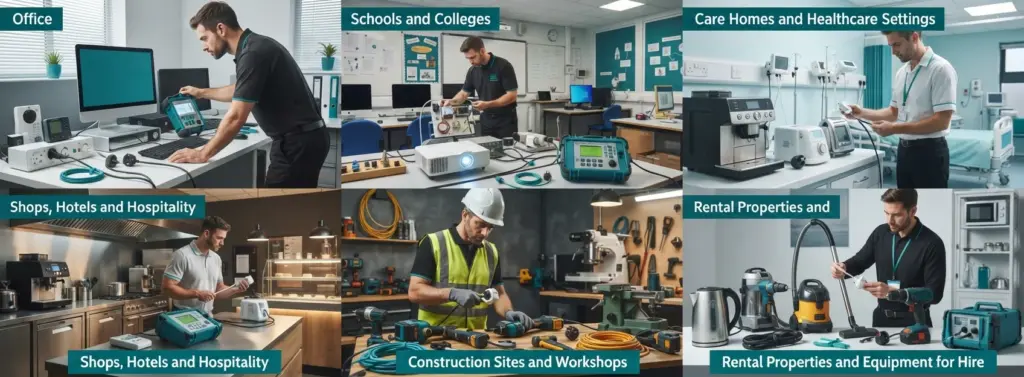
Offices
Offices are low risk. Most IT equipment needs only a visual inspection every 2 to 4 years, while kettles, toasters and other earthed kitchen items suit a combined test every 1 to 2 years. HSE reviewed five years of annual testing in its own offices and decided that user checks and visual inspections by trained staff were enough for much of its equipment.
Schools and colleges
The Department for Education says not all portable equipment needs a PAT, and the law sets no frequency. Base your intervals on risk. Items that pupils handle, and equipment in science labs, design and technology rooms and food rooms, usually need shorter intervals than staffroom kit.
Care homes and healthcare settings
Care settings mean heavy use, frequent cleaning, wet areas and vulnerable residents. HSG107 notes that equipment used by the public may need much more frequent visual inspections. Residents’ own items, such as radios and lamps, are worth checking before they’re used.
Shops, hotels and hospitality
Heat, water and grease in commercial kitchens shorten equipment life, so check Class I items at the short end of HSE’s range or sooner. Kettles and hairdryers in guest rooms are used by the public, so they need regular visual inspections too.
Construction sites and workshops
Use the higher-risk table. Tools on site get dropped, crushed and soaked, so weekly and monthly checks are normal. Workshops fit the light or heavy industrial rows, depending on how hard the equipment is used.
Rental properties
Landlord rules differ in each UK nation. Scottish landlords and social landlords in England must have the appliances they supply checked at least every 5 years, while private landlords elsewhere have no set legal interval. Our guide to PAT testing for landlords sets out the rules nation by nation.
Equipment for hire
HSE strongly recommends that hire firms formally inspect and test equipment before each hire. HSG107 also suggests a visual inspection when it comes back
What Needs PAT Testing (and What Doesn't)?
Almost every item that plugs into the mains needs some kind of check, but not every item needs an electrical test. The item’s class decides which checks apply. The IET Code of Practice now talks about “electrical equipment” rather than “portable appliances”, because the same thinking applies to anything that isn’t part of the fixed wiring.
Class I, Class II and Class III equipment explained
Class I equipment relies on an earth connection for safety. It usually has a metal casing and needs both visual checks and electrical tests. Class II equipment is double insulated, so it has no earth and carries the square-within-a-square symbol. Visual inspection does most of the work. Class III equipment runs at extra-low voltage from a safe power supply. The item itself isn’t tested, but its charger or power supply is checked.
| Item | Usual class | What it usually needs |
|---|---|---|
| Kettle | Class I | User checks, visual inspection and combined test |
| Toaster | Usually Class I | User checks, visual inspection and combined test |
| Microwave | Usually Class I | Visual inspection and combined test |
| Computer monitor | Class I or Class II (check the label) | Visual inspection; combined test only if Class I |
| Laptop charger | Class II | User checks and visual inspection |
| Extension lead | Has an earth, so treated like Class I | User checks, visual inspection and combined test |
| Phone charger | Class II charger for a Class III device | User checks and visual inspection |
Always check the rating label, as the class can vary between models.
Extension leads and cables
Extension leads get stood on, trapped in doors and plugged into each other, so they’re often damaged. Check them at the intervals in the low-risk table above. Look out for one lead plugged into another (daisy-chaining), a common fault.
Fixed and hard-wired equipment
Equipment wired straight into the building’s wiring, such as hand dryers and built-in ovens, is usually checked during the fixed installation inspection by an electrician. That inspection produces an electrical installation condition report (EICR).
New and second-hand equipment
New equipment should arrive in a safe condition. HSE says a simple visual check to make sure it isn’t damaged is enough, and it doesn’t need a formal PAT. Second-hand equipment is different, because you don’t know its history. Inspect it and, if it’s Class I, test it before first use.
How to Set Your Own PAT Testing Schedule
Start with HSE’s table, then adjust it for your own risks. These five steps work for most small and medium workplaces.
- List your equipment. Give each item an ID and note what it is and where it lives.
- Note the environment. Is the item used in a dry office, a busy kitchen or outdoors? How often is it moved or handled?
- Check who uses it. Equipment used by the public, children or vulnerable residents needs closer attention.
- Look at the fault history. Use reports from user checks and past results to spot items and areas that keep failing.
- Set intervals and review them. After each round, look at the results. HSG107 says a low failure rate suggests you can lengthen the interval, and a high one means you should shorten it.
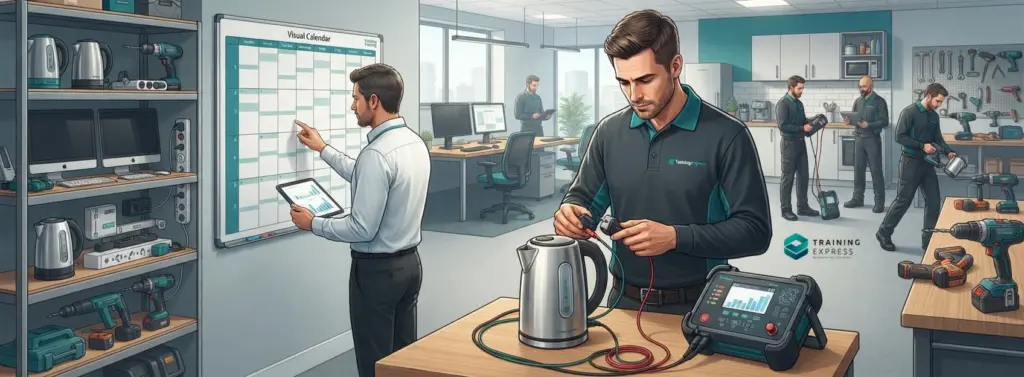
HSE’s travel agent example shows how this works. The manager of a clean, dry high street shop listed two computers, a fax, two printers and a vacuum cleaner. The office equipment rarely moved, so she set a visual inspection every 5 years. The vacuum cleaner was heavily used and had already been repaired, so it got a visual inspection every 6 months, a test after 12 months and a review after 24 months.
A typical small office might end up with something like this: user checks before use, a yearly visual inspection of everything, and a combined test of kettles, toasters and extension leads every 1 to 2 years.
Does a PAT Test Expire?
No. A PAT test has no legal expiry date. HSE’s INDG236 points out that a test only shows an item was safe on the day it was tested. When the next check happens depends on your risk assessment.
HSG107 goes further. It says the person doing the test shouldn’t decide when the next one is due, and a pass label shouldn’t show a next test date. The duty holder sets that date. Many testers still add a “retest” date, so treat it as advice and check it against your own schedule. Our free PAT test certificate template helps you record dates and results.
When to Check or Test Outside Your Schedule
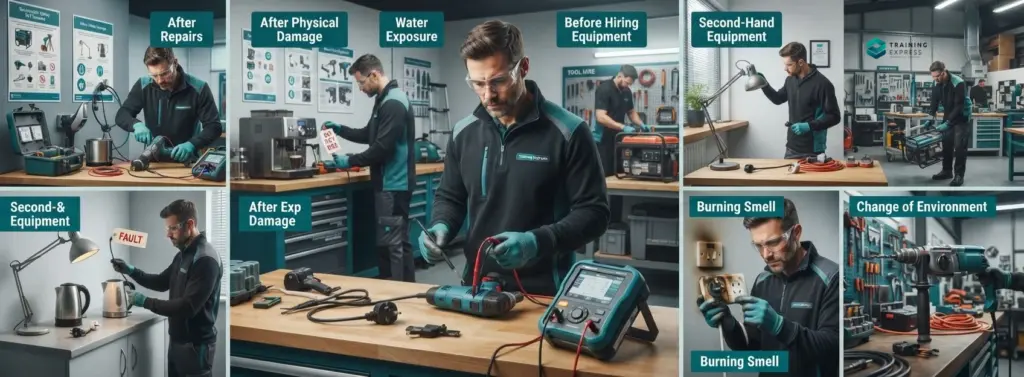
Don’t wait for the next planned date if something changes. Check or test an item:
- after any repair or modification (HSG107 says a combined test is likely to be justified)
- after damage, a drop, crushing or contact with water
- before you hire it out, and when it comes back
- before first use, if it’s second-hand
- after a failed user check, a reported fault or a burning smell
- when it moves to a harsher setting, such as from an office to a workshop
Unplug the item first. If it fails, stop using it and remove it until it’s repaired by a competent person or replaced.
Who Should Carry Out the Checks?
Users do user checks, a trained member of staff can do visual inspections, and combined testing needs a competent person. You don’t need to be an electrician for any of these.
HSE says that in many low-risk workplaces a sensible member of staff with enough knowledge and training can carry out visual inspections. Combined inspection and testing needs more: the right test equipment, the skill to use it and the knowledge to understand the results.
If you’re thinking of training someone in-house, our portable appliance testing certificate page explains what the training covers.
Keep Your Checks In-House
If you’d rather not book a contractor every time, a trained member of staff can handle user checks, visual inspections and, with the right instrument and practice, combined testing. Our PAT testing course builds the knowledge they need, from equipment classes to risk assessment and record-keeping.
This guide is general information, not legal advice. For your specific situation, check HSE guidance, your insurer or a qualified electrician.
Frequently Asked Questions (FAQs)
How often should PAT testing be done in an office?
There’s no fixed rule, but HSE’s suggested intervals for low-risk workplaces suit most offices. Computers and screens usually need a visual inspection every 2 to 4 years and no test if they’re double insulated. Kettles and other earthed kitchen items suit a visual inspection every 6 to 12 months and a combined test every 1 to 2 years. Review the intervals once you see your results.
How often should PAT testing be done in a rental property?
It depends on where the property is. In Scotland, landlord-supplied appliances must be tested at least every 5 years, and social landlords in England must have supplied equipment checked at least every 5 years. Private landlords in England, Wales and Northern Ireland have no set legal interval, but many test before each new tenancy and record the results.
Does PAT testing expire?
No. PAT testing has no legal expiry date. A test shows that an item was safe on the day it was tested. When the next check happens depends on your risk assessment, the type of equipment and how it’s used. HSE guidance says the duty holder, not the tester, should decide when the next test is due.
Do new appliances need PAT testing?
No. HSE says new equipment should be supplied in a safe condition and doesn’t need a formal PAT. A simple visual check to make sure it wasn’t damaged in transit is enough. Add the item to your equipment list so it’s included in future checks. Second-hand equipment is different, so inspect it and, if it’s earthed, test it before first use.
Is PAT testing a legal requirement every year?
No. No law requires yearly PAT testing. HSE says annual testing isn’t always necessary in low-risk workplaces, where many items need only user checks and visual inspections. You must keep electrical equipment safe, and how often you check it depends on risk. Some insurers, licences or contracts may set their own dates, so check any terms you’ve agreed to.
How often should extension leads be PAT tested?
HSE suggests a formal visual inspection of extension leads every 6 months to 4 years and a combined test every 1 to 5 years, depending on what’s plugged into them. Leads used in kitchens, workshops or outdoors sit at the shorter end of the range. Users should also check leads before each use for cuts, crushing and damaged plugs.
Is there a British Standard for PAT testing?
No. There’s no British Standard for PAT testing. The recognised guidance is the IET Code of Practice for In-service Inspection and Testing of Electrical Equipment (5th edition, 2020), alongside HSE guidance such as HSG107 and INDG236. BS 7671, the wiring regulations, covers fixed electrical installations, not plug-in equipment.
Can any electrician carry out PAT testing?
Not automatically. Being an electrician doesn’t by itself make someone competent to PAT test, and you don’t need to be an electrician to do it. HSE says the person needs the right test equipment, the skill to use it and the knowledge to understand the results. Many electricians have this, but ask what training and equipment they have.

Robert Lawrence
Tutor | Specialises in E-Learning
Robert Lawrence is an e-learning specialist and tutor at Training Express, with experience creating practical resources and strategies to support learners and enhance their professional development.
Reviewed by: Stephen Brook | PAT Testing Expert & Course Author at Training Express
Related Blogs