Food Hygiene
 Health & Safety
 Safeguarding
 First Aid
 Business Skills
 Personal Development


Disclaimer: This article is for general information only and doesn’t qualify you as a certified first aider. If you suspect someone has heat stroke, call 999 straight away.
Most of us think we’d recognise heat stroke if we saw it. In reality, St John Ambulance’s own research found that more than half of adults in England can’t reliably tell heat exhaustion and heat stroke apart — and that confusion is exactly what costs time when it matters most. One condition responds to a bit of first aid and a lie-down in the shade. The other needs an ambulance.
We put this guide together to close that gap: what actually causes each condition, how to tell them apart at a glance, what to do in the first 30 minutes, and — because a lot of our readers are responsible for staff, not just family — what UK employers are legally expected to do about it. Where it’s useful, we’ve pointed to the underlying NHS, GOV.UK and HSE guidance rather than just asserting things, so you can check the source yourself.
Table of Contents
Quick answer: what's the difference?
| Comparison | Heat Exhaustion | Heat Stroke |
|---|---|---|
| Cause | Loss of water and salt through excessive sweating | Body's cooling system fails completely |
| Core temperature | Below 40°C | 40°C or above |
| Skin | Pale, cool, clammy, sweaty | Hot, dry or still sweaty, flushed |
| Mental state | Alert, but tired, dizzy, irritable | Confused, disorientated, may lose consciousness |
| Onset | Gradual, over hours | Can develop rapidly, sometimes within minutes |
| Response | First aid: cool down, rehydrate, monitor for 30 minutes | Call 999 immediately — medical emergency |
| Recovery | Usually 30–60 minutes after cooling | Days to weeks; often requires hospital admission |
If you only remember one rule: heat exhaustion cools down with first aid in 30 minutes — if it doesn’t, or if the person is confused, unresponsive, or having seizures, treat it as heat stroke and call 999.
What Causes Heat Exhaustion and Heat Stroke?

Both conditions sit on the same spectrum of heat-related illness, and left untreated, one tends to tip into the other. Think of it less as two separate problems and more as one problem at different stages.
- Heat cramps sit at the mild end — painful muscle spasms, usually in the legs, arms or abdomen, brought on by salt and fluid loss during exercise or exertion in the heat. They’re your body’s way of flagging that something needs attention, not an emergency. Rest, stretch the muscle gently, and rehydrate with water or a sports drink. If the cramps don’t ease, or other symptoms start creeping in, treat it as heat exhaustion instead.
- Heat exhaustion is what happens next: the body starts losing too much water and salt, usually through heavy sweating, physical exertion, or simply being stuck somewhere hot and stuffy for too long. NHS guidance describes it as the body’s warning stage — unpleasant, but not usually dangerous if you act on it within half an hour or so.
- Heat stroke is where it gets serious. Once core temperature climbs past around 40°C, the body’s cooling system — sweating — effectively stops working, and it can no longer bring its own temperature down. GOV.UK’s hot weather guidance is blunt about this one: it’s a medical emergency, full stop. Heat stroke doesn’t always need a heatwave to happen, either — a high fever, certain medications, or stimulant drug use can trigger it too.
One detail we think gets skipped too often: some very common medications raise your risk of heat-related illness, including certain antidepressants, diuretics, antihistamines, and blood pressure medication. If that applies to you, or to someone you’re looking after, it’s worth building a bit of extra caution into hot weather — not panic, just awareness.

Recognising the Signs
None of these signs are exotic or hard to picture — most of us have probably felt a mild version of heat exhaustion at some point without naming it. The list below follows NHS guidance closely, because there’s no point reinventing something that’s already well established.
Signs of heat exhaustion
- Heavy sweating, with skin that feels cool, pale and clammy (colour changes can be harder to spot on brown or black skin — check for a change in skin tone or texture instead)
- Tiredness, weakness, dizziness or faintness
- Headache
- Muscle cramps
- Nausea or vomiting
- Fast, weak pulse
- Irritability or mild confusion
- Intense thirst or reduced urination
Signs of heat stroke — treat as an emergency
This is the list that actually matters most, because getting it right is the difference between calling 111 and calling 999:
- Confusion, disorientation, slurred speech
- Hot skin that isn’t sweating, or has stopped sweating
- Core body temperature at or above 40°C
- Rapid heartbeat or breathing
- Loss of consciousness
- Seizures
- Symptoms of heat exhaustion that haven’t improved after 30 minutes of first aid
Children tend to show the same symptoms as adults, but keep an eye out for them becoming unusually sleepy, floppy, or irritable too — and remember they may not have the words to describe how they’re feeling. It’s worth checking on them more often during hot weather rather than waiting for them to tell you something’s wrong, because often they won’t.
Babies and infants: what's different
Babies can’t regulate their body temperature as efficiently as older children or adults, and they can’t tell you how they’re feeling — so heat illness can develop and worsen faster and be harder to catch early.
Watch for:
- Fewer wet nappies than usual, or dark urine
- Fast breathing or a rapid heartbeat
- Skin that feels unusually hot, or is flushed
- Being unusually sleepy, floppy, or difficult to wake
- Not feeding as normal, or seeming unsettled/irritable
- A soft spot (fontanelle) that looks sunken
If a baby shows these signs, move them somewhere cool immediately, undress them down to their nappy, and cool their skin — a lukewarm (not cold) sponge bath or damp cloth works well, since very cold water can cause shivering, which raises body temperature. Offer usual feeds (breast or bottle) more often for hydration. Call 999 or take them to A&E immediately if a baby is floppy, unresponsive, has a fit, or you’re at all worried — babies can deteriorate quickly, so it’s always better to seek help than wait and see.
Never leave a baby to nap in direct sun, in a hot room, or in a car — even briefly (see below).
How to Treat Heat Exhaustion
If someone is showing signs of heat exhaustion, follow these steps:
- Move them to a cool place — shade, air conditioning, or indoors out of direct sun.
- Get them to lie down and raise their feet slightly.
- Remove unnecessary clothing — jackets, jumpers, socks.
- Cool their skin — sponge or spray with cool water, apply a cold, damp cloth to the neck, armpits or groin, and fan them if possible.
- Give them fluids — water, an isotonic sports drink, or an oral rehydration solution. Avoid alcohol and caffeine.
- Stay with them and monitor for 30 minutes.
Most people improve within 30 to 60 minutes. If they don’t — or if symptoms worsen — call 999 or NHS 111 and treat it as suspected heat stroke.
How to Treat Heat Stroke
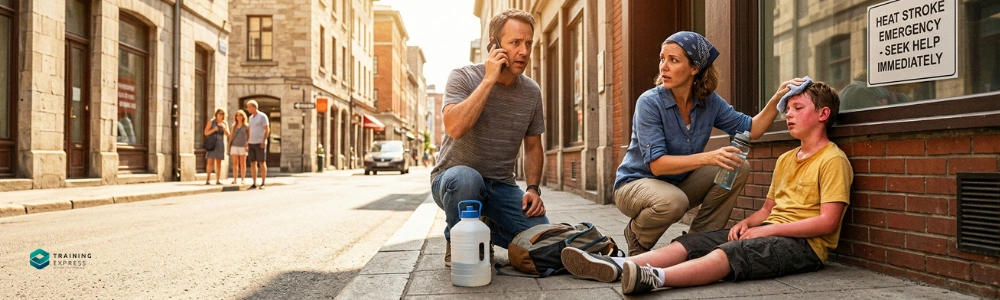
Heat stroke is a medical emergency. Call 999 first, then start cooling the person immediately — don’t wait for the ambulance to arrive before acting.
- Call 999 and clearly state you suspect heat stroke.
- Move them somewhere cool if it’s safe to do so.
- Cool them rapidly. Wrap them in a cool, wet sheet or towel and continuously pour cold water over it. If a sheet isn’t available, sponge them down repeatedly with cold water or use ice packs wrapped in cloth on the neck, armpits and groin.
- Keep cooling until their temperature drops to around 37.5–38°C, or until paramedics take over. Emergency responders sometimes refer to the first 30 minutes as the “golden half-hour” — rapid cooling in this window significantly improves outcomes.
- Monitor responsiveness and breathing. If they lose consciousness, put them in the recovery position and stay with them.
- Prepare to give CPR if they stop breathing or show no signs of life.
- Do not give them anything to drink if they’re not fully alert — there’s a choking risk.
Even with prompt treatment, severe (classic) heat stroke can be life-threatening, with mortality risk rising sharply the longer the body stays overheated — which is exactly why fast action, not waiting to “see if it passes,” is the right call.
NHS 111 or 999? A Quick Rule
People often hesitate at this exact decision point, so here’s the clearest version:
Call NHS 111 (or use 111 online) if:
- Someone has symptoms of heat exhaustion that you’re struggling to manage, or
- You want advice and it’s not an emergency
Call 999 immediately if someone has any sign of heat stroke, including:
- Still feeling unwell after 30 minutes of resting, cooling and drinking fluids
- Confusion, disorientation, or unusual behaviour
- A temperature of 40°C or above
- Loss of consciousness
- A seizure
- Fast breathing or a fast heartbeat that isn’t settling
When in doubt, call 999 — it’s always the safer choice, and the call handler will talk you through what to do while help is on its way. Don’t drive the person to A&E yourself if there’s any sign of heat stroke; call an ambulance instead so treatment can start en route.
Never Leave Anyone in a Hot Car — People or Pets
This deserves its own callout because it’s one of the most common and most preventable causes of severe heat illness and death every summer.
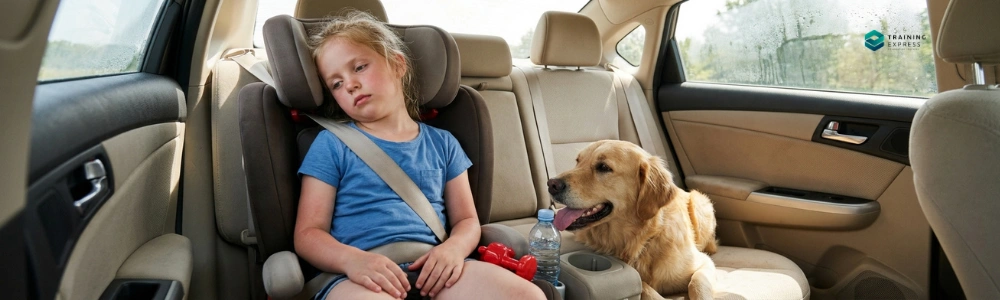
On a warm day, the temperature inside a parked car can climb by 10°C or more within just 10–15 minutes, even with a window cracked open and even if it doesn’t feel that hot outside. Children and pets are especially vulnerable because they overheat faster than adults and can’t always remove themselves from the situation.
- Never leave a child or pet in a parked car, even “just for a minute,” even in the shade, even with windows open.
- If you see a child or animal alone in a hot car and they appear distressed, call 999 immediately.
- Get into the habit of checking the back seat every time you leave the car, particularly if your routine has changed that day.
The same logic applies to caravans, tents, and conservatories — any enclosed space with poor airflow can heat up dangerously fast in direct sun.
Who's Most at Risk?
Anyone can develop heat exhaustion or heat stroke, but some groups face a much higher risk:
- Babies and young children — less able to regulate body temperature and may not communicate symptoms
- Older adults, especially those over 65
- People with long-term health conditions — heart disease, diabetes, respiratory conditions
- People on certain medications (see above)
- Outdoor and manual workers — construction, agriculture, delivery drivers
- Athletes and physically active people, particularly if not acclimatised to heat
- People unaccustomed to hot climates — including UK travellers abroad, or during a UK heatwave when temperatures spike quickly
- Anyone drinking alcohol in hot weather, which accelerates dehydration
Heat Stress at Work: What Employers Need to Know
Unlike most consumer-facing guides on this topic, it’s worth flagging the workplace angle directly, because employers have legal duties here.
Myth-busting: is there a legal maximum workplace temperature in the UK? No — despite what’s often assumed, UK law doesn’t set a maximum temperature at which staff can refuse to work or must be sent home. What the law does require, under the Workplace (Health, Safety and Welfare) Regulations 1992, is that employers keep the workplace at a “reasonable” temperature and take practical steps to prevent it becoming uncomfortable or unsafe — there’s just no fixed number attached to that.
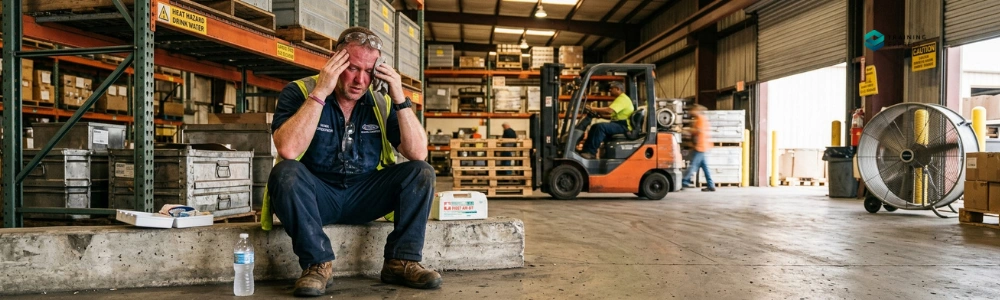
Under the Health and Safety at Work etc. Act 1974, employers have a broader general duty of care to protect employees from foreseeable harm — and prolonged heat exposure in warehouses, kitchens, construction sites, and vehicles counts as a foreseeable risk. The HSE recommends employers:
- Carry out a thermal risk assessment for roles with significant heat exposure
- Provide access to cool drinking water at all times
- Adjust work schedules to avoid the hottest part of the day (typically 11am–3pm) where possible
- Provide shade, ventilation or cooling in hot working environments
- Relax dress codes during heatwaves where practical
- Train staff and supervisors to recognise the early signs of heat exhaustion in themselves and colleagues, so it’s caught before it becomes an emergency
Building this into a wider first aid or health and safety training programme means staff aren’t just told to “drink more water” — they know exactly what to look for and what to do if a colleague starts showing symptoms.
How to Prevent Heat Exhaustion and Heat Stroke
Prevention is far more effective than treatment, and most of it comes down to a few consistent habits during hot weather:
- Stay hydrated — drink water regularly throughout the day, not just when you feel thirsty
- Avoid alcohol and excess caffeine, both of which increase dehydration
- Plan around the heat — avoid strenuous activity or exercise between 11am and 3pm
- Dress for the weather — loose, light-coloured, breathable clothing
- Seek shade and use sunscreen (SPF 30+, at least 4-star UVA protection)
- Check on vulnerable people — elderly neighbours or relatives, babies, and anyone with a long-term health condition
- Never leave anyone in a parked car, even briefly, even with windows cracked
- Acclimatise gradually if you’re travelling somewhere hotter than you’re used to, or if a UK heatwave arrives suddenly
Key Takeaways
- Heat exhaustion is the warning stage; heat stroke is a medical emergency — know the difference and act on it.
- The 30-minute rule is the simplest test: if cooling and rehydrating hasn’t helped within 30 minutes, call 999.
- Employers have a duty of care around heat exposure at work — risk assessments, hydration access and staff training all matter.
- Prevention (hydration, shade, timing activity around the heat) stops most cases before they start.
Want your team to be able to recognise and respond to heat-related emergencies confidently? [Explore our Emergency First Aid at Work training] to build practical skills for hot-weather incidents and beyond.
Frequently Asked Questions (FAQ)
What is the fastest way to cool someone down with heat stroke?
Wrap them in a cool, wet sheet and continuously pour cold water over it, or sponge them repeatedly with cold water. Ice packs on the neck, armpits and groin also help. Call 999 first, then start cooling — don’t wait for paramedics to arrive.
Can heat exhaustion turn into heat stroke?
Yes. If heat exhaustion isn’t treated — or if symptoms haven’t improved within 30 minutes of cooling and rehydrating — it can progress into heat stroke, which is a medical emergency.
What temperature counts as heat stroke?
A core body temperature of 40°C or above, combined with symptoms like confusion, hot dry skin, or loss of consciousness, is generally classed as heat stroke.
Should I give someone with heat stroke water to drink?
Only if they’re fully conscious and alert. If they’re confused, drowsy or unresponsive, don’t give them anything to drink — there’s a risk of choking. Focus on cooling them and call 999.
How long does it take to recover from heat exhaustion?
Most people start to feel better within 30 to 60 minutes of cooling down and rehydrating, though tiredness can linger for up to 24 hours. Heat stroke recovery is much longer and often needs hospital care.
What are the signs of heat stroke in a child?
Similar to adults — hot skin, confusion, rapid pulse — but children may also become unusually sleepy, floppy, or irritable, and may struggle to describe what they’re feeling. Check on children more often during hot weather rather than waiting for them to say something’s wrong.
Is sunstroke the same as heat stroke?
Sunstroke is simply the term used when heat stroke is caused specifically by prolonged sun exposure. The symptoms and treatment are the same.
Is there a legal maximum temperature for working in the UK?
No. UK law requires employers to maintain a “reasonable” workplace temperature but doesn’t set a specific maximum. Employers still have a duty to manage heat risk through hydration, ventilation, rest breaks and adjusted schedules.
How hot does a car get in the sun?
Dangerously fast — the interior temperature of a parked car can rise by 10°C or more within 10–15 minutes, even with a window cracked. Never leave a child or pet in a parked car, even briefly.
What's the difference between heat cramps and heat exhaustion?
Heat cramps are painful muscle spasms caused by salt and fluid loss and are the mildest stage — rest and rehydration usually resolve them. Heat exhaustion is more serious, involving wider symptoms like dizziness, nausea and weakness, and needs active cooling as well as fluids.

Robert Lawrence
Author | Health & Safety Officer.
Robert Lawrence is a Health & Safety Officer and author at Training Express, with over 5 years of experience creating practical resources and strategies to support learners and enhance their professional & personal development.
Related Blogs