Emergency First Aid at Work

4.8 (8496 REVIEWS)
17294 STUDENTS
BestsellerGreat ServiceHighly RatedTrending

GET THIS COURSE AND 2500+ OTHERS FOR ONLY £49 FIND OUT MORE

Emergency First Aid at Work involves providing immediate care to someone who becomes injured or suddenly ill in the workplace before professional medical help arrives. Quick and effective first aid can help preserve life, prevent conditions from worsening, and support recovery during emergencies.

This Emergency First Aid at Work course develops essential knowledge of workplace first aid responsibilities, UK legal requirements, casualty assessment, incident management, CPR and AED awareness, wound care, and emergency response procedures. You will also learn how to respond safely to common workplace injuries, unconscious casualties, breathing difficulties, shock, and other medical emergencies.

Whether you want to improve workplace safety awareness, strengthen professional skills, or gain confidence in handling emergencies, this course provides a strong foundation in workplace emergency response and practical first aid awareness valued across many industries.

Last audited and updated on: 20th April 2026
“Effective early intervention, such as CPR or bleeding control, significantly increases survival chances in workplace emergencies.”

Resuscitation Council UK guidance , saving lives by developing guidelines.

Sneak Peek

Sneak Peek of Emergency First Aid Work

Learning Outcomes

By the end of the Emergency First Aid at Work (EFAW) Course, learners will be able to:

What is Emergency First Aid at Work Course in the UK?

Emergency First Aid at Work Course teaches learners how to respond safely and effectively during workplace accidents and medical emergencies before professional medical help arrives. The course covers essential first aid knowledge such as CPR, choking response, bleeding control, recovery position techniques, casualty assessment, and workplace emergency procedures. It also helps learners understand UK workplace health and safety responsibilities and the importance of emergency preparedness in different working environments.

Who Should Take The EFAW Course

Emergency first aid knowledge is essential in many workplaces and can help individuals respond effectively during accidents and medical emergencies. This EFAW course is ideal for anyone looking to improve workplace safety awareness and build confidence in handling emergency situations.

Suitable for:

Why Take This EFAW Course

Workplace emergencies can happen at any time, and quick action can save lives. This course builds essential Emergency First Aid at Work awareness, helping learners respond safely and confidently in line with UK health and safety standards.

This course is ideal for learners looking to improve workplace safety knowledge, strengthen employability skills, and gain confidence in emergency response situations.

Job Opportunities & Salary Expectations in the UK

This EFAW course is ideal for learners looking to improve workplace safety knowledge, strengthen employability skills, and gain confidence in emergency response situations.

Accreditation of EFAW Course

All of our courses, including this Emergency First Aid at Work Course (EFAW Course) is fully accredited, providing you with up-to-date skills and knowledge and helping you to become more competent and effective in your chosen field.

CPD Accredited

All our courses are CPD accredited, meeting recognised Continuing Professional Development (CPD) standards.

RoSPA Membership

RoSPA membership shows commitment to health and safety and helps organisations maintain strong safety standards and reduce workplace risks.

British Safety Council Member

A British Safety Council Member demonstrates commitment to high health, safety, and wellbeing standards and safer workplaces.

Certification EFAW Course

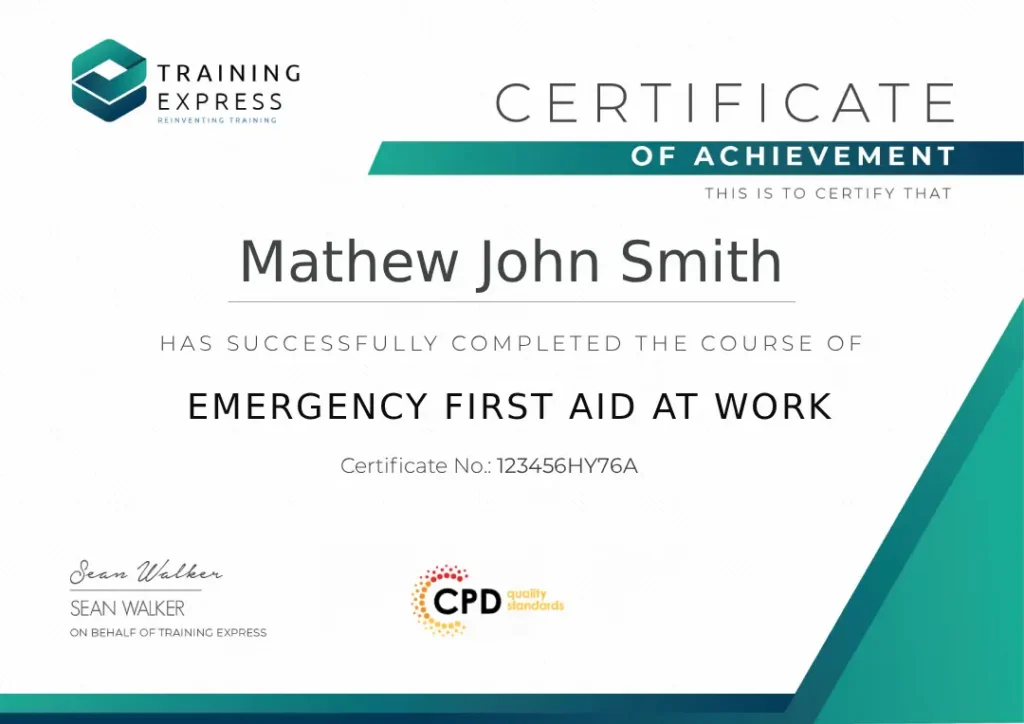
Once you’ve successfully completed your Emergency First Aid at Work Course online, you will immediately be sent a digital certificate. Also, you can have your printed certificate delivered by post (shipping cost £5.99). All of our courses are fully accredited, providing you with up-to-date skills and knowledge and helping you to become more competent and effective in your chosen field.

Certification of Emergency First Aid at Work
Recommended renewal: 3 years.
Our certifications have no expiry dates, but we recommend renewing them to stay up to date with industry best practices.

Course Curriculum

Module One introduces the basic principles of First Aid in the workplace and the important responsibilities that a First-Aider must own. It also looks at the requirements of a good First Aid kit and the importance of preventing cross-infection. It also provides a pointer towards initial actions to take when an emergency is encountered.

In Module Two, we explain the legal duties of an employer (and employee) has in regards to providing First Aid equipment and facilities. It also covers the UK legislation that is currently in place, to ensure that the appropriate workers are trained in First Aid skills, along with further health and safety directives. The importance of accident reporting is examined as well. 

In Module Three, we look at the way in which First Aid personnel should take charge during incidents and guide events. This naturally leads to the recommended actions to take during an emergency, where they will be influential in conducting safety during accidents involving fire, electricity, and water. This module also emphasises the need for self-safety as a First-Aider.

In Module Four, we look at the importance of a Primary Survey during an incident. It emphasises the importance of recording and understanding all the information that can be taken from the casualty and the incident. The module also instructs the way a Recovery Position can be applied to a patient.

Module Five explains the purpose of a Secondary Survey and why it may not always be necessary. It covers the benefits of a more protracted examination and detailed investigation into an incident. We explain the procedural steps of the survey and just how much it can influence the treatment of the casualty.

Module Six comprehensively describes the most commonly used First Aid techniques. We cover the “Chain of Survival”, and the key recommendations in an emergency. The components of a First Aid kit are also explored, with descriptions of how to apply dressings, bandages, and slings. The life-extending procedures involving CPR and AEDs are highlighted as well. 

Module Seven describes the majority of minor injuries that a First-Aider can expect to encounter. It looks at the wide variety of common ailments and wounds that can occur easily, and how best to deal with them. The module also highlights the injuries that can escalate in severity and what to do to ensure the safety of the casualty.

Module Eight starts to cover the Secondary Illnesses that a First-Aider can come across. This module specifically explains the actions required when an adult, child, or baby becomes unconscious. It also goes into detail on how to check for breathing problems and apply resuscitation techniques.

Module Nine continues the theme of treating Secondary illness in a casualty. This module covers the conditions that can cause severe breathing difficulties in an individual, how they should be appropriately treated, and when emergency services should become involved.

Module Ten continues to look at Secondary Injuries that arise from long-time medical conditions or injuries. This covers a range of issues from complications caused by excessive bleeding, to the effects of Epilepsy, and the causes of Heart Attacks. The module also covers the different types of diabetes, and what causes the body to go into shock.

Module Eleven comprehensibly covers the different types of fractures and dislocations. It looks at the different ways bones can break or splinter, along with the appropriate treatment a First-Aider can perform. We also cover the risks behind head injuries and how bone displacement should be handled.

Module Twelve covers and summarises the different types of emergency services that are available in the UK. This final module will affirm the responsibilities of a First-Aider and instructs the learner on how and when to call the appropriate services.

EFAW Course Reviews

Excellent

4.8 Average 8496 Reviews

  Reviews

Geoffrey Lambert
📍GB
Excellent well presented First Aid Course, with a good range of questions in both the mock and final exams at the end.
Lee
📍GB
A very easy interaction and build good first aid knowledge.
Linda Challinor
📍GB
First Aid and CPD, covered everything I needed to know repeating the more important chapters to ensure learning.
PARASKEVI
📍GB
I improved my knowledge in First aid. I had never done any First Aid Training which I found quite interesting.

Frequently Asked Questions (FAQs)

What is the Emergency First Aid at Work course (EFAW)?

The EFAW course is a comprehensive training program designed to equip individuals with the knowledge and skills required to handle workplace emergencies effectively. It covers essential first aid procedures, legal requirements, and techniques for managing incidents involving injuries and illnesses.

Do I need prior experience to enrol in this course?

No, the course is designed for beginners as well as individuals looking to refresh their existing first aid skills.

What is the difference between Emergency First Aid and Standard First Aid?

The main difference is the scope of training:

  • Emergency First Aid at Work (EFAW): Focuses on handling immediate, life-threatening situations such as CPR, choking, and severe bleeding in a workplace setting.
  • Standard First Aid: Includes a broader range of topics, covering additional injuries and illnesses, and is typically more suitable for high-risk environments.

What do you learn in an Emergency First Aid at Work course?

An Emergency First Aid at Work course teaches practical workplace emergency response skills and essential first aid awareness. Learners study CPR procedures, AED awareness, incident management, primary surveys, recovery position techniques, severe bleeding control, burns, fractures, shock, breathing difficulties, unconscious casualties, and workplace accident reporting. The course also covers UK health and safety guidance, infection prevention, and how to contact emergency services appropriately during emergencies.

Why is first aid important in the workplace?

First aid ensures immediate response to injuries or illnesses, reducing the severity of incidents and potentially saving lives before professional medical help arrives.


Yes. Under the Health and Safety (First-Aid) Regulations 1981, employers in the UK are legally required to ensure there are adequate and appropriate first-aid arrangements in place, including equipment, facilities, and trained personnel.

Although the law does not always require a specifically qualified Emergency First Aid at Work (EFAW) certificate holder in every workplace, employers must carry out a first-aid risk assessment to decide what level of training and cover is needed. This ensures that suitable and sufficient first-aid support is always available based on the nature and risks of the workplace.

Who should take an Emergency First Aid at Work course?

An Emergency First Aid at Work course is suitable for employees, supervisors, managers, business owners, teachers, childcare practitioners, healthcare support staff, hospitality workers, construction workers, fitness professionals, warehouse employees, and anyone responsible for workplace safety. It is also valuable for individuals who want to improve their emergency response knowledge for professional development or personal confidence.

What jobs can you get with an Emergency First Aid at Work certificate?

Emergency First Aid at Work training can support career opportunities in industries such as construction, childcare, healthcare support, hospitality, retail, education, warehousing, manufacturing, logistics, fitness, security, transport, and customer service. Employers often value candidates with workplace first aid awareness because they can respond responsibly during emergencies and contribute to safer working environments.

Can beginners take an Emergency First Aid at Work course?

Yes, Emergency First Aid at Work courses are designed for beginners and do not usually require previous medical knowledge or first aid experience. The course introduces essential workplace first aid principles in a clear and accessible way, helping learners understand how to respond safely during accidents and medical emergencies in different workplace environments.

Is Emergency First Aid at Work useful for healthcare and childcare jobs?

Yes, Emergency First Aid at Work training is highly valuable for healthcare support workers, childcare practitioners, teachers, carers, and nursery staff because emergencies can happen at any time in care and educational environments. First aid awareness helps professionals respond more confidently to accidents, injuries, choking incidents, breathing difficulties, and other medical emergencies involving children or vulnerable individuals.

Do employers value Emergency First Aid at Work certification?

Yes, many UK employers value Emergency First Aid at Work certification because it demonstrates awareness of workplace safety, emergency response responsibilities, and health and safety procedures. Employees with first aid knowledge can help organisations maintain safer working environments and respond more effectively during workplace incidents.

Course Curriculum

Emergency First Aid at Work
Introduction to Workplace First Aid 00:38:00
Legal Framework for Workplace First Aid 00:18:00
Incident Management at Work 00:31:00
Primary Survey 00:15:00
Secondary Survey 00:15:00
Basic First-Aid Techniques 00:35:00
Dealing with Minor Injuries at Workplace 00:25:00
Secondary Illness: Loss of Responsiveness and CPR 00:12:00
Secondary Illness: Breathing Problems 00:15:00
Secondary Illnesses and Injuries 00:15:00
Dealing With Fractures and Dislocations 00:21:00
Call for an Emergency 00:13:00
Emergency First Aid at Work
ex Vat

SAVE 50% - OFFER ENDS SOON

TAKE THIS COURSE

OR

🔥 83 units sold in last 24 hours
  • Original price was: £50.00.Current price is: £25.00. ex Vat
  • 1 year
  • Course Certificate
  • 4 hours, 13 minutes
  • Gift this course
£25 /Unit Price
Total:
£125.00
Quantity:

Buying more than one of the same courses?

  • 50% discount for orders of 10+ courses
  • 60% discount for orders of 50+ courses
  • 70% discount for orders of 100+ courses

Looking for a more personalised package?

contact us now

Instructors

17294 STUDENTS ENROLLED