Legal Obligation
Regulation (EC) 852/2004, enacted in UK law, requires all food business operators to ensure that food handlers receive adequate supervision and training in food hygiene.
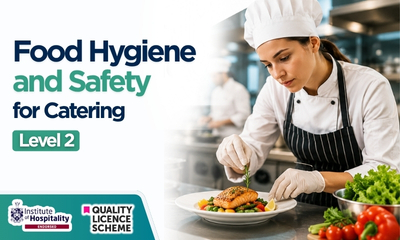
Food safety isn’t just a workplace requirement — it’s a legal responsibility that protects customers, businesses, and reputations. The Level 2 Food Hygiene and Safety for Catering course is designed to give food handlers the essential knowledge needed to prepare, handle, and serve food safely in line with UK legislation and industry best practice.
This course goes beyond basic awareness. It builds real understanding of how food contamination happens, how outbreaks occur, and how to prevent them through correct hygiene procedures, temperature control, and HACCP-based systems. Whether you work in a busy kitchen or a small catering setup, the principles you learn here apply directly to real-world environments.
Delivered online, this Food Hygiene and Safety Level 2 certificate is CPD accredited, IOH endorsed, and EHO approved — giving learners a recognised qualification that supports compliance and career progression in the UK food industry.
By the end of this course, you will be able to confidently demonstrate the knowledge and practices required by UK food safety law:
A legal and professional requirement for every UK food worker, this qualification ensures compliance and safety. The UK Food Standards Agency reports 2.4 million cases of foodborne illness annually, costing around £5 billion and leading to 500,000 hospitalisations.
Regulation (EC) 852/2004, enacted in UK law, requires all food business operators to ensure that food handlers receive adequate supervision and training in food hygiene.
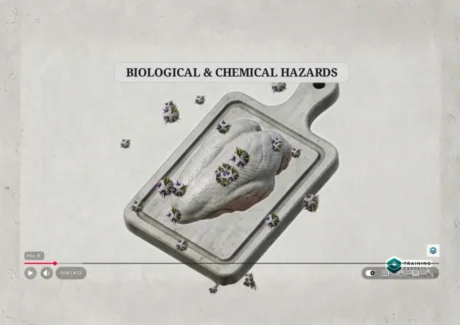
Local authority Environmental Health Officers (EHOs) check food hygiene training records during inspections. Inadequate training can result in improvement notices or closure orders.
The Food Standards Agency's FHRS (scores 0–5) directly affects your business reputation and customer trust. Staff training is a scored criterion in every inspection.
Under the Food Safety Act 1990, both employers and individual food handlers can be held personally liable for food safety breaches — training is your best legal protection.
Ideal for anyone who handles, prepares, or serves food, this Level 2 qualification is the recognised industry standard for food handlers across all catering and hospitality settings in the UK.
Food hygiene failures are a leading cause of foodborne illness in the UK, but most are preventable with proper training. This course gives you a clear understanding of safe food handling to reduce those risks in real working environments.
Unlike theory-based training, it focuses on practical kitchen situations. You’ll learn how contamination occurs, how bacteria spread, and how to control risks using safe hygiene and HACCP-based practices.
It also strengthens your employability, as employers expect recognised food safety certification.
Primary UK legislation creating legal duties for food businesses and individual food handlers.
Implements EC Regulation 852/2004 in England — sets out food handler training requirements.
EU hygiene law retained in UK legislation after Brexit, including HACCP requirements.
Establishes enforcement powers for the Food Standards Agency and ensures traceability.
Requires allergen labelling on food prepared and sold on-site, effective from October 2021.
Established the Food Standards Agency (FSA), protecting public health and food safety.
Completing this level 2 food hygiene and safety for catering qualification opens the door to multiple roles across hospitality, healthcare, retail, and catering industries.
All of our courses, including this level 2 food hygiene and safety for catering course is fully accredited, providing you with up-to-date skills and knowledge and helping you to become more competent and effective in your chosen field.
All of our courses are accredited by the CPD qulity standards as conforming to universally accepted Continuing Professional Development (CPD) guidelines.
This course is endorsed by the Institute of Hospitality, recognising it as high-quality training that meets best-practice standards.
This course has been audited and approved by Environmental Health Officers, with content independently reviewed to meet the required training standards.
RoSPA Membership demonstrates a commitment to health and safety, helping organisations reduce risks and maintain high workplace safety standards.
A British Safety Council Member shows commitment to high health, safety, and wellbeing standards, supporting safer workplaces and best practices.
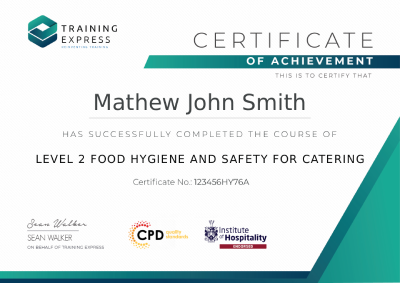
Once you complete your food and hygiene level 2 course, we will send you a digital certificate immediately. You can also have a printed certificate delivered by post for £5.99. Our courses are fully accredited, equipping you with up-to-date skills and knowledge to improve your competence and effectiveness in your field.
Additionally, the Institute of Hospitality endorses this Food Hygiene and Safety for Catering Level 2, guaranteeing high-quality content that teaches industry standards and best practices.
Each module is created to meet the requirements of the Food Safety Act 1990, UK Food Hygiene Regulations 2006, and current FSA guidance.
Comprehensive overview of the UK legislative framework: Food Safety Act 1990, Food Hygiene (England) Regulations 2006, General Food Regulations 2004, and the roles of the FSA and local authority EHOs in enforcement.
Understand the seven principles of Hazard Analysis and Critical Control Points (HACCP) as required under Regulation (EC) 852/2004. Learn how to identify CCPs, set critical limits, and implement monitoring procedures within a catering environment.
Covers the three main categories of food hazard with a detailed focus on the 14 major allergens listed under EU Regulation 1169/2011 (retained in UK law post-Brexit). Includes labelling law, Natasha’s Law, and allergen management protocols.
In-depth look at key pathogens, including Salmonella, E. coli O157, Listeria, Campylobacter, and Staphylococcus aureus — their sources, symptoms, and the specific controls required to prevent cross-contamination and bacterial growth.
Learn the “danger zone” (8°C–63°C), correct chilling and reheating temperatures, and best-practice protocols for hot-holding, cold storage, and defrosting to comply with Food Hygiene Regulations 2006.
Understand the conditions that cause food spoilage, correct storage methods (FIFO, stock rotation), date labelling (use-by vs best before), and permitted food preservation techniques for a safe catering operation.
Covers handwashing technique and frequency, protective clothing requirements, illness and exclusion policies, and personal behaviour standards required by law for all food handlers in the UK.
Detailed guidance on cleaning schedules, disinfection, pest control, and waste management procedures required to pass EHO inspections and maintain a 5-star Food Hygiene Rating.
4.8 Average 9128 Reviews
Reviews
While the law does not mandate a specific certificate by name, the Food Hygiene Regulations 2006 require all food handlers to receive food hygiene training appropriate to their role. The Level 2 Food Hygiene and Safety for Catering qualification is the nationally recognised standard used to demonstrate compliance with this legal requirement. Environmental Health Officers expect to see evidence of training during inspections, and a valid Level 2 certificate is the most widely accepted proof.
The course typically takes between 1 and 2 hours to complete, though because it is entirely online and self-paced, you can spread study across multiple sessions. Most learners complete the course and assessment within a single day. Once you pass, your certificate is available to download immediately.
A Level 2 Food Hygiene certificate is generally recognised for three years from the date of issue. After this period, food handlers are expected to refresh their training to ensure their knowledge remains current — particularly given updates to UK allergen legislation such as Natasha’s Law (2021). Many employers require renewal every three years as part of their food safety management system.
Level 2 Food Hygiene is aimed at all food handlers — anyone who prepares, handles, or serves food as part of their work. Level 3 Food Hygiene (also called Supervising Food Safety) is designed for supervisors, team leaders, and managers responsible for overseeing food safety practices and training other staff. If you manage a kitchen or catering team, you may need Level 3 in addition to Level 2.
Yes. An accredited Level 2 Food Hygiene qualification from a regulated awarding body is recognised by Environmental Health Officers throughout England, Scotland, Wales, and Northern Ireland. When EHOs conduct food hygiene inspections, they assess the documented training records of all food handlers as part of scoring under the Food Hygiene Rating Scheme (FHRS). Holding a valid Level 2 certificate contributes directly to achieving a higher hygiene rating.
HACCP stands for Hazard Analysis and Critical Control Points. It is a systematic, science-based approach to identifying food safety hazards and putting controls in place to prevent them. Under Regulation (EC) 852/2004 — retained in UK law — all food business operators are legally required to implement food safety management procedures based on HACCP principles. This course covers all seven HACCP principles and how to apply them in a catering environment.
Yes, if your business prepares food and sells it on the same premises (for example, sandwiches, salads, or baked goods made in-house), Natasha’s Law requires full ingredient and allergen labelling on every prepacked-for-direct-sale (PPDS) item. This law came into force in England, Wales, and Northern Ireland in October 2021. This course covers allergen management and labelling requirements in full, helping your team comply with these rules and protect customers with food allergies.
Yes — this course is delivered entirely online, meaning you can study at any time, on any device, from anywhere in the UK. There is no need to attend a classroom. The final online assessment can also be taken at home. Upon passing, your accredited certificate is available to download and print straight away, with a digital copy for your records.
No prior qualifications or experience are required. This course is designed to be accessible to all food handlers, including those completely new to catering. A basic level of English reading comprehension is all that is needed. The course is suitable for learners aged 16 and over.
If you do not pass the assessment on your first attempt, you can retake it. You will be encouraged to review the relevant modules before attempting again. The assessment tests your understanding of the key food safety principles covered throughout the course, and most learners pass successfully after reviewing any areas they found challenging.
| Food Hygiene and Safety for Catering Level 2 | |||
| UK Food Safety Law and Hygiene | 00:04:00 | ||
| Designing a HACCP-Compliant Food Premises | 00:07:00 | ||
| Food Hazard Management Physical, Chemical, and Allergenic Safety | 00:06:00 | ||
| Microbiological Hazards and Bacterial Control in Food Safety | 00:04:00 | ||
| Food Poisoning Prevention and Temperature Control Protocols | 00:05:00 | ||
| Standards for Food Spoilage, Preservation, and Storage | 00:05:00 | ||
| Essentials of Personal Hygiene for Food Handlers | 00:06:00 | ||
| Hygienic Standards and Cleaning Protocols for Food Safety | 00:05:00 | ||
| Mock Exam | |||
| Mock Exam – Food Hygiene and Safety for Catering Level 2 | 00:20:00 | ||
| Final Exam | |||
| Final Exam – Food Hygiene and Safety for Catering Level 2 | 00:20:00 | ||
| Transcript and Certificate | |||
| Share Your Feedback | 00:00:00 | ||
| Transcript and Certificate | 00:00:00 | ||
SAVE 88% - OFFER ENDS SOON