Food Hygiene
 Health & Safety
 Safeguarding
 First Aid
 Business Skills
 Personal Development

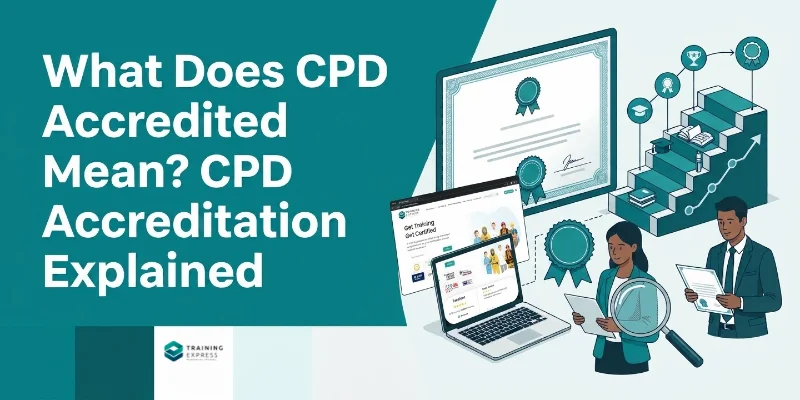

CPD accredited means an independent CPD organisation has reviewed a course and confirmed it meets its standards for structure, learning outcomes and quality. It doesn’t make the course a regulated qualification, and it doesn’t mean a government regulator has approved it.
So is it worth anything? Often, yes. It’s a useful sign of a well-built course, and it helps you log CPD hours. But it’s not a regulated qualification, and that difference matters when a job asks for one. This guide explains exactly what the badge means and how to check it’s genuine.
Key takeaways
- CPD accreditation is an independent quality check of a course, not a test of your skills.
- It's not regulated by Ofqual and has no RQF level, so it isn't a formal qualification.
- Several private organisations accredit CPD. There's no single official CPD regulator.
- It's most useful for building CPD hours, workplace training and showing you keep learning.
- It won't replace a licence or qualification that a job legally requires.
What Is CPD?
CPD stands for continuing professional development. It’s the learning you do throughout your career to keep your skills current, from short online courses to workshops, conferences and reading. Many professional bodies ask members to do a set amount each year.
CPD isn’t only for professionals with letters after their name. A care worker refreshing safeguarding knowledge, a manager learning about mental health at work and a receptionist brushing up on GDPR are all doing CPD. What makes it CPD is that it’s planned, relevant to your work and recorded. If you want the numbers, our guide to CPD points covers how many hours different bodies ask for.
What Does CPD Accredited Mean?
When a course is CPD accredited, an independent CPD body has assessed it before it’s sold. The CPD Standards Office describes accreditation as independent, third-party recognition that a course has been assessed and approved against a recognised CPD standard. In other words, the provider didn’t just award itself the badge.

Assessors usually look at things like:
- clear learning objectives
- content that matches those objectives
- a sensible structure and level
- the number of CPD hours the course should take
- how learners show what they’ve learned, such as a quiz or assessment
Just as important is what accreditation doesn’t mean:
- It’s not a qualification. The CPD Standards Office says CPD accreditation does not carry Ofqual or RQF status.
- It’s not regulator approval. CPD isn’t governed by a single statutory regulator.
- It doesn’t prove you’re competent. It shows the course was well designed and that you completed it.
Who Accredits CPD Courses?
Several independent organisations in the UK accredit CPD. Each one sets its own standards and keeps its own list of accredited providers or courses. Here are three you’ll often see:
| Organisation | What it says about itself | How to check a course |
|---|---|---|
| The CPD Certification Service | An independent organisation providing CPD accreditation, working with organisations in over 100 countries | Search its online lists of courses, providers and events at cpduk.co.uk |
| The CPD Standards Office | An independent standards body that assesses training against its CPD standard | Check its website, cpdstandards.com, or contact it to confirm a provider's accreditation |
| CPD Quality Standards (CPDQS) | A UK CPD accreditation provider for training organisations | Search its directories of providers and courses at cpdqs.co.uk |
Because each body uses its own standards, a course accredited by one isn’t automatically the same as a course accredited by another. What matters most is whether the accreditor is real, the course is listed, and the learning fits your goal.
Is a CPD Course a Qualification?
No. A CPD-accredited course gives you a certificate of completion, not a regulated qualification. Here’s how they compare:
| CPD-accredited course | Regulated qualification | University degree | |
|---|---|---|---|
| Who checks it | An independent CPD accreditation body | An awarding organisation regulated by Ofqual (in England) | A university with degree-awarding powers |
| Has a level? | No and Yes, becasue some has levels | Yes. Entry 1 to 3, then levels 1 to 8 on the RQF | Yes. A bachelor's degree is level 6 |
| Typical length | A few hours to a few weeks | Weeks to a year or more | Usually three years or more full-time |
| What it proves | You completed a quality-checked course | You met a set standard, usually through assessment | Broad, in-depth knowledge of a subject |
| When employers require it | Required, often welcomed | Often required for licensed or regulated jobs | Required for some professions, such as teaching and medicine |
What About CPD Points?
Most accredited courses list a number of CPD hours or points. One point usually equals one hour of learning, and you can log those hours with your professional body. For the full picture, including real requirements from bodies like the NMC and RICS, see what CPD points are and how many you need.
Is CPD Accreditation Worth It?
It depends on why you’re learning. CPD accreditation adds the most value when you want a trusted, structured course, not a formal qualification.

When it helps
- Logging CPD hours. An accredited certificate shows the hours and a clear course outline, which is handy evidence for your professional body.
- Workplace training. Many employers use accredited online courses for topics like safeguarding, fire safety or GDPR.
- Showing initiative. A relevant, recent course on your CV shows you keep your skills up to date.
- Learning something quickly. Short accredited courses let you pick up a specific skill without a long programme.
When it won't be enough
- Licensed or regulated jobs.
- Jobs that name a qualification.
- Proving deep expertise.
Here’s another point worth knowing. Many professional bodies don’t require accredited CPD at all. The HCPC, for example, doesn’t approve or endorse individual CPD activities. It cares about what you learned and how you used it.
Is a CPD course right for your goal?
| Your goal | Is a CPD-accredited course a good fit? |
|---|---|
| Meet your professional body's yearly CPD hours | Yes, if the topic is relevant to your role |
| Complete mandatory training at work | Often yes. Check what your employer accepts |
| Learn a new skill for your current job | Yes. It's quick, flexible and usually low cost |
| Test the water before a career change | Yes, as a first step before a bigger commitment |
| Get a licence or legal permission to work | No. You need the specific licence or approved qualification |
| Meet a job advert that asks for a named qualification | No. Take the qualification the advert names |
CPD Accredited, Certified or Approved: Is There a Difference?
You’ll see all three words on course pages. In practice, providers often use them to mean much the same thing: an outside body has looked at the course. There’s no legal definition that separates them.
So don’t judge a course by the word it uses. Look for two things instead: the name of the organisation that did the checking, and proof that the course is listed with that organisation. A course that says “CPD certified” with a named body you can check is more reassuring than one that says “fully accredited” with no name at all.
Questions to Ask a Provider Before You Buy
A good provider will answer these quickly and clearly:
- Which organisation accredits this course, and where can I check it?
- How many CPD hours is the course worth?
- What will my certificate show, and is there an extra fee for it?
- How is the course assessed?
- How long will I have access to the course?
- Is this a regulated qualification, or a CPD course?
If the answers are vague, or you’re pushed to buy before you get them, take that as a warning sign.
Are CPD Certificates Recognised by Employers?
Most employers see a CPD certificate as evidence that you’ve done relevant learning. What they value most is relevance. A care worker with recent courses in dementia awareness and safeguarding stands out more than someone with ten unrelated certificates.

To get the most from a CPD course:
- choose topics that match the job you want
- be ready to explain what you learned and how you’d use it
- keep your certificates organised so you can share them quickly
For a wider look at how employers view online learning, read our guide on whether online courses are worth it.
How to Check a Course Is Really CPD Accredited (in 2 Minutes)
Most accredited courses are genuine, but logos are easy to copy. Before you pay, run this quick check:
- Find the accreditor’s name. The course page should name the organisation, not just show a logo.
- Visit the accreditor’s own website. Type the address yourself rather than clicking a link on the course page.
- Search its directory. Look for the training provider and, if possible, the specific course.
- Check the details match. The course title, hours and provider name should line up.
- Ask what’s on the certificate. It should show your name, the course title, the date, the hours and the provider.
Red flags to watch for
- a CPD logo but no named accrediting body
- an accreditor you can’t find online, or one with no list of providers or courses
- a course described as a “qualification” or “diploma” with a level, but not on the GOV.UK register
- promises of a guaranteed job
How to Show CPD Courses on Your CV
List relevant CPD courses in a “Courses and training” section, with the course name, provider, accrediting body and year. You can add the CPD hours too. Our guide on how to list certifications on your CV has examples you can copy.
The Bottom Line
CPD accredited means a course has passed an independent quality check. It’s a good sign, and it makes logging CPD hours easier. It’s not a qualification, though, so match the course to your goal. If you need a licence or a regulated qualification, get that first. If you want to build skills and CPD hours, an accredited course is a smart choice.
Ready to start? Browse Training Express’s CPD-accredited courses or see all available courses
Frequently Asked Questions (FAQ)
Do CPD certificates expire?
Most don’t have an expiry date. Some topics, such as first aid or food hygiene, are usually refreshed every few years because rules and practice change. Your employer or professional body may set how often.
Is CPD recognised outside the UK?
CPD is used in many countries, but CPD accreditation from UK bodies is a UK quality mark. Employers abroad may welcome it as evidence of learning. Check with your local employer or regulator if it’s for a formal requirement.
Is CPD accredited the same as Ofqual regulated?
No. Ofqual regulates qualifications and the organisations that award them in England. CPD accreditation is a separate, independent quality check, and CPD courses don’t carry an RQF level.
Can I get a job with a CPD certificate?
Any certificate alone rarely gets you a job, but CPD can help. It shows initiative and relevant knowledge, especially for entry-level roles or when you’re changing career.
Are free CPD courses accredited?
Some are, many aren’t. Check the course page for a named accrediting body, then search that body’s directory. If it’s not accredited, it can still count as CPD if it’s relevant and you keep evidence.

Robert Lawrence
Author | Specialises in E-Learning.
Robert Lawrence is an author at Training Express, with over 5 years of experience creating practical resources and strategies to support learners and enhance their professional & personal development.