Food Hygiene
 Health & Safety
 Safeguarding
 First Aid
 Business Skills
 Personal Development
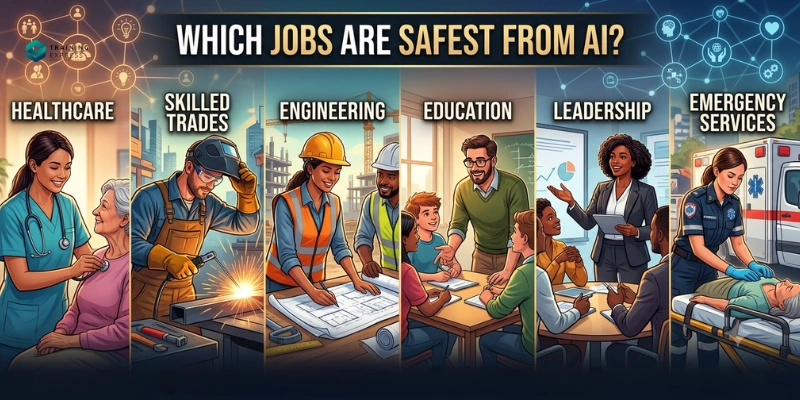

Artificial intelligence is changing nearly every industry, but it is not replacing every job equally. The careers most resistant to AI in 2026 tend to combine human judgment, physical adaptability, interpersonal trust, regulatory responsibility, and complex problem-solving rather than repetitive digital tasks.
Instead of asking, “Which jobs can’t AI do?” the better question is, “Which jobs are least exposed to automation over the next decade?” The answer is backed by labor market research from the U.S. Bureau of Labor Statistics (BLS), World Economic Forum (WEF), O*NET, McKinsey & Company, and influential academic studies on occupational automation.
Key Takeaways
- No job is 100% “AI-proof.” But some jobs are much more resistant than others because of what they actually require: physical dexterity, high-stakes judgment, licensing, or deep human trust.
- The most resistant careers cluster in skilled trades, healthcare, education, and hands-on personal services — not because AI can’t touch them at all, but because the core task can’t be fully automated yet.
- Jobs that look safe on the surface — like paralegals or entry-level coders — are often more exposed than people assume.
- The real question isn’t “will AI take my job?” It’s “how much of my job can be automated, and what’s left over?”
- You’ll find a full list of 30 AI-resistant careers below, organized by category, plus a practical framework for evaluating your own job.
Table of Contents
How We Define "AI-Resistant" (Methodology)

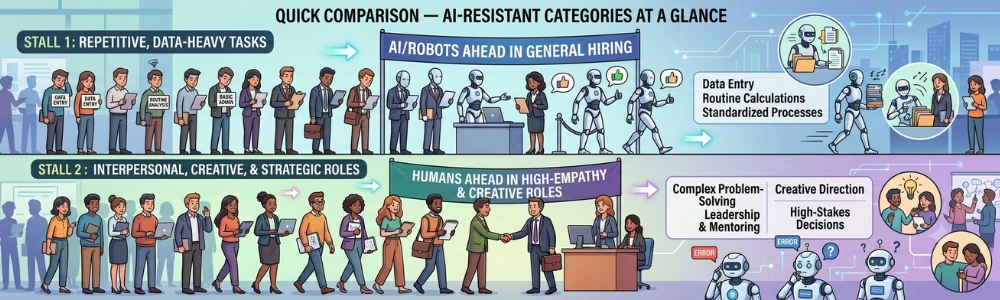
“AI-resistant” doesn’t mean AI can’t help with any part of the job. It means the core function of the job is hard to fully automate with current or near-term AI.
We based this list on a mix of sources:
- Bureau of Labor Statistics (BLS) occupational outlook and growth projections
- World Economic Forum’s Future of Jobs Report, which surveys employers on which roles they expect AI to displace or grow
- O*NET task-level data, which breaks jobs down into specific tasks and how routine or non-routine they are
- Academic research on automation exposure, including work building on the original Frey and Osborne framework
We treated “resistance” as a spectrum, not a yes/no label. A job can be 70% automatable and still need a human for the last 30% — and that 30% might be the part that actually matters most.
The Traits That Actually Make a Job AI-Resistant
Before you scan the list, it helps to know why certain jobs make the cut. If you understand the pattern, you can evaluate your own job — even if it’s not on this list.
Jobs tend to resist automation when they involve:
- Physical dexterity in unpredictable environments. AI struggles with tasks that require adapting to a messy, physical world in real time — think plumbing under a 1940s house or moving a couch around a tight stairwell.
- High-stakes judgment and liability. When a wrong call has serious consequences — legal, medical, financial — someone usually needs to be accountable. That someone is a licensed human, not a model.
- Regulatory and licensing barriers. Some jobs are protected less by “AI can’t do this” and more by “the law says a licensed person must do this.” Nursing, law, and skilled trades often fall here.
- Deep interpersonal trust. Therapy, caregiving, and teaching rely on human connection. People generally don’t want a bot handling their grief, their kid’s education, or their mental health crisis.
- Novel problem-solving. Jobs where every situation is a little different — a detective, a research scientist, a crisis negotiator — are harder to automate than jobs built around repeatable patterns.
If your job leans on two or more of these, it’s probably more resistant than average.
Quick Comparison — AI-Resistant Categories at a Glance
| Category | AI Resistance | Why Protected | Example Roles | Entry Barrier | Typical Salary (US) |
|---|---|---|---|---|---|
| Healthcare | 92 / 100 | Human care, licensing, high-stakes decisions. | Physician Nurse Practitioner |
Graduate education & licensing | $80k–$250k+ |
| Skilled Trades | 90 / 100 | Physical work in unpredictable environments. | Electrician Plumber |
Apprenticeship / Certification | $55k–$110k |
| Emergency Services | 89 / 100 | Crisis response, rapid judgement, public safety. | Firefighter EMT |
Certification / Training | $45k–$120k |
| Mental Health & Social Services | 88 / 100 | Empathy, trust and therapeutic relationships. | Therapist Clinical Psychologist |
Master's / Doctorate & Licensing | $60k–$150k |
| Engineering & Infrastructure | 84 / 100 | Complex design, liability and regulatory oversight. | Civil Engineer Mechanical Engineer |
Bachelor's / Professional Licence | $80k–$160k |
| Leadership & Management | 82 / 100 | Strategy, decision-making and accountability. | Operations Manager Project Manager |
Experience + Degree | $90k–$250k+ |
| Education | 80 / 100 | Mentoring, classroom management and human interaction. | Teacher Professor |
Degree & Teaching Licence | $50k–$120k |
| Specialized Technical Field Service | 79 / 100 | On-site diagnostics and complex repairs. | Wind Turbine Technician Field Service Engineer |
Technical Training | $60k–$110k |
Note: These scores are editorial estimates, not official government ratings. They synthesise findings from the U.S. Bureau of Labor Statistics (BLS), O*NET, the World Economic Forum Future of Jobs Report, and McKinsey Global Institute research on task automation and occupational exposure. They should be interpreted as relative comparisons, not precise measurements.
30 AI-Resistant Careers in 2026 — Backed by Labor Market Data
No job is completely AI-proof, but some are far more resistant than others. These 30 careers are backed by labor market research and are among the strongest long-term options in 2026.
Healthcare
Healthcare remains among the safest sectors because it combines technical expertise with empathy, ethics, licensing, and legal accountability.
- 1. Physician
- 2. Surgeon
- 3. Nurse Practitioner
- 4. Registered Nurse
- 5. Physical Therapist
- 6. Occupational Therapist
Why they’re protected: Direct patient care, diagnosis, communication, and responsibility remain difficult to automate completely.
Labor market: The BLS projects continued growth across many healthcare occupations through the coming decade due to aging populations and healthcare demand.
Entry barrier: Professional degrees, licensing, and extensive clinical training.
Skilled Trades
Automation has made factories more efficient, but repairing a leaking pipe in a century-old building remains a completely different challenge.
- 7. Electrician
- 8. Plumber
- 9. HVAC Technician
- 10. Elevator Installer
- 11. Construction Manager
Why they’re protected: Every worksite is different, requiring dexterity, troubleshooting, customer interaction, and adaptation.
Labor market: Skilled labor shortages continue across North America, increasing demand.
Entry barrier: Apprenticeships, certifications, and field experience.
Engineering and Infrastructure
Engineering increasingly uses AI tools, but responsibility still rests with licensed professionals.
- 12. Civil Engineer
- 13. Environmental Engineer
- 14. Mechanical Engineer
- 15. Industrial Engineer
- 16. Power Systems Engineer
Why they’re protected: Design decisions involve safety regulations, complex trade-offs, and professional liability.
Data point: Infrastructure investment continues supporting long-term engineering demand in many economies.
Education
Teaching involves far more than delivering information.
- 17. Elementary Teacher
- 18. Special Education Teacher
- 19. University Professor
- 20. Instructional Designer
Why they’re protected: Motivation, classroom management, mentorship, and adapting to individual students remain fundamentally human.
Entry barrier: Teaching credentials or advanced degrees depending on role.
Mental Health and Social Services
These occupations depend heavily on trust and emotional intelligence.
- 21. Clinical Psychologist
- 22. Licensed Therapist
- 23. Social Worker
Research consistently finds emotional support professions among the least susceptible to full automation because human relationships themselves create much of the value.
Public Safety
- 24. Firefighter
- 25. Police Detective
- 26. Emergency Medical Technician
Emergency situations rarely unfold according to predictable patterns. Human coordination, rapid judgment, and ethical decision-making remain essential.
Leadership and Business
- 27. Operations Manager
- 28. Project Manager
AI can produce reports and forecasts, but people still lead teams, resolve conflict, negotiate priorities, and accept accountability.
Specialized Technical Roles
- 29. Cybersecurity Analyst
- 30. Wind Turbine Service Technician
Cybersecurity requires continuous adaptation against intelligent human adversaries, while wind turbine maintenance combines climbing, diagnostics, mechanical repairs, and field work.
Jobs That Seem Safe But Aren't

Some roles that feel “obviously safe” are actually more exposed than people think. A little myth-busting:
Paralegals: Much of the job — document review, research, drafting — is exactly the kind of repeatable, text-based task generative AI is good at. The role isn’t disappearing, but it’s shrinking and shifting toward oversight of AI output rather than doing the work from scratch.
Radiologists: AI is genuinely strong at pattern recognition in medical imaging. This doesn’t mean radiologists are being replaced — a human still needs to interpret results and take responsibility — but the day-to-day workflow is changing fast, and some routine image review is already AI-assisted.
Entry-level coders: Writing basic, well-defined code is one of the areas where AI tools have made the fastest progress. Junior developer roles focused on repetitive, low-complexity coding are more exposed than senior engineering roles that involve architecture and judgment calls.
Customer service reps: Chatbots now handle a large share of routine inquiries. Human reps increasingly get routed the harder, more emotional, or more unusual cases — which means the job isn’t gone, but it’s a smaller, more specialized version of what it used to be.
Financial analysts (entry-level): Basic data crunching and report generation are increasingly automated. The analysts who remain valuable are the ones doing judgment-heavy interpretation and client-facing advising.
The pattern: if a big chunk of your job is repetitive, text-based, or pattern-based, that part is exposed — even if your job title sounds safe.
The Risk Spectrum: "Augmented" vs. "Structurally Protected"
It helps to think of jobs on a spectrum rather than a simple safe/unsafe list:
- Structurally protected jobs have a core function that’s hard to automate no matter how good AI gets — usually because it requires a physical body, a license, or deep human trust. Plumber, nurse, and therapist fall here.
- Augmented jobs will look different in five years, but the human role doesn’t disappear — it shifts toward oversight, strategy, or the parts AI can’t do. Radiologist, financial analyst, and marketing manager fall here.
- Highly exposed jobs involve mostly repetitive, well-defined, text- or data-based tasks with low human interaction. Basic data entry and routine transcription are examples.
Most careers on the “30 jobs” list above are structurally protected. Many white-collar jobs that seem safe today are actually in the “augmented” category — not gone, but changed.
The Bill Gates Short List — And What He Actually Said
Bill Gates has frequently argued that AI will transform many professions while leaving greater demand for roles involving human judgment, biology, energy, and complex engineering. His comments are useful perspectives but should not be treated as definitive predictions.
Other respected organizations offer similar conclusions.
The World Economic Forum Future of Jobs Report 2025 projects growth in healthcare, education, engineering, renewable energy, and skilled trades despite expanding AI adoption.
McKinsey Global Institute concludes that AI automates specific activities more readily than complete occupations, with knowledge workers experiencing significant task transformation rather than wholesale replacement.
Taken together, expert opinion points toward adaptation rather than mass elimination of work.
What's Actually Happening in the 2025–2026 Labor Market

A few real trends worth knowing, based on recent labor market reporting:
- Entry-level hiring has slowed in some white-collar sectors, particularly tech and finance, as companies use AI tools to handle tasks junior employees used to do.
- Skilled trades are facing labor shortages, not AI displacement. Demand for electricians, plumbers, and HVAC technicians continues to outpace the supply of trained workers.
- Healthcare hiring remains strong, driven by an aging population and persistent staffing shortages in nursing and home care.
- Companies are increasingly hiring for “AI-adjacent” skills — people who can work alongside AI tools, prompt them effectively, and check their output — rather than replacing entire departments overnight.
The overall picture is less “robots take all the jobs” and more “certain tasks get automated, certain roles shrink, and certain roles grow.” It’s uneven, and it’s happening industry by industry rather than all at once.
How to Future-Proof Your Career
If you’re worried about your own job, here’s where to focus your energy:
- Identify the repeatable parts of your job. Be honest about which of your tasks are routine and text- or data-based. Those are the parts most likely to be automated first.
- Build skills AI can’t easily replicate. Judgment, in-person trust, physical skill, and complex problem-solving all age well.
- Learn to work with AI tools, not against them. Being someone who can use AI to work faster and better is more valuable than trying to avoid it.
- Consider adjacent skilled-trade or hands-on training. Trade schools and certification programs are often shorter and cheaper than a four-year degree, and many trades have real labor shortages right now.
- Stay close to your industry’s actual data. Follow BLS projections and reports specific to your field rather than general headlines — the picture varies a lot by industry and role.
None of this guarantees permanent job security. But it shifts the odds in your favor.
Final Thoughts
The honest answer to “which jobs are safest from AI in 2026” is: none are completely safe, but some are far more resistant than others — and the pattern is predictable once you know what to look for.
Jobs built on physical skill, licensed judgment, and human trust are holding up well. Jobs built on repeatable, text-based tasks are changing fast, even when the job title sounds secure.
If you’re feeling anxious about your own role, the most useful step isn’t panicking about AI in general — it’s taking an honest look at which parts of your specific job are routine, and building the skills that sit on the more human side of that line.
Frequently Asked Questions (FAQ)
Will AI take my job in the next 5 years?
It depends heavily on your specific role and tasks. Jobs built around repetitive, text-based, or data-based work are more exposed. Jobs requiring physical skill, licensing, or deep human trust are typically more resistant, at least in the near term.
What jobs are 100% safe from AI?
No job is guaranteed 100% safe. Even the most resistant careers are being changed by AI tools in some way. “Structurally protected” jobs like nursing, skilled trades, and therapy are considered lower-risk because their core function is hard to automate — not because they’re untouched by AI entirely.
Is nursing safe from AI?
Nursing is generally considered one of the more AI-resistant careers because it combines licensed clinical judgment, hands-on care, and human trust. AI tools may assist with documentation or monitoring, but direct patient care remains a human role.
Are coding jobs going away because of AI?
Entry-level, routine coding tasks are more exposed to automation. Senior engineering roles that involve architecture, system design, and complex judgment tend to be more resistant, though the field overall is changing quickly.
What's the safest career to switch to right now?
There’s no single “safest” answer — it depends on your interests, timeline, and location. Skilled trades (electrician, plumber, HVAC) currently combine strong resistance to automation with real labor shortages, making them a practical option for many career changers.

Robert Lawrence
Author | Specialises in e-learning.
Robert Lawrence is an e-learning specialist and author at Training Express, with over 5 years of experience creating practical resources and strategies to support learners and enhance their professional & personal development.