Food Hygiene
 Health & Safety
 Safeguarding
 First Aid
 Business Skills
 Personal Development

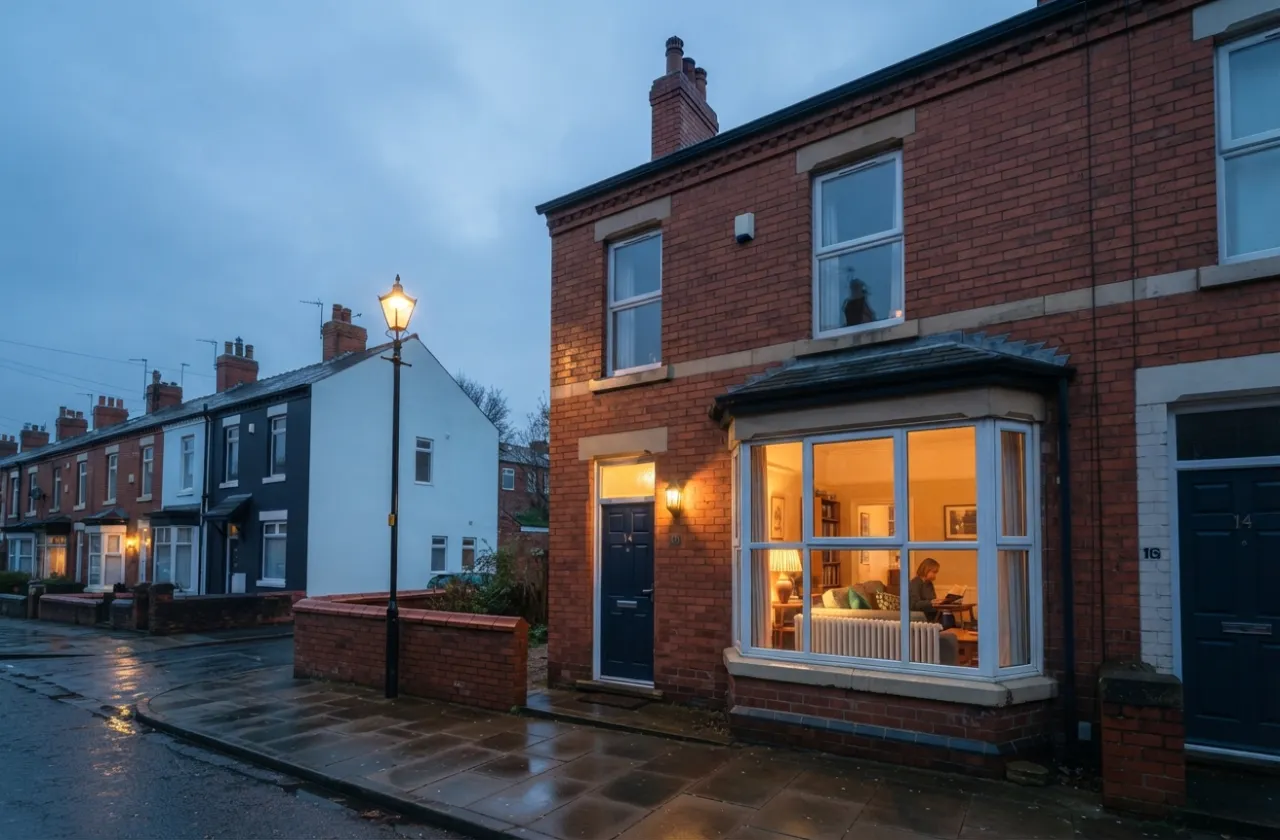

Keeping your home warm during a British winter can become expensive, especially when heating bills take up a significant part of your household budget.
As temperatures fall, many families face the challenge of staying comfortable without spending more than necessary on gas and electricity.
Fortunately, you can keep your house warm and save money by using heating controls effectively, reducing draughts and preventing unnecessary heat loss.
Small changes to everyday habits can make a difference, while improvements such as insulation may help reduce heating costs over time.
Whether you own your home or rent, there are practical ways to improve comfort without making expensive changes. This guide covers affordable heating tips, energy-saving improvements, UK government support and simple steps to help you manage your winter energy bills.
Table of Contents
Quick Ways to Keep Your Home Warm Without Spending More
You do not necessarily need a new boiler or expensive insulation to make your home feel warmer. Before investing in major improvements, look at how you use your heating and where warmth may be escaping.
Start With These Free Energy-Saving Tips
- Close curtains after dark. Well-fitting curtains can help reduce heat loss through windows, especially during cold evenings.
- Keep internal doors closed where appropriate. This can help retain warmth in rooms you use regularly.
- Use heating timers. Schedule your heating around your normal routine rather than running it when it is not needed.
- Keep radiators unobstructed. Move large furniture away from radiators to help warm air circulate.
- Check for unwanted draughts. Look around external doors, windows and floorboards for gaps letting cold air inside.
- Monitor your energy consumption. Checking how much energy you use can help identify habits that increase your bills.
These measures are useful starting points for energy saving at home. The UK government’s energy-saving advice also recommends improving heating controls, finding draughts and monitoring consumption.
Which Changes Should You Try First?
The most useful improvement depends on your property’s condition, your heating system and your available budget.
| Energy-Saving Action | Upfront Cost | Main Benefit |
|---|---|---|
| Adjust heating schedules | Free | Reduces unnecessary heating |
| Close curtains after dark | Free | Helps retain warmth |
| Use existing radiator controls | Free | Improves room temperature control |
| Install suitable draught excluders | Low | Reduces unwanted cold air |
| Improve loft or wall insulation | Higher, unless funded | Limits long-term heat loss |
Start with the problems you can identify. A draught excluder may help if cold air enters beneath your front door, but it will not address insufficient roof insulation.
Use Your Heating Controls to Reduce Energy Bills
Heating controls determine when your heating operates and how warm your rooms become. Using them correctly can improve comfort while preventing unnecessary energy consumption.
Set a Comfortable Thermostat Temperature
A room thermostat measures the temperature and switches the heating on or off according to your chosen setting.
Setting the thermostat higher than necessary does not usually make a home heat up faster. Instead, it may keep the heating running until the room reaches an unnecessarily high temperature.
Energy Saving Trust recommends selecting the lowest temperature that remains comfortable for your household. Individual requirements vary depending on health, age and personal circumstances.
According to NHS winter health guidance, regularly used rooms should ideally be heated to at least 18°C where possible, particularly for people with health conditions.
For example, if your home feels comfortable at 20°C, increasing the thermostat to 23°C may use more energy without providing a worthwhile improvement.
Try adjusting your thermostat gradually and monitor whether your rooms remain comfortable.
Make Better Use of Timers and Radiator Controls
Heating timers allow you to decide when your central heating operates. A suitable schedule can prevent your system from heating an empty home unnecessarily.
Someone working outside the home may prefer heating during the morning and evening. A person working remotely may need a different schedule.
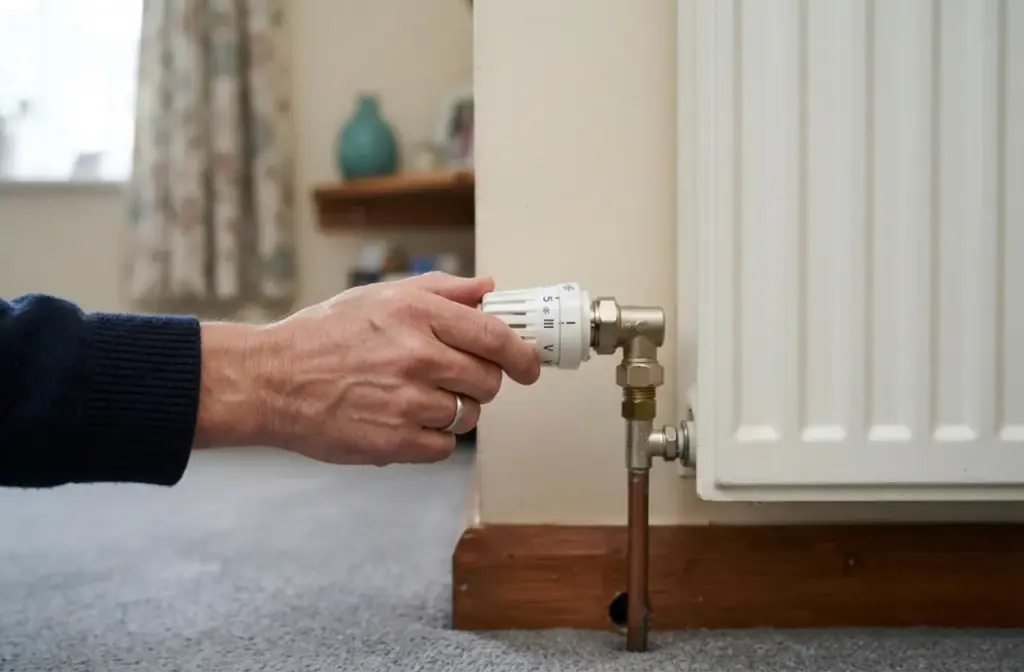
Thermostatic radiator valves, commonly called TRVs, help regulate temperatures in individual rooms.
You can use them to:
- Avoid overheating rooms that are used less frequently.
- Maintain comfortable temperatures in occupied rooms.
- Adjust heating according to household routines.
- Reduce unnecessary energy consumption.
However, avoid allowing unused rooms to become excessively cold, particularly where damp or condensation is a concern. The best settings depend on your property’s insulation, heating system and ventilation.
If your home has a modern combi boiler, reviewing its central heating flow temperature may help improve efficiency.
Flow temperature refers to the temperature of the water leaving the boiler and travelling to the radiators.
Some condensing boilers operate more efficiently with lower flow temperatures, although rooms may take longer to warm up.
The appropriate temperature depends on the boiler, radiators, property and weather conditions. Settings for central heating must not be confused with stored hot-water temperatures, which have additional safety considerations.
If you are unsure about your system, follow the manufacturer’s instructions or ask a qualified heating professional.
Citizens Advice provides further guidance on heating and hot water controls.
Stop Heat Escaping Through Doors, Windows and Floors
A home may feel cold even when the heating runs regularly if warm air escapes through gaps around doors, windows and floors.
Reducing unwanted draughts helps retain heat and can make rooms more comfortable without increasing thermostat settings.
Find and Fix Draughts Around Your Home
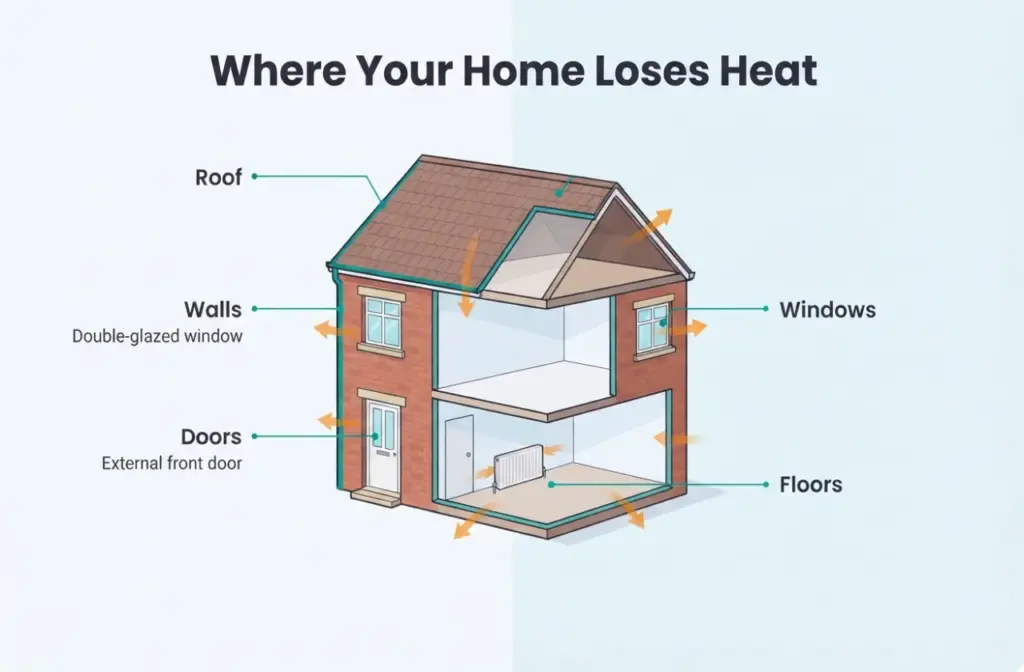
Common sources of draughts include window frames, external doors, letterboxes, skirting boards and gaps in wooden floorboards.
Several straightforward measures can help:
- Fit suitable self-adhesive draught-proofing strips around windows.
- Use a door draught excluder where cold air enters beneath an external door.
- Install an appropriate letterbox brush or cover.
- Seal suitable gaps around skirting boards.
- Use removable draught-proofing products in rented properties.
According to Energy Saving Trust’s draught-proofing guidance, addressing draughts around windows, floors and doors could save approximately £55 annually in Great Britain or £80 in Northern Ireland. Actual savings depend on the property and installation.
However, draught-proofing must not prevent necessary ventilation. Never block air bricks, extractor fans or vents required for the safe operation of heating appliances.
Use Curtains and Room Layout to Retain Warmth
Curtains can help reduce heat loss through windows, especially overnight.
Open them during sunny winter days to allow natural warmth into your rooms, then close them when daylight fades.
Make sure curtains do not cover radiators. Otherwise, warm air may become trapped between the curtain and window instead of circulating throughout the room.
Furniture placement can also affect comfort. Large sofas or cabinets positioned directly against radiators may restrict airflow.
Although these changes cannot replace proper insulation, they provide affordable ways to keep your home warmer.
Improve Home Insulation for Long-Term Savings
Insulation helps slow the movement of heat from warmer indoor spaces to colder surroundings.
When a property loses heat quickly, its heating system must work harder to maintain a comfortable temperature. Improving insulation can reduce this demand and support better home energy efficiency.
Consider Loft, Wall and Floor Insulation
Different types of insulation address different sources of heat loss.
- Loft insulation reduces heat escaping through the roof. It may be particularly useful where existing insulation is missing, damaged or insufficient.
- Cavity wall insulation can reduce heat loss through suitable external walls. However, not every property is appropriate for this treatment.
- Solid wall insulation may improve the thermal performance of older homes without cavity walls, although installation can involve substantial work.
- Floor insulation can help retain warmth in properties with suitable suspended floors.
- Hot water cylinder insulation reduces heat loss from stored water in systems that use a separate cylinder.
Before installing insulation, consider your property’s construction, ventilation and moisture conditions.
Incorrect insulation can create problems, particularly where existing damp or inadequate ventilation has not been addressed.
Check Your Home's Energy Performance
An Energy Performance Certificate, or EPC, provides an assessment of a property’s energy performance.
It also identifies potential improvements that may help reduce energy consumption.
For example, an EPC might recommend improving loft insulation, upgrading heating controls or replacing inefficient equipment.
However, recommendations should be considered alongside the property’s actual condition. A professional assessment may be necessary before completing significant work.
Larger improvements should be prioritised according to their suitability, installation costs and expected benefits rather than advertised savings alone.
Understand Your Energy Bills and Heating Running Costs
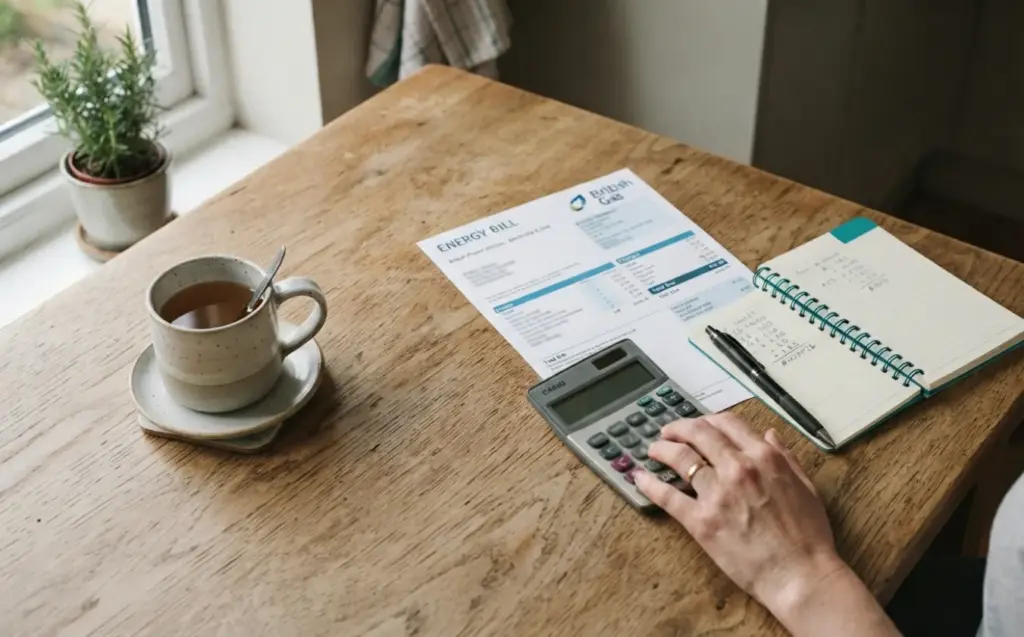
Understanding how gas and electricity charges work can help you make more informed decisions about household energy use.
Your total bill depends on several factors, including consumption, unit rates, standing charges, tariff type and payment method.
Understand Unit Rates and Standing Charges
Most domestic energy bills include two main types of charges.
- Unit rate: The price charged for each kilowatt-hour (kWh) of energy consumed.
- Standing charge: A fixed daily amount paid for maintaining access to the energy supply.
A kilowatt-hour measures energy consumption.
For example, a 2kW electric heater operating continuously at full power for one hour uses approximately 2kWh of electricity.
If the electricity unit rate is 25p per kWh, the heater would cost approximately 50p to run for that hour, excluding the standing charge.
The calculation is:
Energy used (kWh) × Unit rate (£) = Usage cost (£)
Actual running costs depend on the heater’s operating pattern and your tariff. A thermostatically controlled heater may switch on and off rather than consume its full rated power continuously.
This calculation is useful when comparing heating appliances or estimating how changes in usage may affect your bills.
What Does the Ofgem Energy Price Cap Mean?
Ofgem’s energy price cap limits the unit rates and standing charges that suppliers can charge households on covered default tariffs.
It does not set a maximum total energy bill.
For 1 October to 31 December 2026, the annualised price cap for a typical dual-fuel household paying by Direct Debit in England, Scotland or Wales is £1,723.
This figure is based on typical consumption and represents an annualised illustration of the rates for that period. A household using more energy can pay more.
You can check Ofgem’s current energy price cap to compare the applicable rates with your tariff. Because these figures change periodically, check the relevant dates before estimating future heating costs.
Can Smart Meters Help You Save Money?
A smart meter records energy consumption and can automatically send readings to your supplier.
Many households also receive an in-home display showing estimated usage and costs. The meter itself does not automatically reduce energy bills. However, it can make changes in consumption easier to identify.
For example, you could compare your usage before and after adjusting heating schedules. Monitoring results over several days may help you identify whether a particular change is useful.
Get Government Help With Heating and Energy Costs
Reducing wasted energy is helpful, but some households still struggle to afford adequate heating.
Government support may provide financial assistance or help with improvements that make homes more energy-efficient. Eligibility depends on the scheme, location and household circumstances.
What Is the Warm Home Discount?
The Warm Home Discount provides a one-off £150 electricity-bill discount for eligible households during winter 2026–27.
The amount is generally credited to the customer’s energy account rather than paid directly into a bank account.
Eligibility and administrative arrangements differ between England, Wales and Scotland. Some households receive the discount automatically, while others may need to provide information or follow additional instructions.
The scheme does not operate in Northern Ireland.
If you believe you may qualify, check the official Warm Home Discount eligibility information rather than assuming an application is always required.
What Is the UK Warm Homes Plan?
The Warm Homes Plan is a UK government policy programme aimed at improving housing energy efficiency and helping households reduce energy costs.
Published in January 2026, it outlines measures to support warmer homes, energy improvements and the transition towards lower-carbon technologies.
These include support for suitable insulation, cleaner heating and other home upgrades.
However, the Warm Homes Plan is not a single grant automatically available to every household. Individual programmes have separate eligibility conditions and application arrangements.
Can You Get Help With Insulation or Heating Improvements?
Households in England may qualify for energy-efficiency improvements through the Warm Homes: Local Grant.
Depending on eligibility, property suitability and available funding, improvements may include:
- Wall, loft or underfloor insulation.
- Air source heat pumps.
- Smart heating controls.
- Solar panels.
The programme supports qualifying privately owned or privately rented homes with EPC ratings of D to G. Household income and other eligibility routes are also considered.
If approved, the local authority arranges the agreed improvements. Landlords may need to contribute towards work in rented properties.
You can check your eligibility through the official Warm Homes: Local Grant service.
Scotland, Wales and Northern Ireland have different support arrangements, so households should check the schemes available in their nation.
How Renters and Homeowners Can Keep Heating Costs Down
Your options for improving heating efficiency depend partly on whether you rent or own your home.
Some improvements are affordable and temporary, while others involve permanent building alterations or professional installation.
Affordable Heating Improvements for Renters
If you rent privately or live in social housing, start with changes that do not permanently alter the property.
Suitable options may include draught excluders, curtains, furniture repositioning and more effective use of existing heating controls.
If your heating is faulty, windows do not close properly or serious draughts affect your home, report the problem to your landlord or housing provider.
In England and Wales, covered privately rented properties generally need to achieve at least an EPC rating of E, unless a valid exemption applies.
The government’s minimum energy efficiency standards explain these legal requirements and the circumstances in which exemptions may apply.
Seek permission before carrying out permanent insulation or heating alterations.
Long-Term Options for Homeowners
Homeowners have greater flexibility to invest in permanent energy-efficiency improvements.
These may include:
- Loft insulation: Improving loft insulation to reduce heat loss.
- Wall insulation: Installing suitable wall insulation.
- Heating controls: Introducing improved heating controls.
- Heating equipment: Replacing inefficient heating equipment.
Before committing to a major upgrade, consider the following:
- Installation cost: Compare the cost of installing the improvement.
- Expected savings: Consider the expected running-cost savings.
- Property suitability: Assess whether the improvement is suitable for your property.
A modern detached house may require different improvements from an older terraced property or small flat.
A professional energy assessment can help identify appropriate options and reduce the risk of investing in unsuitable measures.
Stay Warm Without Putting Your Health or Safety at Risk
Reducing energy consumption should never mean keeping your home dangerously cold. Low indoor temperatures can affect health, particularly among older adults, young children and people with existing medical conditions.
Keep frequently used rooms comfortably warm and pay attention to condensation, damp and mould. Homes also need adequate ventilation during winter, so avoid blocking essential vents or sealing spaces required for safe airflow.
Portable heaters should be kept away from curtains, furniture and flammable materials. Never use outdoor barbecues, camping stoves or patio heaters indoors because of serious fire and carbon monoxide risks.
Gas appliances should be maintained by appropriately qualified Gas Safe registered engineers. If you cannot afford to maintain safe indoor temperatures, seek financial assistance rather than relying on unsafe heating methods.
A Simple Winter Energy-Saving Plan for Your Home
Making several improvements at once can make it difficult to identify what genuinely reduces energy consumption.
A practical approach is to review your current heating arrangements, make suitable changes and monitor the results.
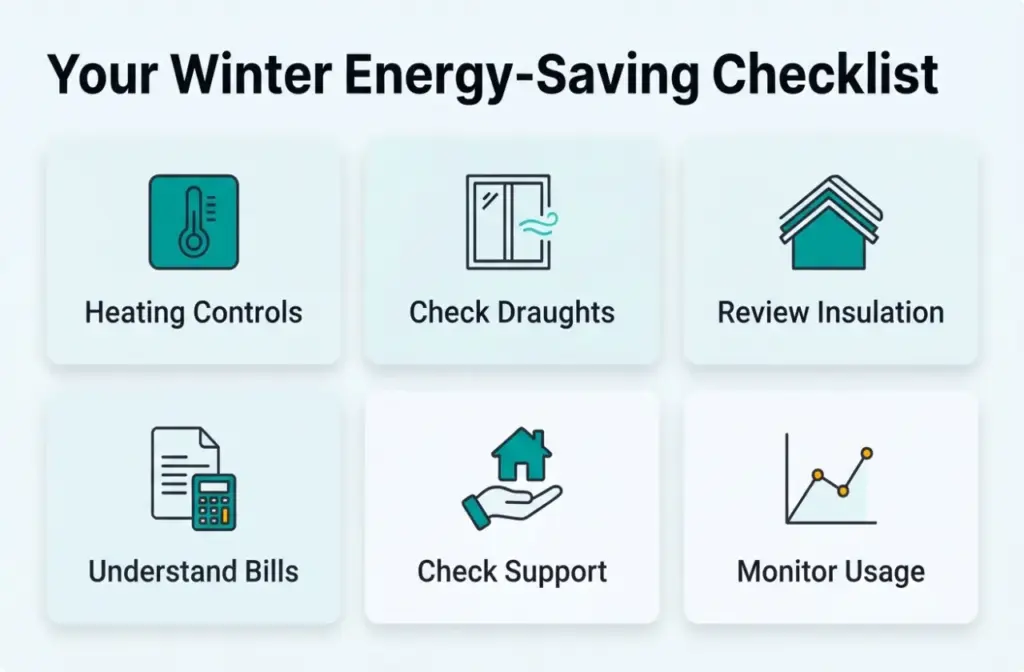
What to Do First
- Review your heating settings. Check the thermostat, timers and radiator controls.
- Identify unwanted draughts. Look around external doors, windows and suitable floor gaps.
- Assess existing insulation. Consider whether your roof, walls or floors may be losing unnecessary heat.
- Understand your energy bill. Review unit rates, standing charges and consumption.
- Check available financial support. Find out whether relevant grants or discounts could help.
- Monitor your progress. Compare energy use while maintaining comfortable indoor temperatures.
Start with one or two realistic improvements rather than attempting every change immediately.
Understanding energy use can also encourage more sustainable choices beyond household heating. For readers interested in the wider subject, Training Express offers an energy efficiency course covering sustainable energy, solar technologies, wind power, bioenergy and other renewable energy sources.
The online Energy Efficiency and Sustainable Development course provides CPD-accredited learning for those interested in sustainability and energy-related knowledge. It is not a regulated heating installation qualification or a licence to undertake specialist work.
Conclusion
Keeping your home warm does not always require expensive improvements or higher heating bills. Simple changes to heating schedules, radiator controls, curtains and draught-proofing can reduce wasted energy while helping maintain a comfortable indoor environment.
For longer-term savings, consider suitable insulation, better energy management and available government assistance. Understanding how your home uses and loses heat can help you make informed decisions without spending unnecessarily on heating equipment.
Start with the improvements your property needs most and monitor the results over time. Those interested in broader sustainable energy knowledge can also consider Training Express’s Energy Efficiency and Sustainable Development course as an optional further-learning opportunity.
Frequently Asked Questions (FAQ)
Is It Cheaper to Leave the Heating on All Day?
Not necessarily. Continuous heating can increase energy use, particularly in homes that lose heat quickly. A suitable heating schedule may be more economical, although the best approach depends on your property, heating system and occupancy.
What Is the Cheapest Way to Keep a House Warm?
Begin with free or low-cost improvements such as adjusting heating schedules, closing curtains after dark and reducing unwanted draughts. These measures can help retain warmth without requiring major investment.
Can Closing Curtains Help Keep a Room Warm?
Yes. Closing well-fitting curtains after dark can help reduce heat loss through windows. Keep curtains away from radiators to allow warmth to circulate effectively.
Are Electric Heaters Cheaper Than Central Heating?
It depends on energy tariffs, equipment efficiency and the space being heated. An electric heater may be useful for briefly heating one occupied room, but electricity often costs more per kWh than gas. Compare actual running costs before choosing.
How Can I Keep My Home Warm If I Cannot Afford Heating?
Contact your energy supplier as soon as possible to discuss your circumstances. Suppliers may offer repayment arrangements or other assistance. Ofgem provides official information about help with energy bills, including support for households experiencing payment difficulties.

Adam Smith
Author | Specialises in E-Learning.
Adam is an author at Training Express, with over 3 years of experience creating practical resources and strategies to support learners and enhance their professional & personal development.
Other Blogs