Food Hygiene
 Health & Safety
 Safeguarding
 First Aid
 Business Skills
 Personal Development


If your team brings you every small decision, this is probably why: somewhere along the way, you taught them that coming to you is faster than figuring it out themselves. You didn’t mean to. You just answered quickly because you were busy, and it worked, so they kept doing it.
The good news is this is fixable. Teaching problem-solving isn’t about running a training session once a year. It’s about changing how you respond in the moment, every time someone brings you a problem. Do that consistently, and your team starts solving things without you.
Table of Contents
Why most managers accidentally train their team not to problem-solve
You reinforce dependency every time you give a quick answer instead of asking a question back.
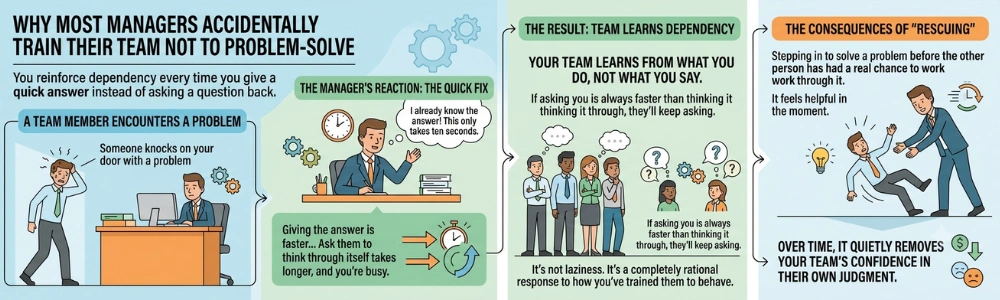
It makes sense why this happens. Someone knocks on your door with a problem, you already know the answer, and giving it takes ten seconds. Asking them to think it through themselves takes longer, and you’re busy. So you answer. Every time.
But here’s the catch: your team learns from what you do, not what you say. If asking you is always faster than thinking it through, they’ll keep asking. It’s not laziness. It’s a completely rational response to how you’ve trained them to behave.
This is sometimes called “rescuing” — stepping in to solve a problem before the other person has had a real chance to work through it. It feels helpful in the moment. Over time, it quietly removes your team’s confidence in their own judgment.
The shift: from answer-giver to question-asker
The fix is simple to describe and hard to practice: when someone brings you a problem, ask a question before you give an answer.
You’re not withholding help. You’re redirecting the thinking back to them, while staying available if they genuinely get stuck. A few questions work in almost any situation:
- “What have you tried so far?”
- “What do you think the options are?”
- “If I weren’t here, what would you do?”
- “What’s your gut telling you, and why?”
- “What’s the worst that happens if you just try your first idea?”
The first few times you do this, it’ll feel slower and a little awkward — for both of you. Your team member might just want the answer. Stay with the question anyway. That discomfort is the whole point. It’s where the thinking actually happens.
A simple framework to teach
You don’t need a complicated model. A simple four-step version works for almost any workplace problem:
- Define it. What’s actually going wrong, in one sentence?
- Explore options. What are two or three different ways to handle it?
- Decide. Which option fits best, given time, resources, and impact?
- Review. Did it work? What would you do differently next time?
Teach this as shared language, not a rigid checklist. The goal isn’t for your team to recite four steps out loud. It’s for them to have a mental habit they can lean on instead of freezing or defaulting to you.
What this looks like in practice
Frameworks are easier to trust once you’ve seen them play out in a real situation. Here’s a common scenario that shows how this looks day to day.

The situation: Picture a retail store manager whose team escalates almost every customer complaint straight to her — even small ones, like a customer wanting a return outside the return window. She’s constantly interrupted, and her team never gets the chance to build confidence handling anything remotely tricky.
The change: She makes one change: when someone comes to her with a complaint, she asks, “What would you do if I weren’t here today?” At first, this goes badly. An employee guesses wrong and offers a refund the store’s policy doesn’t actually allow. Her instinct is to jump in and fix it immediately.
Instead, she waits until the customer leaves, then walks through it with the employee — what happened, what the policy actually said, and what they’d do differently next time. She doesn’t scold the mistake — she treats it as the review step in the framework above.
The result: A few weeks of this, and escalations start dropping. Employees begin handling routine disputes on their own, using roughly the reasoning she would have used herself. Nothing about the team’s intelligence changed. They were simply given room to think, and a manager who resisted the urge to think for them.
What the research says: Harvard Business Review found in "The Leader as Coach" (Ibarra & Scoular, HBR, Nov–Dec 2019) that as work gets more complex, managers get better results facilitating their team's thinking through questions rather than directing with answers. The four-step framework above is a simplified version of the same idea behind the GROW model referenced in that article — a widely used coaching structure built around goal, reality, options, and way forward.
Practical ways to build the habit day-to-day
A few small rules make this easier to stick to, even on busy days:
- Ask for options, not just problems. Tell your team: “Come to me with at least one idea of your own, even if it’s a guess.” This alone filters out a lot of unnecessary escalations.
- Set clear delegation boundaries. Be explicit about what they can decide on their own versus what needs your input. Vague boundaries create anxious over-checking. Clear ones build confidence fast.
- Debrief wins, not just failures. Most teams only review what went wrong. Take two minutes after something goes right to ask, “What did you do there, and why did it work?” This builds pattern recognition much faster than only picking apart mistakes.
Team activities that build the muscle
Beyond day-to-day coaching, short team exercises help reinforce the habit in a lower-stakes setting:
- Scenario walkthroughs. Present a realistic problem your team might face and have them talk through it together before you weigh in.
- “You’re the manager for a day.” Rotate who handles minor decisions for a shift or a day, with you available only as a last resort.
- Post-mortem roundtables. After a real problem gets solved, have the team briefly discuss what worked, without turning it into a blame session.
These work best as short, regular habits rather than one big annual workshop. If you want a deeper list of exercises to run with your team, that’s worth its own dedicated read.
Common mistakes managers make when trying to teach this

- Stepping in too soon. If you rescue at the first sign of struggle, you’ve undone the whole exercise. Let the discomfort sit a little longer than feels natural.
- Only addressing the mistake, not the thinking. Correcting the outcome without discussing the reasoning behind it teaches your team what happened once — not how to think next time.
- Treating it as a one-off training day. A single workshop won’t shift a habit that’s been reinforced for months or years. This has to show up in your daily responses, not just a slide deck.
- Praising the outcome instead of the process. If you only celebrate good results, your team optimizes for looking right instead of thinking well. Praise good reasoning even when the outcome isn’t perfect.
How to know it's working
You’ll notice a few clear signals over a few weeks:
- Your team starts bringing you solutions, not just problems.
- You get fewer repeat questions about things you’ve already covered.
- People contribute more in meetings, because they’re used to forming an opinion before speaking.
None of this happens in a day. Harvard Business Review’s research on coaching notes that managers often default to giving answers simply because it feels faster and reinforces their own expertise — and that unwinding this takes deliberate, repeated practice, not a single conversation. Expect a few weeks of consistent effort before the shift becomes visible, not because the framework is magic, but because habits take repetition to form, for you and for your team.
The bottom line
Teaching your team to problem-solve isn’t really about the framework. It’s about resisting the urge to solve it for them, over and over, until it becomes their habit instead of yours. That takes weeks of consistency, not one good conversation.
If you want a more structured way to build this across your whole team — not just one-on-one coaching moments — a dedicated problem-solving and leadership course can give you a shared framework and language to work from. Explore our Problem-Solving Skills training if you’d like a head start.
Frequently Asked Questions (FAQ)
How do I teach problem-solving skills to my employees?
Start by asking questions instead of giving answers when they bring you a problem. Questions like “what have you tried?” or “what would you do if I weren’t here?” push the thinking back to them. Pair this with a simple shared framework — define the problem, explore options, decide, review — so your team has consistent language to work from.
What are good problem-solving questions to ask my team?
A few that work in almost any situation: “What have you tried so far?”, “What do you think the options are?”, “If I weren’t here, what would you do?”, and “What’s the worst that happens if you just try your first idea?” The goal is to get them thinking out loud, not to test them.
How long does it take to build problem-solving skills in a team?
Most managers notice a real shift within a few weeks of consistent practice, not after one conversation or a single training session. It takes repetition — the same as building any other habit — because you’re changing both your response and your team’s expectation of how you’ll respond.
What's the GROW model, and should I use it?
GROW stands for goal, reality, options, and way forward. It’s a coaching structure originally built for one-on-one conversations, and it’s a useful reference if you want more structure than the simple four-step framework in this guide. You don’t need to use it formally — the core idea (ask before you answer) matters more than the exact model.
What if my team keeps giving the wrong answer even after I stop rescuing them?
That’s normal, especially early on. Let mistakes happen within safe limits, then walk through what happened afterward — what they were thinking, what the right information was, and what they’d do differently. This review step is where the actual learning happens, not the mistake itself.
Is it better to teach problem-solving one-on-one or as a team?
Both matter. One-on-one coaching moments handle real situations as they come up day to day. Team activities and scenario walkthroughs build the same muscle in a lower-stakes setting, so people aren’t practicing for the first time when something actually goes wrong.
How do I know if my team's problem-solving skills are actually improving?
Watch for three signals: your team starts bringing you solutions instead of just problems, you get fewer repeat questions about things you’ve already covered, and people contribute more in meetings because they’re used to forming an opinion before speaking up.
Should I still step in if my team gets stuck?
Yes — this isn’t about leaving people to struggle indefinitely. If someone is genuinely stuck after trying to work through it, help them. The goal is to stop being the default first move, not to remove yourself as a resource entirely.

Robert Lawrence
Author | Specialises in e-learning.
Robert Lawrence is an e-learning specialist and author at Training Express, with over 5 years of experience creating practical resources and strategies to support learners and enhance their professional development.