SENCO - Special Educational Needs Coordination

4.8 (8 REVIEWS)
530 STUDENTS

GET THIS COURSE AND 2500+ OTHERS FOR ONLY £49 FIND OUT MORE

A SENCO (special educational needs coordinator) is the person who makes sure children with special educational needs and disabilities (SEND) get the right support to learn and thrive. Every mainstream school in England must have one. With more than 1.8 million pupils in England now identified with SEN, the role has never mattered more.

This SENCO course shows you how the job really works. You’ll learn how to spot needs early, use the graduated approach, plan support, steer EHC plans and work well with parents and outside professionals. It suits teaching assistants, teachers, nursery staff and anyone who wants to move into an SEN role.

The course is online, CPD accredited and self-paced, so it fits around a busy school day. Think of it as your smart first step: you’ll understand the role, the law and the language before you take the next step in your SEN career.

Last audited and updated on: 2nd June 2026

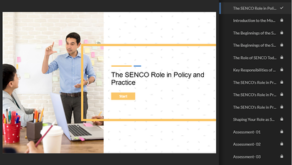
Sneak Peek

Sneak Peek of SENCO Course

Learning Outcomes of The Special Educational Needs Coordination- SENCO Course

By the end of the Special Educational Needs Coordination- SENCO Course, learners will be able to:

What Is a SENCO (Special Educational Needs Coordinator)?

A SENCO (special educational needs coordinator) is the staff member in a school or nursery who coordinates support for children with special educational needs and disabilities (SEND). In England, every mainstream school must have a SENCO who is a qualified teacher. Day to day, a SENCO identifies pupils’ needs, plans and reviews support through the graduated approach, advises staff, works with parents and outside agencies, and manages EHC plan processes. In private and voluntary nurseries, the SENCO is often an experienced Level 3 early years practitioner rather than a teacher.

How to Become a SENCO

Becoming a SENCO starts with understanding the role inside out, and that’s exactly what this SENCO course gives you. Here’s the path most people follow, and how the course helps at every stage.

Step 1: Learn the SENCO role with this course

Start here, whatever your background. You’ll learn the SEND Code of Practice, the graduated approach, EHC plans, the four areas of need and how to work with parents and professionals. When you pass, you’ll get a CPD accredited certificate that shows employers you know your stuff.

Step 2: Put your learning into practice

Use what you learn in your current role straight away. Offer to help your school’s SENCO with reviews, interventions or paperwork, or volunteer in an SEN setting. Real experience plus your certificate is a strong combination on any CV.

Step 3: Explore where your skills fit

  • In schools: Understanding SEN coordination helps you play a bigger part in your school’s SEND support, whether you work in the classroom, support pupils one to one or help with reviews and plans.
  • In nurseries and early years: You’ll be better placed to spot needs early and support young children and their families with confidence.
  • In SEN support roles: Teaching assistants, learning mentors, family support workers and SEND caseworkers all draw on the same knowledge this course covers.

Wherever you’re headed, this SENCO course is the first step you can take today.

Who Should Take This SENCO Course?

This SENCO course is for anyone who works with, or wants to work with, children who need a bit more support. You don’t need to be a teacher to start. It’s especially useful if you are:

Wherever you’re starting from, you’ll finish with a clear understanding of how SEN support works in UK schools and nurseries, and where you fit in it.

Why Take This SENCO Course?

SEN support is growing fast. In 2025/26, 538,547 pupils in England had an EHC plan, up 11.6% in a single year, and schools need staff who understand how support works. This SENCO training online gives you that understanding quickly and affordably:

In short, it’s a low-risk, high-value way to test your interest in SEN coordination and build skills that schools and nurseries value now.

Entry Requirements

SENCO Jobs and Salaries in the UK

SEN skills open doors in schools, nurseries and local councils. Here are 8 roles this SENCO course supports, with typical pay in England. Some roles have extra requirements, which we’ve noted.

Salaries vary by region, school and experience. London pay scales are higher.

Assessment SENCO Training

At the end of the Special Educational Needs Coordination- SENCO Training Course, there will be an online assessment, which you will need to pass to complete the course. Answers are marked instantly and automatically, allowing you to know straight away whether you have passed. If you haven’t, there’s no limit on the number of times you can take the final exam. All this is included in the one-time fee you paid for the course itself.

Accreditation of SENCO Course

All of our courses, including this Emergency First Aid at Work Course (EFAW Course) is fully accredited, providing you with up-to-date skills and knowledge and helping you to become more competent and effective in your chosen field.

CPD Accredited

All our courses are CPD accredited, meeting recognised Continuing Professional Development (CPD) standards.

RoSPA Membership

RoSPA membership shows commitment to health and safety and helps organisations maintain strong safety standards and reduce workplace risks.

British Safety Council Member

A British Safety Council Member demonstrates commitment to high health, safety, and wellbeing standards and safer workplaces.

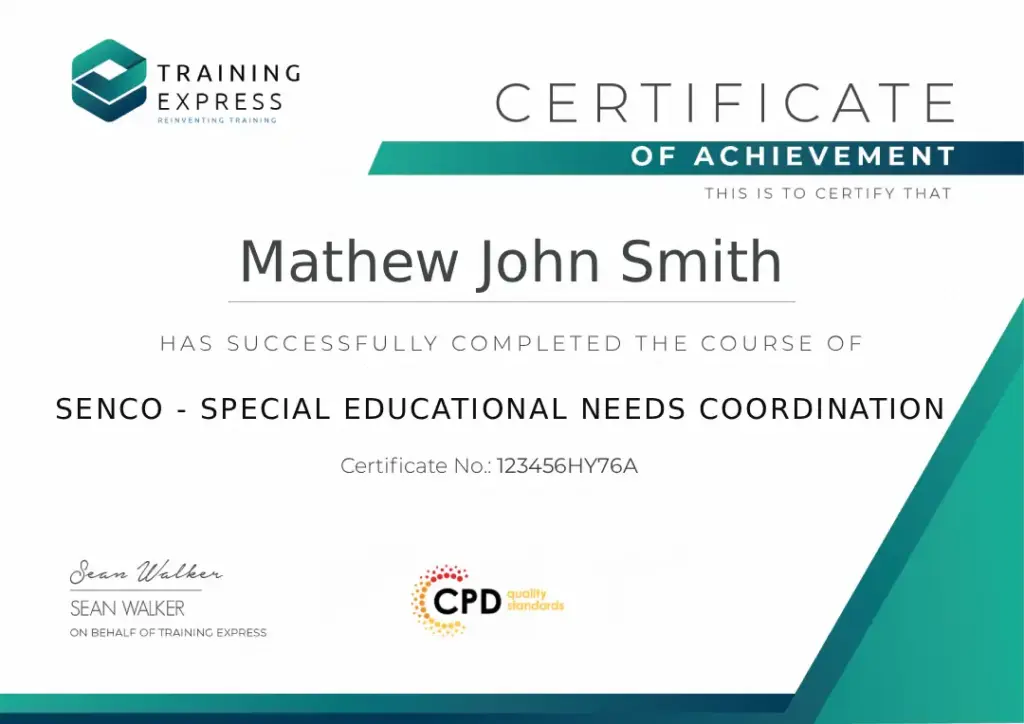
SENCO Certification

Once you’ve successfully completed your Special Educational Needs Coordination- SENCO Online Course, you will immediately be sent a digital certificate. Also, you can have your printed certificate delivered by post (shipping cost £5.99). All of our courses are fully accredited, providing you with up-to-date skills and knowledge and helping you to become more competent and effective in your chosen field. 

Certification of SENCO - Special Educational Needs Coordination
↻
Recommended renewal: 3 years.
Our certifications have no expiry dates, but we recommend renewing them to stay up to date with industry best practices.

Course Curriculum

In module one, we will learn the definition of special educational needs, with an introduction to the Children and Families Act 2014. It covers the key principles of SENCO and the role of education providers in improving learning outcomes.

In module two, we will gain an insight into the SENCO role in practice, including responsibilities, teaching policies and the SEND code of practice.

In module three, we will get an in-depth overview of the duties of governing bodies and trust boards, the role of the SENCO, and the SEN budget. It also provides essential information on managing your time and resources.

In module four, we will gain a comprehensive understanding of the National Curriculum 

In module five, we will learn how to determine if a SENCO should be on the senior leadership team, how to develop your status as a SENCO, create priority through a development plan, and other key topics. 

In module six, we will explore the ways in which we can lead and support colleagues and why it’s important. It includes important fundamental on how to recognise staff needs and create opportunities for development.

In module seven, we will build our communication skills to develop positive working relationships with pupils and parents. It also explores the barriers to building relationships and how to overcome them.

In module eight, we will be trained on how to maintain SEN records and prepare for an Ofsted inspection. It also provides tips on how to deal with complaints and organise reviews for those receiving SEN support. 

In module nine, we will gain essential time management skills, and learn how to overcome challenges such as workload and contingency planning. It also provides information on modes of study.

In module ten, we will learn how to maintain an inclusive learning environment in a classroom setting, as well as explore the definition of inclusive education and how to shape your future as an SENCO.

SENCO Course Reviews

Excellent

4.8 Average 208 Reviews

  Reviews

Katie
📍GB
Easy to follow training, gave great information even as someone who work in a SEN school and has received training on ADHD before hand this training has given me knew information and new ideas to support my learning and development. I am very grateful to this course. When I have reached out to the support team they always answer back quickly and are always willing to help
DA
📍GB
Support services were great. Adi Zayn was knowledgeable, efficient and helpful. The course I completed was also great - good value for money, easy to follow, digest and learn.
Kelly Shepherd-Burridge
📍GB
Amazing course, definitely helped me with all I needed to know and learn
Rosa Arleny Pascual Veras
📍GB
This course is very well structured and designed around the needs of people who may not have many hours available to attend face-to-face classes while continuing to develop their knowledge and skills.

SENCO Course FAQs

What does a SENCO do?

A SENCO coordinates support for pupils with special educational needs and disabilities. They identify needs, plan and review support using the graduated approach, advise teachers and TAs, work with parents and outside professionals, and manage EHC plan assessments and annual reviews. In many schools, the SENCO also sits on the senior leadership team.

How do I become a SENCO teacher?

To become a SENCO teacher in England, you need qualified teacher status (QTS), classroom experience with SEN pupils. Most people gain QTS, teach for a few years, take on SEN responsibilities, then apply for an assistant SENCO or SENCO post. A short SENCO course helps you learn the role early.

Can you be a SENCO without being a teacher?

In a mainstream school, no: the SENCO must be a qualified teacher. In private, voluntary and independent nurseries, yes: the SENCO is often an experienced Level 3 early years practitioner. Non-teachers can also work in SEN as teaching assistants, learning mentors or SEND caseworkers, and SENCO training for non-teachers is a great way to start.

Is there a Level 3 SENCO qualification?

Yes. This SENCO course is a Level 3 course, and it’s CPD accredited. It covers the SEND Code of Practice, the graduated approach, EHC plans and working with parents and professionals, all at a level that suits teaching assistants, nursery staff, teachers and anyone moving into SEN. You can study it online at your own pace and get your certificate as soon as you pass.

Is this SENCO course accredited?

Yes. This SENCO course is CPD accredited, so it meets recognised standards for continuing professional development. When you pass the assessment, you’ll receive a certificate you can add to your CV and CPD record. It’s great preparation for SENCO, SEN support and early years roles.

Can I do SENCO training online?

Yes. This SENCO training is 100% online and self-paced, so you can study on a phone, tablet or laptop whenever it suits you. You’ll get a CPD accredited certificate when you pass the assessment.

What jobs can you get with an Emergency First Aid at Work certificate?

Emergency First Aid at Work training can support career opportunities in industries such as construction, childcare, healthcare support, hospitality, retail, education, warehousing, manufacturing, logistics, fitness, security, transport, and customer service. Employers often value candidates with workplace first aid awareness because they can respond responsibly during emergencies and contribute to safer working environments.

How much does a SENCO earn in the UK?

A school SENCO in England is paid on the teacher pay scales: £34,069 to £52,835 from September 2026 outside London. Many also receive an SEN allowance of £2,885 to £5,690, and some earn leadership pay or a TLR payment on top. Nursery SENCOs usually earn less, often around £13 to £15 an hour.

What's the difference between a SENCO and a SENDCo?

There’s no real difference. SENDCo (special educational needs and disabilities coordinator) is a newer name that makes disability part of the title. Both describe the same role, and many schools use the two names interchangeably.

Course Curriculum

Module 1: Introduction to SEN Co-ordination
Introduction to SEN Co-ordination 00:13:00
Module 2: The SENCO Role in Policy and Practice
The SENCO Role in Policy and Practice 00:12:00
Module 3: Roles and Responsibilities within whole School SEN Co-ordination
Roles within Whole School SEN Co-ordination 00:12:00
Module 4: Supporting Teaching and Learning
Supporting Teaching and Learning 00:22:00
Module 5: The SENCO and the Senior Leadership Team
The SENCO and the Senior Leadership Team 00:14:00
Module 6: Supporting Colleagues and working with Professionals and Organisations beyond the School
Working with Professionals beyond the School 00:24:00
Module 7: Developing Relationship with Pupils and Parents
Developing Relationships with Pupils and Parents 00:19:00
Module 8: SENCO’s Role in Leading and Managing SEND Administration
Leading and Managing SEND Administration 00:17:00
Module 9: Challenges and Opportunities
Challenges and Opportunities 00:16:00
Module 10: Developing Inclusive Practice and the Future SENCO Role
Developing Inclusive Practice and the Future SENCO Role 00:13:00
Mock Exam
Mock Exam – SENCO – Special Educational Needs Coordination Course 00:20:00
Final Exam
Final Exam – SENCO – Special Educational Needs Coordination Course 00:20:00
SENCO – Special Educational Needs Coordination
ex Vat

SAVE 84% - OFFER ENDS SOON

TAKE THIS COURSE

Or

  • Original price was: £125.00.Current price is: £20.00. ex Vat
  • 1 year
  • Course Certificate
  • 3 hours, 22 minutes
  • Gift this course
£20 /Unit Price
Total:
£100.00
Quantity:

Buying more than one of the same courses?

  • 50% discount for orders of 10+ courses
  • 60% discount for orders of 50+ courses
  • 70% discount for orders of 100+ courses

Looking for a more personalised package?

contact us now

Instructors

530 STUDENTS ENROLLED
top