Level 3 Light Vehicle Maintenance

4.8 (918 REVIEWS)
55 STUDENTS

GET THIS COURSE AND 2500+ OTHERS FOR ONLY £49 FIND OUT MORE

Our Level 3 Light Vehicle Maintenance online course takes you beyond the basics and into how modern cars are diagnosed, repaired and restored. If you already know your way around oil checks and tyre pressures, or you’ve completed our Level 2 Light Vehicle Maintenance course, this is the next step. You’ll learn how to find faults, not just spot them.

Across 33 modules, you’ll work through engine diagnostics, ignition, lubrication, transmission, steering and suspension, then move on to a full car restoration plan, from stripping the interior to the final test drive. You’ll also discover how hybrid electric vehicles are built and how they differ from petrol and diesel cars, and finish with the regulations that keep workshop equipment safe to use.

Whether you’re thinking about a career in the motor trade, building on garage experience, or restoring a car of your own, this self-paced course gives you the technical knowledge to talk confidently about what’s happening under the bonnet.

Last audited and updated on: 20th September 2026

Sneak Peek

Sneak Peek of level 3 light vehicle maintenance

Learning Outcomes

By the end of this Level 3 Light Vehicle Maintenance course, you will be able to:

What is a Level 3 Light Vehicle Maintenance course?

A Level 3 Light Vehicle Maintenance course builds on foundation-level vehicle knowledge. It focuses on diagnosis, troubleshooting and more advanced repair of cars and light vans. Where a Level 2 course explains how each vehicle system works, Level 3 looks at why systems fail, how to trace faults logically, and how to restore and maintain vehicles to a high standard, including the hybrid technology now common on UK roads. It’s a fast track CPD accredited course, you  can complete it from anywhere in online.

Who Should Take This Level 3 Light Vehicle Maintenance Course

Whether you’re progressing from Level 2 or coming to vehicle maintenance as an adult with a new career in mind, this course gives you a deeper, more practical understanding of light vehicles.

Suitable for:

Why Take This Level 3 Light Vehicle Maintenance Course

Modern cars are more complex than ever, and knowing how to trace a fault logically saves time, money and guesswork, whether you’re in a workshop or on your own driveway.

This course will help you to:

Whether you’re preparing for college or an apprenticeship, moving up from Level 2, or restoring a car of your own, this Level 3 course gives you the knowledge to take the next step with confidence.

Job Opportunities & Salary Expectations in the UK

The UK motor industry needs skilled people, especially as more hybrid and electric vehicles come in for servicing. This course doesn’t qualify you as a vehicle technician on its own. It gives you the advanced knowledge that supports further training and helps you understand the roles available.

Roles where this knowledge may be beneficial include:

Salaries vary depending on qualifications, experience, employer and location.

Entry Requirements Level 3 Light Vehicle Maintenance

There are no formal entry requirements for this course. To study this course, you should have:

You can complete the course at your own pace, so it fits around work, family and other commitments.

Assessment of Level 3 Light Vehicle Maintenance

At the end of this Level 3 Light Vehicle Maintenance course, there will be an online assessment, which you will need to pass to complete the course. The questions are based on the topics covered across the modules, from engine diagnostics and troubleshooting to car restoration and hybrid vehicles. Answers are marked instantly and automatically, so you’ll know straight away whether you have passed. If you haven’t, there’s no limit on the number of times you can take the final exam. All this is included in the one-time fee you paid for the course itself.

Accreditation of Level 3 Light Vehicle Maintenance Online Course

All of our courses, including this Level 3 Light Vehicle Maintenance is fully accredited, providing you with up-to-date skills and knowledge and helping you to become more competent and effective in your chosen field.

CPD Accredited

All our courses are CPD accredited, meeting recognised Continuing Professional Development (CPD) standards.

RoSPA Membership

RoSPA membership shows commitment to health and safety and helps organisations maintain strong safety standards and reduce workplace risks.

British Safety Council Member

A British Safety Council Member demonstrates commitment to high health, safety, and wellbeing standards and safer workplaces.

Certification

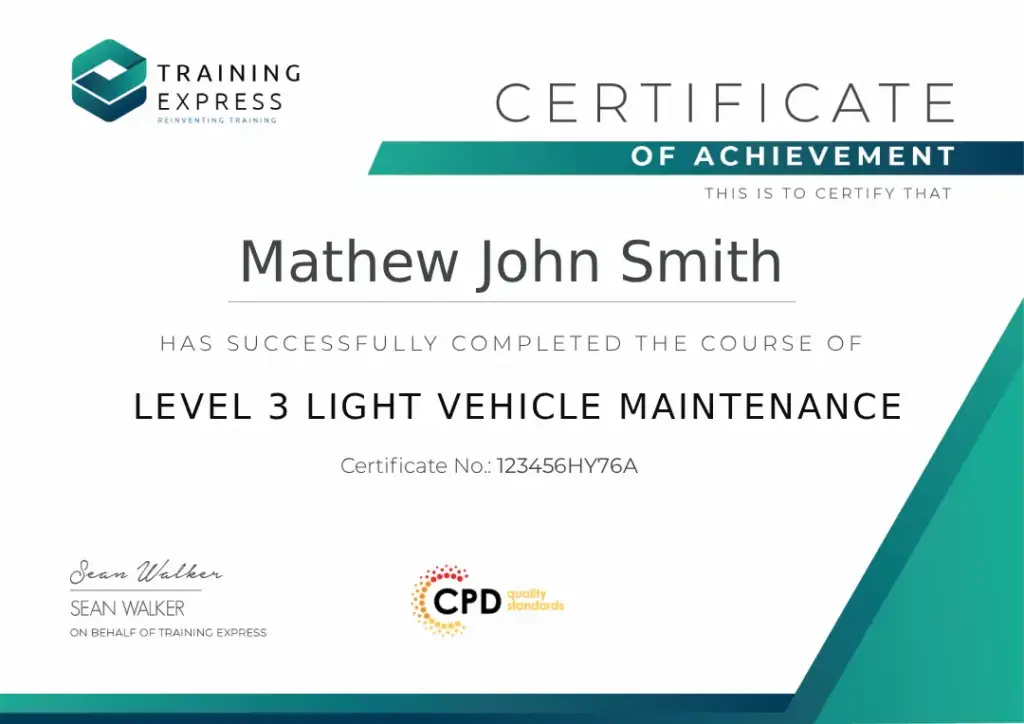
Once you’ve successfully completed your course, you will immediately be sent a digital certificate. Also, you can have your printed certificate delivered by post (shipping cost £5.99). All of our courses are fully accredited, providing you with up-to-date skills and knowledge and helping you to become more competent and effective in your chosen field.

Certification of Level 3 Light Vehicle Maintenance
↻
Recommended renewal: 3 years.
Our certifications have no expiry dates, but we recommend renewing them to stay up to date with industry best practices.

Course Curriculum

The detailed curriculum outline of our Level 3 Light Vehicle Maintenance is as follows:

Start with the safety habits every workshop depends on. You’ll learn how to spot common hazards, use personal protective equipment, handle tools correctly and keep your working area safe. You’ll also see why planned maintenance matters for keeping a vehicle reliable and roadworthy.

Learn the routine checks that keep a car running smoothly between services, including fluid levels, filters, wiper blades, lights and belts. You’ll understand how service intervals work and how regular attention prevents small issues from turning into expensive repairs.

Find out what your car’s warning lights are telling you. This module explains the difference between red, amber and green indicators, which warnings mean you should stop driving, and how dashboard lights can point you towards the system that needs checking.

Explore tyre construction, sidewall markings, correct pressures and wheel care. You’ll learn how to check tread depth against the UK legal minimum of 1.6mm, recognise uneven wear patterns, and understand what those patterns reveal about alignment and suspension.

Understand how a petrol or diesel engine turns fuel into motion, including the four-stroke cycle and the main engine components. You’ll also learn why engine oil is so important, what oil grades mean, and how to check and change oil correctly.

Learn how the radiator, thermostat, water pump and coolant work together to stop an engine from overheating. You’ll look at common cooling problems such as leaks, blockages and failed thermostats, and the warning signs to watch for.

Follow fuel on its journey from the tank to the combustion chamber. This module covers the fuel pump, filter, lines and injection system, and helps you recognise the symptoms of fuel delivery problems, such as poor starting, hesitation and rising fuel consumption.

Get to know the battery, alternator, starter motor, fuses and wiring that power a modern vehicle. You’ll learn how the charging and starting systems work together and how to recognise common electrical faults before they leave you stranded.

Discover how engine power reaches the wheels through the clutch, gearbox, driveshafts and differential. You’ll compare front-wheel, rear-wheel and all-wheel drive layouts and learn the noises and symptoms that point to drivetrain wear.

Learn how disc and drum brakes, pads, shoes and hydraulic brake fluid work together to stop a vehicle safely. You’ll understand the role of the master cylinder and callipers, and how to spot early signs of brake wear and fluid problems.

Move from knowing how an engine works to finding out why it isn’t working properly. This module introduces a structured diagnostic approach: gathering symptoms, carrying out checks and tests, and confirming the cause before any parts are replaced.

Revisit engine fundamentals in greater depth, including the cylinder head, valves, pistons, crankshaft and timing components. A stronger understanding of how these parts move together makes it much easier to interpret faults and plan repairs.

Take a closer look at how cooling and lubrication protect an engine from heat and friction. You’ll learn how oil pressure, oil flow and coolant circulation are maintained, and what happens to engine components when either system starts to fail.

Understand how the ignition system creates the spark that starts combustion, from the battery and ignition coils to the spark plugs. You’ll learn how ignition timing affects performance and how to recognise misfires and other ignition-related faults.

Bring your knowledge together with a logical, step-by-step troubleshooting process. You’ll practise working from symptom to cause on common problems, such as a car that won’t start, rough running and overheating, so you can solve faults methodically rather than by guesswork.

Explore how manual and automatic transmissions, the vehicle frame and the steering system work together to give a car control and stability. You’ll learn the main steering components and the signs of transmission and steering wear.

Learn how springs, shock absorbers, control arms and bushes keep a car stable, comfortable and in contact with the road. You’ll understand how worn suspension affects handling, braking and tyre wear, and how to recognise the warning signs.

Study the systems that bring air and fuel into the engine and carry exhaust gases away, along with the clutch that connects the engine to the gearbox. You’ll learn how each system affects performance and emissions, and how to identify common faults.

Build on your electrical knowledge with practical maintenance of batteries, lighting, fuses, connectors and wiring. You’ll learn safe methods for checking electrical components and how to approach electrical faults in a logical order.

Put your knowledge of wheels, tyres and brakes into practice. This module covers inspection and maintenance routines, how to judge when parts need replacing, and why these safety-critical systems should always be checked to a high standard.

Learn how to plan a restoration project before picking up a spanner. You’ll look at how to assess a vehicle’s condition, set a realistic budget and timeline, source parts, and decide which jobs to tackle yourself and which to leave to specialists.

Discover how to bring a tired interior back to life, from seats, carpets and trim to the dashboard and headlining. You’ll learn the order of work, how to protect original features, and how to achieve a clean, professional finish.

Explore bodywork restoration, from dealing with rust and dents to preparing surfaces and refinishing paintwork. You’ll also learn how to restore chrome, trim, lights and glass so the outside of the car matches the quality of your mechanical work.

Follow the process of restoring an engine, from removal and strip-down to inspection, cleaning and rebuilding. You’ll learn how to judge which components can be reused and which need replacing, and why careful reassembly matters.

Bring the whole project together. This module covers reassembling the vehicle in the right order, carrying out final safety checks, and completing a careful test drive to confirm everything works as it should.

Find out what makes a hybrid electric vehicle (HEV) different from a conventional car, and why hybrids have become so popular on UK roads. You’ll explore well-known hybrid models and how hybrid technology has developed over time.

Learn how hybrids combine an engine, electric motor and battery pack. This module explains the main hybrid layouts, how energy flows between the engine, motor and battery, and how regenerative braking helps recover energy.

Take a closer look at parallel hybrids, where the engine and electric motor can both drive the wheels. You’ll understand how the two power sources share the workload and the advantages and limitations of this design.

Explore other hybrid designs, including series and series-parallel systems. You’ll compare how each layout works and why manufacturers choose different approaches. The module also highlights the specialist training needed before working on high-voltage components.

Get an overview of the Provision and Use of Work Equipment Regulations 1998 (PUWER) and what they mean for workshops. You’ll learn who has legal duties, what counts as work equipment, and why the regulations matter for everyone who uses tools and machinery.

Learn how to choose equipment that is suitable for the job, the working environment and the people using it. You’ll also understand conformity requirements, such as UKCA and CE marking, and why equipment must meet safety standards before it’s used.

Explore the features that make equipment safe to use, including guards on dangerous parts, controls, emergency stops, stability and lighting. You’ll learn how to keep equipment in safe working order and why training and clear information are essential.

Find out how to inspect, maintain and keep records for workshop equipment. You’ll learn how regular monitoring identifies wear and risks early, and how to review equipment safety so it stays compliant and fit for purpose.

Frequently Asked Questions (FAQs)

What will I learn in this Level 3 Light Vehicle Maintenance course?

You’ll study advanced light vehicle maintenance across 33 modules, including engine diagnostics, ignition, cooling and lubrication, troubleshooting, transmission, steering and suspension, and electrical maintenance. The course also covers a full car restoration plan, the design of hybrid electric vehicles, and the Provision and Use of Work Equipment Regulations (PUWER) for workshop safety.

Do I need to complete Level 2 first?

It isn’t required, but it helps. This course assumes some basic knowledge of how cars work. If you’re new to vehicle maintenance, our Level 2 Light Vehicle Maintenance course covers the foundations and leads straight into this course.

Can this course help me become a mechanic?

It can help you take the first steps. The course gives you a solid understanding of diagnostics, repair and vehicle systems, which is useful preparation.

Does the course cover hybrid and electric vehicles?

Yes. Four modules cover hybrid electric vehicles, including how they’re designed, parallel hybrid layouts and other architectures. Please note that working on high-voltage systems requires specialist hands-on training and certification. This course gives you the knowledge base, not the authorisation to work on live high-voltage components.

How long does it take to complete this course?

The course contains around 12 hours of learning, and you have 12 months’ access. Because it’s self-paced, you can finish in a couple of weeks or spread it out over several months, revisiting any module whenever you need to.

Will I receive a certificate after completing the course?

Yes. After successfully completing the Level 3 Light Vehicle Maintenance course, you’ll receive an instant digital free CPD-accredited certificate. A printed copy can be posted to you for £5.99.

Why choose Training Express for Level 3 Light Vehicle Maintenance training?

Training Express offers flexible, affordable online learning. You’ll get a structured curriculum covering diagnostics, repair, restoration and hybrid technology, full audio voiceover, 24/7 learning assistance and instant certification, all at your own pace.

Level 3 Light Vehicle Maintenance Course Reviews

Excellent

4.8 Average 918 Reviews

  Reviews

Zulfadhli Ismail
📍GB
This course really benefit me in strengthening my existing understanding in this topic. The layout of the presentation slides is simple and the explanation is easy to understand.
Banjo
📍GB
My experience with the Training Express website has been very positive and rewarding. Through the training materials, reading activities, and quizzes, I have gained valuable knowledge and a better understanding
Sandra
📍GB
Covered in detail areas I was unaware of and enhanced my knowledge significantly
Kelly Shepherd-Burridge
📍GB
Amazing layout, I found it very easy to use, and definitely easier to complete on this website.

Course Curriculum

Level 3 Light Vehicle Maintenance
Module 01: Introduction to Safety and Maintenance 00:12:00
Module 02: General Maintenance 00:35:00
Module 03: Dashboard Indicator Lights 00:32:00
Module 04: Tyres and Wheels 00:40:00
Module 05: Internal Combustion Engines & Engine Oil 00:00:00
Module 06: The Cooling System 00:29:00
Module 07: The Fuel System 00:30:00
Module 08: The Electrical System 00:31:00
Module 09: The Drive train 00:33:00
Module 10: The Braking System 00:29:00
Module 11: Engine -Diagnostics 00:05:00
Module 12: Basics of Engine 00:09:00
Module 13: Engine Cooling and Lubrication 00:14:00
Module 14: Ignition 00:09:00
Module 15: Troubleshooting 00:16:00
Module 16: Transmission, Frame and Steering 00:22:00
Module 17: Suspension 00:09:00
Module 18: Intake, Fuel, Clutch, and Exhaust Systems 00:18:00
Module 19: Electrical Maintenance 00:16:00
Module 20: Wheels, Tires, and Brakes Maintenance 00:15:00
Module 21: Car Restoration Plan 00:49:00
Module 22: Restoring the Car’s Interior 00:30:00
Module 23: Restoring the Car’s Exterior 00:34:00
Module 24: Restoring the Engine 00:31:00
Module 25: Reassemble & Test Drive 00:30:00
Module 26: What is HEV & world famous models 00:02:00
Module 27: Architecture of Hybrid Electric vehicles 00:08:00
Module 28: Parallel Hybrid Vehicles 00:06:00
Module 29: Other types of Architecture 00:07:00
Module 30: Provision and Use of Work Equipment Regulations 00:48:00
Module 31: Selection and Conformity of Work Equipment 00:25:00
Module 32: Safe Functionality of Work Equipment 00:36:00
Module 33: Monitoring and Evaluation of Work Equipment 00:28:00
Level 3 Light Vehicle Maintenance
ex Vat

SAVE 84% - OFFER ENDS SOON

TAKE THIS COURSE

Or

  • Original price was: £125.00.Current price is: £20.00. ex Vat
  • 1 year
  • Course Certificate
  • 12 hours, 18 minutes
  • Gift this course
£20 /Unit Price
Total:
£100.00
Quantity:

Buying more than one of the same courses?

  • 50% discount for orders of 10+ courses
  • 60% discount for orders of 50+ courses
  • 70% discount for orders of 100+ courses

Looking for a more personalised package?

contact us now

Instructors

55 STUDENTS ENROLLED