Finance, Investment & Risk Management

4.8 (128 REVIEWS)
358 STUDENTS

GET THIS COURSE AND 2500+ OTHERS FOR ONLY £49 FIND OUT MORE

Finance, Investment & Risk Management introduces the principles that shape financial decision-making in modern organisations and personal wealth planning. The course is designed for learners who want to understand financial markets, investment strategies, and risk control while building knowledge valuable for finance-related careers.

Finance, investment, and risk management play a central role in today’s global economy. Businesses, financial institutions, and individuals rely on sound financial knowledge to plan investments, manage assets, analyse financial statements, and reduce financial uncertainty. Understanding these principles allows professionals to make informed financial decisions and maintain financial stability.

This course provides a structured introduction to finance, covering financial planning, wealth management, investment markets, and financial reporting. Learners explore how bonds, stocks, and investment strategies function while developing knowledge of financial statements such as balance sheets, income statements, and cash flow reports. The course also examines global financial considerations and the relationship between different financial records.

In addition, the programme explores financial risk management, including risk identification, assessment, measurement, and mitigation. Learners will gain a strong understanding of market, credit, operational, and liquidity risks alongside governance and compliance frameworks used by financial organisations.

Format & Key Features

Sneak Peek

Learning Outcomes

After completing this course, learners will be able to:

Who Should Take This Course

This course is suitable for:

Career Path / Opportunities

Career Progression Example

Typical progression may include:

Further study in finance or specialised certifications may support career development in investment or financial advisory fields.

Practical Details

Accreditation

All of our courses, including this Finance, Investment & Risk Management course are fully CPD accredited, providing you with up-to-date skills and knowledge and helping you to become more competent and effective in your chosen field

Certification

After successfully completing the course assessment, learners can obtain:

  • Digital Certificate: Free and issued instantly upon completion
  • Printed Certificate: Available with free certificate and £5.99 shipping cost

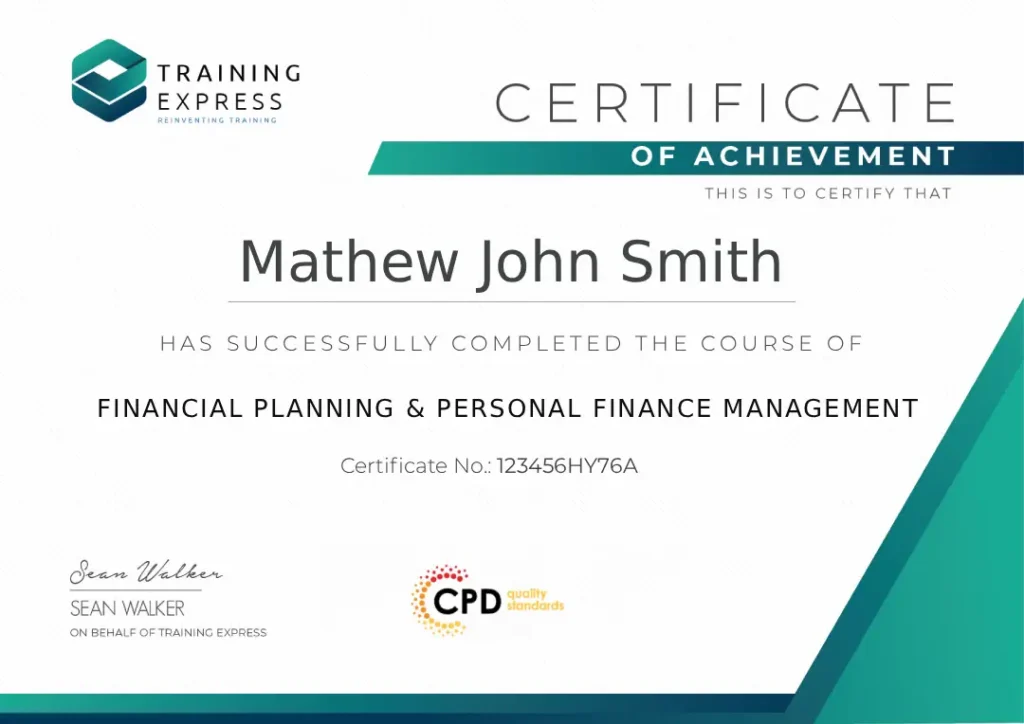
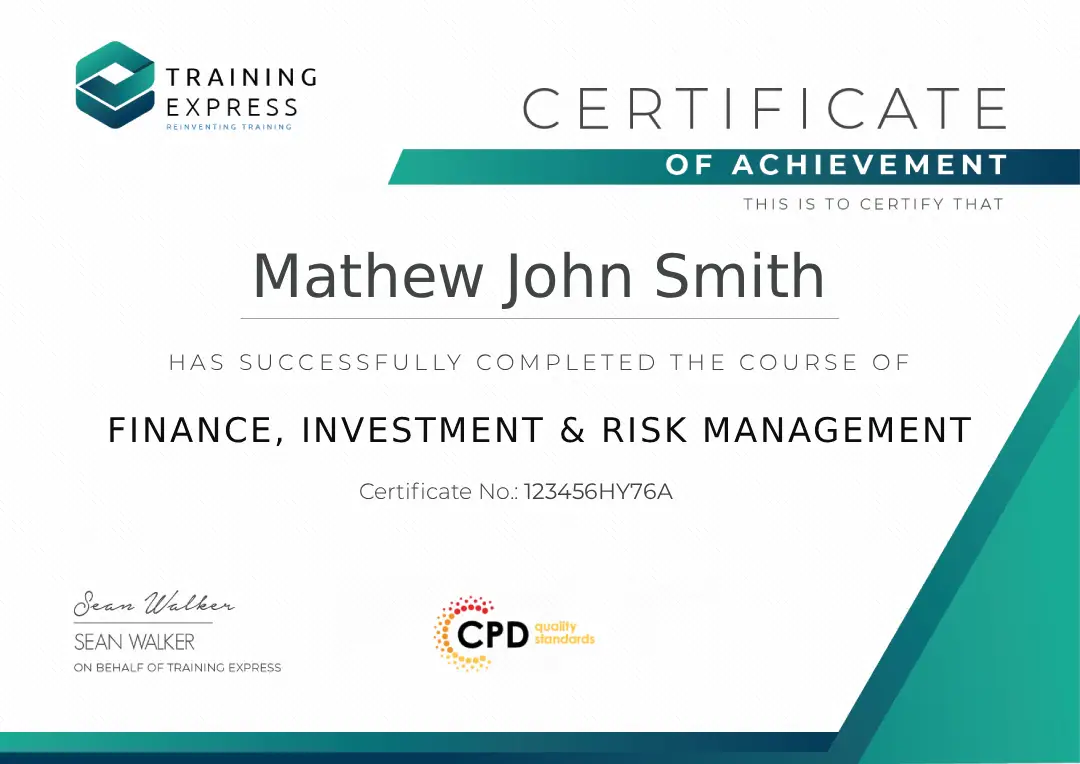
Certificates demonstrate completion of training and can support professional development records.

Financial Planning & Personal Finance Management Certification
Recommended renewal: 3 years.
Our certifications have no expiry dates, but we recommend renewing them to stay up to date with industry best practices.
Course Curriculum

The detailed curriculum outline of our Financial Planning & Personal Finance Management is as follows:

Explores the foundations of finance and the role financial systems play in businesses, markets, and personal financial decision-making.

Examines communication, analytical thinking, and advisory skills required when guiding clients through financial planning and investment choices.

Introduces structured financial planning methods used to manage income, assets, liabilities, and long-term financial goals.

Covers wealth management strategies and explains how to prepare personal financial statements to evaluate financial health.

Provides a basic overview of investments, financial markets, and how individuals and organisations allocate capital.

Examines various investment instruments and strategies used to diversify portfolios and balance risk and returns.

Explains essential investment principles such as risk tolerance, diversification, and long-term portfolio strategies.

Develops broader understanding of financial systems, institutions, and how financial markets operate globally.

Introduces bond investments, government and corporate bonds, and how fixed-income securities function in financial markets.

Explores stock market fundamentals, equity investments, market behaviour, and basic trading principles.

Focuses on building structured investment strategies aligned with financial goals and risk profiles.

Provides an overview of financial risk and the frameworks used by organisations to manage financial uncertainty.

Explains methods used to identify financial risks and evaluate their potential impact on financial performance.

Introduces tools and techniques used to measure financial risk and estimate potential financial exposure.

Examines strategies used to reduce risk exposure through diversification, financial controls, and policy frameworks.

Explores how financial institutions manage market volatility and credit exposure.

Discusses operational risks within organisations and the importance of maintaining liquidity stability.

Highlights the role of regulatory frameworks and reporting standards in financial risk governance.

Examines organisational culture, governance structures, and leadership responsibilities in risk management.

Explores how portfolio management techniques balance investment returns with financial risk considerations.

Provides frameworks for evaluating financial risk within organisations and investment portfolios.

Explains financial planning considerations during divorce, including asset division and financial restructuring.

Introduces financial management principles used by organisations to manage resources and financial performance.

Covers budgeting techniques used to plan, allocate, and monitor financial resources effectively.

Explains the structure and purpose of balance sheets and how they represent an organisation’s financial position.

Introduces income statements and explains how they measure profitability over a defined period.

Discusses the importance of cash flow management and how organisations track incoming and outgoing funds.

 Explores equity statements and how they illustrate ownership changes within a business.

Develops skills for analysing financial statements to assess organisational performance.

Explains how financial statements connect and provide a complete financial overview.

Examines financial management in a global context, including exchange rates, international markets, and financial regulations.

Course Reviews

Excellent

4.8 Average 128 Reviews

  Reviews

Kerry Clark
📍GB
Great learning experience, I have several courses with the company and all very interesting making it easy to learn on the go and at my own pace.

FAQs

What is the Finance, Investment & Risk Management course?

This course introduces financial planning, investment principles, financial reporting, and risk management strategies used in modern financial environments.

Do I need previous finance experience?

No prior knowledge is required. The course is suitable for beginners and learners interested in finance and investment.

How long does it take to complete the course?

Completion time depends on the learner’s pace. The course is fully self-paced and accessible for one year.

What certificate will I receive?

Learners receive a CPD-accredited certificate of completion available in digital format, with an optional printed version.

Can this course help with finance careers?

The course builds foundational knowledge in finance, investment, and risk management that can support entry-level roles in financial services and business finance.

Course Curriculum

Module 01: Introduction to Finance — Key financial principles and concepts
Module 01: Introduction to Finance — Key financial principles and concepts 00:23:00
Module 02: Essential Skills for Financial Advisor
Module 02: Essential Skills for Financial Advisor 00:34:00
Module 03: Financial Planning
Module 03: Financial Planning 00:37:00
Module 04: Wealth Management and Personal Financial Statements
Module 04: Wealth Management and Personal Financial Statements 00:18:00
Module 05: Introduction to Investment
Module 05: Introduction to Investment 00:14:00
Module 06: Types and Techniques of Investment
Module 06: Types and Techniques of Investment 00:20:00
Module 07: Key Concepts in Investment
Module 07: Key Concepts in Investment 00:17:00
Module 08: Understanding Finance
Module 08: Understanding Finance 00:14:00
Module 09: Investing in Bond Markets
Module 09: Investing in Bond Markets 00:14:00
Module 10: Investing in Stock Markets
Module 10: Investing in Stock Markets 00:17:00
Module 11: Investment Planning
Module 11: Investment Planning 00:25:00
Module 12: Introduction to Financial Risk Management
Module 12: Introduction to Financial Risk Management 00:16:00
Module 13: Risk Identification and Assessment
Module 13: Risk Identification and Assessment 00:17:00
Module 14: Risk Measurement and Quantification
Module 14: Risk Measurement and Quantification 00:15:00
Module 15: Risk Mitigation and Control
Module 15: Risk Mitigation and Control 00:18:00
Module 16: Market and Credit Risk Management
Module 16: Market and Credit Risk Management 00:16:00
Module 17: Operational and Liquidity Risk Management
Module 17: Operational and Liquidity Risk Management 00:19:00
Module 18: Regulatory Compliance and Risk Reporting
Module 18: Regulatory Compliance and Risk Reporting 00:19:00
Module 19: Risk Culture and Governance
Module 19: Risk Culture and Governance 00:16:00
Module 20: Risk and Portfolio Management
Module 20: Risk and Portfolio Management 00:16:00
Module 21: Financial Risk Management and Assessment
Module 21: Financial Risk Management and Assessment 00:31:00
Module 22: Divorce Planning
Module 22: Divorce Planning 00:26:00
Module 23: Introduction to Financial Management
Module 23: Introduction to Financial Management 00:10:00
Module 24: Fundamentals of Budgeting
Module 24: Fundamentals of Budgeting 00:18:00
Module 25: The Balance Sheet
Module 25: The Balance Sheet 00:15:00
Module 26: The Income Statement
Module 26: The Income Statement 00:12:00
Module 27: The Cash Flow Statement
Module 27: The Cash Flow Statement 00:14:00
Module 28: Statement of Stockholders’ Equity
Module 28: Statement of Stockholders’ Equity 00:12:00
Module 29: Analysing and Interpreting Financial Statements
Module 29: Analysing and Interpreting Financial Statements 00:50:00
Module 30: Inter-Relationship Between Financial Statements
Module 30: Inter-Relationship Between Financial Statements 00:16:00
Module 31: International Aspects of Financial Management
Module 31: International Aspects of Financial Management 00:28:00
Finance, Investment & Risk Management
ex Vat

SAVE 84% - OFFER ENDS SOON

TAKE THIS COURSE
£20 /Unit Price
Total:
£100.00
Quantity:

Buying more than one of the same courses?

  • 50% discount for orders of 10+ courses
  • 60% discount for orders of 50+ courses
  • 70% discount for orders of 100+ courses

Looking for a more personalised package?

contact us now

Instructors

358 STUDENTS ENROLLED