Food Hygiene
 Health & Safety
 Safeguarding
 First Aid
 Business Skills
 Personal Development

Course Curriculum
| Unit 1: Introduction to Electric Machines | |||
| Module 1- Introduction to Electric Machines | 00:03:00 | ||
| Module 2- Types of Electric Machines and Principle of Electrical Generation | 00:09:00 | ||
| Unit 2: DC Machines | |||
| Module 1- Importance and Construction of DC Machines | 00:26:00 | ||
| Module 2- Armature Winding and EMF Equation | 00:40:00 | ||
| Module 3-Solved Example 1 | 00:05:00 | ||
| Module 4-Solved Example 2 | 00:04:00 | ||
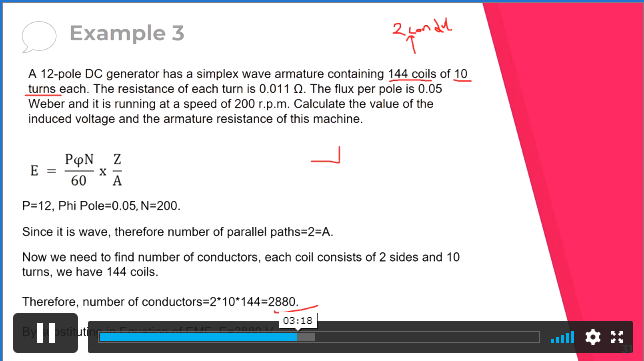
| Module 5-Solved Example 3 | 00:07:00 | ||
| Module 6-Solved Example 4 | 00:06:00 | ||
| Module 7-Separately Excited DC Machine | 00:21:00 | ||
| Module 8-Shunt and Series DC Machines | 00:25:00 | ||
| Module 9-Solved Example 1 on Separately Excited DC Machine | 00:07:00 | ||
| Module 10-Solved Example 2 on Separately Excited DC Machine | 00:07:00 | ||
| Module 11-Solved Example 3 on Shunt Generator | 00:04:00 | ||
| Module 12-Solved Example 4 on Shunt Generator | 00:07:00 | ||
| Module 13-Solved Example 5 on Series DC Generator | 00:06:00 | ||
| Module 14-Types and Applications of Compound DC Motors | 00:07:00 | ||
| Module 15- Torque-Speed Characteristics and Speed Control of Separately Excited DC Motor | 00:33:00 | ||
| Module 16- Torque-Speed Characteristics of Series DC Motor | 00:08:00 | ||
| Module 17-Solved Example 1 on Speed Control | 00:08:00 | ||
| Module 18-Solved Example 2 on Speed Control | 00:06:00 | ||
| Module 19- Starting of DC Machine | 00:14:00 | ||
| Module 20- Armature Reaction in DC Machines | 00:10:00 | ||
| Module 21-Losses in DC Machines | 00:04:00 | ||
| Unit 3: Construction of Transformers | |||
| Module 1- Introduction to Transformers | 00:02:00 | ||
| Module 2- Importance of Transformer | 00:04:00 | ||
| Module 3-Iron Core of Transformer | 00:04:00 | ||
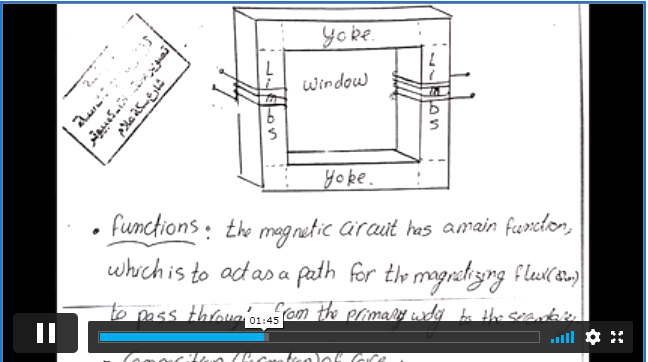
| Module 4- Magnetic Circuit Inside Transformer | 00:05:00 | ||
| Module 5- Windings of Transformer | 00:03:00 | ||
| Module 6- Why are Windings Made of Copper | 00:01:00 | ||
| Module 7- Classification of Windings | 00:05:00 | ||
| Module 8- Insulating Material and Transformer Oil | 00:02:00 | ||
| Module 9- Conservator of Transformer | 00:03:00 | ||
| Module 10- Breather of Transformer | 00:04:00 | ||
| Module 11- Bushings of Transformer | 00:04:00 | ||
| Module 12- Tap Changer of Transformer | 00:03:00 | ||
| Module 13- Cooling Tubes of Transformer | 00:01:00 | ||
| Module 14- Buchholz Relay of Transformer | 00:02:00 | ||
| Module 15- Explosion Vent | 00:02:00 | ||
| Module 16- Methods of Cooling | 00:03:00 | ||
| Module 17-Types of Transformers | 00:03:00 | ||
| Module 18- Power Transformer and Distribution Transformer | 00:05:00 | ||
| Module 19- Single Phase Core Type Transformer | 00:04:00 | ||
| Module 20-Single Phase Shell Type Transformer | 00:05:00 | ||
| Module 21- 3 Phase Core Type | 00:02:00 | ||
| Module 22- 3 Phase Shell Type | 00:01:00 | ||
| Module 23- Comparison between Shell and Core CSA | 00:01:00 | ||
| Module 24- Comparison between Shell and Core Type | 00:01:00 | ||
| Module 25- Notes | 00:03:00 | ||
| Module 26-Video Explaining The Components in 3D and Real Life | 00:05:00 | ||
| Unit 4: Fundamentals of Magnetic Circuits | |||
| Module 1- Introduction to Magnetic Circuits | 00:02:00 | ||
| Module 2- Induced Emf and Current | 00:04:00 | ||
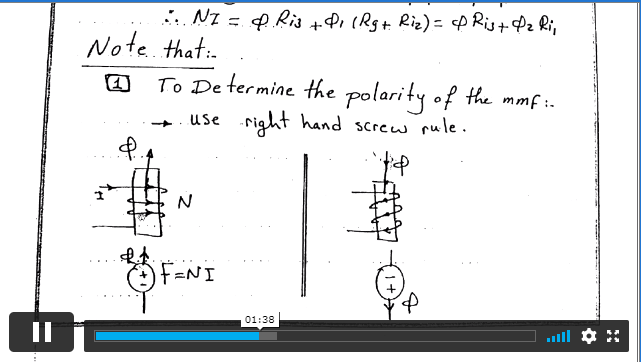
| Module 3- Ampere Right Hand Rule | 00:04:00 | ||
| Module 4- Magnetic Circuit and Important Definitions | 00:06:00 | ||
| Module 5- Linear and Non Linear Materials | 00:03:00 | ||
| Module 6-Flux Linkage and Reluctance | 00:04:00 | ||
| Module 7- Analogy between Electric and Magnetic Circuits | 00:06:00 | ||
| Module 8- Fringing Effect | 00:02:00 | ||
| Module 9- Example 1 Magnetic Circuits | 00:07:00 | ||
| Module 10- Example 2 | 00:03:00 | ||
| Module 11- Example 3 | 00:06:00 | ||
| Module 12- Application on Magnetic Circuit – Transformers | 00:04:00 | ||
| Unit 5: Theoretical Part on Transformers | |||
| Module 1- Introduction to Transformers | 00:02:00 | ||
| Module 2- Construction of Transformer | 00:02:00 | ||
| Module 3-Theory of Operation | 00:04:00 | ||
| Module 4- Ideal Transformer | 00:05:00 | ||
| Module 5-Non Ideal Transformer | 00:02:00 | ||
| Module 6- Effect of Loading on Transformer | 00:03:00 | ||
| Module 7- Transformer Regulation | 00:03:00 | ||
| Module 8- Transformer Losses | 00:03:00 | ||
| Module 9- Transformer Efficiency | 00:05:00 | ||
| Module 10- Transformer Rating | 00:02:00 | ||
| Module 11- Question 1 | 00:01:00 | ||
| Module 12- Question 2 | 00:02:00 | ||
| Module 13- Question 3 | 00:01:00 | ||
| Module 14- Example 1 | 00:01:00 | ||
| Module 15- Voltage Relation of Transformer | 00:04:00 | ||
| Module 16- Transformer Exact Equivalent Circuit | 00:06:00 | ||
| Module 17- Concept of Refereeing | 00:04:00 | ||
| Module 18- Approximate Equivalent Circuit | 00:02:00 | ||
| Unit 6: Synchronous Machines | |||
| Module 1- Construction and Principle of Operation of Synchronous Generator | 00:29:00 | ||
| Module 2- Principle of Operation of Synchronous Motor | 00:24:00 | ||
| Module 3- Equivalent Circuit and Phasor Diagram of Non Salient Synchronous Machine | 00:29:00 | ||
| Module 4-Solved Example 1 on Non Salient Machine | 00:05:00 | ||
| Module 5-Solved Example 2 on Non Salient Machine | 00:11:00 | ||
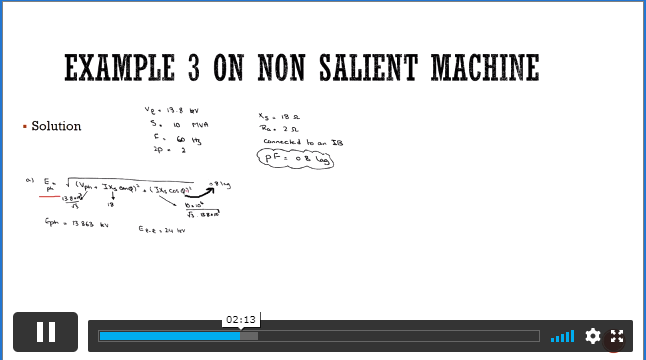
| Module 6-Solved Example 3 on Non Salient Machine | 00:07:00 | ||
| Module 7- Solved Example 4 on Non Salient Machine | 00:04:00 | ||
| Module 8-Solved Example 5 on Non Salient Machine | 00:07:00 | ||
| Module 9-Solved Example 6 on Non Salient Machine | 00:03:00 | ||
| Module 10- Equivalent Circuit and Phasor Diagram of Salient Synchronous Machine | 00:39:00 | ||
| Module 11-Solved Example 1 on Salient Machine | 00:09:00 | ||
| Module 12- Solved Example 2 on Salient Machine | 00:05:00 | ||
| Module 13-Solved Example 3 on Salient Machine | 00:10:00 | ||
| Module 14- Parallel Operation of Two Generators | 00:17:00 | ||
| Module 15- Synchronization of Machine with Grid | 00:10:00 | ||
| Unit 7: Induction Machines | |||
| Module 1- Construction and Theory of Operation of Induction Machines | 00:27:00 | ||
| Module 2- Equivalent Circuit and Power Flow in Induction Motor | 00:23:00 | ||
| Module 3- Torque-Speed Characteristics of Induction Motor | 00:20:00 | ||
| Module 4- Solved Example 1 on Induction Motor | 00:08:00 | ||
| Module 5-Solved Example 2 on Induction Motor | 00:06:00 | ||
| Module 6-Solved Example 3 on Induction Motor | 00:06:00 | ||
| Module 7-Solved Example 4 on Induction Motor | 00:18:00 | ||
| Module 8-Solved Example 5 on Induction Motor | 00:13:00 | ||
| Module 9- Methods of Speed Control of Induction Motor | 00:27:00 | ||
| Module 10- Methods of Starting of Induction Motor | 00:21:00 | ||
| Module 11-Solved Example on Motor Starter | 00:15:00 | ||
| Module 12- Principle of Operation of Doubly Fed Induction Generator | 00:11:00 | ||
| Module 13-Self Excited Induction Generator | 00:08:00 | ||
Course Ratings
No Ratings found for this course.
£25
ex Vat
TAKE THIS COURSE
SAVE 80% - OFFER ENDS SOON
Or
96% OFF
Take all courses for £49
- Original price was: £125.00.£25.00Current price is: £25.00. ex Vat
- 1 year
- Intermediate
- Course Certificate
- 14 hours, 20 minutes Gift this course
Buying more than one of the same courses?
- 50% discount for orders of 10+ courses
- 60% discount for orders of 50+ courses
- 70% discount for orders of 100+ courses
Looking for a more personalised package?
contact us nowInstructors

54 STUDENTS ENROLLED