CSR & ESG Fundamentals for UK Professionals (In Chinese)

0 (0 REVIEWS)
3 STUDENTS

GET THIS COURSE AND 2500+ OTHERS FOR ONLY £49 FIND OUT MORE

CSR and ESG are no longer optional considerations, they are essential components of responsible and successful organisations across the UK. Around 75% of UK consumers say they prefer to buy from companies that act responsibly and ethically. This course introduces the core principles of ethical leadership, sustainability, and corporate governance, helping learners understand how businesses can operate responsibly while maintaining performance and trust.

You will explore how organisations manage stakeholder relationships, implement sustainable practices, and ensure transparency in operations. From environmental strategies to diversity and inclusion, the course provides a well-rounded understanding of how CSR and ESG frameworks shape modern business practices.

After compelting the course, learners will gain insight into implementing CSR initiatives, measuring social impact, and integrating ESG considerations into decision-making processes. This knowledge is valuable for professionals aiming to contribute to ethical, sustainable, and forward-thinking organisations.

Last audited and updated on: 20th April 2026
“Effective early intervention, such as CPR or bleeding control, significantly increases survival chances in workplace emergencies.”

Resuscitation Council UK guidance , saving lives by developing guidelines.

Sneak Peek

Learning Outcomes

By completing this course, learners will be able to:

Who Should Take The Course?

CSR Strategy Training is ideal for Chinese-speaking professionals, managers, and leaders seeking practical CSR and ESG knowledge for international business settings. 

This course is suitable for:

This course offers a practical pathway into the growing world of ESG and responsible business leadership.

Why Take This Course?

CSR and ESG are now essential for organisations seeking long-term growth, investor confidence, regulatory compliance, and public trust. Across the UK, businesses increasingly need professionals who understand sustainability, ethical governance, responsible sourcing, and ESG reporting standards. 

This course introduces modern CSR and ESG principles while comparing UK expectations with Chinese sustainability approaches. Learners explore ethical leadership, stakeholder management, sustainable operations, and ESG investment strategies valued across multiple industries.

Unlike generic sustainability courses, this CPD-accredited programme is tailored for Chinese-speaking professionals in UK and international business settings, offering flexible online learning, tutor support, mobile access, and an instant free CPD certificate.

Job Opportunities & Salary Expectations (UK)

CSR and ESG knowledge supports careers in sustainability, governance, compliance, corporate affairs, responsible investment, and ethical supply chain management.

Salary expectations vary by experience, employer, industry, and UK location, while CSR and ESG training can strengthen long-term employability.

Entry Requirements

Accreditation

All of our courses, including this CSR & ESG Fundamentals for UK Professionals, are fully accredited, providing you with up-to-date skills and knowledge and helping you to become more competent and effective in your chosen field.

CPD Accredited

All our courses are CPD accredited, meeting recognised Continuing Professional Development (CPD) standards.

RoSPA Membership

RoSPA membership shows commitment to health and safety and helps organisations maintain strong safety standards and reduce workplace risks.

British Safety Council Member

A British Safety Council Member demonstrates commitment to high health, safety, and wellbeing standards and safer workplaces.

Certification

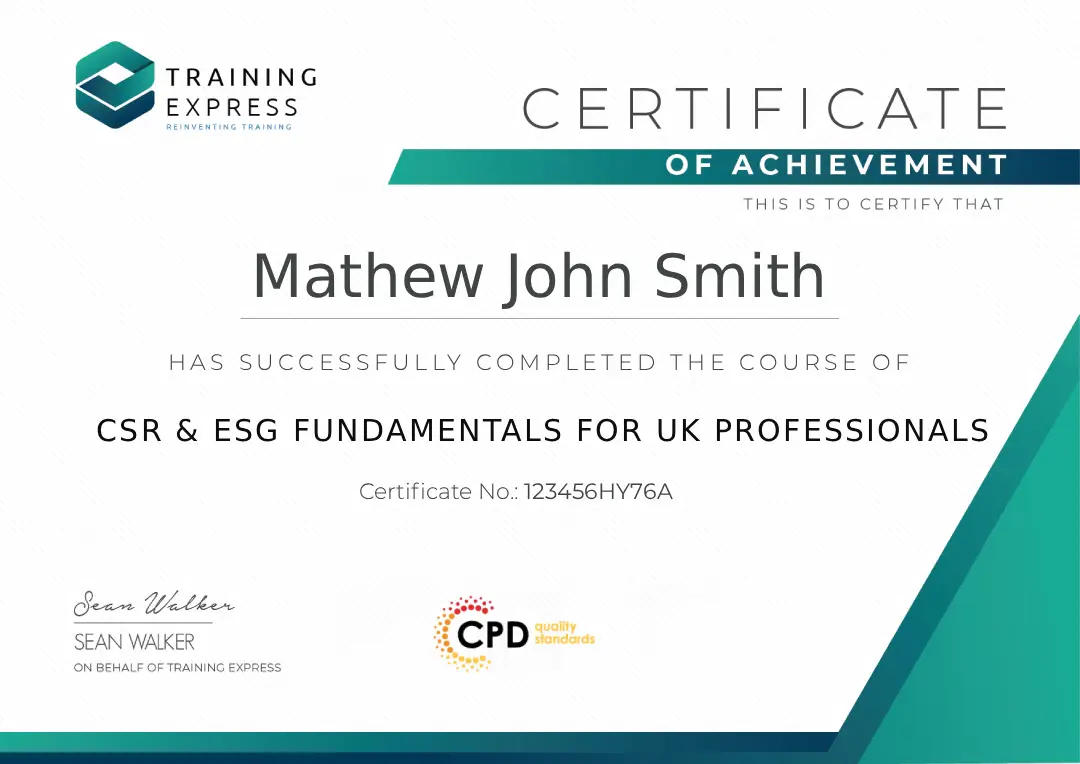
Once you’ve successfully completed your course, you will immediately be sent a digital certificate. Also, you can have your printed certificate delivered by post (shipping cost £5.99). All of our courses are fully accredited, providing you with up-to-date skills and knowledge and helping you to become more competent and effective in your chosen field.

Certification of CSR & ESG Fundamentals for UK Professionals (In Chinese)
Recommended renewal: 3 years.
Our certifications have no expiry dates, but we recommend renewing them to stay up to date with industry best practices.

Course Curriculum

The detailed curriculum outline of our CSR & ESG Fundamentals for UK Professionals Course is as follows:

  •  Unit 1: CSR 
  •  Unit 2: Importance of Ethical Leadership 
  •  Unit 3: Stakeholder Theory in CSR 
  •  Unit 4: Business Ethics and Values 
  •  Unit 5: Overview of CSR Strategies 
  •  Unit 6: Characteristics of Ethical Leaders 
  •  Unit 7: Ethical Decision-Making Processes 
  •  Unit 8: Role of Trust in Ethical Leadership 
  •  Unit 9: Leadership Integrity and Transparency 
  •  Unit 10: Case Studies on Ethical Leadership 
  •  Unit 11: Identifying Stakeholders in Organizations 
  •  Unit 12: Stakeholder Mapping and Analysis 
  •  Unit 13: Engaging with Internal Stakeholders 
  •  Unit 14: Community Engagement Initiatives 
  •  Unit 15: Effective Communication with Stakeholders 
  •  Unit 16: Environmental Sustainability in Business 
  •  Unit 17: Green Initiatives and Resource Management 
  •  Unit 18: Carbon Footprint Reduction Strategies 
  •  Unit 19: Sustainable Supply Chain Management 
  •  Unit 20: Best Practices in Sustainable Operations 
  •  Unit 21: Diversity and Inclusion in the Workplace 
  •  Unit 22: Creating a Culture of Equity 
  •  Unit 23: Promoting Gender Equality 
  •  Unit 24: Inclusive Hiring and Talent Development 
  •  Unit 25: Case Studies on Diverse Workplaces 
  •  Unit 26: Principles of Corporate Governance 
  •  Unit 27: Ethics in Decision-Making 
  •  Unit 28: Board Responsibility in Governance 
  •  Unit 29: Regulatory Compliance and Ethics 
  •  Unit 30: Corporate Integrity Standards 
  •  Unit 31: Understanding Supply Chain Responsibility 
  •  Unit 32: Supplier Accountability and Transparency 
  •  Unit 33: Fair Labor Practices in the Supply Chain 
  •  Unit 34: Addressing Human Rights Violations 
  •  Unit 35: Responsible Sourcing Strategies 
  •  Unit 36: Measuring CSR Performance 
  •  Unit 37: Social Impact Evaluation Metrics 
  •  Unit 38: Impact Assessment Tools 
  •  Unit 39: Reporting on Social Contributions 
  •  Unit 40: Case Studies on Impact Measurement 
  •  Unit 41: Strategic Philanthropic Giving 
  •  Unit 42: Community Engagement Initiatives 
  •  Unit 43: Corporate Giving Programs 
  •  Unit 44: Partnerships for Social Good 
  •  Unit 45: Success Stories in Corporate Philanthropy 
  •  Unit 46: Handling CSR Controversies 
  •  Unit 47: Reputation Management in Crisis 
  •  Unit 48: Crisis Communication Strategies 
  •  Unit 49: Rebuilding Trust post-Crisis 
  •  Unit 50: Lessons from CSR Crisis Situations 
  •  Unit 51: Benefits of Employee Volunteering 
  •  Unit 52: Creating Volunteer Opportunities 
  •  Unit 53: Engaging Employees in Social Causes 
  •  Unit 54: Skill-Based Volunteering 
  •  Unit 55: Employee Volunteerism Impact Studies 
  •  Unit 56: Circular Economy Concepts 
  •  Unit 57: Reducing Waste and Emissions 
  •  Unit 58: Sustainable Product Development 
  •  Unit 59: Green Certification Standards 
  •  Unit 60: Business Models for Sustainability 
  •  Unit 61: Respecting Human Rights in Business 
  •  Unit 62: Fair Labor Standards 
  •  Unit 63: Non-Discrimination Policies 
  •  Unit 64: Human Rights Due Diligence 
  •  Unit 65: Mitigating Business-Related Human Rights Risks 
  •  Unit 66: Transparency in Corporate Communication 
  •  Unit 67: Integrated Reporting Practices 
  •  Unit 68: Sustainability Reporting Frameworks 
  •  Unit 69: Auditing CSR Performance 
  •  Unit 70: Case Studies on Transparent Reporting 
  •  Unit 71: Ethical Advertising Practices 
  •  Unit 72: Consumer Rights Protection 
  •  Unit 73: Responsible Branding Strategies 
  •  Unit 74: Promoting Ethical Products 
  •  Unit 75: Marketing Campaigns with Social Impact 
  •  Unit 76: Integration of ESG Factors in Investments 
  •  Unit 77: Impact Investing Strategies 
  •  Unit 78: Benefits of Socially Responsible Investing 
  •  Unit 79: Ethical Investment Principles 
  •  Unit 80: Case Studies in Socially Responsible Investment 
  •  Unit 81: Cultural Considerations in CSR 
  •  Unit 82: International Sustainability Standards 
  •  Unit 83: CSR Across Borders 
  •  Unit 84: Humanitarian Aid and Global Impact 
  •  Unit 85: Challenges of Global CSR Initiatives 
  •  Unit 86: Emerging CSR Technologies 
  •  Unit 87: Innovations in Sustainable Practices 
  •  Unit 88: Evolution of CSR Reporting 
  •  Unit 89: Digital Transformation and CSR 
  •  Unit 90: Predictions for the Future of CSR 
  •  Unit 91: Applying CSR in SMEs 
  •  Unit 92: Challenges and Opportunities 
  •  Unit 93: Benefits of CSR for Small Businesses 
  •  Unit 94: CSR Implementation Strategies 
  •  Unit 95: Success Stories from SMEs 
  •  Unit 96: Role of Leaders in CSR 
  •  Unit 97: Creating a Sustainable Vision 
  •  Unit 98: Driving Organizational Change 
  •  Unit 99: Sustainability Leadership Models 
  •  Unit 100: Final Reflections on CSR Leadership 

Frequently Asked Questions (FAQs)

What does CSR stand for in business?

CSR stands for Corporate Social Responsibility. It refers to how businesses manage their impact on society, employees, communities, supply chains, and the environment while operating ethically, sustainably, transparently, and commercially responsibly within modern business expectations.

What is ESG, and examples of ESG practices?

ESG stands for Environmental, Social, and Governance. Examples include reducing emissions, improving workplace diversity, protecting human rights, managing supply chain ethics, strengthening board accountability, improving transparency, and supporting sustainable investment decisions.

Is this CSR and ESG course suitable for beginners?

Yes, this CSR and ESG course is beginner-friendly and designed for learners with little or no prior experience in sustainability, corporate responsibility, ESG reporting, ethical leadership, stakeholder engagement, governance standards, or responsible business strategy.

Is the course recognised in the UK?

Yes, the course is CPD-accredited and developed to support UK professional development standards, making it valuable for learners who want recognised knowledge in CSR, ESG, sustainability, and ethical business practices.

Can I study this course online?

Yes, this CSR and ESG course is fully online, self-paced, and mobile-friendly, with lifetime access included. Learners can study flexibly from anywhere, revisit lessons when needed, and fit professional development around work, business, education, or personal commitments.

Who should take a CSR and ESG course?

This course is ideal for professionals in sustainability, governance, finance, compliance, HR, procurement, consulting, operations, corporate affairs, supply chain management, or UK-China business relations seeking practical, responsible business knowledge.

Why is ESG important for businesses?

ESG helps businesses manage risk, improve transparency, attract responsible investors, strengthen reputation, meet stakeholder expectations, support sustainability goals, and make better long-term decisions across environmental, social, and governance performance areas.

What are some examples of corporate social responsibility?

Corporate social responsibility examples include environmental initiatives, employee volunteering, ethical sourcing, charitable giving, diversity and inclusion policies, community engagement, responsible supply chains, fair labour practices, and reducing environmental impact through sustainable operations.

Will I receive a certificate after completing the course?

Yes, learners receive an instant free CPD-accredited certificate after successfully completing the course. This certificate can help demonstrate professional development in CSR, ESG awareness, sustainability, and responsible business practices.

How long does the course take to complete?

The course takes approximately 4 hours and 6 minutes to complete. Learners can study at their own pace, revisit lessons whenever needed, and access all course materials permanently through lifetime access for flexible professional development.

Course Curriculum

CSR & ESG Fundamentals for UK Professionals
Unit 1: CSR 00:03:00
Unit 2: Importance of Ethical Leadership 00:03:00
Unit 3: Stakeholder Theory in CSR 00:02:00
Unit 4: Business Ethics and Values 00:03:00
Unit 5: Overview of CSR Strategies 00:03:00
Unit 6: Characteristics of Ethical Leaders 00:02:00
Unit 7: Ethical Decision-Making Processes 00:02:00
Unit 8: Role of Trust in Ethical Leadership 00:03:00
Unit 9: Leadership Integrity and Transparency 00:02:00
Unit 10: Case Studies on Ethical Leadership 00:03:00
Unit 11: Identifying Stakeholders in Organizations 00:02:00
Unit 12: Stakeholder Mapping and Analysis 00:02:00
Unit 13: Engaging with Internal Stakeholders 00:03:00
Unit 14: Community Engagement Initiatives 00:02:00
Unit 15: Effective Communication with Stakeholders 00:03:00
Unit 16: Environmental Sustainability in Business 00:03:00
Unit 17: Green Initiatives and Resource Management 00:03:00
Unit 18: Carbon Footprint Reduction Strategies 00:02:00
Unit 19: Sustainable Supply Chain Management 00:03:00
Unit 20: Best Practices in Sustainable Operations 00:02:00
Unit 21: Diversity and Inclusion in the Workplace 00:03:00
Unit 22: Creating a Culture of Equity 00:03:00
Unit 23: Promoting Gender Equality 00:02:00
Unit 24: Inclusive Hiring and Talent Development 00:02:00
Unit 25: Case Studies on Diverse Workplaces 00:03:00
Unit 26: Principles of Corporate Governance 00:03:00
Unit 27: Ethics in Decision-Making 00:02:00
Unit 28: Board Responsibility in Governance 00:02:00
Unit 29: Regulatory Compliance and Ethics 00:02:00
Unit 30: Corporate Integrity Standards 00:03:00
Unit 31: Understanding Supply Chain Responsibility 00:03:00
Unit 32: Supplier Accountability and Transparency 00:03:00
Unit 33: Fair Labor Practices in the Supply Chain 00:02:00
Unit 34: Addressing Human Rights Violations 00:02:00
Unit 35: Responsible Sourcing Strategies 00:03:00
Unit 36: Measuring CSR Performance 00:03:00
Unit 37: Social Impact Evaluation Metrics 00:02:00
Unit 38: Impact Assessment Tools 00:03:00
Unit 39: Reporting on Social Contributions 00:02:00
Unit 40: Case Studies on Impact Measurement 00:03:00
Unit 41: Strategic Philanthropic Giving 00:03:00
Unit 42: Community Engagement Initiatives 00:02:00
Unit 43: Corporate Giving Programs 00:02:00
Unit 44: Partnerships for Social Good 00:02:00
Unit 45: Success Stories in Corporate Philanthropy 00:02:00
Unit 46: Handling CSR Controversies 00:03:00
Unit 47: Reputation Management in Crisis 00:02:00
Unit 48: Crisis Communication Strategies 00:02:00
Unit 49: Rebuilding Trust post-Crisis 00:03:00
Unit 50: Lessons from CSR Crisis Situations 00:02:00
Unit 51: Benefits of Employee Volunteering 00:02:00
Unit 52: Creating Volunteer Opportunities 00:02:00
Unit 53: Engaging Employees in Social Causes 00:02:00
Unit 54: Skill-Based Volunteering 00:02:00
Unit 55: Employee Volunteerism Impact Studies 00:02:00
Unit 56: Circular Economy Concepts 00:02:00
Unit 57: Reducing Waste and Emissions 00:02:00
Unit 58: Sustainable Product Development 00:02:00
Unit 59: Green Certification Standards 00:02:00
Unit 60: Business Models for Sustainability 00:03:00
Unit 61: Respecting Human Rights in Business 00:02:00
Unit 62: Fair Labor Standards 00:02:00
Unit 63: Non-Discrimination Policies 00:03:00
Unit 64: Human Rights Due Diligence 00:02:00
Unit 65: Mitigating Business-Related Human Rights Risks 00:03:00
Unit 66: Transparency in Corporate Communication 00:03:00
Unit 67: Integrated Reporting Practices 00:03:00
Unit 68: Sustainability Reporting Frameworks 00:03:00
Unit 69: Auditing CSR Performance 00:03:00
Unit 70: Case Studies on Transparent Reporting 00:02:00
Unit 71: Ethical Advertising Practices 00:02:00
Unit 72: Consumer Rights Protection 00:03:00
Unit 73: Responsible Branding Strategies 00:02:00
Unit 74: Promoting Ethical Products 00:02:00
Unit 75: Marketing Campaigns with Social Impact 00:03:00
Unit 76: Integration of ESG Factors in Investments 00:02:00
Unit 77: Impact Investing Strategies 00:02:00
Unit 78: Benefits of Socially Responsible Investing 00:02:00
Unit 79: Ethical Investment Principles 00:03:00
Unit 80: Case Studies in Socially Responsible Investment 00:02:00
Unit 81: Cultural Considerations in CSR 00:03:00
Unit 82: International Sustainability Standards 00:03:00
Unit 83: CSR Across Borders 00:03:00
Unit 84: Humanitarian Aid and Global Impact 00:02:00
Unit 85: Challenges of Global CSR Initiatives 00:03:00
Unit 86: Emerging CSR Technologies 00:03:00
Unit 87: Innovations in Sustainable Practices 00:02:00
Unit 88: Evolution of CSR Reporting 00:03:00
Unit 89: Digital Transformation and CSR 00:03:00
Unit 90: Predictions for the Future of CSR 00:02:00
Unit 91: Applying CSR in SMEs 00:02:00
Unit 92: Challenges and Opportunities 00:03:00
Unit 93: Benefits of CSR for Small Businesses 00:03:00
Unit 94: CSR Implementation Strategies 00:03:00
Unit 95: Success Stories from SMEs 00:03:00
Unit 96: Role of Leaders in CSR 00:02:00
Unit 97: Creating a Sustainable Vision 00:02:00
Unit 98: Driving Organizational Change 00:02:00
Unit 99: Sustainability Leadership Models 00:02:00
Unit 100: Final Reflections on CSR Leadership 00:02:00
CSR & ESG Fundamentals for UK Professionals (In Chinese)
ex Vat

SAVE 84% - OFFER ENDS SOON

TAKE THIS COURSE

OR

🔥 83 units sold in last 24 hours
  • Original price was: £125.00.Current price is: £20.00. ex Vat
  • 1 year
  • Course Certificate
  • 4 hours, 6 minutes
  • Gift this course
£20 /Unit Price
Total:
£100.00
Quantity:

Buying more than one of the same courses?

  • 50% discount for orders of 10+ courses
  • 60% discount for orders of 50+ courses
  • 70% discount for orders of 100+ courses

Looking for a more personalised package?

contact us now

Instructors

3 STUDENTS ENROLLED