Food Hygiene
 Health & Safety
 Safeguarding
 First Aid
 Business Skills
 Personal Development

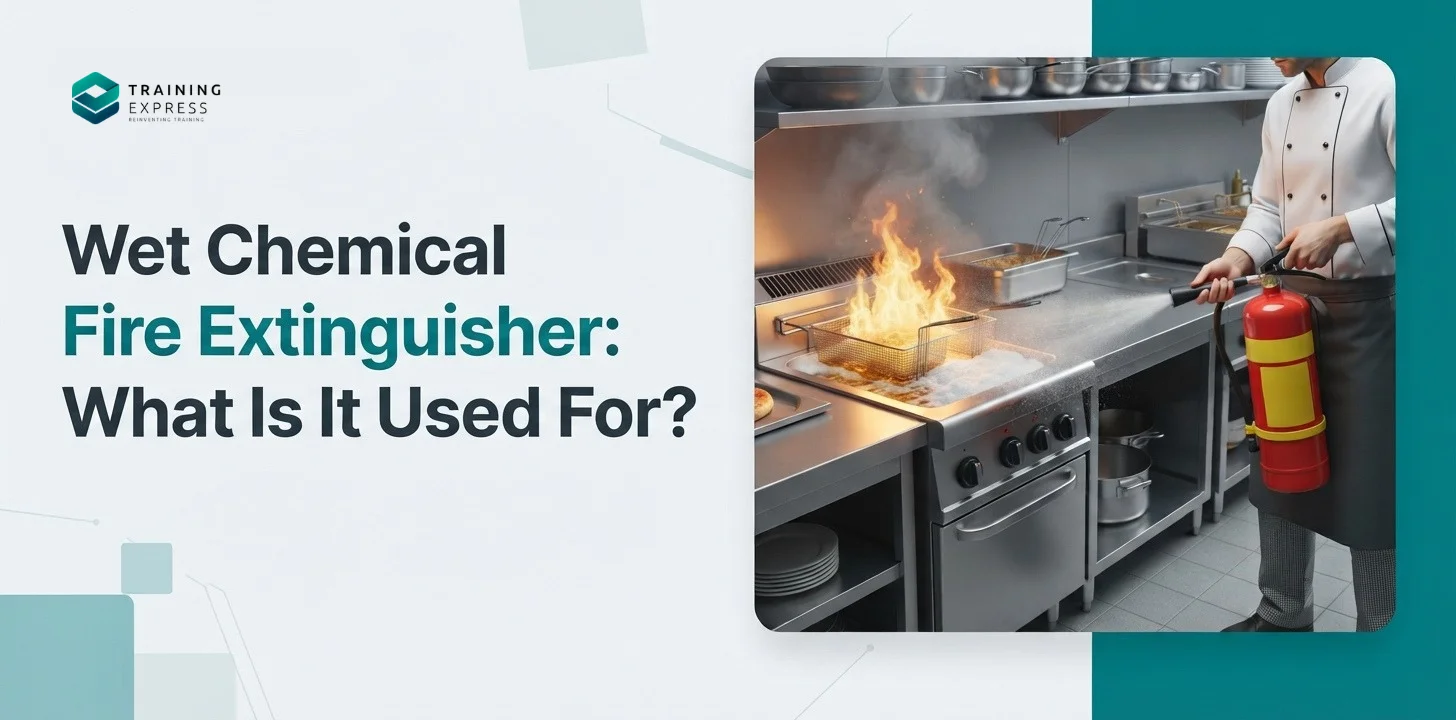

A wet chemical fire extinguisher is designed to put out Class F fires, which involve cooking oils and fats in deep fat fryers and pans. It sprays a fine mist that cools the burning oil and forms a soapy layer on top, cutting off the oxygen. It’s red with a canary yellow band or panel.
A wet chemical fire extinguisher is made for one of the most dangerous fires in any kitchen: burning cooking oil. If you have a deep fat fryer or pans of hot fat, it’s the extinguisher your fire risk assessment is most likely to call for.
Table of Contents
What Is a Wet Chemical Fire Extinguisher?
A wet chemical fire extinguisher is a portable extinguisher filled with a special liquid, usually a potassium-based solution, that’s designed to tackle fires in cooking oils and fats. It has a long hose with a lance on the end, so you can stand back from the fire.
The lance lets you apply the agent gently from above, rather than blasting the oil around the kitchen.
What Is a Wet Chemical Fire Extinguisher Used For?
A wet chemical fire extinguisher is used on Class F fires, which are fires in cooking oils and fats. Most models are also rated for Class A fires (solid materials such as paper, wood and fabric).
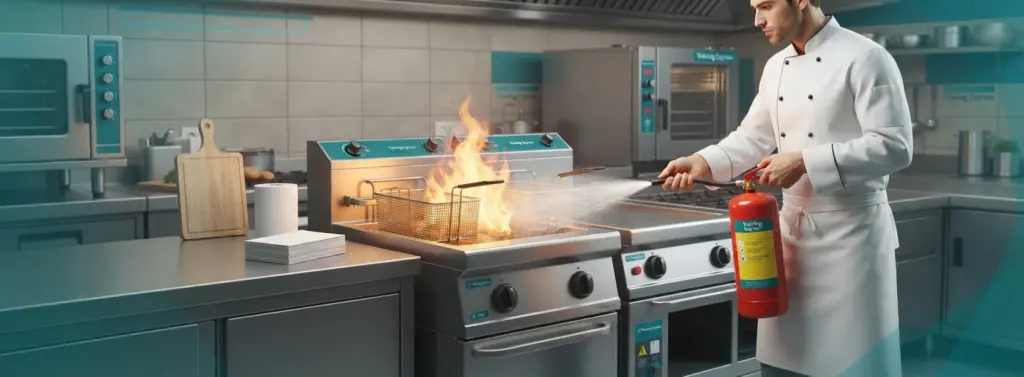
Class F Fires Explained
The NBS describes Class F fires as “fires involving combustible cooking media such as fats, oil or grease”, for example olive oil, maize oil, lard or butter. They behave differently from other liquid fires.
The Fire Industry Association explains that cooking oils and fats usually catch fire on their own at over 340°C, which is much hotter than most flammable liquids. That’s why ordinary extinguishers for flammable liquids (Class B) don’t work on them.
Can It Be Used on Class A Fires?
Yes, in most cases. The NBS lists wet chemical extinguishers as suitable for Class A and Class F fires. Always check the label on your own extinguisher, because it shows exactly which fire classes it’s rated for.
Where You Need One
You’ll find them wherever food is fried at work: restaurants, takeaways, school and care home kitchens, canteens and food vans. Your fire risk assessment decides if you need one and where it goes.
When Not to Use a Wet Chemical Extinguisher
Don’t use a wet chemical extinguisher on fires it isn’t rated for. That means no flammable liquids such as petrol or solvents (Class B), no flammable gases (Class C), no burning metals (Class D) and no electrical fires.
For an electrical fire, switch off the power if it’s safe and use an extinguisher rated for electrical fires, such as CO2. If you’re unsure what’s burning, don’t tackle it. Get out and call 999.
What Colour Is a Wet Chemical Fire Extinguisher?
A wet chemical fire extinguisher has a red body with a canary yellow band or panel. The NBS says modern extinguishers must conform to BS EN 3 and are mainly red, with a coloured band covering about 5% of the body to show the type.
The London Fire Brigade gives the colour for wet chemical as canary yellow.
| Extinguisher type | Colour band | Main use in a kitchen |
|---|---|---|
| Wet chemical | Canary yellow | Cooking oil and fat fires (Class F) |
| Water | Red (no band) | Paper, wood and fabric (Class A), never oil or electrics |
| Foam | Cream | Class A and flammable liquids, not cooking oil |
| CO2 | Black | Electrical equipment, not cooking oil |
| Dry powder | Blue | Mixed risks outside the kitchen, not cooking oil |
For a full run-down of every type, read our guide to the types of fire extinguishers.
How Does a Wet Chemical Extinguisher Work?
A wet chemical extinguisher works in two ways: it cools the burning oil, and it reacts with the oil to form a thick, soapy layer on top. That layer seals the surface, cuts off the oxygen and helps stop the oil reigniting.
The reaction is called saponification, which simply means “turning into soap”. Because the agent comes out as a fine spray, it settles on the surface instead of splashing the oil.
How to Use a Wet Chemical Fire Extinguisher: Step by Step
Only use a wet chemical extinguisher if you’ve been trained, the fire is small, and you have a clear way out behind you. If the fire is spreading, or you’re not sure, get everyone out, close the door and call 999.
- Raise the alarm so everyone knows there’s a fire.
- Turn off the heat or the fryer, but only if you can do it safely. Never lean over the fire.
- Pull out the safety pin and hold the lance.
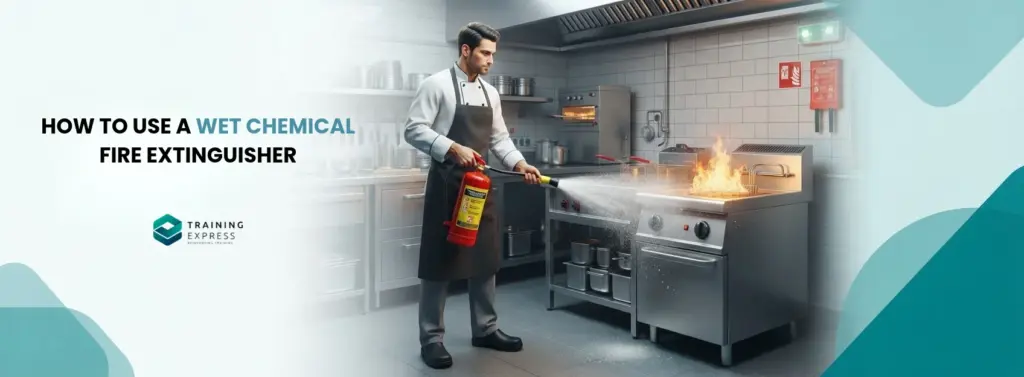
- Hold the extinguisher at arm’s length, with the lance well above the fire and the nozzle at least a metre away.
- Squeeze the handle and apply the agent gently in slow circles, so it settles on the surface.
- Keep going until the extinguisher is empty, to stop the oil reigniting.
- Don’t move the pan or fryer. Leave it to cool completely.
- If the fire doesn’t go out, leave straight away, close the door and call 999.
Steps 4 and 5 follow the NBS guidance on wet chemical extinguishers. For the general technique, see our guides on how to use a fire extinguisher and what PASS stands for.
Why You Must Never Use Water, Foam, CO2 or Powder on an Oil Fire
Water, foam, CO2 and powder can all spread a cooking oil fire instead of putting it out. The NBS warns that “water, powder, foam and CO2 all carry the risk of spreading the burning oil into the room”.
Water is the worst. It sinks below the hot oil, turns to steam in an instant and throws burning oil up and out of the pan. The London Fire Brigade warns that throwing water on a pan fire “could create a fireball”.
Which Fire Extinguisher Is Best for a Kitchen?
For a commercial kitchen with fryers or pans of oil, a wet chemical extinguisher is usually the best choice, alongside a fire blanket. The right mix for your kitchen depends on your fire risk assessment, because other areas may need a different type.
| Fire in the kitchen | Right choice | Never use |
|---|---|---|
| Fryer or pan of oil | Wet chemical extinguisher or fire blanket (trained staff, small fire only) | Water, foam, CO2, powder |
| Electrical equipment | Switch off the power, then a CO2 extinguisher | Water or wet chemical |
| Paper, packaging or cloths | Water or wet chemical (if rated Class A) | Anything not rated Class A |
At home, it’s different. Fire services advise people not to tackle a pan fire themselves, and Devon and Somerset Fire and Rescue Service says never to use water or an extinguisher on one. Turn off the heat if safe, get out, close the door and call 999. Our guide to putting out a chip pan fire covers home and workplace steps in full.
Wet Chemical Extinguisher Sizes and How Many You Need
Wet chemical extinguishers commonly come in 2, 3 and 6 litre sizes. How many you need and what size isn’t set by a fixed rule. Your fire risk assessment decides.
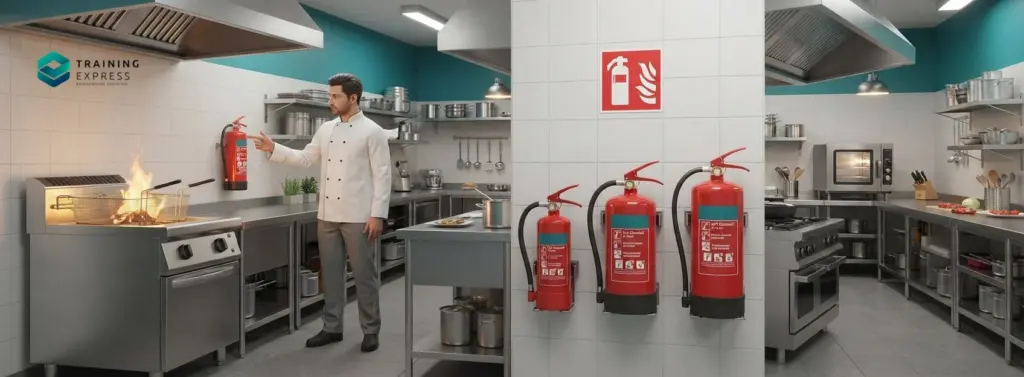
A competent assessor looks at your fryers, the amount of oil and your layout. Mount the extinguisher near the cooking line, where staff can grab it without reaching across the fire.
Do You Legally Need a Wet Chemical Extinguisher?
The law doesn’t name a specific type of extinguisher. But in England and Wales, the Regulatory Reform (Fire Safety) Order 2005 says the “responsible person” (usually the employer, owner or whoever controls the premises) must carry out a fire risk assessment, review it regularly, put suitable fire safety measures in place and train staff.
In practice, if your kitchen cooks with oil, your fire risk assessment will almost always call for suitable equipment for Class F fires. In England, since 1 October 2023, the responsible person must also record the full fire risk assessment, not just its main findings. Scotland and Northern Ireland have their own fire safety laws, so check with your local fire and rescue service if you’re based there.
Servicing and Checks
Check your wet chemical extinguisher monthly and have it serviced every year. The NBS says extinguishers in commercial settings should be inspected each month for damage, and serviced annually in line with British Standard BS 5306-3 by a BAFE-registered company.
For the monthly check, we suggest making sure it’s on its bracket and easy to reach, the pin and tamper seal are in place, the gauge (if fitted) is in the green, and there’s no damage or leaks.
If an extinguisher has been used, even for a second, it must be recharged according to the manufacturer’s guidance before it goes back on the wall. Servicing is a job for a competent engineer, not something to do yourself.
Wet Chemical Extinguisher vs Fire Blanket vs Kitchen Suppression System
A wet chemical extinguisher, a fire blanket and a fixed suppression system all tackle cooking oil fires, but they do different jobs. Many commercial kitchens have all three.
| Equipment | Best for | Points to know |
|---|---|---|
| Fire blanket | A very small fire in a single pan | Quick to use; must stay in place while the pan cools |
| Wet chemical extinguisher | Small fires in fryers and larger pans | Needs training; must be recharged after any use |
| Fixed suppression system | Fires in fryers, ranges and the extraction canopy | Fitted in the canopy and can work automatically; your fire risk assessment says if you need one |
Good habits prevent most oil fires in the first place. See hazard 3 in our guide to kitchen hazards, and the fire rules in our kitchen safety rules.
Knowing which extinguisher to grab, and when to walk away, needs practice before a fire. Our fire extinguisher training course covers this.
Be Ready Before a Fire Starts
A wet chemical extinguisher only helps if your team knows when to use it and when to get out. Our fire extinguisher training and basic fire safety awareness courses give kitchen staff that confidence, with a certificate on completion. Managers can record fire alongside other hazards using our kitchen risk assessment template.
Frequently Asked Questions (FAQs)
What is a wet chemical fire extinguisher used for?
A wet chemical fire extinguisher is used on Class F fires, which involve cooking oils and fats, such as fires in deep fat fryers and pans. Most models are also rated for Class A fires involving paper, wood and fabric. It should only be used by trained staff on small fires, with a clear way out. If the fire is spreading, leave and call 999.
What colour is a wet chemical fire extinguisher?
A wet chemical fire extinguisher is red with a canary yellow band or panel. Under BS EN 3, extinguishers are mainly red, with a coloured band covering about 5% of the body to show the type. Always read the label too, because it confirms which fire classes the extinguisher is rated for and how to use it.
What is a Class F fire extinguisher?
A Class F fire extinguisher is any extinguisher rated for fires involving cooking oils and fats. Wet chemical extinguishers are the most common type in UK kitchens. The NBS also lists dry water mist extinguishers and fire blankets as suitable for Class F fires. Water, foam, CO2 and powder are not, because they can spread burning oil.
Can you use a wet chemical extinguisher on electrical fires?
No. Wet chemical extinguishers aren’t designed for electrical fires. If electrical equipment is on fire, switch off the power if you can do it safely and use an extinguisher rated for electrical fires, such as CO2. If the fire is spreading, or you’re unsure what’s burning, get everyone out and call 999.
What is the difference between wet chemical and dry powder extinguishers?
A wet chemical extinguisher is made for cooking oil and fat fires. It cools the oil and forms a soapy layer that stops it reigniting. A dry powder extinguisher covers several other fire classes but isn’t suitable for cooking oil, because the NBS warns powder can spread burning oil.
What type of fire extinguisher is best for a kitchen?
For a commercial kitchen with fryers or pans of oil, a wet chemical extinguisher plus a fire blanket is usually the best set-up, but your fire risk assessment decides. At home, fire services advise against tackling pan fires yourself. If a pan catches fire at home, turn off the heat if safe, get out, close the door and call 999.
How often should a wet chemical extinguisher be serviced?
The NBS says extinguishers in commercial or public settings should be inspected for damage every month and serviced every year in line with BS 5306-3, by a BAFE-registered company. Any extinguisher that has been used, even partly, must be recharged according to the manufacturer’s guidance before it goes back into service.

Robert Lawrence
Author | Specialises in E-Learning.
Robert Lawrence is an author at Training Express, with over 5 years of experience creating practical resources and strategies to support learners and enhance their professional & personal development.
Other Blogs