Food Hygiene
 Health & Safety
 Safeguarding
 First Aid
 Business Skills
 Personal Development



Legislation shapes almost every aspect of health and social care, from protecting patient information to ensuring people receive safe and respectful treatment. But what does it actually mean for someone working in a hospital, care home or community setting?
Legislation in health and social care refers to laws that establish legal rights, responsibilities and standards for delivering and managing care. These laws help protect patients and service users, promote their wellbeing and ensure care organisations operate within the law.
Understanding legislation is important whether you’re studying health and social care, starting your first care role or developing your professional knowledge. Knowing how the law relates to everyday responsibilities can help you make informed decisions and recognise when concerns need to be raised.
What Does Legislation Mean in Health and Social Care?
Legislation is the body of laws made through an authorised law-making process. In health and social care, these laws govern matters such as safety, safeguarding, equality, confidentiality and the responsibilities of care providers.
For example, an organisation cannot simply decide to ignore applicable safety requirements because its internal procedures are different. Its policies and working practices must comply with relevant legal obligations.
What Is Legislation in Simple Terms?
Think of legislation as the legal foundation for how care services must operate.
It establishes requirements that protect individuals and help ensure organisations are accountable for their actions. Unlike optional recommendations, applicable legal requirements must be followed.
However, not every rule used in a care setting is legislation. Professional codes, workplace policies and guidance may have different legal statuses.
What Are Primary and Secondary Legislation?
UK law distinguishes between two important types of legislation.
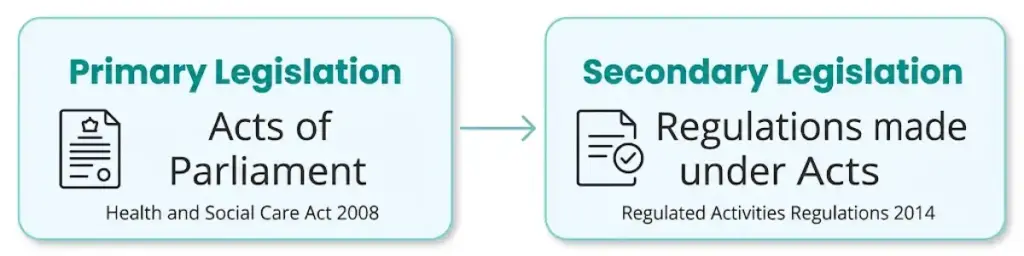
- Primary legislation: Acts passed by the UK Parliament or a devolved legislature, such as the Health and Social Care Act 2008.
- Secondary legislation: Laws made under powers granted by primary legislation, often through statutory instruments.
For example, the Health and Social Care Act 2008 provides the legislative foundation for important elements of England’s care regulation, while the Health and Social Care Act 2008 (Regulated Activities) Regulations 2014 set out specific requirements for regulated activities.
The UK Parliament’s explanation of primary and secondary legislation provides further detail on this distinction.
Why Is Legislation Important in Health and Social Care?
Legislation matters because people receiving care may depend on others for their safety, wellbeing and everyday needs. Laws establish protections and responsibilities that help prevent unsafe or unfair treatment.
Protecting People’s Safety, Dignity and Rights
Health and social care legislation supports the protection of individuals’ rights, including their privacy, equality and personal dignity.
Consider an older person receiving assistance with washing and dressing. Staff should respect their privacy, explain what they are doing and involve the person in decisions wherever possible.
Legislation helps protect people’s dignity, privacy and independence, but the physical environment also affects how these rights are respected. For example, a lack of private spaces or unsuitable facilities can undermine dignity during personal care. Understanding how care environments can promote and undermine people’s dignity and rights is therefore an important part of delivering respectful support.
Supporting Safe and Accountable Care Services
Legislation helps establish expectations for care organisations, including requirements relating to safe treatment, safeguarding and appropriate staffing.
In England, the Care Act 2014 also places important responsibilities on local authorities concerning adult care and support. Its wellbeing principle is explained in the government’s Care and Support Statutory Guidance.
Such legal frameworks help clarify who is responsible for particular decisions and services.
Establishing Responsibilities for Care Professionals
Legislation also influences how staff recognise risks, respond to concerns and carry out their responsibilities.
For instance, workers should understand when a situation needs to be reported and which workplace procedures apply.
Legal responsibilities also connect closely with the duty of care in health and social care, which involves taking reasonable care to avoid causing foreseeable harm. This helps workers understand why recognising risks and reporting concerns are important parts of everyday practice.
How Is Legislation Different From Regulations, Policies and Procedures?
Although these terms are closely related, they do not mean the same thing.
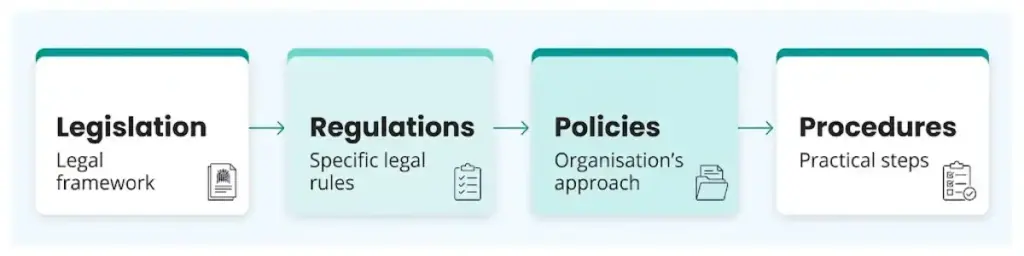
Legislation provides legal rules. Regulations are often legally binding requirements made under an Act. Policies and procedures explain how an organisation approaches its responsibilities and carries out particular activities.
Swipe left to see the full table →
| Term | Meaning | Health and social care example |
|---|---|---|
| Legislation | Laws establishing legal rights and duties | Health and Social Care Act 2008 |
| Regulations | Legally binding requirements, often made under an Act | Regulated Activities Regulations 2014 |
| Statutory guidance | Guidance issued under statutory authority, with legal significance depending on the governing law | Care and support statutory guidance |
| Policy | An organisation's approach to an issue | Confidentiality policy |
| Procedure | Steps for completing an activity | Reporting a safeguarding concern |
How Policies and Procedures Put Legislation Into Practice
Imagine a care organisation needs to protect sensitive information.
Relevant data protection law establishes legal obligations. The organisation’s confidentiality policy explains its approach, while its procedures tell workers how to store, access and share information appropriately.
Legislation sets legal requirements, while workplace policies and procedures explain how organisations put relevant obligations into practice. Understanding the difference between policy and procedure in health and social care helps staff distinguish organisational expectations from the specific steps they must follow.
What Are Examples of Legislation in Health and Social Care?
Several important Acts and regulations influence care in the UK. Their application depends on the setting, activity and relevant jurisdiction.
The following examples illustrate how legislation can protect people and establish responsibilities.
Laws Protecting Care Standards and Wellbeing
Health and Social Care Act 2008: This Act underpins the regulation of health and adult social care services in England. Associated regulations establish requirements for registered providers, including aspects of safe care and treatment.
Care Act 2014: This Act provides a central framework for adult care and support in England, including local authority responsibilities for wellbeing, assessment and safeguarding.
These laws affect different organisations and responsibilities; they do not impose identical duties on every individual care worker.
Laws Supporting Equality, Consent and Privacy
Equality Act 2010: Provides protection against unlawful discrimination in specified circumstances, including the provision of services.
Mental Capacity Act 2005: Establishes principles for making decisions involving people aged 16 or over who may lack capacity to make a particular decision. It applies in England and Wales. Its principles include presuming capacity unless established otherwise and supporting people to make their own decisions. The government’s Mental Capacity Act Code of Practice explains these responsibilities.
Data Protection Act 2018 and UK GDPR: Together, these form important parts of the UK’s data protection framework. They establish requirements for handling personal information, including health information, which receives additional protection.
These examples demonstrate how different laws address care quality, equality, consent and privacy. Understanding the key UK legislation every care worker should know can also help professionals recognise which legal requirements are relevant to their responsibilities.

Does the Same Legislation Apply Across the UK?
Not always. Health and social care legislation differs across England, Scotland, Wales and Northern Ireland.
For example, the Care Quality Commission regulates health and adult social care services in England. Care Inspectorate Wales regulates social care services in Wales, while Healthcare Inspectorate Wales has a separate healthcare oversight role. Scotland has the Care Inspectorate for care services, and Northern Ireland has the Regulation and Quality Improvement Authority.
The government’s list of UK regulators identifies relevant regulatory organisations.
When researching legislation, always check which country the legal requirement applies to.
How Does Legislation Affect Everyday Health and Social Care Practice?
Legal requirements become easier to understand when connected with situations care workers may encounter.
Protecting Confidential Information
Imagine a care worker receives a telephone call from someone requesting details about a resident’s medical condition.
The caller claims to be a relative, but the worker cannot confirm whether they are authorised to receive the information.
Rather than sharing the details immediately, the worker should follow the organisation’s identity-verification and information-sharing procedures.
The Information Commissioner’s Office explains that health information is special category data, requiring additional protection under data protection law.
Appropriate information sharing remains possible where there is a valid legal basis. The important point is that disclosure must be justified and handled correctly.
Protecting personal information is an important legal responsibility in care settings. Understanding confidentiality in health and social care helps workers recognise when information can be shared appropriately and when disclosure could put someone’s privacy at risk.
Reporting Concerns About Someone’s Safety
A support worker notices unexplained injuries and changes in a person’s behaviour. These observations may indicate a safeguarding concern.
The worker should record factual observations and report concerns through the appropriate safeguarding arrangements, rather than attempting an independent investigation.
Safeguarding responsibilities depend on the circumstances and applicable law.
Respecting Choice, Communication and Dignity
A person receiving care has difficulty expressing their preferences verbally. Staff must not automatically assume that this means the person cannot make decisions.
In England and Wales, the Mental Capacity Act requires appropriate support for decision-making before concluding that someone lacks capacity.
Using pictures, gestures or other accessible methods may help the person communicate their wishes.
Supporting someone to express their preferences may involve gestures, pictures, facial expressions or communication aids. Effective non-verbal communication in health and social care can help staff understand a person’s wishes without making assumptions about their ability to decide.
Who Is Responsible for Following Health and Social Care Legislation?
Responsibility is shared across the sector, although specific legal duties vary.
Responsibilities of Care Workers and Employers
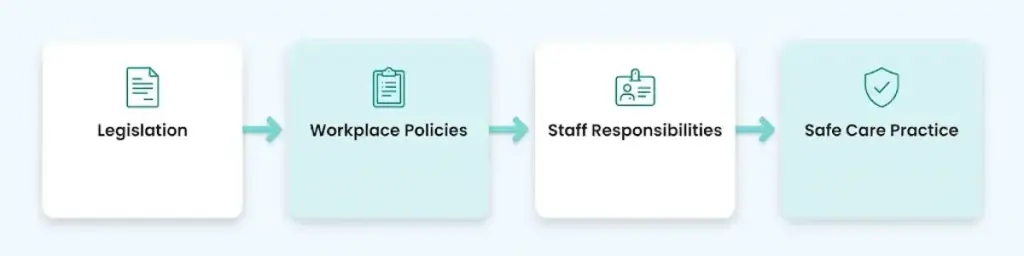
Care workers are expected to understand the requirements relevant to their role, follow lawful workplace procedures and raise concerns appropriately.
Employers and registered providers have additional responsibilities, which may include maintaining safe working arrangements, providing appropriate training and ensuring services comply with applicable regulations.
Employers must also support safe working practices through appropriate policies, supervision and training. For example, CSTF infection prevention and control training may form part of an organisation’s workforce development arrangements, depending on the setting and staff roles.
The Role of Regulators
Regulators monitor compliance within their respective areas of responsibility.
In England, the CQC can inspect regulated services and take enforcement action where appropriate. Other UK nations operate under their own regulatory arrangements.
Failure to comply with legislation can result in regulatory action, civil liability or criminal consequences, depending on the legal requirement and circumstances.
Not every breach leads to the same outcome, and organisational responsibility should not automatically be confused with an individual worker’s liability.
Understanding Legislation Through Health and Social Care Training
Understanding legislation helps care workers recognise their responsibilities and appreciate why workplace procedures matter.
Training can develop this knowledge alongside important topics such as safeguarding, communication, infection control and person-centred support. However, online learning should complement relevant workplace induction, supervision and practical competence requirements.
For learners interested in building broader knowledge, Training Express offers a Level 3 Diploma in Health and Social Care.
This online, self-paced course covers several essential care subjects and is advertised as CPD accredited and Quality Licence Scheme endorsed. It supports knowledge development but should not be confused with an Ofqual-regulated qualification or a licence to practise.
Frequently Asked Questions About Secondary Care
1. Is Legislation the Same as a Workplace Policy?
No. Legislation establishes legal requirements, while workplace policies explain how an organisation approaches particular responsibilities. Policies must comply with applicable laws, and procedures help staff put those policies into practice.
2. Does the Same Health and Social Care Legislation Apply Throughout the UK?
No. Some legislation applies across the UK, while other laws and regulations apply specifically to England, Scotland, Wales or Northern Ireland. Care workers should understand the legal requirements relevant to their location and workplace.
3. What Happens If Health and Social Care Legislation Is Not Followed?
Failure to comply with legislation can result in regulatory action, financial penalties, civil claims or criminal proceedings, depending on the breach. Organisations may also face reputational damage, while individuals receiving care could experience avoidable harm.
4. Who Makes Legislation for Health and Social Care in the UK?
The UK Parliament and devolved legislatures make primary legislation within their respective powers. Government ministers and other authorised bodies can also make secondary legislation under powers granted by Acts. The applicable law depends on the subject and jurisdiction.
5. How Can Care Workers Keep Up With Changes in Legislation?
Care workers can stay informed through workplace training, employer updates, official government websites and guidance from relevant regulators. Regularly reviewing organisational policies and attending professional development sessions also helps them understand how legal changes affect their responsibilities.

Robert Lawrence
Author | Specialises in Health and Social Care
Robert Lawrence is an author at Training Express, with over 5 years of experience creating practical resources and strategies to support learners and enhance their professional & personal development.