Food Hygiene
 Health & Safety
 Safeguarding
 First Aid
 Business Skills
 Personal Development

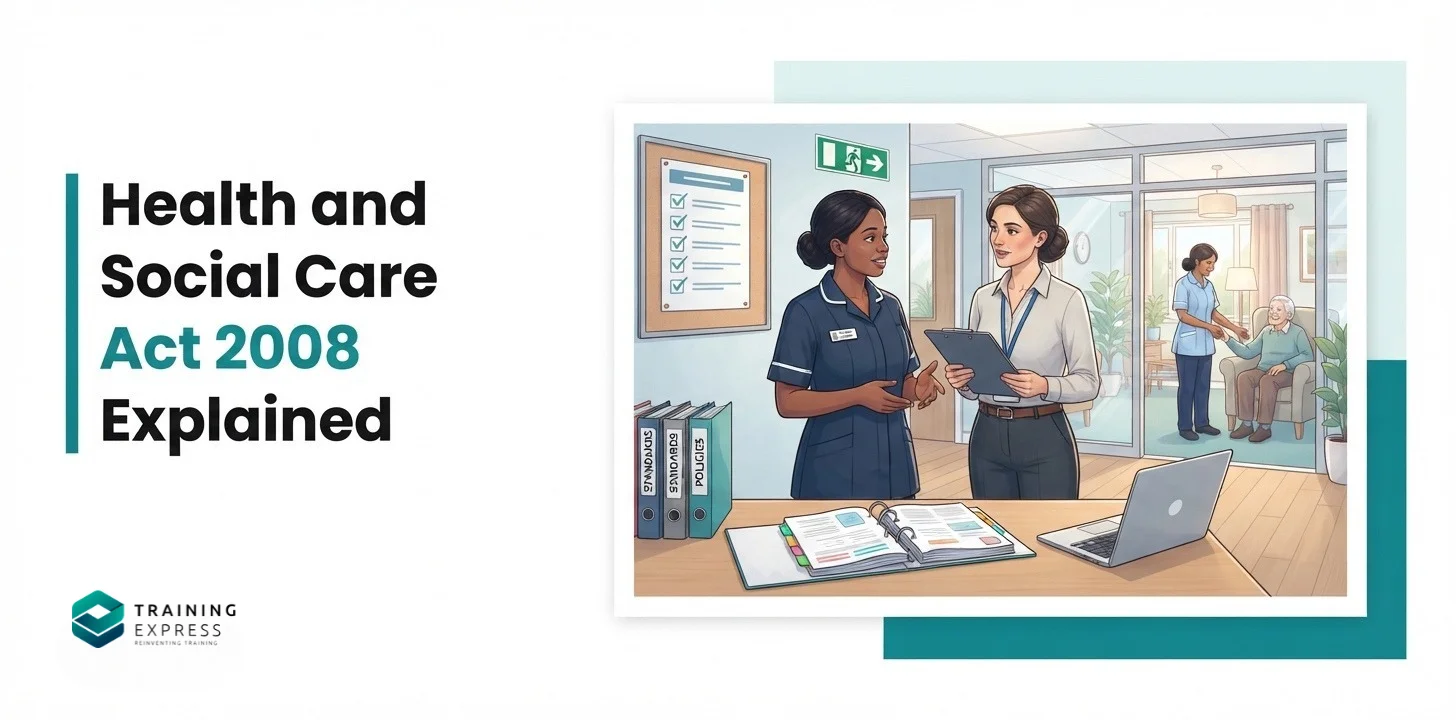

The Health and Social Care Act 2008 is the law that created the Care Quality Commission (CQC) and the system of registration for health and adult social care providers in England. Regulations made under the Act set out the fundamental standards, the minimum standards that care must never fall below.
This guide explains what the Act does, how the 2014 Regulations and fundamental standards work, how CQC enforces them, and what it all means for you as a care worker or learner.
This is general guidance, not legal advice. For specific compliance questions, check CQC guidance or speak to a qualified adviser.
Table of Contents
What is the Health and Social Care Act 2008?
The Health and Social Care Act 2008 is an Act of Parliament that set up the CQC as the regulator of health and adult social care in England. It requires anyone who carries on a “regulated activity” in England to register with CQC.
A regulated activity is a type of care or treatment listed in the regulations, such as personal care, accommodation for people who need nursing or personal care, or treatment of disease, disorder or injury. If a care home or home care agency provides one of these, it must be registered.
The Act has been changed many times since 2008, including by the Care Act 2014 and the Health and Care Act 2022. That’s why you’ll often see it described as “the Health and Social Care Act 2008 (as amended)”.

Key points of the Health and Social Care Act 2008
- It created the Care Quality Commission (CQC), which started work in 2009.
- It requires providers of regulated activities in England to register with CQC.
- It gives the government power to make regulations that set standards of care (section 20).
- It gives CQC powers to inspect, rate and take enforcement action against providers.
- It makes it a criminal offence to carry on a regulated activity without being registered.
- It includes a statutory code of practice on preventing and controlling infections.
Who does the Act apply to?
The Act’s registration rules apply to providers and registered managers of regulated activities in England. That includes care homes, home care agencies, GP practices, hospitals and dental practices.
As a care worker, the Act applies to you indirectly. Your employer must meet the regulations, so they write policies and train you to follow them. When you follow your employer’s policies, you’re helping them meet the law. Our guide to policies and procedures in health and social care explains how this works.
The Health and Social Care Act 2008 (Regulated Activities) Regulations 2014
The Act itself doesn’t list the standards of care. They’re in a separate set of rules called the Health and Social Care Act 2008 (Regulated Activities) Regulations 2014, made under section 20 of the Act.
The 2014 Regulations do two main things:
- They list the regulated activities that need CQC registration (in Schedule 1).
- They set out the fundamental standards that every registered provider must meet.
The fundamental standards came into force for all health and adult social care services on 1 April 2015. They were introduced after Sir Robert Francis’s inquiry into care at Mid Staffordshire NHS Foundation Trust.
The CQC fundamental standards (Regulations 9 to 20A)
The fundamental standards are the regulations in the 2014 Regulations that set the minimum standards of care. CQC’s regulations for service providers and managers list them from Regulation 9 to Regulation 20A, including Regulation 9A, which was added in 2024.
| Regulation | What it requires (summary) | Example policy |
|---|---|---|
| Regulation 9: Person-centred care | Care must be appropriate, meet the person's needs and reflect their preferences | Care planning |
| Regulation 9A: Visiting and accompanying in care homes, hospitals and hospices | People should be able to have visitors and be accompanied, except in exceptional circumstances | Visiting |
| Regulation 10: Dignity and respect | People must be treated with dignity and respect, including privacy | Dignity and privacy |
| Regulation 11: Need for consent | Care must only be given with consent, or as the Mental Capacity Act 2005 allows | Consent and MCA |
| Regulation 12: Safe care and treatment | Care must be safe, including medicines, equipment and infection control | Medicines; infection control |
| Regulation 13: Safeguarding service users from abuse and improper treatment | Systems must protect people from abuse and improper treatment | Safeguarding |
| Regulation 14: Meeting nutritional and hydration needs | People must have enough to eat and drink to meet their needs | Nutrition and hydration |
| Regulation 15: Premises and equipment | Premises and equipment must be clean, secure, suitable and maintained | Health and safety; maintenance |
| Regulation 16: Receiving and acting on complaints | There must be an accessible system for handling complaints | Complaints |
| Regulation 17: Good governance | There must be systems to check and improve quality and safety, and keep accurate records | Governance and audit; records |
| Regulation 18: Staffing | There must be enough suitably qualified, competent staff, with training and supervision | Training and supervision |
| Regulation 19: Fit and proper persons employed | Staff must be of good character and have the right skills; checks must be made | Recruitment and DBS |
| Regulation 20: Duty of candour | Providers must be open and honest with people when something goes wrong | Duty of candour |
| Regulation 20A: Requirement as to display of performance assessments | Providers must display their CQC rating | Display of ratings |
That’s 14 regulations in total. Many websites still say there are 13 fundamental standards, because they were written before Regulation 9A was added.
For a full list of the policies care homes use to show they meet these standards, see our care home policies and procedures list.
Regulation 9A: visiting and accompanying
Regulation 9A is the newest fundamental standard. It came into force on 6 April 2024 and applies to care homes, hospitals and hospices.
It means that, unless there are exceptional circumstances:
- people living in care homes should be able to receive visits from people they want to see
- care home residents shouldn’t be discouraged from going out on visits
- people in hospitals and hospices should be able to have someone accompany them.
Regulation 9A was introduced after concerns about visiting restrictions during the COVID-19 pandemic. In 2025 the Department of Health and Social Care ran a review of how well it was working.

Regulation 12 safe care and treatment, and Regulation 17 good governance
These are two of the most searched regulations, because they cover so much of daily care.
Regulation 12 covers how care is given safely. That includes risk assessments, safe use of medicines, infection prevention and control, and making sure staff are competent for the tasks they do. In practice, it’s the regulation behind your medication round, moving and handling plans and hand hygiene.
Regulation 17 covers how a service is run. Providers must have systems to check and improve quality and safety, and keep accurate, complete records. In practice, it’s the reason for audits, accurate daily notes and acting on feedback.
Regulation 20: duty of candour
The duty of candour is a legal duty on providers to be open and honest when something goes wrong with someone’s care. When a “notifiable safety incident” happens (an unexpected event that causes certain levels of harm), the provider must tell the person, apologise, explain what happened and put it in writing.
For care workers, it means you should report incidents honestly and straight away, so your employer can meet this duty. Covering up a mistake can stop them doing so.
CQC Registration Regulations 2009
Alongside the 2014 Regulations, registered providers must follow the Care Quality Commission (Registration) Regulations 2009. For most care staff, the key part is notifications.
Providers must tell CQC about certain events without delay, including:
- Regulation 16: the death of a person using the service
- Regulation 18: other incidents, such as serious injuries, abuse or allegations of abuse, and applications to deprive someone of their liberty.
If you’re involved in an incident, your manager may need your account to complete the notification, so accurate records matter.
What happens if a provider breaches the regulations?
CQC can take civil or criminal enforcement action when a provider doesn’t meet the regulations. What it does depends on how serious the breach is and the risk to people. CQC’s enforcement policy explains its approach.
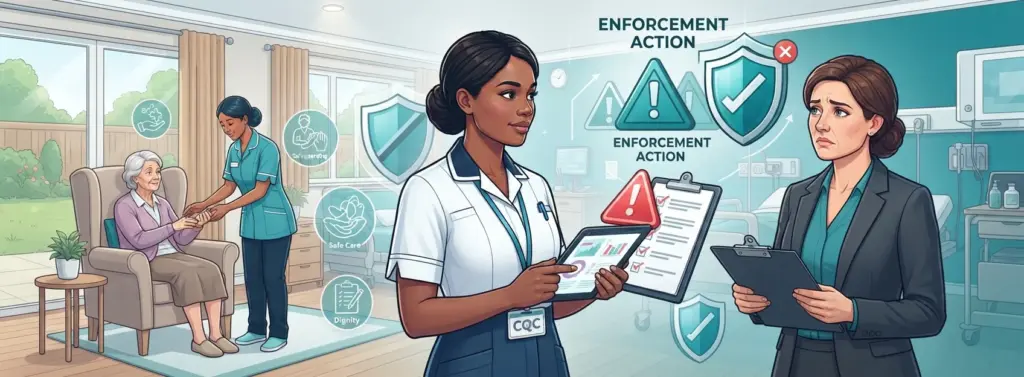
CQC can only prosecute breaches of certain regulations. According to CQC’s offences guidance:
- Can be prosecuted directly: Regulation 11 (consent), 16(3) (giving CQC complaints information when asked), 17(3) (good governance reports), 20(2)(a) and 20(3) (duty of candour) and 20A (displaying ratings).
- Can be prosecuted only if people are exposed to avoidable harm, significant risk of harm, or loss of money or property: Regulation 12 (safe care), 13(1) to 13(4) (safeguarding) and 14 (nutrition and hydration).
- Registration Regulations 2009: CQC can prosecute breaches of notification duties, such as Regulation 16 (death of a service user) and Regulation 18 (other incidents).
For other regulations, such as Regulation 17 in general, CQC uses other action.
Health and Social Care Act 2008 vs 2012 vs Care Act 2014 vs Health and Care Act 2022
These four laws are often mixed up. They do different jobs, and the 2012 Act didn’t replace the 2008 Act.
| Law | What it mainly did |
|---|---|
| Health and Social Care Act 2008 | Created CQC and the registration system for health and adult social care providers in England |
| Health and Social Care Act 2012 | Reorganised the NHS in England and made NICE a statutory body, among other changes |
| Care Act 2014 | Set out local authorities' duties for adult social care in England, including wellbeing and adult safeguarding |
| Health and Care Act 2022 | Created integrated care boards (ICBs), and added a legal duty for CQC-registered providers to train staff in learning disability and autism |
For a wider overview of the laws that apply in care, read our guide to legislation in health and social care.
The 5 CQC key questions vs the fundamental standards
The 5 key questions and the fundamental standards are different things. The fundamental standards are the law. The 5 key questions are how CQC organises its assessments of whether providers meet that law.
CQC’s 5 key questions ask whether a service is:
- Safe
- Effective
- Caring
- Responsive to people’s needs
- Well-led
There’s no such thing as “the 5 fundamental standards”. At the time of writing, CQC is changing how it assesses services: in March 2026 it published draft frameworks that keep the 5 key questions but replace its quality statements with key lines of enquiry.
What the Act means for care workers day to day
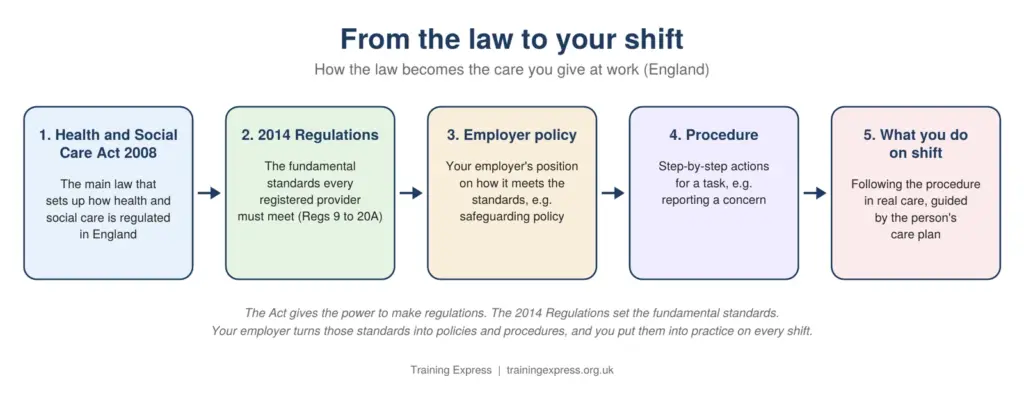
For most care workers, the Act shows up in the everyday things your employer asks you to do. Every regulation becomes a policy, every policy becomes a procedure, and every procedure becomes something you do on shift.
Here’s how that chain looks in practice:
| Regulation | Your employer's policy | What you do on shift |
|---|---|---|
| Regulation 11: Need for consent | Consent and MCA policy | Ask before giving care, and record the person's choice |
| Regulation 12: Safe care and treatment | Medicines policy | Check the medication administration record (MAR) before giving medicines |
| Regulation 13: Safeguarding | Safeguarding policy | Report bruises or concerns to the person in charge straight away |
| Regulation 17: Good governance | Record keeping policy | Write clear, factual notes at the end of each visit or shift |
| Regulation 18: Staffing | Training policy | Complete your training and refreshers on time |
This chain is what we call agreed ways of working. Your behaviour while you follow it is described in the code of conduct for healthcare support workers.
Does the Act apply in Wales, Scotland and Northern Ireland?
CQC registration under the Health and Social Care Act 2008 applies to England only. Each of the other UK nations has its own regulator and law for care services.
| Nation | Social care regulator | Main law |
|---|---|---|
| England | Care Quality Commission (CQC) | Health and Social Care Act 2008 |
| Wales | Care Inspectorate Wales (CIW) | Regulation and Inspection of Social Care (Wales) Act 2016 |
| Scotland | Care Inspectorate | Public Services Reform (Scotland) Act 2010 |
| Northern Ireland | Regulation and Quality Improvement Authority (RQIA) | Health and Personal Social Services (Quality, Improvement and Regulation) (Northern Ireland) Order 2003 |
Learn more with Training Express
If you want to understand the law behind your everyday care work, our Level 3 Diploma in Health and Social Care covers legislation, professional standards and safeguarding in health and social care.
Frequently Asked Questions (FAQs)
What is the Health and Social Care Act of 2008?
The Health and Social Care Act 2008 is a law that created the Care Quality Commission (CQC) and requires providers of health and adult social care in England to register with it. Regulations made under the Act set out the fundamental standards that all registered providers must meet, such as safe care, safeguarding, dignity and good governance.
What are the key points of the Health and Social Care Act?
The key points are that it set up CQC, created a registration system for providers of regulated activities in England, allowed the government to make regulations setting standards of care, gave CQC powers to inspect and take enforcement action, and made it an offence to provide regulated activities without registering. It also includes a code of practice on infection prevention.
What is the difference between the Health and Social Care Act 2008 and 2012?
The 2008 Act created CQC and the registration system for health and social care providers in England. The 2012 Act was mainly about reorganising the NHS in England, including how services are commissioned, and it made NICE a statutory body. The 2012 Act didn’t replace the 2008 Act. Both are still law, along with later changes.
What is CQC regulation 9?
Regulation 9 is the fundamental standard on person-centred care. It means care and treatment must be appropriate, meet the person’s needs and reflect their preferences. Providers must assess needs with the person, plan care around them and involve them (and others they choose) in decisions. In practice, it’s the regulation behind care planning and regular reviews.
What is CQC regulation 20?
Regulation 20 is the duty of candour. It requires providers to be open and honest with people when something goes wrong with their care. After a notifiable safety incident, the provider must tell the person, apologise, explain what happened and follow up in writing. Staff support this by reporting incidents honestly and promptly.
What are the 5 fundamental standards of CQC?
There aren’t 5 fundamental standards. People usually mean CQC’s 5 key questions: safe, effective, caring, responsive and well-led. These are how CQC assesses services. The fundamental standards are a separate legal list, from Regulation 9 to Regulation 20A of the 2014 Regulations, including Regulation 9A on visiting. That’s 14 regulations in CQC’s current list.
What are the full list of CQC regulations?
CQC’s list of regulations for providers includes Regulations 4 to 7 (fit and proper directors, registered managers and other requirements) and the fundamental standards from Regulation 9 to 20A in the 2014 Regulations. It also includes the CQC (Registration) Regulations 2009, which cover things like notifications and the statement of purpose. CQC’s website lists every regulation with guidance.
Related Blogs