Child Protection and Safeguarding

4.8 (3211 REVIEWS)
6316 STUDENTS
BestsellerGreat ServiceHighly RatedTrending

GET THIS COURSE AND 2500+ OTHERS FOR ONLY £49 FIND OUT MORE

The Child Protection and Safeguarding course is a CPD-accredited online course for anyone who works with children in the UK. It teaches you how to recognise abuse and neglect, respond to concerns and report them through the right channels. Safeguarding is a shared legal duty, so trained staff help children get support sooner, keep their organisation compliant and stand out to employers.

Across 8 modules, you’ll follow the full child protection process: spotting the signs of physical, emotional and sexual abuse and neglect, handling a disclosure, making a referral and keeping accurate records. You’ll also learn the role of the Designated Safeguarding Lead, the rules on sharing confidential information and the law behind safeguarding and child protection. That includes the Children Act 1989 and 2004, Keeping Children Safe in Education 2026 and Working Together to Safeguard Children 2026.

The course is designed for teachers, teaching assistants, early years staff, childminders, social care workers, youth workers and volunteers. It gives you the confidence to act quickly and correctly whenever a child’s protection is at stake, whether you’re new to safeguarding or refreshing your knowledge.

Last audited and updated on: 12th October 2026
“Safeguarding and promoting the welfare of children is everyone’s responsibility.”

Department for Education (DfE), Keeping Children Safe in Education 2026 , statutory guidance that sets the safeguarding standard for every school and college in England.

Sneak Peek of Child Protection and Safeguarding

Sneak Peek of Child Protection and Safeguarding

Learning Outcomes

By the end of the course, learners will be able to:

What is Child Protection and Safeguarding?

Safeguarding is the action taken to promote the welfare of all children and protect them from harm. It covers everything from preventing abuse and neglect to making sure children grow up with safe and effective care. Child protection is the part of safeguarding that responds to a specific child who is suffering, or is likely to suffer, significant harm. Together, safeguarding and child protection keep children safe in schools, nurseries, healthcare, sport, youth services and the wider community.

Who Should Take The Child Protection and Safeguarding Course

This course is for anyone whose work or volunteering brings them into contact with children and young people. It suits people new to the role and those who need a refresher. It is ideal for:

If you have a duty of care towards children, this course gives you the knowledge to act with confidence.

Why Take This Child Protection and Safeguarding Course

Signs of abuse are rarely obvious. The right training helps you spot early warning signs and know exactly what to do next. With this course, you will:

It takes only a few hours, and it can make a real difference to the children in your care.

Job Opportunities & Salary Expectations in UK

Safeguarding knowledge is essential across child-focused careers. Some of the roles below need further qualifications, but this course is a strong foundation for all of them.

*Social work requires a degree in social work and registration with Social Work England.

Salaries are approximate, based on 2025–26 UK data, and vary by location, employer and experience.

Entry Requirements of Child Protection and Safeguarding

Why This Child Protection and Safeguarding Certificate Matters?

UK employers, schools and regulators expect anyone working with children to be trained in safeguarding. Your certificate is clear proof that you understand your responsibilities and know how to act on a concern.

This certificate supports, but does not replace, a DBS check, your employer’s own safeguarding induction or role-specific training such as DSL training.

Assessment of Child Protection and Safeguarding

At the end of the course, there will be an online assessment, which you will need to pass to complete the course. Answers are marked instantly and automatically, allowing you to know straight away whether you have passed. If you haven’t, there’s no limit on the number of times you can take the final exam. All this is included in the one-time fee you paid for the course itself.

Accreditation of Child Protection and Safeguarding

All of our courses, including this Child Protection and Safeguarding course is fully accredited, providing you with up-to-date skills and knowledge and helping you to become more competent and effective in your chosen field.

CPD Accredited

All our courses are CPD accredited, meeting recognised Continuing Professional Development (CPD) standards.

RoSPA Membership

RoSPA membership shows commitment to health and safety and helps organisations maintain strong safety standards and reduce workplace risks.

British Safety Council Member

A British Safety Council Member demonstrates commitment to high health, safety, and wellbeing standards and safer workplaces.

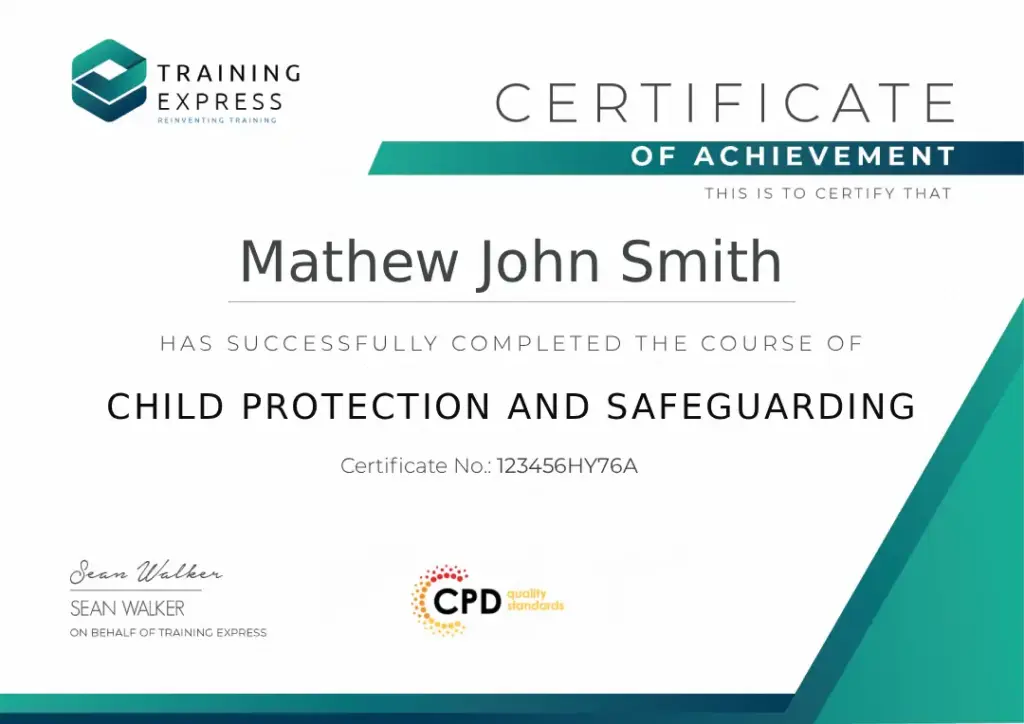
Certification of Child Protection and Safeguarding

Once you’ve successfully completed your course, you will immediately be sent a digital certificate. Also, you can have your printed certificate delivered by post (shipping cost £5.99). All of our courses are fully accredited, providing you with up-to-date skills and knowledge and helping you to become more competent and effective in your chosen field. 

Certification of Child Protection and Safeguarding
↻
Recommended renewal: 3 years.
Our certifications have no expiry dates, but we recommend renewing them to stay up to date with industry best practices.

Course Curriculum

In module one, we will learn the definition of safeguarding, the importance of safeguarding, safeguarding roles and responsibilities, and child protection policies.

In module two, we will explore the UK laws and key legislation behind safeguarding children, outlining the fundamental points of each act. We will also take a look at child safeguarding policy and guidelines.

In module three, we will gain an in-depth understanding of what constitutes abuse and neglect, the different types of abuse, and how to identify the signs of a child at risk.

In module 4, we will learn about child sexual exploitation, the types of sexual abuse, the characteristics of sexual offenders, and the common patterns and signs of child sexual abuse. 

In module 5, you will be guided on how to assess if a child is at risk of harm, how to recognise a high-risk situation, and will explore the steps in the single assessment process.

In module 6, we will learn about the protocol on sharing information that has been disclosed by a child, your ‘duty of care’, and how to take appropriate action when making referrals to social care services.

In module 7, you will learn how to make a referral to social services, what should be included in your referral, and what to do if you disagree with the decision made.

The final module takes a look at record-keeping procedures and policies, including which documents should be included in safeguarding records, and the policy regarding sharing information.

Child Protection and Safeguarding Course Reviews

Excellent

4.8 Average 3211 Reviews

  Reviews

Alice Yengo
📍GB
This course has enhanced my knowledge and understanding of safeguarding for both children and adults. I have developed a clearer awareness of key legislation and its implications across a wide range of safeguarding matters.
Mochi
📍GB
I urgently needed a child protection and safeguarding certificate during a bank holiday weekend. I was able to enrol , complete and get the certificate on time. Though there was a technical glitch, I sent an email and I was pleased to get a quick response and resolution .
Mr Christopher Jenner
📍GB
Excellent course, this has given me a greater insight into safeguarding. It is challenging enough to keep you interested. I have really enjoyed completing this course.
Olalekan Akinde
📍GB
The process of completing the course was smooth and learning modules are appropriate especially the mental health and safeguarding.

Frequently Asked Questions (FAQs)

What is the difference between safeguarding and child protection?

Safeguarding is the broad, preventive work of protecting all children from harm and promoting their welfare. Child protection is a narrower part of safeguarding that focuses on a specific child who is suffering, or is likely to suffer, significant harm. In simple terms, safeguarding is what everyone does to keep children safe every day. Child protection is the formal response when a particular child is at risk, such as a referral to children’s social care, a Section 47 enquiry under the Children Act 1989 or a child protection plan.

What are the 4 Rs of safeguarding?

The 4 Rs of safeguarding are Recognise, Respond, Report and Record:


  • Recognise: know the signs and indicators of abuse and neglect.
  • Respond: act promptly and appropriately, even if a concern seems small.
  • Report: pass your concern to the Designated Safeguarding Lead or the right agency without delay.
  • Record: write down what you saw or heard, what was said and what action was taken.

What are the four main types of child abuse?

The four main types of child abuse are physical abuse, emotional abuse, sexual abuse and neglect. Physical abuse means causing deliberate physical harm. Emotional abuse is ongoing treatment that damages a child’s emotional development. Sexual abuse involves forcing or enticing a child into sexual activity, online or offline. Neglect is the persistent failure to meet a child’s basic needs. UK guidance also highlights specific risks such as child criminal exploitation, child sexual exploitation, domestic abuse, female genital mutilation (FGM) and radicalisation.

What should you do if a child tells you they are being abused?

Stay calm, listen carefully and reassure the child that they were right to tell you. Do not promise to keep it a secret, ask leading questions or confront the alleged abuser. Explain that you will need to share the information with people who can help. Report it to your Designated Safeguarding Lead straight away, and write down what the child said in their own words as soon as possible. If a child is in immediate danger, call 999.

Who is responsible for safeguarding children?

Safeguarding children is everyone’s responsibility. Every adult who works or volunteers with children has a duty to act on concerns. Organisations must have clear safeguarding policies, and schools and colleges must appoint a Designated Safeguarding Lead. In England, local safeguarding partners, led by the local authority, the police and the NHS integrated care board, coordinate safeguarding arrangements under Working Together to Safeguard Children.

What level of safeguarding training do I need?

The level you need depends on your role. Level 1 suits staff and volunteers who have limited, supervised contact with children. Level 2 is for people who work directly with children, such as teachers, nursery staff and youth workers. Level 3 is for those with lead responsibility, such as Designated Safeguarding Leads, who need extra role-specific training. Always check your employer’s or local safeguarding partnership’s requirements.

How often should safeguarding training be renewed?

Most UK employers expect safeguarding training to be refreshed every one to three years, and many ask for it every year. For schools and colleges in England, Keeping Children Safe in Education says all staff should get safeguarding and child protection training at induction, with updates at least once a year. DSLs should update their training at least every two years. Our certificate does not expire, but we recommend refreshing your knowledge every 3 year.

What are the main laws for safeguarding children in the UK?

The main safeguarding law in England is the Children Act 1989, which sets out local authority duties to children in need (Section 17) and children at risk of significant harm (Section 47). Other key laws include:

  • The Children Act 2004, which placed a safeguarding duty on key agencies
  • The Safeguarding Vulnerable Groups Act 2006, which underpins the DBS barring scheme
  • The Children and Social Work Act 2017

Statutory guidance includes Working Together to Safeguard Children 2026 and Keeping Children Safe in Education 2026. Scotland, Wales and Northern Ireland each have their own frameworks.

Is online safeguarding training accepted by employers?

Yes. Online safeguarding training from a CPD-accredited provider is widely accepted by UK employers in education, childcare, health and social care as evidence of safeguarding knowledge. It is flexible, quick to complete and easy to refresh. Some roles, such as Designated Safeguarding Leads, may also need extra role-specific or multi-agency training set by the employer or local safeguarding partnership.

How long does the Child Protection and Safeguarding course take, and will I get a certificate?

The course takes around 4 hours and 37 minutes to complete. At the end, you take an online assessment that is marked instantly, with unlimited free retakes. Once you pass, you get a free CPD-accredited digital certificate straight away. A printed copy can be posted to you for £5.99.

Do employers value Emergency First Aid at Work certification?

Yes, many UK employers value Emergency First Aid at Work certification because it demonstrates awareness of workplace safety, emergency response responsibilities, and health and safety procedures. Employees with first aid knowledge can help organisations maintain safer working environments and respond more effectively during workplace incidents.

Course Curriculum

Safeguarding Children
Module 01: Introduction to Safeguarding 00:21:00
Laws and Guidance. 00:42:00
Module 02: Child Abuse 00:48:00
Child Sexual Exploitation. 00:39:00
Risks and Risk Assessment. 00:16:00
Module 03: Responding to Disclosure and Reporting 00:32:00
Things To Do After Referral 00:22:00
Record Keeping. 00:17:00
Mock Exam
Mock Exam – Child Protection and Safeguarding 00:20:00
Final Exam
Final Exam – Child Protection and Safeguarding 00:20:00
Child Protection and Safeguarding
ex Vat

SAVE 50% - OFFER ENDS SOON

TAKE THIS COURSE

Or

  • Original price was: £40.00.Current price is: £20.00. ex Vat
  • 1 year
  • Course Certificate
  • 4 hours, 37 minutes
  • Gift this course
£20 /Unit Price
Total:
£100.00
Quantity:

Buying more than one of the same courses?

  • 50% discount for orders of 10+ courses
  • 60% discount for orders of 50+ courses
  • 70% discount for orders of 100+ courses

Looking for a more personalised package?

contact us now

Instructors

6316 STUDENTS ENROLLED
top