Food Hygiene
 Health & Safety
 Safeguarding
 First Aid
 Business Skills
 Personal Development
Course Curriculum
| Introduction | |||
| Notes (Downloadable PDF) Basic Concepts | 00:05:00 | ||
| The Daily Scrum in 3 minutes | 00:03:00 | ||
| Don’t fool yourself: what Scrum is NOT! | 00:02:00 | ||
| What Scrum REALLY is! | 00:04:00 | ||
| Scrum subway | 00:02:00 | ||
| Agile Mindset 101 | 00:03:00 | ||
| The Scrum Guide – (Downloadable PDF) | 00:05:00 | ||
| [VERY IMPORTANT] How to follow this course | 00:05:00 | ||
| Scrum Glossary (Downloadable PDF) | 00:05:00 | ||
| [EXTRA] Tips for you to learn more effectively (Downloadable) | 00:05:00 | ||
| Key Takeways – Introduction | 00:05:00 | ||
| Basic concepts | |||
| First things first. What is a project? | 00:03:00 | ||
| Learn to differ a project from business as usual | 00:02:00 | ||
| Projects as a means to reach your objectives | 00:03:00 | ||
| You were, are, and will always be a project manager | 00:04:00 | ||
| How do projects organize the effort to deliver products? | 00:01:00 | ||
| Key Takeaways – Basic concepts | 00:05:00 | ||
| Setting your goals | 00:05:00 | ||
| Traditional Project Management | |||
| What is “Traditional” Project Management? | 00:04:00 | ||
| The “Traditional” way of dealing with scope, time, and cost | 00:01:00 | ||
| The golden project management paradox: Knowledge x Ease of Change | 00:03:00 | ||
| When is it better to go with the “Traditional” paradigm? | 00:05:00 | ||
| Why do projects fail? | 00:03:00 | ||
| Key Takeaways – Traditional Project Management | 00:05:00 | ||
| Agile Project Management | |||
| Agile for the Rescue! | 00:01:00 | ||
| The agility mindset | 00:03:00 | ||
| The values that guide agility | 00:07:00 | ||
| The principles that sustain agility | 00:01:00 | ||
| Agile Project Principles | 00:05:00 | ||
| Agile Product Principles | 00:02:00 | ||
| Agile People Principles | 00:06:00 | ||
| Agile Process Principles | 00:01:00 | ||
| [EXTRA] Beyond the Agile Manifesto | 00:01:00 | ||
| Key Takeaways – Agile Project Management | 00:01:00 | ||
| Which way to go: Traditional or Agile? | |||
| Should you go with the Traditional or Agile paradigm? | 00:01:00 | ||
| Risks and Project Planning: the Cone of Uncertainty | 00:02:00 | ||
| The Agile way of dealing with scope, time, and cost | 00:01:00 | ||
| Final words about the battle: “Traditional or Agile?” | 00:01:00 | ||
| Key Takeaways – Which way to go? Traditional or Agile? | 00:01:00 | ||
| The Skeleton and Heart of Scrum | |||
| Scrum in 1 minute | 00:01:00 | ||
| Dissecting Scrum: Scrum as a Value-driven effort | 00:03:00 | ||
| Dissecting Scrum: Sprints, the heart Scrum! | 00:03:00 | ||
| Dissecting Scrum: how does the Sprint Backlog fit in? | 00:01:00 | ||
| Dissecting Scrum: the importance of the Increment | 00:02:00 | ||
| Dissecting Scrum: the Team’s continuous improvement and balance | 00:04:00 | ||
| The Product Owner as the Business Catalyst | 00:05:00 | ||
| [SCRUM WAR STORY] The Weak Proxy Product Owner | 00:04:00 | ||
| The Development Team- delivering work collaboratively | 00:04:00 | ||
| What does a Scrum Master do? | 00:02:00 | ||
| Key Takeaways – The Skeleton and Heart of Scrum | 00:01:00 | ||
| Let's Simulate a Project! | |||
| The Scrum Lifecycle | 00:02:00 | ||
| Let’s kickoff our project! \o/ | 00:01:00 | ||
| A quick look at our case study (project simulation) | 00:03:00 | ||
| A quick look at our project management tool | 00:01:00 | ||
| Key Takeaways – Let´s simulate a project | 00:01:00 | ||
| [Initiation] Guaranteeing Project Success Since its Kickoff | |||
| Quick introduction to Initiation work | 00:01:00 | ||
| Defining where to go: the Product Vision! | 00:10:00 | ||
| Let’s update the system with our product vision! | 00:01:00 | ||
| [Extra] Using personas to build better customer-centric products (Downloadable PDF) | 00:01:00 | ||
| [EXTRA] Order your User Stories with the Story Mapping | 00:01:00 | ||
| Describing the product tactics: the Product Backlog | 00:05:00 | ||
| Customer-driven requirements: the User Story | 00:06:00 | ||
| How to define the Product tactic? Ordering the Product Backlog | 00:07:00 | ||
| Estimating effort, the agile way | 00:01:00 | ||
| Story points as the agile measure for effort estimates | 00:07:00 | ||
| Estimate effort collaboratively with the Planning Poker | 00:04:00 | ||
| Defining the business values of the product “ideas” with the Kano Model | 00:08:00 | ||
| [TEMPLATE] Apply the Kano Model for you projects | 00:01:00 | ||
| How to Manage the Product Backlog in 3 minutes | 00:03:00 | ||
| Forming the Scrum Team | 00:02:00 | ||
| [Extra] Adding the Scrum Team to our project management tool | 00:01:00 | ||
| Planning the Delivery: the Release Plan | 00:07:00 | ||
| An alternative way of creating the Release Plan | 00:02:00 | ||
| How to define velocity for a Release Plan? | 00:04:00 | ||
| [EXTRA] Why using the range 0.6x to 1.6x for planning? | 00:01:00 | ||
| A guideline on how to Plan a Release | 00:03:00 | ||
| [EXTRA] Drive your Product Strategy with a Product Roadmap (Downloadable PDF) | 00:01:00 | ||
| [EXTRA] A Fun Fact about Release Plan | 00:01:00 | ||
| Practical advices to define the sprints length | 00:03:00 | ||
| Bring balance to your project by Defining Done | 00:04:00 | ||
| What is the “sprint 0”? | 00:01:00 | ||
| Practical tips on how to organize your workspace to boost collaboration | 00:03:00 | ||
| Key Takeaways – Agile Project Management | 00:01:00 | ||
| [Planning] Plan to Deliver Value | |||
| Getting Ready for Sprinting | 00:04:00 | ||
| Refining the Product Backlog | 00:02:00 | ||
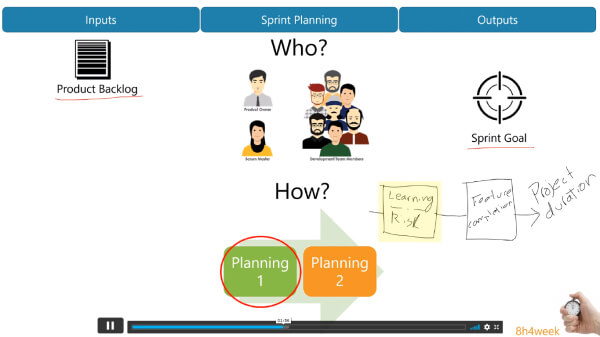
| Planning the Sprint | 00:04:00 | ||
| Sprint Goal Template | 00:01:00 | ||
| [EXTRA] Sprint Goal Template (Downloadable PDF) | 00:01:00 | ||
| Defining WHAT to do during the Sprint | 00:06:00 | ||
| An overview on how to plan WHAT to do during the Sprint | 00:05:00 | ||
| Defining HOW to deliver work during the Sprint | 00:07:00 | ||
| Key Takeaways – Planning | 00:01:00 | ||
| [Execution] Managing the Execution | |||
| Constructing the Product | 00:05:00 | ||
| Adding the Scrum Team to our project management tool | 00:02:00 | ||
| The Daily Scrum in 3 minutes | 00:03:00 | ||
| Making the Impediments Visible | 00:02:00 | ||
| 4 Tips to Boost your Daily Scrums | 00:03:00 | ||
| [EXTRA] Monitoring Progress with the Sprint Burndown Chart + Template | 00:01:00 | ||
| [TEMPLATE] Build your own Burndown Charts | 00:01:00 | ||
| 6 Indicators of BAD Daily Scrums | 00:02:00 | ||
| [EXTRA] A Complete Guide for Conducting Effective Daily Scrum meetings | 00:01:00 | ||
| Backlog Refinement session | 00:07:00 | ||
| [SCRUM WAR STORY] Customer disturbing sprints | 00:09:00 | ||
| What to do if work is not Done by the end of the Sprint? | 00:02:00 | ||
| The Sprint Retrospective Blueprint: Closing | 00:01:00 | ||
| Key Takeaways – Execution | 00:01:00 | ||
| [Inspection and Adaptation] Closing and Validation and Sprint | |||
| Intro to Inspect and Adapt | 00:01:00 | ||
| Scrum’s Product Feedback Cycle | 00:02:00 | ||
| Getting Ready to Demonstrate Value | 00:02:00 | ||
| How to NOT demonstrate value | 00:01:00 | ||
| Getting informed customer feedback by demonstrating value | 00:03:00 | ||
| The Sprint Review Blueprint | 00:06:00 | ||
| An overview on how to execute the Sprint Review meetings | 00:02:00 | ||
| [EXTRA] Getting Valuable Feedback from the Users | 00:01:00 | ||
| Adapting the Product Backlog | 00:02:00 | ||
| A quick note on the terms Backlog Refinement and Grooming | 00:01:00 | ||
| Improving Continuously with the Sprint Retrospective meetings | 00:02:00 | ||
| 2 quick tips for before starting the Sprint Retrospective meeting | 00:01:00 | ||
| The Sprint Retrospective Blueprint: Setting the stage | 00:02:00 | ||
| The Sprint Retrospective Blueprint: Gathering Data | 00:02:00 | ||
| The Sprint Retrospective Blueprint: Generating Insights | 00:04:00 | ||
| The Sprint Retrospective Blueprint: Deciding What to Do | 00:01:00 | ||
| Key Takeaways – Inspection and adaptation | 00:01:00 | ||
| [Closure] Closing a Project | |||
| Delivering the Product | 00:01:00 | ||
| Project Retrospective: avoiding recurring mistakes with Lessons Learned | 00:03:00 | ||
| Key Takeaways – Closure | 00:01:00 | ||
| [EXTRA] Getting certified! | |||
| [Bonus Course 1] Crash Course on Leadership | |||
| Introduction | 00:10:00 | ||
| Boss vs Leader | 00:13:00 | ||
| Tip #1: Forget your Comfort Zone and Develop Your Communication Skills | 00:09:00 | ||
| Tip #2: Work on your Motivation and Optimism | 00:06:00 | ||
| Tip #3: Develop your Empathy | 00:06:00 | ||
| Tip #4: Don’t choose your Type! | 00:08:00 | ||
| Tip #5: Find your references! | 00:05:00 | ||
| [Bonus Course 2] Crash Course on Negotiation | |||
| Introduction | 00:04:00 | ||
| The Elements of Negotiation | 00:07:00 | ||
| The Stages of Negotiation (Part A) | 00:06:00 | ||
| The Stages of Negotiation (Part B) | 00:03:00 | ||
| The Stages of Negotiation (Part C) | 00:05:00 | ||
| 6 Things You Must Do To Be More Successful On Your Negotiations | 00:06:00 | ||
| 5 Things You MUST NOT Do on Negotiations | 00:04:00 | ||
| Final Remarks | 00:02:00 | ||
| [Bonus Course 3] Crash Course on Productivity | |||
| Introduction [Bonus Course 3] Crash Course on Productivity | 00:06:00 | ||
| Basic concepts | 00:09:00 | ||
| Step #1: Collect | 00:08:00 | ||
| Step #2: Process | 00:14:00 | ||
| Step #3: Organize | 00:04:00 | ||
| Step #4: Plan | 00:05:00 | ||
| Step #5: Execute | 00:03:00 | ||
| Final Remarks | 00:02:00 | ||
| Additional Resource Materials | |||
| Resources: Complete Scrum Agile Training | 00:00:00 | ||
Course Ratings
No Ratings found for this course.
£20
ex Vat
TAKE THIS COURSE
SAVE 84% - OFFER ENDS SOON
- Original price was: £125.00.£20.00Current price is: £20.00. ex Vat
- 1 year
- Intermediate
- Course Certificate
- 8 hours, 25 minutes Gift this course
Buying more than one of the same courses?
- 50% discount for orders of 10+ courses
- 60% discount for orders of 50+ courses
- 70% discount for orders of 100+ courses
Looking for a more personalised package?
contact us nowInstructors


126 STUDENTS ENROLLED