Food Hygiene
 Health & Safety
 Safeguarding
 First Aid
 Business Skills
 Personal Development

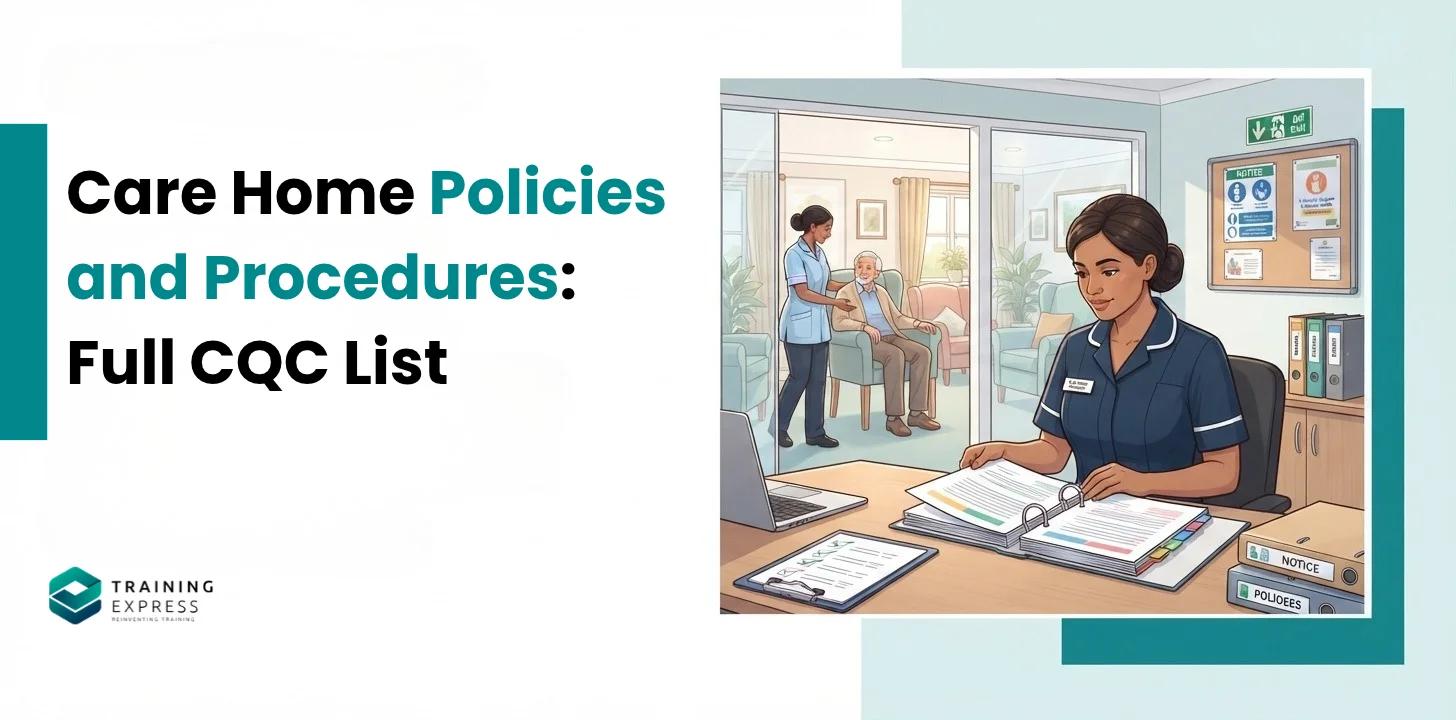

Care home policies and procedures are the written rules that show how your home meets the law and keeps residents safe. In England, the Care Quality Commission (CQC) doesn’t publish one official list of required policies. Instead, you need policies that show how you meet the fundamental standards in the regulations.
This guide gives you a full list of care home policies and procedures, grouped by CQC’s 5 key questions. For each one, we show the regulation it mainly supports and whether it’s a legal requirement, expected by CQC or good practice. If you’re not sure what a policy is, or how it differs from a procedure, start with our main guide to policies and procedures in health and social care.
This is general guidance, not legal advice. For specific compliance questions, check CQC guidance or speak to a qualified adviser.
Table of Contents
What policies does a care home need?
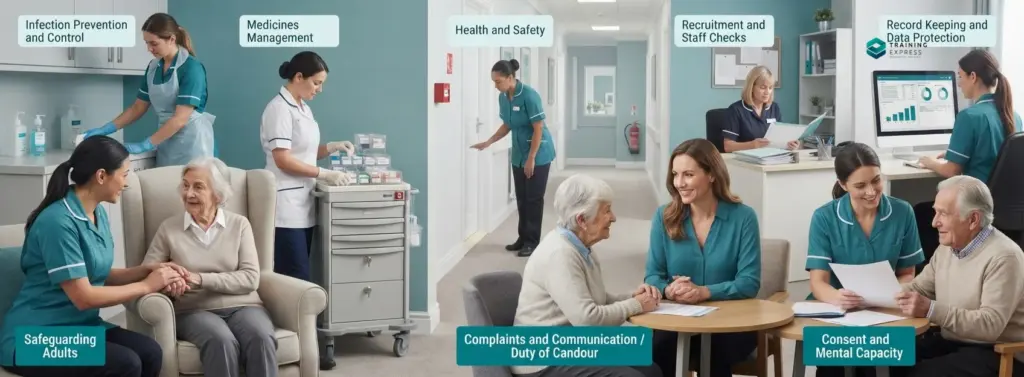
Most care homes in England need at least these 10 core policies. Inspectors usually ask about these first:
- Safeguarding adults
- Medicines management
- Infection prevention and control
- Health and safety (a written policy is a legal requirement if you have 5 or more employees)
- Fire safety
- Complaints
- Consent and the Mental Capacity Act
- Recruitment and staff checks
- Duty of candour
- Record keeping and data protection
The full list below covers about 30 policies across all 5 key questions.
Why care home policies matter for CQC
CQC uses your policies as evidence that you meet the fundamental standards. The fundamental standards are set out in Regulations 9 to 20A of the Health and Social Care Act 2008 (Regulated Activities) Regulations 2014. Every registered care home in England must meet them.
A policy alone isn’t enough. CQC also looks at whether staff know the policy and follow it in practice. Our guide to the Health and Social Care Act 2008 explains the law behind these standards.
CQC’s assessment approach has been changing. At the time of writing, CQC still uses the 5 key questions (safe, effective, caring, responsive and well-led). In March 2026 it published draft sector-specific frameworks that replace its quality statements with key lines of enquiry.
Care home policies and procedures list (by CQC key question)
The tables below group policies by the CQC key question they mainly support. Many policies support more than one key question, so we’ve placed each one where it fits best, with no repeats.
How to read the status column:
- Required by law: a named law or regulation requires a written policy, or the specific system the policy describes.
- Expected by CQC: CQC guidance expects the area to be managed, and a written policy is the usual way to show it.
- Good practice: not legally required, but recommended.
Safe
| Policy | Main regulation | Status |
|---|---|---|
| Safeguarding adults | Reg 13: Safeguarding service users from abuse and improper treatment | Required system: Reg 13 requires systems and processes to prevent abuse |
| Medicines management | Reg 12: Safe care and treatment | Expected by CQC; NICE recommends care homes have a medicines policy |
| Infection prevention and control | Reg 12: Safe care and treatment | Expected by CQC, with the Code of Practice on infection prevention |
| Health and safety | Health and Safety at Work etc Act 1974, s2(3); Reg 12 and 15 | Required by law if you have 5 or more employees |
| Fire safety and evacuation | Regulatory Reform (Fire Safety) Order 2005; Reg 15 | Fire risk assessment required by law; findings must be recorded if you have 5 or more employees |
| Falls prevention | Reg 12: Safe care and treatment | Good practice |
| Moving and handling | Reg 12; Manual Handling Operations Regulations 1992 | Risk assessment required by law; policy is good practice |
| Restrictive practice and restraint | Reg 13 | Expected by CQC |
| Incident and accident reporting | Reg 12 and 17; CQC Registration Regulations 2009 (notifications) | Expected by CQC |
| Business continuity and emergencies | Reg 12 and 17 | Expected by CQC |
Effective
| Policy | Main regulation | Status |
|---|---|---|
| Consent and Mental Capacity Act (MCA), including DoLS | Reg 11: Need for consent | Expected by CQC |
| Assessment, admission and discharge | Reg 9: Person-centred care | Expected by CQC |
| Care planning and review | Reg 9: Person-centred care | Expected by CQC |
| Nutrition and hydration | Reg 14: Meeting nutritional and hydration needs | Expected by CQC |
| Staff training, induction and supervision | Reg 18: Staffing | Expected by CQC. Learning disability and autism training is required by law (see below) |
| Working with other services (GPs, district nurses, hospitals) | Reg 12 | Good practice |
MCA stands for the Mental Capacity Act 2005. DoLS (the Deprivation of Liberty Safeguards) are the legal process for authorising care that restricts someone’s liberty when they lack capacity to consent. At the time of writing, DoLS still apply. The government announced in October 2025 a consultation on the Liberty Protection Safeguards (LPS), which would replace DoLS.
Since 1 July 2022, the law has required CQC-registered providers to make sure staff receive learning disability and autism training appropriate to their role. This came from section 181 of the Health and Care Act 2022. The Oliver McGowan code of practice, which explains how to meet the requirement, became final on 6 September 2025.
Caring
| Policy | Main regulation | Status |
|---|---|---|
| Dignity and respect | Reg 10: Dignity and respect | Expected by CQC |
| Privacy and confidentiality | Reg 10; UK GDPR and Data Protection Act 2018 | Expected by CQC |
| Equality, diversity and inclusion | Reg 10; Equality Act 2010 | Expected by CQC |
| End of life care | Reg 9: Person-centred care | Expected by CQC |
| Cultural, religious and personal preferences | Reg 9 and 10 | Good practice |
Responsive
| Policy | Main regulation | Status | Requirements |
|---|---|---|---|
| Complaints | Reg 16: Receiving and acting on complaints | Required system: Reg 16 requires an accessible complaints system | Required |
| Visiting | Reg 9A: Visiting and accompanying in care homes, hospitals and hospices | Expected by CQC | Expected |
| Activities and wellbeing | Reg 9: Person-centred care | Good practice | Good practice |
| Accessible information and communication | Reg 9; Accessible Information Standard | Expected by CQC | Expected |
| Resident and family feedback | Reg 17: Good governance | Expected by CQC | Expected |
Well-led
| Policy | Main regulation | Status |
|---|---|---|
| Governance, quality assurance and audit | Reg 17: Good governance | Expected by CQC |
| Duty of candour | Reg 20: Duty of candour | Required duty: Reg 20 sets out what you must do when something goes wrong |
| Whistleblowing and speaking up | Reg 17 | Expected by CQC |
| Recruitment, DBS and staff checks | Reg 19: Fit and proper persons employed | Required checks under Reg 19 |
| Record keeping | Reg 17: Good governance | Expected by CQC |
| Data protection | UK GDPR, Article 24 | Required by law where proportionate |
| Social media and use of technology | Reg 17 | Good practice |
| CCTV and surveillance | UK GDPR; Reg 10 | Good practice (if you use CCTV) |
Some policy-pack sellers say Freedom to Speak Up policies are now a CQC requirement for care homes. We couldn’t confirm this from a primary source.
Required vs recommended policies
Only a few care home policies are required by name in law. Most are “expected”: the law requires a result, such as safe care or an effective complaints system, and a written policy is the usual way to prove it.
| Type | What it means | Examples |
|---|---|---|
| Required by law | A law names a written policy or a specific system | Written health and safety policy (5 or more employees); complaints system (Reg 16); safeguarding systems (Reg 13); duty of candour (Reg 20) |
| Expected by CQC | CQC guidance expects it to be managed and evidenced | Medicines, infection control, consent and MCA, governance |
| Good practice | Recommended, not required | Falls prevention, activities, social media |
The health and safety policy rule comes from section 2(3) of the Health and Safety at Work etc Act 1974. All employers need a health and safety policy, but you only have to write it down if you employ 5 or more people.
Policies for nursing homes vs residential care homes
Nursing homes need extra clinical policies, because registered nurses provide nursing care on site. Residential care homes without nursing rely on community nurses and GPs for clinical care.
| Area | Residential care home | Nursing home (extra) |
|---|---|---|
| Clinical care | Escalation to GP, 111 or district nurse | Clinical assessment, wound care, catheter and PEG care |
| Medicines | Administration by trained care staff | Nurse-led administration, controlled drugs, syringe drivers |
| Staff checks | DBS and references | Plus NMC registration checks for nurses |
| Deterioration | Recognising and reporting changes | Clinical monitoring and escalation tools |
These are typical differences (good practice), not a complete legal list. Check your registration and the regulated activities you’re registered for.
How often should care home policies be reviewed?
There’s no law that sets a review date for most care home policies. Reviewing each policy at least once a year is widely seen as good practice. You should also review a policy straight away when:
- the law, regulations or national guidance change
- something goes wrong, such as a serious incident or complaint
- CQC gives you feedback
- your service changes, for example you start supporting people with new needs.

Who should own each policy
Give every policy a named owner, usually the registered manager or a lead (for example, the infection control lead). Use version control: put the version number, review date and owner on every policy, and keep old versions on file. A simple policy register (a spreadsheet listing each policy, its owner, its last review date and its next review date) makes this easy to track.
How to make policies work in practice
A policy only protects people if staff understand it and follow it. CQC will look for evidence in practice, not just in your policy folder.
- Induction: cover the core policies in every new starter’s induction.
- Sign-off: ask staff to confirm they’ve read and understood key policies.
- Supervision: talk through real situations, such as a medication error or a safeguarding concern.
- Audits: check that practice matches the policy, for example with medication audits.
- Agreed ways of working: turn policies into clear daily routines. Our guide to agreed ways of working explains how.
Typical example: an inspector asks a carer on shift, “What would you do if you saw a bruise on a resident?” A good answer follows the safeguarding policy: make sure the person is safe, record what you saw, and tell the person in charge straight away. That’s the evidence that the policy works.
For home care, the policies and risks are different. See our guide to domiciliary care policies and procedures. For more on the difference between a policy and a procedure, read the difference between policy and procedure.
Care home policies in Wales and Scotland
This list is based on the law in England. Care homes in Wales and Scotland have different regulators and standards.
| Nation | Regulator | Main framework |
|---|---|---|
| England | Care Quality Commission (CQC) | Health and Social Care Act 2008 (Regulated Activities) Regulations 2014 |
| Wales | Care Inspectorate Wales (CIW) | Regulation and Inspection of Social Care (Wales) Act 2016 and the Regulated Services Regulations 2017. |
| Scotland | Care Inspectorate | Health and Social Care Standards (2017) |
| Northern Ireland | Regulation and Quality Improvement Authority (RQIA) | Care standards for residential and nursing homes, published by the Department of Health NI. |
Free care home policies checklist
Use our checklist to see which policies you have, when each one was last reviewed and who owns it. It follows the same key question groups as the tables above.
Frequently Asked Questions (FAQs)
What are the key policies and procedures for care homes?
The key care home policies are safeguarding, medicines management, infection prevention and control, health and safety, fire safety, complaints, consent and the Mental Capacity Act, recruitment checks, duty of candour, and record keeping and data protection. Together they show CQC how a home meets the fundamental standards. Most homes have 30 or more policies in total.
What are some examples of policies in a care home?
Examples include a safeguarding policy (how staff spot and report abuse), a medicines policy (how medicines are ordered, stored, given and recorded), a complaints policy (how complaints are received and answered), a visiting policy and a dignity policy. Each policy is usually backed by procedures that explain the step-by-step actions staff take.
What are the rules and regulations for care homes?
In England, care homes must register with CQC and meet the fundamental standards in the Health and Social Care Act 2008 (Regulated Activities) Regulations 2014. Other laws also apply, including the Health and Safety at Work etc Act 1974, the Mental Capacity Act 2005, fire safety law, the Equality Act 2010 and data protection law. Wales, Scotland and Northern Ireland have their own regulators.
What are the 5 main care standards?
People often mean CQC’s 5 key questions: is the service safe, effective, caring, responsive and well-led? These aren’t standards in law. The legal minimum standards are the fundamental standards in Regulations 9 to 20A. CQC uses the 5 key questions to structure its assessments and ratings of how well a home meets those standards.
What are the 7 standards of care?
There’s no official list called “the 7 standards of care”. People usually mean the 7 standards in the Code of Conduct for Healthcare Support Workers and Adult Social Care Workers in England, which cover accountability, dignity, teamwork, communication, confidentiality, development and equality. See our guide to the code of conduct for healthcare support workers.

Robert Lawrence
Tutor | Specialises in Health and Social Care
Robert Lawrence is an e-learning specialist and tutor at Training Express, with experience creating practical resources and strategies to support learners and enhance their professional development.